When I was born, I was categorized based on visual inspection of my parts, and designated male.
You've heard all this before, over and over. I don't need to repeat objections that you could recite as easily as I could. Let's do something more interesting... let's dive into the head of the people who don't understand what we're objecting to.
I'm picking this guy, let's call him Sammy. He says that as far as he's concerned, the designation and categorization mean exactly the same thing as the parts themselves. "Penis means you're male. I ain't saying that makes you Rambo. Maybe you're into ballet, or you want to be Earth Mom. I don't care if you paint your room pink or blue or you play with dolls or fire engines, you hear what I'm sayin'? Male just means you got a penis and we figure you're gonna grow hair and so on because that's what usually happens."
Sammy is effectively making the claim that he — and most of the rest of the world — doesn't attach any additional meaning to being male.
He is wrong. He does it all the time, I've seen him do it over and over. In a discussion of evolutionary pressures and social status, he said the high status males will naturally be the ones who have sex with the most females, while the highest status females will be the ones who only have sex with a few carefully selected males. That's attaching a significance to "male" that goes far beyond "has a penis". And in discussions of romantic comedy movies, he described a character played by Katharine Hepburn as having "won" against the male lead when he ends up proposing marriage to her — "she got him, he's captured". Sammy can protest all he wants about how he isn't projecting pink versus blue expectations and roles onto people and attaching those things to what sex he considers them to be, but he's definitely doing it, and the society that surrounds us is definitely doing it.
It's hard to know what to say to someone who insists that they are only seeing and thinking in terms of physical body structure when they clearly show that they assume different priorities, different values, different behavioral patterns, different personality characteristics... and different roles that interact with other, equally sex-specific roles.
Maybe it's a good thing to aspire to. Maybe we should all be trying not to assume anything whatsoever about how a person will behave or what's important to them in life based on whether we perceive their bodies to be male, or female instead. Maybe we should all be trying not to interpret the same behavior as meaning a different thing depending on whether we perceive the person to be female or to be male. But pretending that nobody does that any more except for transgender and genderqueer and nonbinary people, as if the rest of the world doesn't attach any meaning to being a man or being a woman other than the physical? Give me a break!
That's not to say that it isn't useful to think of, and speak of, the physical architecture separately from the identity, the gendered self that we have come to believe is not defined by our sexual plumbing. If being born with a clitoris and vagina does not make one a girl or a woman, then you don't need to have a clitoris and a vagina in order to be one, nor to present and pass as a person who has that kind of physical architecture. If your gender identity is valid, then it's valid on the nude beach or the doctor's examining room. It's valid when you're wearing the garments that are typically worn by the people who have the same physical body structure instead of the garments typically worn by the people who have the same gender identity.
Trans people often say "Trans women don't owe you femininity". Well, I don't owe you the need to be thought of as physically female.
There are other people — some of my trans brothers and sisters — whose situation is different from mine. Some of them do need to do a medical transition. And I support them and their rights and their need for social and medical accommodations.
But me, I don't need false breasts. I don't need real breasts. I don't need brassieres. I have no interest in lipstick or rouge, I don't own a single pair of high heels, and I don't paint my fingernails. My face grows hair because of my hormones, and I don't shave it off, nor do I pluck it. It grows there naturally. I don't owe you femaleness. I'm femme. You'll discover who I am soon enough if you interact with me.
———————
You're secluded in quarantine, and all the performances and events have been cancelled, so it's a good time to read a book!
My book, GenderQueer: A Story From a Different Closet, has been published by Sunstone Press. It is available on Amazon and Barnes & Noble in paperback and ebook, and as ebook only from Apple, Kobo, and directly from Sunstone Press themselves.
Links to published reviews and comments are listed on my Home Page
———————
This DreamWidth blog is echoed on LiveJournal, WordPress, and Blogger. Please friend/link me from any of those environments on which you have an account.
————————
Index of all Blog Posts
Showing posts with label femininity. Show all posts
Showing posts with label femininity. Show all posts
Wednesday, December 16, 2020

Sunday, December 6, 2020
The Tomato Manifest
I often feel like a tomato.
You know that a tomato is a fruit, yes? A fruit is a ripened flower ovary and it contains seeds. I often feel like a tomato in a world where fruits are generally sweet and vegetables are generally savory. I clearly fit in with the veggies, but my fruitness isn't invalid or wrong, I really am a fruit. It would be wrong to measure me against oranges and lemons and strawberries and say "Ewww, this tomato isn't sweet AT ALL, it completely flunks as a fruit!" because I don't aspire to those standards. I want to be measured against the potatoes and onions and kale, where you can see that I shine. But that doesn't mean I want to pass as a vegetable. I'm not ashamed of my seeds. My fruit-ness is every bit as valid as my savory-ness and dammit you folks have got to get over your attitude that fruits are sweet and veggies are savory. You have to accept specimens like me as valid in our own right.
Let's talk about dysphoria for a moment. Author Julia Serano makes an important distinction between being alienated from one's own body structure and being unhappy about other folks' social expectations:
— Julia Serano, Whipping Girl pgs 80, 82
The common phrase is "gender dysphoria" but in light of what Serano is specifying here, I'm going to replace that term with "sex dysphoria".
Now let's talk about sexist stereotypes, and feminists, gender-critical feminists and even the feminists who nowadays get called "TERFs". They reject sexist expectations and sexist restrictions, you know that, right? Well, even the ones who don't spend their energy arguing against transgender people's identities often find it hard to understand dysphoria. "Oh, I hate to see so many people feeling like in order to be the kind of person they are, they have to reject their body", they will say. "Don't they realize that if we got rid of sexist attitudes, there wouldn't be a different set of expectations foisted off on you depending on whether your body has a penis or not?"
So their ideal world would get rid of those sexist social attitudes, which would mean that if your body was of the sort that gets designated female, you would not be expected to be alluring and seductive, nurturant and sensitive and understanding, verbal and emotional, delicate and able to be vulnerable without severe discomfort. Nor would you be expected to be decisive and authoritative, bluntly-spoken and aggressive, rationally logical and spatial, and bravely courageous in the face of frontal attacks, for that matter.
But that would not fix the dysphoria that Julia Serano is talking about. Do you see that?
So we're talking about two separate things here: sex dysphoria and sexist expectations.
Now follow me, because we're doing to dive right between them.
Check out the elementary school classroom, 4th grade.
Many girls who in 4th grade were happy with and proud of their bodies internalize a lot of social messages — from fashion magazines, diet ads, beauty contests, Instagram and Tik Tok, from their peers and their parents — that they should be skinny and slender and waiflike. And by 8th grade many of these same girls hate their bodies, consider their bodies to be *all wrong*.
From the outside we say "there is nothing wrong with this person's body, the problem is with harmful social messaging that has made her feel otherwise", but that's not how the anorexic herself sees it. We realize that and along with that we realize that we need to provide positive body-confirming alternative messages if we want to make this phenomenon dissipate; we realize that saying "Oh c'mon, girl, you are mentally ill to think that, and by going around repeating that you're too fat you are contributing to the harmful message that's got you destroying yourself" would not be productive, and surely would not be supportive.
I bet you see where I'm headed with this. This is a person who would be okay with her body if it weren't for society's messaging, but because of society's messaging is not okay with her body. And yes, this can happen with gender messaging the same way.
SOCIAL DYSPHORIA is where a person would be okay with their body if it weren't for social messaging — sexist expectations to use the feminist terms — but BECAUSE of social messaging has come to hate their body and to see it as being wrong for them.
This phenomenon definitely exists.
Saying it exists doesn't erase the realness of the kind of dysphoria that Julia Serano talks about. So it has to be okay within the trans community to recognize it, and to not see this as an attack on their trans identities.
Julia Serano ALSO wrote:
— Julia Serano, Whipping Girl pgs 27-28
Neither the feminist community (which often tends to reject transgender people for their apparent rejection of feminist understanding of sexist expectations being the problem, not the body) nor the transgender community (which is often suspicious of any perspective that looks like it might invalidate transitioning) has provided much of a home for folks whose problem is social dysphoria.
I don't have social dysphoria myself. They didn't get to me. They didn't make me reject my body. I'm a proud tomato.
I get to be an activist. I get to tell people that YES your gender identity doesn't have to match your physical sex.
It doesn't make me a transphobic TERF and it also doesn't make me an antifeminist person who is propping up gender ideology. If what I've written upsets you on occasion, check your own privilege as a participant in a social voice that's larger than mine is.
———————
You're secluded in quarantine, and all the performances and events have been cancelled, so it's a good time to read a book!
My book, GenderQueer: A Story From a Different Closet, has been published by Sunstone Press. It is available on Amazon and Barnes & Noble in paperback and ebook, and as ebook only from Apple, Kobo, and directly from Sunstone Press themselves.
Links to published reviews and comments are listed on my Home Page
———————
This DreamWidth blog is echoed on LiveJournal, WordPress, and Blogger. Please friend/link me from any of those environments on which you have an account.
————————
Index of all Blog Posts
You know that a tomato is a fruit, yes? A fruit is a ripened flower ovary and it contains seeds. I often feel like a tomato in a world where fruits are generally sweet and vegetables are generally savory. I clearly fit in with the veggies, but my fruitness isn't invalid or wrong, I really am a fruit. It would be wrong to measure me against oranges and lemons and strawberries and say "Ewww, this tomato isn't sweet AT ALL, it completely flunks as a fruit!" because I don't aspire to those standards. I want to be measured against the potatoes and onions and kale, where you can see that I shine. But that doesn't mean I want to pass as a vegetable. I'm not ashamed of my seeds. My fruit-ness is every bit as valid as my savory-ness and dammit you folks have got to get over your attitude that fruits are sweet and veggies are savory. You have to accept specimens like me as valid in our own right.
Let's talk about dysphoria for a moment. Author Julia Serano makes an important distinction between being alienated from one's own body structure and being unhappy about other folks' social expectations:
Perhaps the best way to describe how my subconscious sex feels to me is to say that it seems as if, on some level, my brain expects my body to be female...
I am sure that some people will object to me referring to this aspect of my person as a subconscious "sex" rather than "gender.". I prefer "sex" because I have experienced it as being rather exclusively about my physical sex, and because for me this subconscious desire to be female has existed independently of the social phenomena commonly associated with the word "gender".
— Julia Serano, Whipping Girl pgs 80, 82
The common phrase is "gender dysphoria" but in light of what Serano is specifying here, I'm going to replace that term with "sex dysphoria".
Now let's talk about sexist stereotypes, and feminists, gender-critical feminists and even the feminists who nowadays get called "TERFs". They reject sexist expectations and sexist restrictions, you know that, right? Well, even the ones who don't spend their energy arguing against transgender people's identities often find it hard to understand dysphoria. "Oh, I hate to see so many people feeling like in order to be the kind of person they are, they have to reject their body", they will say. "Don't they realize that if we got rid of sexist attitudes, there wouldn't be a different set of expectations foisted off on you depending on whether your body has a penis or not?"
So their ideal world would get rid of those sexist social attitudes, which would mean that if your body was of the sort that gets designated female, you would not be expected to be alluring and seductive, nurturant and sensitive and understanding, verbal and emotional, delicate and able to be vulnerable without severe discomfort. Nor would you be expected to be decisive and authoritative, bluntly-spoken and aggressive, rationally logical and spatial, and bravely courageous in the face of frontal attacks, for that matter.
But that would not fix the dysphoria that Julia Serano is talking about. Do you see that?
So we're talking about two separate things here: sex dysphoria and sexist expectations.
Now follow me, because we're doing to dive right between them.
Check out the elementary school classroom, 4th grade.
Many girls who in 4th grade were happy with and proud of their bodies internalize a lot of social messages — from fashion magazines, diet ads, beauty contests, Instagram and Tik Tok, from their peers and their parents — that they should be skinny and slender and waiflike. And by 8th grade many of these same girls hate their bodies, consider their bodies to be *all wrong*.
From the outside we say "there is nothing wrong with this person's body, the problem is with harmful social messaging that has made her feel otherwise", but that's not how the anorexic herself sees it. We realize that and along with that we realize that we need to provide positive body-confirming alternative messages if we want to make this phenomenon dissipate; we realize that saying "Oh c'mon, girl, you are mentally ill to think that, and by going around repeating that you're too fat you are contributing to the harmful message that's got you destroying yourself" would not be productive, and surely would not be supportive.
I bet you see where I'm headed with this. This is a person who would be okay with her body if it weren't for society's messaging, but because of society's messaging is not okay with her body. And yes, this can happen with gender messaging the same way.
SOCIAL DYSPHORIA is where a person would be okay with their body if it weren't for social messaging — sexist expectations to use the feminist terms — but BECAUSE of social messaging has come to hate their body and to see it as being wrong for them.
This phenomenon definitely exists.
Saying it exists doesn't erase the realness of the kind of dysphoria that Julia Serano talks about. So it has to be okay within the trans community to recognize it, and to not see this as an attack on their trans identities.
Julia Serano ALSO wrote:
Perhaps the most underacknowledged issue with regard to the transgender community... is the fact that many...strategies and identities that trans people gravitate towards in order to relieve their gender dissonance are also shared by people who do not experience any discomfort with regards to their subconscious and physical sex....
— Julia Serano, Whipping Girl pgs 27-28
Neither the feminist community (which often tends to reject transgender people for their apparent rejection of feminist understanding of sexist expectations being the problem, not the body) nor the transgender community (which is often suspicious of any perspective that looks like it might invalidate transitioning) has provided much of a home for folks whose problem is social dysphoria.
I don't have social dysphoria myself. They didn't get to me. They didn't make me reject my body. I'm a proud tomato.
I get to be an activist. I get to tell people that YES your gender identity doesn't have to match your physical sex.
It doesn't make me a transphobic TERF and it also doesn't make me an antifeminist person who is propping up gender ideology. If what I've written upsets you on occasion, check your own privilege as a participant in a social voice that's larger than mine is.
———————
You're secluded in quarantine, and all the performances and events have been cancelled, so it's a good time to read a book!
My book, GenderQueer: A Story From a Different Closet, has been published by Sunstone Press. It is available on Amazon and Barnes & Noble in paperback and ebook, and as ebook only from Apple, Kobo, and directly from Sunstone Press themselves.
Links to published reviews and comments are listed on my Home Page
———————
This DreamWidth blog is echoed on LiveJournal, WordPress, and Blogger. Please friend/link me from any of those environments on which you have an account.
————————
Index of all Blog Posts
Saturday, October 24, 2020
The Future (or Lack Thereof) of Gender
What do you think gender will look like in the future? Fifteen years from now? Twenty-five or fifty years?
A lot of people agree that the characteristics of a person's physical body shouldn't be used by society to attribute gender to them.
"A person's gender identity is valid", someone will say, "regardless of whether they have a penis or a vagina".
"Oh", says another person, "not just that, but whether they have a beard or not. Or breasts or no breasts. Or whether they have wide hips or wide shoulders. People shouldn't go around telling people their body isn't right for their gender identity!"
A smaller minority -- some nonbinary transgender, gender-critical feminists, genderqueer, gender-outlaw activists, etc -- explicitly want gender to utterly disappear:
"Gender doesn't exist except as harmful sexist propaganda about what it means if you have a certain kind of body", says one feminist.
An activist in a t-shirt that says FUCK GENDER says, "I don't see the point of being 'genderfluid', really. Having a gender is all about limitations, so what's the point of bouncing around from one set of limitations to another set when you can just be outside of all that?"
This question is for the rest of you, the ones who don't think gender itself is a bad thing, but don't want it to be connected to any specific physical body configuration: how do you think gender will survive being split off from an essentially physical anchor?
Let's review how gender has traditionally worked in human society. It was believed that people come in two (usually; occasionally more than two) essential types, which were different from each other in physical ways which was how you knew which type you were dealing with; and that each of these types were fundamentally different in other, less immediately visible ways. Personality differences. Differences in attitude towards what they want out of life. Different ways of behaving. Different ways of signalling what they want, both consciously and unconsciously, which meant differences in how you, the observer, should interpet behaviors. Different ways of experiencing sex and sexuality. Different values, different priorities, different obligations, different purposes in life.
So now, we're saying we're not going to attribute all that stuff to a person based on their bodies. Instead we're going to open up all those identities, and also add a bunch more that people have started identifying as, and establish throughout society that anyone can be any of these gender identities regardless of what body they were born with. So let's assume that really does happen. That people cease to see a person's physical body and mentally paste a batch of expectations of what that person is like.
Well, if it's not based on the body, what one (or three, or six) feature(s) of a person's dress or behavior determines which other expectations society ought to glue onto them?
If no expectations are being glued on from a handful of initial observations, how is that different from a world that doesn't have gender identities? If you don't have expectations from having mentally categorized a person, that person might do or be absolutely anything next. We aren't thinking of them as being "like" other people in that category and "different" from people who are in other categories.
So if you don't think gender will evaporate once we get rid of body-based stereotyped expectations, why wouldn't it? What's your theory on how gendered identities will persist? Will we preserve historically established identities, along with their roles and expected traits? Will we keep the traditional "man" and "woman"? How about the others, like "demigirl" and "demiboy" and "bigender" and "genderfluid" and so on, will we keep those too? Is there an upper limit to how many gender identities we'll believe people fit into, or will it expand to almost infinite numbers of identities?
Or maybe we won't impose expectations on others as part of understanding and accepting someone else's gender identity, but instead wait for them to explain to us how they want us to see them. But if we don't have any preformed notions in our heads, like "what it means to be a man" or "what women are like" or whatever, won't they be in the same situation they'd be in in a world without genders, where each person exists as a unique individual and as "one more person" not not as part of any divisional category?
What are your thoughts?
———————
You're secluded in quarantine, and all the performances and events have been cancelled, so it's a good time to read a book!
My book, GenderQueer: A Story From a Different Closet, has been published by Sunstone Press. It is available on Amazon and Barnes & Noble in paperback and ebook, and as ebook only from Apple, Kobo, and directly from Sunstone Press themselves.
Links to published reviews and comments are listed on my Home Page
———————
This DreamWidth blog is echoed on LiveJournal, WordPress, and Blogger. Please friend/link me from any of those environments on which you have an account.
————————
Index of all Blog Posts
A lot of people agree that the characteristics of a person's physical body shouldn't be used by society to attribute gender to them.
"A person's gender identity is valid", someone will say, "regardless of whether they have a penis or a vagina".
"Oh", says another person, "not just that, but whether they have a beard or not. Or breasts or no breasts. Or whether they have wide hips or wide shoulders. People shouldn't go around telling people their body isn't right for their gender identity!"
A smaller minority -- some nonbinary transgender, gender-critical feminists, genderqueer, gender-outlaw activists, etc -- explicitly want gender to utterly disappear:
"Gender doesn't exist except as harmful sexist propaganda about what it means if you have a certain kind of body", says one feminist.
An activist in a t-shirt that says FUCK GENDER says, "I don't see the point of being 'genderfluid', really. Having a gender is all about limitations, so what's the point of bouncing around from one set of limitations to another set when you can just be outside of all that?"
This question is for the rest of you, the ones who don't think gender itself is a bad thing, but don't want it to be connected to any specific physical body configuration: how do you think gender will survive being split off from an essentially physical anchor?
Let's review how gender has traditionally worked in human society. It was believed that people come in two (usually; occasionally more than two) essential types, which were different from each other in physical ways which was how you knew which type you were dealing with; and that each of these types were fundamentally different in other, less immediately visible ways. Personality differences. Differences in attitude towards what they want out of life. Different ways of behaving. Different ways of signalling what they want, both consciously and unconsciously, which meant differences in how you, the observer, should interpet behaviors. Different ways of experiencing sex and sexuality. Different values, different priorities, different obligations, different purposes in life.
So now, we're saying we're not going to attribute all that stuff to a person based on their bodies. Instead we're going to open up all those identities, and also add a bunch more that people have started identifying as, and establish throughout society that anyone can be any of these gender identities regardless of what body they were born with. So let's assume that really does happen. That people cease to see a person's physical body and mentally paste a batch of expectations of what that person is like.
Well, if it's not based on the body, what one (or three, or six) feature(s) of a person's dress or behavior determines which other expectations society ought to glue onto them?
If no expectations are being glued on from a handful of initial observations, how is that different from a world that doesn't have gender identities? If you don't have expectations from having mentally categorized a person, that person might do or be absolutely anything next. We aren't thinking of them as being "like" other people in that category and "different" from people who are in other categories.
So if you don't think gender will evaporate once we get rid of body-based stereotyped expectations, why wouldn't it? What's your theory on how gendered identities will persist? Will we preserve historically established identities, along with their roles and expected traits? Will we keep the traditional "man" and "woman"? How about the others, like "demigirl" and "demiboy" and "bigender" and "genderfluid" and so on, will we keep those too? Is there an upper limit to how many gender identities we'll believe people fit into, or will it expand to almost infinite numbers of identities?
Or maybe we won't impose expectations on others as part of understanding and accepting someone else's gender identity, but instead wait for them to explain to us how they want us to see them. But if we don't have any preformed notions in our heads, like "what it means to be a man" or "what women are like" or whatever, won't they be in the same situation they'd be in in a world without genders, where each person exists as a unique individual and as "one more person" not not as part of any divisional category?
What are your thoughts?
———————
You're secluded in quarantine, and all the performances and events have been cancelled, so it's a good time to read a book!
My book, GenderQueer: A Story From a Different Closet, has been published by Sunstone Press. It is available on Amazon and Barnes & Noble in paperback and ebook, and as ebook only from Apple, Kobo, and directly from Sunstone Press themselves.
Links to published reviews and comments are listed on my Home Page
———————
This DreamWidth blog is echoed on LiveJournal, WordPress, and Blogger. Please friend/link me from any of those environments on which you have an account.
————————
Index of all Blog Posts
Sunday, October 11, 2020
I Get a Really Nice Interview! FiftyShadesOfGender!
Podcast host Esther Lemmens maintains Fifty Shades of Gender, a series in which she interviews a different individual in each episode to do a deep dive into gender, sex, and sexuality. "Come with us on a journey of inclusion, acceptance and respect", she invites.
Esther Lemmens has a gift for asking the right questions to let her subjects introduce or explain the things most important to them. She senses areas where the person might want to elaborate or make things clearer, and probes in such a way as to give that opportunity.
I've been interviewed several times as a book author with a book being published, but often came away from them feeling less than overjoyed about how my gender identity, or my book, were being presented. But Lemmens has elicited from me the best spoken overview I've ever given.
A Conversation with Allan D. Hunter, Podcast Episode 14, 2 October 2020.
You should check out her other episodes as well.
———————
You're secluded in quarantine, and all the performances and events have been cancelled, so it's a good time to read a book!
My book, GenderQueer: A Story From a Different Closet, has been published by Sunstone Press. It is available on Amazon and Barnes & Noble in paperback and ebook, and as ebook only from Apple, Kobo, and directly from Sunstone Press themselves.
Links to published reviews and comments are listed on my Home Page
———————
This DreamWidth blog is echoed on LiveJournal, WordPress, and Blogger. Please friend/link me from any of those environments on which you have an account.
————————
Index of all Blog Posts
Esther Lemmens has a gift for asking the right questions to let her subjects introduce or explain the things most important to them. She senses areas where the person might want to elaborate or make things clearer, and probes in such a way as to give that opportunity.
I've been interviewed several times as a book author with a book being published, but often came away from them feeling less than overjoyed about how my gender identity, or my book, were being presented. But Lemmens has elicited from me the best spoken overview I've ever given.
A Conversation with Allan D. Hunter, Podcast Episode 14, 2 October 2020.
You should check out her other episodes as well.
———————
You're secluded in quarantine, and all the performances and events have been cancelled, so it's a good time to read a book!
My book, GenderQueer: A Story From a Different Closet, has been published by Sunstone Press. It is available on Amazon and Barnes & Noble in paperback and ebook, and as ebook only from Apple, Kobo, and directly from Sunstone Press themselves.
Links to published reviews and comments are listed on my Home Page
———————
This DreamWidth blog is echoed on LiveJournal, WordPress, and Blogger. Please friend/link me from any of those environments on which you have an account.
————————
Index of all Blog Posts
Monday, October 5, 2020
Gender-Critical, Transgender, Gender Inversion, & Transsexuality Conference
Hi! Want to moderate a discussion panel? Your mission, should you choose to accept it, is to lead these four folks to some sort of accord, or, failing that, to moderate their debate fairly and give each one a chance to support their positions.
I'll let them introduce themselves as they deem appropriate --
Lillian: Hello, I'm Lillian. I'm a gender critical feminist. I'm 70. When I was young, I was part of the feminist second wave that attacked the notion that biology is destiny, that if you were born male you were designed to live *this* life but if you were female you were destined to live *that* life. As feminists, we indicted gender roles and gendered assumptions about people. Because they aren't necessary for the functioning of society -- except the unfair parts -- and they aren't good for us as individuals. They are restrictions! We opposed sexist double standards and sexist expectations and assumptions. Anyone might be a leader. Anyone might be a nurturant caregiver. Anyone might be a belligerent asshole. Anyone might be an empty-headed doll-person. None of that is due to whether you were born with a penis or a vagina! Sex polarization that divides us up into women and men is a tool of patriarchal oppression and it exists to the detriment of women. Women are oppressed. Now, me personally, when I was first in the women's movement, well, we were white and straight and didn't pay enough attention to other people's situation. But we've become more intersectional and we listen to black women's voices and the voices of women who come from poverty, disabled women, and other forms of additional marginalization. But first and foremost, society is a patriarchy; that's still the bottom line for me. If men don't like it, they're in charge so all they've got to do is stand down and change it and quit opposing us.
Sylvia: Well, I guess you could say I was also involved in attacking that 'biology is destiny' thing. Hey, everybody, I'm Sylvia. I am trans. Back when I was figuring that out, the word was 'transsexual', and that's still what I prefer to use, but I don't want to offend anybody. I had gender dysphoria, the body I was born with was not my destiny. It wasn't right for me, and I knew it from pretty much the time I was old enough to understand the difference between boys and girls. I know some of you younger folks say things differently, you'd say I was assigned male at birth. Well, I had to get myself unassigned, because my gender didn't match that assignment at all. I changed my body to match my gender. Now, I understand the notion that we ought to have equal attitudes to a person no matter if their body is male or female. Or whether it came with a penis on the front of it or a vagina instead, if you like that language better. I understand saying that what your body is like shouldn't matter and we shouldn't have sexist beliefs. But that's not the world I got to live in. Maybe someday society will be that way but not in my lifetime. Not in yours either, probably. Getting sex reassignment surgery was something I could get within a few years, and I did, and it has made it possible for me to live my life with people seeing me and treating me like who I am -- a woman -- and I don't see why anybody's got any cause for having a problem with that.
Jesse: My name's Jesse and my pronouns are he, him, his. I was assigned male at birth. When I was younger, there was an attitude that what you were supposed to do if your gender didn't match your designation was to go out and get hormones and surgery, and if you did that and you could *pass*, then you were authentically trans. Well, some of those surgeries are expensive and not everyone can afford them, and there's medical issues with procedures, and hormones too, and during my generation we pushed back against that elitist attitude. Because you don't need to have anything specific done to you to make your gender identity valid, okay? It's fine to get gender confirmation surgery if that's what you *want*, and you can afford it and it's safe for you and all that. What is *not* fine is to go around telling people they aren't trans enough if they don't, you hear what I'm saying? And I am a man. Trans men are men. Trans women are women. You body is not 'who you really are', so yeah count me in as well on kicking that 'biology is destiny' off the map. What's up with people deciding they get to decide who you are based on what's inside your underwear? That's creepy. Anyone with that attitude, go perv on someone else, all right? Meanwhile, I hear what you're saying about gender being confining, but it can also be liberating and you ought to think about that. There are strong notions about how to be a man that go beyond being an okay person, it's heroic and inspiring to connect with that. Women, too, womanhood is a powerful notion. I got nothing against people who want to be agender or whatever, but I like being a man.
Allan (me): I'm Allan. I never bought into all the junk that gets glued onto a male, beliefs and assumptions and all that, because I didn't get issued all that stuff along with the body in which I was born. I grew up with messages about what it means to be a man, and also messages about what it means if your body is male and you don't match that description. Feminism told me that was sexist and I could ignore it, so I did. Until I couldn't. The world was too much in my face about it to ignore. So I became an activist. And yeah, biology isn't destiny. I agree that gender has its positive uses. Androgyny means expecting everyone to be in the middle, like beige or something. I'm not androgynous, I'm femme. Meanwhile I understand about it being easier to change your body, or to just change your presentation, how you look to the world, to get folks to think of your body as the body that goes with your gender, so that they'll get your gender correct. But the world got in my face and I'm returning the favor, I don't want to pass, I want to take the fact that I am male but also feminine and shove that at people. My body is not the problem, it's people's notion that if your body is male that makes you a man, a masculine person. That's what's got to change. We don't change that by converting male people to female people so they can be correctly regarded as women. Damn right our gender identity is valid regardless of our body. That means I get to walk down the nude beach with my flat chest and facial hair and my penis bouncing against my testicles and that doesn't make me a man. I want to be accepted as femme without lipstick, corset, boobs, or tucking. And patriarchy is in my way. I don't care if you want to call me a feminist or what, but I'm in the struggle against patriarchal oppression for my own damn reasons. And, yeah, I get to call my body male. I don't need to believe that I'm female in order to validate my gender identity. That's the whole point. It's *not*, and yet I'm still as femme as anybody.
———————
You're secluded in quarantine, and all the performances and events have been cancelled, so it's a good time to read a book!
My book, GenderQueer: A Story From a Different Closet, has been published by Sunstone Press. It is available on Amazon and Barnes & Noble in paperback and ebook, and as ebook only from Apple, Kobo, and directly from Sunstone Press themselves.
Links to published reviews and comments are listed on my Home Page
———————
This DreamWidth blog is echoed on LiveJournal, WordPress, and Blogger. Please friend/link me from any of those environments on which you have an account.
————————
Index of all Blog Posts
I'll let them introduce themselves as they deem appropriate --
Lillian: Hello, I'm Lillian. I'm a gender critical feminist. I'm 70. When I was young, I was part of the feminist second wave that attacked the notion that biology is destiny, that if you were born male you were designed to live *this* life but if you were female you were destined to live *that* life. As feminists, we indicted gender roles and gendered assumptions about people. Because they aren't necessary for the functioning of society -- except the unfair parts -- and they aren't good for us as individuals. They are restrictions! We opposed sexist double standards and sexist expectations and assumptions. Anyone might be a leader. Anyone might be a nurturant caregiver. Anyone might be a belligerent asshole. Anyone might be an empty-headed doll-person. None of that is due to whether you were born with a penis or a vagina! Sex polarization that divides us up into women and men is a tool of patriarchal oppression and it exists to the detriment of women. Women are oppressed. Now, me personally, when I was first in the women's movement, well, we were white and straight and didn't pay enough attention to other people's situation. But we've become more intersectional and we listen to black women's voices and the voices of women who come from poverty, disabled women, and other forms of additional marginalization. But first and foremost, society is a patriarchy; that's still the bottom line for me. If men don't like it, they're in charge so all they've got to do is stand down and change it and quit opposing us.
Sylvia: Well, I guess you could say I was also involved in attacking that 'biology is destiny' thing. Hey, everybody, I'm Sylvia. I am trans. Back when I was figuring that out, the word was 'transsexual', and that's still what I prefer to use, but I don't want to offend anybody. I had gender dysphoria, the body I was born with was not my destiny. It wasn't right for me, and I knew it from pretty much the time I was old enough to understand the difference between boys and girls. I know some of you younger folks say things differently, you'd say I was assigned male at birth. Well, I had to get myself unassigned, because my gender didn't match that assignment at all. I changed my body to match my gender. Now, I understand the notion that we ought to have equal attitudes to a person no matter if their body is male or female. Or whether it came with a penis on the front of it or a vagina instead, if you like that language better. I understand saying that what your body is like shouldn't matter and we shouldn't have sexist beliefs. But that's not the world I got to live in. Maybe someday society will be that way but not in my lifetime. Not in yours either, probably. Getting sex reassignment surgery was something I could get within a few years, and I did, and it has made it possible for me to live my life with people seeing me and treating me like who I am -- a woman -- and I don't see why anybody's got any cause for having a problem with that.
Jesse: My name's Jesse and my pronouns are he, him, his. I was assigned male at birth. When I was younger, there was an attitude that what you were supposed to do if your gender didn't match your designation was to go out and get hormones and surgery, and if you did that and you could *pass*, then you were authentically trans. Well, some of those surgeries are expensive and not everyone can afford them, and there's medical issues with procedures, and hormones too, and during my generation we pushed back against that elitist attitude. Because you don't need to have anything specific done to you to make your gender identity valid, okay? It's fine to get gender confirmation surgery if that's what you *want*, and you can afford it and it's safe for you and all that. What is *not* fine is to go around telling people they aren't trans enough if they don't, you hear what I'm saying? And I am a man. Trans men are men. Trans women are women. You body is not 'who you really are', so yeah count me in as well on kicking that 'biology is destiny' off the map. What's up with people deciding they get to decide who you are based on what's inside your underwear? That's creepy. Anyone with that attitude, go perv on someone else, all right? Meanwhile, I hear what you're saying about gender being confining, but it can also be liberating and you ought to think about that. There are strong notions about how to be a man that go beyond being an okay person, it's heroic and inspiring to connect with that. Women, too, womanhood is a powerful notion. I got nothing against people who want to be agender or whatever, but I like being a man.
Allan (me): I'm Allan. I never bought into all the junk that gets glued onto a male, beliefs and assumptions and all that, because I didn't get issued all that stuff along with the body in which I was born. I grew up with messages about what it means to be a man, and also messages about what it means if your body is male and you don't match that description. Feminism told me that was sexist and I could ignore it, so I did. Until I couldn't. The world was too much in my face about it to ignore. So I became an activist. And yeah, biology isn't destiny. I agree that gender has its positive uses. Androgyny means expecting everyone to be in the middle, like beige or something. I'm not androgynous, I'm femme. Meanwhile I understand about it being easier to change your body, or to just change your presentation, how you look to the world, to get folks to think of your body as the body that goes with your gender, so that they'll get your gender correct. But the world got in my face and I'm returning the favor, I don't want to pass, I want to take the fact that I am male but also feminine and shove that at people. My body is not the problem, it's people's notion that if your body is male that makes you a man, a masculine person. That's what's got to change. We don't change that by converting male people to female people so they can be correctly regarded as women. Damn right our gender identity is valid regardless of our body. That means I get to walk down the nude beach with my flat chest and facial hair and my penis bouncing against my testicles and that doesn't make me a man. I want to be accepted as femme without lipstick, corset, boobs, or tucking. And patriarchy is in my way. I don't care if you want to call me a feminist or what, but I'm in the struggle against patriarchal oppression for my own damn reasons. And, yeah, I get to call my body male. I don't need to believe that I'm female in order to validate my gender identity. That's the whole point. It's *not*, and yet I'm still as femme as anybody.
———————
You're secluded in quarantine, and all the performances and events have been cancelled, so it's a good time to read a book!
My book, GenderQueer: A Story From a Different Closet, has been published by Sunstone Press. It is available on Amazon and Barnes & Noble in paperback and ebook, and as ebook only from Apple, Kobo, and directly from Sunstone Press themselves.
Links to published reviews and comments are listed on my Home Page
———————
This DreamWidth blog is echoed on LiveJournal, WordPress, and Blogger. Please friend/link me from any of those environments on which you have an account.
————————
Index of all Blog Posts
Friday, July 17, 2020
Hey, Sister...
Hey, sister, got a moment? Any chance we can reconcile?
You find it bewildering that as a femme-identifying person, I refer to myself as male. You find it appalling and maybe even transphobic when I explain that what I mean when I say I'm "male" is that I was born with a set of physical equipment that, in our culture, has historically been designated "male", although many other people (perhaps including you) may have this same set of bodily components and call those physical structures something other than "male".
You say "Why can't you just call it a penis? A penis isn't male. It's just a penis! Girls can have a penis. Boys can have a vulva".
Well, yeah, I know girls can have a penis. I'm a girl and I've got one. Are we both cool and totally down with the notion that having a penis doesn't define our gender? Can we please have a little moment of peace and solidarity and not be quick to hate on each other for using language a bit differently, and for coming at this situation from different angles?
You identify as transgender. I don't. That means you're a part of a subculture, a community; and you folks, collectively, you got your own way of expressing things, and you also got your own history. Let's talk about the history thing for a sec.
I'm 61; forty years ago, when I was 21 and first coming out, trans people explained the situation to the larger surrounding culture like this: trans people realized at some point in their life that their gender was the gender typically found in the other type of body, and so they'd ideally get hormones and surgery and transition, so that their body would match their gender. And what they said they wanted from the surrounding world was to be accepted as a normal and ordinary person of that gender and that sex. And most trans people wanted to "pass" — they didn't want to receive social acceptance only from a handful of people who heard their life story and learned about transsexuals and all that, but instead they wanted to look and otherwise present in such a way that strangers who didn't know them would just automatically treat them as the gender that they were.
Fast forward to the more-or-less present era. Trans activists interact with lots of transgender people who can't afford hormones and surgery even if they want them, and lots of people who are blocked from having access to the medical interventions they want because doctors and insurance companies are playing gatekeeper. They also interact with a lot of transgender people who don't want the whole package of medical options for a variety of reasons. There's a risk of significant loss of sensation and function when doctors rearrange biological tissue, and there are systemic repercussions to hormones with risk factors and so on and so forth.
Well, it's really fundamentally a human rights issue that the body you inhabit should not detract from the legitimacy of your gender identity. So the social message changed, to become a lot more inclusive. You were valid as a trans person (woman or man) whether you passed or did not pass, and, in fact, fuck "pass". Identities are what are valid; your body doesn't matter! And they didn't use "male" and "female" to refer to bodily architecture because that can imply to some trans people that they've got the wrong body for their gender identity.
I apologize if I've misrepresented the transgender movement and its history in that short summary. I'm writing from the outside. I try to learn and listen but if I've distorted things, I'm sorry, but I hope I mostly got it right.
I'm not trans. I heard the 40-years-ago version of what trans was, gave it some thought, decided nope, that's not me. It's something else. I haven't been a part of your community these 40 years.
So I've got a different history, with different understandings and stuff. I'm hoping you'll be compassionate and interested in a story that's different from yours, so you can see how I got to my viewpoint, ok?
I came out in 1980 as a sissy. A person in a male body whose personality and behavior were a mismatch for what's expected of male people, but a good match for the expectations for female people. I did not want to be perceived as an ordinary typical female person any more than I wanted to be perceived as an ordinary male person. I wanted to be perceived as what I'd been harassed about and accused of all my life: an effeminate sissy girlish male person. The world apparently thought I should be ashamed of that, but I was proud of it. And I was finally angry about it and ready to take a stand. To be in your face about it. Yeah, I'm male, and I'm one of the girls. Get used to it. Deal.
My attitude is that until the world nods in agreement that yeah, male girls exist and no, it's not a damn affliction or an embarrassment, a failure to be sufficiently manly... until then, there's always going to be this notion that if you're perceived and recognized as a male-bodied person, you'll be regarded as less of a man than a masculine man and less of a woman than a physically female-structured person who has boobs and vag and all that.
Not only don't I want to pass, I want to "anti-pass". I want, as I said, to be up in people's face about the lack of correspondence between my body and my gender identity. You've got a male girl here. Flying pride flags about it, no less, got that?
So... you don't use "male" to refer to physical stuff like testicles and penis. You basically use "male" to mean the same thing as "man" and "boy" and so on. I, on the other hand, do use it to mean the physical stuff. My attitude is we've already got plenty of gender words ("man", "boy", "masculine", "feminine", "guy", "dude", "gal", etc), and the word "male" is historically about the raw physical architecture (including other species and also things like hose couplings and electrical plugs), so why can't we keep that word for sex and use existing gender words for gender? This isn't about invalidating anybody's gender identity, it's really not. Yeesh, do I sound like J. K. fucking Rowling here? Seriously?
You ask "Well, why can't you just call it a penis, why do you have to say male?". I say "I want a goddam adjective. An already-recognized adjective to describe me as a person-with-penis-and-associated-bits. I don't want to use a long klunky phrase like 'person with a penis and testicles and adam's apple and absence of a vulva and clitoris and breasts, person who happens to be dyadic or endosex as opposed to intersex and most likely has XY chromosomes and doesn't have a period and has spermatotrophic hormone and a vas deferens'".
If I don't specify that when I say "male" I'm talking about my plumbing and not my personality and inclinations, people often assume I'm saying I have a "male side and a female side", like genderfluid or bigender people. Which isn't it at all. I'm not less feminine than you are. I'm not less male than a rooster. I'm not in-between, either sexually (as intersex people may consider themselves to be) or genderwise. I'm solidly male and utterly feminine.
I'm talking about mine. MY parts. I'm not calling your parts male. I'm calling my parts male.
Not everybody is either male or female, just as not everybody who is male is a man and not everybody who is female is a woman. But the fact that sex isn't binary doesn't mean sex doesn't exist. By the way, intersex people can't talk about being intersex — and distinguish intersex from being nonbinary or intergender or genderfluid or whatever — if they can't talk about bodies and why their atypical body has marked them as different and marginalized them. Most of the intersex activists I know really want to distinguish sex from gender. Because otherwise they get erased.
In a similar way, I can't do the political activity of getting in people's face about being a male girl if I can't say "male girl" and can't talk about the body that caused my girlness to be perceived as something wrong and in need of fixing, or as reason to provoke dismissive contempt.
I personally identify as genderqueer and, more specifically, as a gender invert. I'm a speaker, a blogger, and an author. I just got a book published (and BTW you should read it if you have any appetite for coming-of-age / coming-out stories). I'm not going to go away or shut up.
Does this help?
———————
You're secluded in quarantine, and all the performances and events have been cancelled, so it's a good time to read a book!
My book, GenderQueer: A Story From a Different Closet, has been published by Sunstone Press. It is available on Amazon and Barnes & Noble in paperback and ebook, and as ebook only from Apple, Kobo, and directly from Sunstone Press themselves.
Links to published reviews and comments are listed on my Home Page
———————
This DreamWidth blog is echoed on LiveJournal, WordPress, and Blogger. Please friend/link me from any of those environments on which you have an account.
————————
Index of all Blog Posts
You find it bewildering that as a femme-identifying person, I refer to myself as male. You find it appalling and maybe even transphobic when I explain that what I mean when I say I'm "male" is that I was born with a set of physical equipment that, in our culture, has historically been designated "male", although many other people (perhaps including you) may have this same set of bodily components and call those physical structures something other than "male".
You say "Why can't you just call it a penis? A penis isn't male. It's just a penis! Girls can have a penis. Boys can have a vulva".
Well, yeah, I know girls can have a penis. I'm a girl and I've got one. Are we both cool and totally down with the notion that having a penis doesn't define our gender? Can we please have a little moment of peace and solidarity and not be quick to hate on each other for using language a bit differently, and for coming at this situation from different angles?
You identify as transgender. I don't. That means you're a part of a subculture, a community; and you folks, collectively, you got your own way of expressing things, and you also got your own history. Let's talk about the history thing for a sec.
I'm 61; forty years ago, when I was 21 and first coming out, trans people explained the situation to the larger surrounding culture like this: trans people realized at some point in their life that their gender was the gender typically found in the other type of body, and so they'd ideally get hormones and surgery and transition, so that their body would match their gender. And what they said they wanted from the surrounding world was to be accepted as a normal and ordinary person of that gender and that sex. And most trans people wanted to "pass" — they didn't want to receive social acceptance only from a handful of people who heard their life story and learned about transsexuals and all that, but instead they wanted to look and otherwise present in such a way that strangers who didn't know them would just automatically treat them as the gender that they were.
Fast forward to the more-or-less present era. Trans activists interact with lots of transgender people who can't afford hormones and surgery even if they want them, and lots of people who are blocked from having access to the medical interventions they want because doctors and insurance companies are playing gatekeeper. They also interact with a lot of transgender people who don't want the whole package of medical options for a variety of reasons. There's a risk of significant loss of sensation and function when doctors rearrange biological tissue, and there are systemic repercussions to hormones with risk factors and so on and so forth.
Well, it's really fundamentally a human rights issue that the body you inhabit should not detract from the legitimacy of your gender identity. So the social message changed, to become a lot more inclusive. You were valid as a trans person (woman or man) whether you passed or did not pass, and, in fact, fuck "pass". Identities are what are valid; your body doesn't matter! And they didn't use "male" and "female" to refer to bodily architecture because that can imply to some trans people that they've got the wrong body for their gender identity.
I apologize if I've misrepresented the transgender movement and its history in that short summary. I'm writing from the outside. I try to learn and listen but if I've distorted things, I'm sorry, but I hope I mostly got it right.
I'm not trans. I heard the 40-years-ago version of what trans was, gave it some thought, decided nope, that's not me. It's something else. I haven't been a part of your community these 40 years.
So I've got a different history, with different understandings and stuff. I'm hoping you'll be compassionate and interested in a story that's different from yours, so you can see how I got to my viewpoint, ok?
I came out in 1980 as a sissy. A person in a male body whose personality and behavior were a mismatch for what's expected of male people, but a good match for the expectations for female people. I did not want to be perceived as an ordinary typical female person any more than I wanted to be perceived as an ordinary male person. I wanted to be perceived as what I'd been harassed about and accused of all my life: an effeminate sissy girlish male person. The world apparently thought I should be ashamed of that, but I was proud of it. And I was finally angry about it and ready to take a stand. To be in your face about it. Yeah, I'm male, and I'm one of the girls. Get used to it. Deal.
My attitude is that until the world nods in agreement that yeah, male girls exist and no, it's not a damn affliction or an embarrassment, a failure to be sufficiently manly... until then, there's always going to be this notion that if you're perceived and recognized as a male-bodied person, you'll be regarded as less of a man than a masculine man and less of a woman than a physically female-structured person who has boobs and vag and all that.
Not only don't I want to pass, I want to "anti-pass". I want, as I said, to be up in people's face about the lack of correspondence between my body and my gender identity. You've got a male girl here. Flying pride flags about it, no less, got that?
So... you don't use "male" to refer to physical stuff like testicles and penis. You basically use "male" to mean the same thing as "man" and "boy" and so on. I, on the other hand, do use it to mean the physical stuff. My attitude is we've already got plenty of gender words ("man", "boy", "masculine", "feminine", "guy", "dude", "gal", etc), and the word "male" is historically about the raw physical architecture (including other species and also things like hose couplings and electrical plugs), so why can't we keep that word for sex and use existing gender words for gender? This isn't about invalidating anybody's gender identity, it's really not. Yeesh, do I sound like J. K. fucking Rowling here? Seriously?
You ask "Well, why can't you just call it a penis, why do you have to say male?". I say "I want a goddam adjective. An already-recognized adjective to describe me as a person-with-penis-and-associated-bits. I don't want to use a long klunky phrase like 'person with a penis and testicles and adam's apple and absence of a vulva and clitoris and breasts, person who happens to be dyadic or endosex as opposed to intersex and most likely has XY chromosomes and doesn't have a period and has spermatotrophic hormone and a vas deferens'".
If I don't specify that when I say "male" I'm talking about my plumbing and not my personality and inclinations, people often assume I'm saying I have a "male side and a female side", like genderfluid or bigender people. Which isn't it at all. I'm not less feminine than you are. I'm not less male than a rooster. I'm not in-between, either sexually (as intersex people may consider themselves to be) or genderwise. I'm solidly male and utterly feminine.
I'm talking about mine. MY parts. I'm not calling your parts male. I'm calling my parts male.
Not everybody is either male or female, just as not everybody who is male is a man and not everybody who is female is a woman. But the fact that sex isn't binary doesn't mean sex doesn't exist. By the way, intersex people can't talk about being intersex — and distinguish intersex from being nonbinary or intergender or genderfluid or whatever — if they can't talk about bodies and why their atypical body has marked them as different and marginalized them. Most of the intersex activists I know really want to distinguish sex from gender. Because otherwise they get erased.
In a similar way, I can't do the political activity of getting in people's face about being a male girl if I can't say "male girl" and can't talk about the body that caused my girlness to be perceived as something wrong and in need of fixing, or as reason to provoke dismissive contempt.
I personally identify as genderqueer and, more specifically, as a gender invert. I'm a speaker, a blogger, and an author. I just got a book published (and BTW you should read it if you have any appetite for coming-of-age / coming-out stories). I'm not going to go away or shut up.
Does this help?
———————
You're secluded in quarantine, and all the performances and events have been cancelled, so it's a good time to read a book!
My book, GenderQueer: A Story From a Different Closet, has been published by Sunstone Press. It is available on Amazon and Barnes & Noble in paperback and ebook, and as ebook only from Apple, Kobo, and directly from Sunstone Press themselves.
Links to published reviews and comments are listed on my Home Page
———————
This DreamWidth blog is echoed on LiveJournal, WordPress, and Blogger. Please friend/link me from any of those environments on which you have an account.
————————
Index of all Blog Posts
Saturday, July 4, 2020
Femininity in Contrast to Femaleness
Femininity and womanhood are gender identity terms, but more fundamentally than that, they are socially shared notions, and what they are notions about, historically speaking, are female people.
I have male parts (or at least the parts that led my mom's obstetrician to put "male" on my birth certificate—and for the record I call them male parts myself). But I'm definitely a femme, and I'm happy to be living in 2020 where gender identity has been somewhat split off from physical bodily architecture.
But it doesn't avail us anything to pretend that the feminine gender identities don't have diddly squat to do with physical femaleness. The socially shared concepts and roles, and the accompanying notions about a feminine person's beliefs and attitudes and priorities, personality and behavioral nuances and tastes and so on, didn't originate independently and then somehow get ideologically and artificially attached to the female physical morphology. The notions were originally notions about female people. They may not have correctly or adequately described female people in general, and they certainly did not correctly or adequatly describe all female people; and because this has long been a patriarchy, this human society of ours, there may indeed have been ideological content stirred into the pot along with the generalizations. But the gender identity is social; it exists as a bundle of shared concepts, and the subject matter that the concepts were originally and historically concepts about were people who had vaginas and ovaries and fallopian tubes, the biological females of our species.
Now, even as increasing numbers of us find personal validation in gender identities that don't correspond to the physical morphology to which those identities were originally and historically attached, some of that past still haunts us.
You'll recall that I said this society has historically been a patriarchy. One thing that means is that the most established socially shared notions about pretty much anything are men's ideas. To be more specific, cisgender heterosexual men's ideas. Because the viewpoints of other people weren't being spoken in public, weren't being published. So views and attitudes that were really only the views and attitudes of these men got put out there as default views and attitudes. That applies to a lot of subjects, but at the moment let's focus on the definition of women.
Top of the list: sexual attractiveness, the desirability quotient, one's value as a sexual commodity. These days we refer to it as the "male gaze" but it used to be discussed as if women's sexual appeal was intrinsic to the women and men were just noticing it. Because "attractive to cis het men" was defaulted, universalized into "attractive". Because women's usefulness in patriarchy was largely constrained to their usefulness as mates to men.
Women may have meant more to each other, and to themselves, but their opinions weren't being enshrined. I wrote earlier of a feminine person's beliefs and attitudes and priorities, personality and behavioral nuances and tastes and so on — all components of her gender identity as a woman. Those are all aspects of the self that a woman may find validation in, may take pride in, but all that has tended to be overshadowed by the focus on sexual desirability, aka sexual desirability as determined by an audience of cis het male people and their appetites.
Why is this relevant to today's gender identity discussion? Because sexual attraction often tends to be "to a body structure". (And that, too, has been culturally emphasized.) In short, sexual orientation has been geared not so much towards what we speak of as gender identity, but to the physical morphology, to shape and contour. So the most emphasized, the most underlined, aspect of what it means to be a woman is to have female curves and contours and the relevant female organs. That shoves beliefs and attitudes and priorities, personality and behavioral nuances and tastes, etc, into the background.
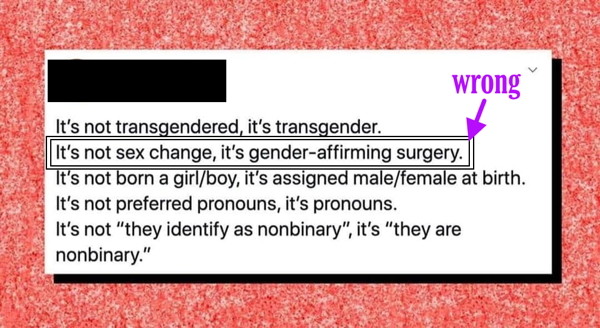
Someone in a Facebook group posted a meme stating "It's not sex change, it's gender-affirming surgery". Well, that's wrong. It's not gender-affirming surgery, its SEX-affirming surgery. If a person's gender identity as a woman is 100% valid whether they have a penis or a vagina, then obtaining surgical services to modify their physical structure so that any visual observers will assign it "vagina" doesn't affirm their gender. It affirms their SEX, as female.
Of course, being attractive to the heterosexual male gaze really is central to some people's sense of their feminine identity. It's what's most emotionally important to them about being a woman, as opposed to singing alto arias or becoming a really good seamstress or something. Nothing wrong with that.
But not everyone who identifies as woman or femme or girl is primarily concerned with appealing to the male gaze. Of having a sexually desirable appearance as filtered through the fakely universalized male gaze.
The centrality of the whole "do you look sexy, can you compete with the sexy women of the world in sexy appearance?" question is often used to invalidate feminine people. It is used to invalidate many cis women for whom it simply isn't the end-all and be-all of their self-worth. It is used to invalidate many trans women for whom being evaluated in terms of how well they "pass" as a sexually desirable specimen gets to be old and tiresome.
Well, it is also used to invalidate the identity of people like me, who definitively do not identify as female, who do not transition, who do not attempt to present as female-bodied people, who distinguish between physical sex and gender and identify as male women, male femmes, male girls.
I get a lot of pushback about it. People who say "It's nobody's business what you got in your underpants" when what they really mean is "You've got no business having that attitude of 'yeah I'm male, so what', that's the wrong attitude about your male parts, we're all supposed to be going around saying 'it doesn't matter'". But what actually doesn't matter to me is being found sexy in that sense. Sexy to the falsely universal male gaze. I am male. Sure I want to be found sexy... to people who specifically like the male physical morphology. Since that's the morphology I've got. And I'm a male girl. My gender-atypical identity doesn't have a damn thing to do with claiming femaleness, regardless of whether yours does or not.
———————
You're secluded in quarantine, and all the performances and events have been cancelled, so it's a good time to read a book!
My book, GenderQueer: A Story From a Different Closet, has been published by Sunstone Press. It is available on Amazon and Barnes & Noble in paperback and ebook, and as ebook only from Apple, Kobo, and directly from Sunstone Press themselves.
Links to published reviews and comments are listed on my Home Page
———————
This LiveJournal blog is echoed on DreamWidth, WordPress, and Blogger. Please friend/link me from any of those environments on which you have an account.
————————
Index of all Blog Posts
Saturday, June 20, 2020
Just
"I don't see why that makes it a different gender identity", someone asks me. (I visualize them with their arms crossed and scowling). "Why can't you just say you're a man with a lot of traits that are generally associated with women?"
OK, I'll give you your answer.
It's sitting there inside your question. You said just.
We often say "just" to mean merely, or less than: "Why do I have to mop the floor? Can't I just sweep up the crumbs and dirt with a broom?"
When you suggest I should "just" identify as a man with a bunch of feminine traits, it sounds like you're saying that the identity terms I'm using -- genderqueer, gender invert, being a male girl -- is more audacious, a stronger statement. That I'm making a bigger deal out of the difference than you think I ought to.
But it is a big deal. That's the point.
On the other hand, sometimes we say "just" to mean simpler even when it isn't less than: "It's taking forever to clip the burrs out of Blackie's fur. Why don't we just dip him in a vat of Nair and wait for his hair to grow back, it would be easier!"
You're not doing that. You're not using "just" in that way. I could, though: "Why would I want to spend my life explaining that I'm a male with a lot of traits and tastes that are more typically associated with women than with men? Why can't I just say I'm a male girl?"
The way I express my identity has a "let's cut to the chase" simplicity to it.
———————
You're secluded in quarantine, and all the performances and events have been cancelled, so it's a good time to read a book!
My book, GenderQueer: A Story From a Different Closet, has been published by Sunstone Press. It is available on Amazon and Barnes & Noble in paperback and ebook, and as ebook only from Apple, Kobo, and directly from Sunstone Press themselves.
Links to published reviews and comments are listed on my Home Page
———————
This LiveJournal blog is echoed on DreamWidth, WordPress, and Blogger. Please friend/link me from any of those environments on which you have an account.
————————
Index of all Blog Posts
OK, I'll give you your answer.
It's sitting there inside your question. You said just.
We often say "just" to mean merely, or less than: "Why do I have to mop the floor? Can't I just sweep up the crumbs and dirt with a broom?"
When you suggest I should "just" identify as a man with a bunch of feminine traits, it sounds like you're saying that the identity terms I'm using -- genderqueer, gender invert, being a male girl -- is more audacious, a stronger statement. That I'm making a bigger deal out of the difference than you think I ought to.
But it is a big deal. That's the point.
On the other hand, sometimes we say "just" to mean simpler even when it isn't less than: "It's taking forever to clip the burrs out of Blackie's fur. Why don't we just dip him in a vat of Nair and wait for his hair to grow back, it would be easier!"
You're not doing that. You're not using "just" in that way. I could, though: "Why would I want to spend my life explaining that I'm a male with a lot of traits and tastes that are more typically associated with women than with men? Why can't I just say I'm a male girl?"
The way I express my identity has a "let's cut to the chase" simplicity to it.
———————
You're secluded in quarantine, and all the performances and events have been cancelled, so it's a good time to read a book!
My book, GenderQueer: A Story From a Different Closet, has been published by Sunstone Press. It is available on Amazon and Barnes & Noble in paperback and ebook, and as ebook only from Apple, Kobo, and directly from Sunstone Press themselves.
Links to published reviews and comments are listed on my Home Page
———————
This LiveJournal blog is echoed on DreamWidth, WordPress, and Blogger. Please friend/link me from any of those environments on which you have an account.
————————
Index of all Blog Posts
Saturday, May 9, 2020
Diminishing Returns
My transgender woman friend is replying to a comment that she finds annoying. Somebody has said that they have nothing against transgender women, "but why do you embrace all of the most phony and stereotypical trappings of restrictive femininity? It's all pink lipstick and false eyelashes and nylons and pointy shoes with you. Don't you see how that comes across to us cis women? It's like you think that's what being a woman is all about!"
My friend finds the comment annoying because she feels like she keeps answering it over and over, it's a reoccurring theme and she's tired of it. She writes, "We don't like being misgendered. I happen to be tall for a woman, with more narrow hips and a more angular jaw. I grew up before puberty blockers. Many of us need to send as many signals as possible or we run the risk of being addressed as 'sir' or 'mister'. Why is that hard for you to understand?"
She uses socially recognized indicators of gender. Things that men don't do, things that men don't wear. That only works as long as men, in general, don't do those things, don't wear those items.
Meanwhile, we cheer when we hear stories of boys in preschool who aren't chased away from the fairy princess costumes. We celebrate the decline in rigid notions of what boys can do, what girls can do. We agree that the body with which one is born should not artificially limit one's choices, that people should have the maximum freedom to be and do any of the things that other people get to be and do in our society.
Many nonbinary and agender people say they would be glad to see gender disappear entirely: just treat people for who they are, don't categorize people as genders at all. But at the same time, many of them continue to be assigned to a gender by the people who encounter them. The assignment tends to be the same assignment they were given at birth--not because of actual genitalia, necessarily, but assorted visibly discernable physical characteristics that are the product of our sex hormones and the effects they have on our bodies. The same things that my transgender friend has to work against to avoid being misgendered. So it happens with nonbinary and agender people, too, they get misgendered and to try to keep that from happening, they, too, make use of garments and grooming styles to "look more masc" or "look more femme", to offset those traits.
I could identify as transgender or as nonbinary, but mostly I don't. I don't seek to be perceived as a female person, and I don't seek to be perceived as someone who is neither male nor female. I most often call myself genderqueer instead, and explain to people that I am a gender invert, a male girl (or male femme if you prefer), that I have a body and I have a personality, a sex and a gender, and what makes me genderqueer is that they are a mixed bag, an apparent mismatch.
Like the transgender and the nonbinary people, I, too, use some signals to convey visually a bit of who I am. I wear my hair long, I wear some jewelry that's not typical for males to wear, and I wear some apparel that isn't considered men's clothes (especially skirts). Since I present (nevertheless) as a male person (the facial hair being a pretty distinctive marker, and a prominent male larynx also makes that statement), it's a mixed signal, which is more or less as good as I can accomplish in the absense of a widespread social expectation that there are such people as male girls out there.
If there were a lot of other male people doing that, though, using items that socially symbolize femininity without attempting to be perceived as physically female, wouldn't it just dilute and eventually erase the perception of those items as feminine? Or is there a way to create the identity "male girl" and be recognized as a feminine male instead of being seen as a longhaired man in a skirt?
And is it a problem anyway? If the world had not insisted on a bunch of rigid notions about how girls and boys are supposed to be different from each other, would I have ever pushed away from the "boy" identity and decided I was more like one of the girls?
Maybe. Maybe not. I think the answer to that depends on whether males in general have different traits (other than the physical, I mean) from females in general. If there are such differences at the generalization level, I might still have come to see myself as an exception, even without the excessively rigid and proscriptive attitudes I grew up with.
People might want to hold on to artificial signals, signals that have historically said "feminine" or "masculine", not to gild the lily of their body's own physical manifestations but to signal where on the spectrum of masculinity to femininity they consider themselves to belong. There's no innate reason for most of these markers to convey the meaning that they currently convey, but that's true of the sounds that constitute our language and yet we continue to use language to communicate.
But if, on the other hand, there are no real non-physical-body differences between the sexes, it does seem like gender would disappear if there were no ideology propping it up. So notions of "masculinity" and "femininity" might fade away, along with any possible signals to convey them.
———————
You're secluded in quarantine, and all the performances and events have been cancelled, so it's a good time to read a book!
My book has been published by Sunstone Press. It is available on Amazon and Barnes & Noble in paperback and ebook, and as ebook only from Apple, Kobo, and directly from Sunstone Press themselves.
Links to published reviews and comments are listed on my Home Page
———————
This LiveJournal blog is echoed on DreamWidth, WordPress, and Blogger. Please friend/link me from any of those environments on which you have an account.
————————
Index of all Blog Posts
My friend finds the comment annoying because she feels like she keeps answering it over and over, it's a reoccurring theme and she's tired of it. She writes, "We don't like being misgendered. I happen to be tall for a woman, with more narrow hips and a more angular jaw. I grew up before puberty blockers. Many of us need to send as many signals as possible or we run the risk of being addressed as 'sir' or 'mister'. Why is that hard for you to understand?"
She uses socially recognized indicators of gender. Things that men don't do, things that men don't wear. That only works as long as men, in general, don't do those things, don't wear those items.
Meanwhile, we cheer when we hear stories of boys in preschool who aren't chased away from the fairy princess costumes. We celebrate the decline in rigid notions of what boys can do, what girls can do. We agree that the body with which one is born should not artificially limit one's choices, that people should have the maximum freedom to be and do any of the things that other people get to be and do in our society.
Many nonbinary and agender people say they would be glad to see gender disappear entirely: just treat people for who they are, don't categorize people as genders at all. But at the same time, many of them continue to be assigned to a gender by the people who encounter them. The assignment tends to be the same assignment they were given at birth--not because of actual genitalia, necessarily, but assorted visibly discernable physical characteristics that are the product of our sex hormones and the effects they have on our bodies. The same things that my transgender friend has to work against to avoid being misgendered. So it happens with nonbinary and agender people, too, they get misgendered and to try to keep that from happening, they, too, make use of garments and grooming styles to "look more masc" or "look more femme", to offset those traits.
I could identify as transgender or as nonbinary, but mostly I don't. I don't seek to be perceived as a female person, and I don't seek to be perceived as someone who is neither male nor female. I most often call myself genderqueer instead, and explain to people that I am a gender invert, a male girl (or male femme if you prefer), that I have a body and I have a personality, a sex and a gender, and what makes me genderqueer is that they are a mixed bag, an apparent mismatch.
Like the transgender and the nonbinary people, I, too, use some signals to convey visually a bit of who I am. I wear my hair long, I wear some jewelry that's not typical for males to wear, and I wear some apparel that isn't considered men's clothes (especially skirts). Since I present (nevertheless) as a male person (the facial hair being a pretty distinctive marker, and a prominent male larynx also makes that statement), it's a mixed signal, which is more or less as good as I can accomplish in the absense of a widespread social expectation that there are such people as male girls out there.
If there were a lot of other male people doing that, though, using items that socially symbolize femininity without attempting to be perceived as physically female, wouldn't it just dilute and eventually erase the perception of those items as feminine? Or is there a way to create the identity "male girl" and be recognized as a feminine male instead of being seen as a longhaired man in a skirt?
And is it a problem anyway? If the world had not insisted on a bunch of rigid notions about how girls and boys are supposed to be different from each other, would I have ever pushed away from the "boy" identity and decided I was more like one of the girls?
Maybe. Maybe not. I think the answer to that depends on whether males in general have different traits (other than the physical, I mean) from females in general. If there are such differences at the generalization level, I might still have come to see myself as an exception, even without the excessively rigid and proscriptive attitudes I grew up with.
People might want to hold on to artificial signals, signals that have historically said "feminine" or "masculine", not to gild the lily of their body's own physical manifestations but to signal where on the spectrum of masculinity to femininity they consider themselves to belong. There's no innate reason for most of these markers to convey the meaning that they currently convey, but that's true of the sounds that constitute our language and yet we continue to use language to communicate.
But if, on the other hand, there are no real non-physical-body differences between the sexes, it does seem like gender would disappear if there were no ideology propping it up. So notions of "masculinity" and "femininity" might fade away, along with any possible signals to convey them.
———————
You're secluded in quarantine, and all the performances and events have been cancelled, so it's a good time to read a book!
My book has been published by Sunstone Press. It is available on Amazon and Barnes & Noble in paperback and ebook, and as ebook only from Apple, Kobo, and directly from Sunstone Press themselves.
Links to published reviews and comments are listed on my Home Page
———————
This LiveJournal blog is echoed on DreamWidth, WordPress, and Blogger. Please friend/link me from any of those environments on which you have an account.
————————
Index of all Blog Posts
Saturday, April 18, 2020
The Inadequacy of Straight / Gay / Bi
"Oh, great", the gay and lesbian readers may be thinking. "First they want in, and make us expand what we call ourselves to include them, and use this ever-expanding acronym. And now they want to kick our identity out!"
Don't worry, you've got company. "Transgender / Cisgender" is inadequate too. I'm not trans. I was assigned male at birth. I identify as male. Not trans, right? I identify as femme, as girl, gal, woman. When I was assigned male, I was also assigned boy. I'm not cis. Because I'm all sissy. I'm not a man.
I'm not kicking anyone out. I'm coming out, which means I'm coming in, and for me to be in, some of the assumptions have to go out, so get used to it, because I'm not going back in, so let me in. It's complicated. Get used to that, too!
Let's start with the simple complicated. You've seen the genderbread person and the gender unicorn posters, right? The ones that give a nice simple explanation of why sexual orientation and gender identity is so much more complicated than "are you a boy or are you a girl" and "so are you straight, gay, or bi", right?


I'm male, that's my sex; I was assigned male at birth. They assigned me that way because they saw a penis. I've never dissented with that. It's the body I was born with and it's not the problem. I'm male. Male is not my gender identity, mind you. I'm one of the girls, that's my gender.
You with me so far? You see where those answers appear on those posters?
OK, then, with that in mind, let's move on to sexual orientation. I'm attracted to female folks.
Straight, gay, or bi?
Umm... sex or gender? I'm a male girlish person. Male people attracted more or less exclusively to female people are het, right? But women loving women, those are lesbians, aren't they?
This time the posters don't clarify much. Gender Unicorn gives me the choice of "physically attracted to "women", "men", or "other genders". Well, that doesn't help. I said I was attracted to female people, I didn't say anything about their gender identities!
Let's try the other poster. Genderbread says I might be "sexuallly attracted" to "women and/or feminine and/or female" people. That's a lot of and/or. The chart also gives me the option of "men and/or masculine and/or male" people. What happens if I'm attracted to masculine female people?
Both posters also address romantic (or emotional) attraction but the options are the same. And neither of them deal with the question of gay or straight or bi. It's just as well, because those terms can't handle the complexity of what's on those charts.
And the charts oversimplify matters too much.
Someone else might be attracted to feminine people, to people whose gender identity is expressed to be "woman". They might find a masculine female person uninteresting from a sexual standpoint. They might find a feminine male person to be of erotic interest. What defines sexual orientation may differ from one person to the next.
There's something else that the charts leave out about sexual orientation. Neither of them mention how the person wishes to be sexually perceived. Both charts have a space for gender expression but that's about gender, and I'm talking about sexual orientation. I'm referring to which of a person's characteristics one wishes to be found sexy on the basis of. That, for example, someone wants to be perceived as a sexually attractive woman, to be appealing to people whose attraction is towards women. It's not necessarily the same as gender or sex. I know several cisgender women who do not like being found sexually attractive as sexy female people. It's not how they prefer to market themselves in the universe of sexual orientation. I know both intersex and trans people who are revolted at the idea of "chasers", of people who are (or would be) turned on by their physical morphology. I know others who would feel very disappointed if their partner was not turned on by their physical morphology.
In my case, I'm into female boyish people who are attracted to male girls. Yeah, try to find that option on your dating app!
———————
You're secluded in quarantine, and all the performances and events have been cancelled, so it's a good time to read a book!
My book has been published by Sunstone Press. It is available on Amazon and Barnes & Noble in paperback and ebook, and as ebook only from Apple, Kobo, and directly from Sunstone Press themselves.
Links to published reviews and comments are listed on my Home Page
———————
This LiveJournal blog is echoed on DreamWidth, WordPress, and Blogger. Please friend/link me from any of those environments on which you have an account.
————————
Index of all Blog Posts
Don't worry, you've got company. "Transgender / Cisgender" is inadequate too. I'm not trans. I was assigned male at birth. I identify as male. Not trans, right? I identify as femme, as girl, gal, woman. When I was assigned male, I was also assigned boy. I'm not cis. Because I'm all sissy. I'm not a man.
I'm not kicking anyone out. I'm coming out, which means I'm coming in, and for me to be in, some of the assumptions have to go out, so get used to it, because I'm not going back in, so let me in. It's complicated. Get used to that, too!
Let's start with the simple complicated. You've seen the genderbread person and the gender unicorn posters, right? The ones that give a nice simple explanation of why sexual orientation and gender identity is so much more complicated than "are you a boy or are you a girl" and "so are you straight, gay, or bi", right?
I'm male, that's my sex; I was assigned male at birth. They assigned me that way because they saw a penis. I've never dissented with that. It's the body I was born with and it's not the problem. I'm male. Male is not my gender identity, mind you. I'm one of the girls, that's my gender.
You with me so far? You see where those answers appear on those posters?
OK, then, with that in mind, let's move on to sexual orientation. I'm attracted to female folks.
Straight, gay, or bi?
Umm... sex or gender? I'm a male girlish person. Male people attracted more or less exclusively to female people are het, right? But women loving women, those are lesbians, aren't they?
This time the posters don't clarify much. Gender Unicorn gives me the choice of "physically attracted to "women", "men", or "other genders". Well, that doesn't help. I said I was attracted to female people, I didn't say anything about their gender identities!
Let's try the other poster. Genderbread says I might be "sexuallly attracted" to "women and/or feminine and/or female" people. That's a lot of and/or. The chart also gives me the option of "men and/or masculine and/or male" people. What happens if I'm attracted to masculine female people?
Both posters also address romantic (or emotional) attraction but the options are the same. And neither of them deal with the question of gay or straight or bi. It's just as well, because those terms can't handle the complexity of what's on those charts.
And the charts oversimplify matters too much.
Someone else might be attracted to feminine people, to people whose gender identity is expressed to be "woman". They might find a masculine female person uninteresting from a sexual standpoint. They might find a feminine male person to be of erotic interest. What defines sexual orientation may differ from one person to the next.
There's something else that the charts leave out about sexual orientation. Neither of them mention how the person wishes to be sexually perceived. Both charts have a space for gender expression but that's about gender, and I'm talking about sexual orientation. I'm referring to which of a person's characteristics one wishes to be found sexy on the basis of. That, for example, someone wants to be perceived as a sexually attractive woman, to be appealing to people whose attraction is towards women. It's not necessarily the same as gender or sex. I know several cisgender women who do not like being found sexually attractive as sexy female people. It's not how they prefer to market themselves in the universe of sexual orientation. I know both intersex and trans people who are revolted at the idea of "chasers", of people who are (or would be) turned on by their physical morphology. I know others who would feel very disappointed if their partner was not turned on by their physical morphology.
In my case, I'm into female boyish people who are attracted to male girls. Yeah, try to find that option on your dating app!
———————
You're secluded in quarantine, and all the performances and events have been cancelled, so it's a good time to read a book!
My book has been published by Sunstone Press. It is available on Amazon and Barnes & Noble in paperback and ebook, and as ebook only from Apple, Kobo, and directly from Sunstone Press themselves.
Links to published reviews and comments are listed on my Home Page
———————
This LiveJournal blog is echoed on DreamWidth, WordPress, and Blogger. Please friend/link me from any of those environments on which you have an account.
————————
Index of all Blog Posts
Saturday, March 28, 2020
Anatomy of a Review: Karen Bernard's LAKESIDE
Event: Salon: Karen Bernard's LAKESIDE
Date: February 06, 2020 8:00 PM
Douglas Dunn's Studio
541 Broadway
New York, NY 10012
My friend and I share our guilty secret: we prefer narrative forms of dance and performance art, where there is a message or a plot line. It's akin to admitting you mostly like representational art when you're coming back from a show of abstract oil paintings. It tends to brand one as less sophisticated.
I find that the lack of a defined meaning creates a challenge for someone seeking to do a review. One could restrict one's self to how the performer moved, their talent and grace on stage. But that dismisses the performance itself as exercise. The problem is that my mind wants the piece to be "about something" and so it seizes on a message, a "something" that may originate entirely in my own head, making any review more about me and what I made out of this Rorschach choreography than about the performance that anyone else may have seen.
Hence the title "Anatomy of a Review".
I bring with me to the audience member seat a pair of tools, if you will, my main everyday obsessions: feminist theory and gender theory. When the only tool you own is a hammer, everything looks like a nail, they say. Well, here's what I saw:
A garment is in view in front of a kneeling performer (K. Bernard) under a tightly focused light. She and it. She stays that way for a prolonged duration, and doesn't react. Then very very slowly extends her hand, until the elbow is completely straightened, the arm as distant from the core of her body as she can make it, before she slowly pinches the fabric between fingertips and with agonizing slowness lifts it towards her.
Do I see a facial expression, or am I imagining it? I interpret something repellent, a displeasure, that makes the slow approach shot through with reluctance.
The outfit turns out to be a skirt and blouse. I see: gendered clothing. It has pastel colors, lacy ruffles, and once she (slowly) dons it, I see it is cut in a style that draws visual attention to legs and breasts, curve of torso, neck, and arms.
Once she's finally in the thing, she strikes poses and begins to move in it. I see: mockery, revulsion. I see: mincing and prancing, acting out in overstated compliance that which is expected of her. I see: resistance to femininization, trivialization, sexual fetishism and objectification. Her costume is a garment that renders one as an object for others' visual consumption, and it's not designed primarily for the wearer's convenience and comfort. These aren't, I think, interpretations that the clothing in and of itself would conjure for me, but by her body language as she interacted with it.
Due to my gender identity activities, I'm quick to attach the extreme reluctance and disgust that I see to the act of being misgendered. An expression not so much of resentment towards the costume per se as towards the package of feelings and attitudes towards anyone who would wear it, a rejection of femme. "Yes, that's it", I nod affirmatively in my seat. I imagine the cartoon thought-balloons over her head: "I don't want to wear this girly-girl thing, this so is not me. I'm supposed to be in this and prance around like this and pretend I'm eye candy and shit. Fuck this, gimme a goddam suit and a tie and a fedora, willya?"
The piece was presented without program notes, and was not followed by one of those "talkbacks" where the audience or a panel of people discuss the piece and what they got out of it, so we made our exit with only each other to consult.
We agreed that the dancing, the timing, the expressiveness were superb. She creates suspense and delivers an almost nerve-wracking intensity at times in her performance.
Had I seen anything that the artist had intended? Had the things that I did see reside at all in the performance piece, or strictly within my head as a gender-variant person and a feminist theory junkie?
"I saw an earlier version", my companion told me. "There were things she took out. I always thought it was about a murder. But that could have just been me, that's what I thought the piece was about, and she took out the parts that made me think so, so who knows?
Now to be fair, we do that to everyday life. The events of the real world aren't written with a plot, a clear storyline. We weren't handed a program explaining what the life we're about to experience is supposed to be about.
(Or, for those of us who were, we came to doubt the authority of the ushers who handed it to us). Some of us embraced a viewpoint, a political social theory about what's going on in life. We have come to use concepts of gender and identity and narrow confining gender-boxes that people are imprisoned in and struggle with. We embraced the concepts because they explained a lot to us, they clicked into place inside our heads and caused a lot of what we saw on the stage called World to make sense to us.
I believe in theory. I believe in the process of analyzing things. For the record, I don't think it leads to seeing things that your theoretical model say are there when it really all comes from you, the person observing life, inventing meaning where none actually exists. We share these analyses as communities of people who believe these explanations fit well, that they make sense of life. If they didn't offer us much explanatory power, it wouldn't be very satisfying to use them and we'd switch to one that did.
But I do think a lot of it is involves filling in a lot of everyday blank spots with what our theory says is going on. We see a behavior and without access to the thoughts in the behaving person's head, we make assumptions about their attitudes and intentions.
Being self-aware means reminding ourselves occasionally that we do that.
———————
You're secluded in quarantine, and all the performances and events have been cancelled, so it's a good time to read a book!
My book has been published by Sunstone Press. It is available on Amazon and Barnes & Noble in paperback and ebook, and as ebook only from Apple, Kobo, and directly from Sunstone Press themselves.
Links to published reviews and comments are listed on my Home Page
———————
This LiveJournal blog is echoed on DreamWidth, WordPress, and Blogger. Please friend/link me from any of those environments on which you have an account.
————————
Index of all Blog Posts
Date: February 06, 2020 8:00 PM
Douglas Dunn's Studio
541 Broadway
New York, NY 10012
My friend and I share our guilty secret: we prefer narrative forms of dance and performance art, where there is a message or a plot line. It's akin to admitting you mostly like representational art when you're coming back from a show of abstract oil paintings. It tends to brand one as less sophisticated.
I find that the lack of a defined meaning creates a challenge for someone seeking to do a review. One could restrict one's self to how the performer moved, their talent and grace on stage. But that dismisses the performance itself as exercise. The problem is that my mind wants the piece to be "about something" and so it seizes on a message, a "something" that may originate entirely in my own head, making any review more about me and what I made out of this Rorschach choreography than about the performance that anyone else may have seen.
Hence the title "Anatomy of a Review".
I bring with me to the audience member seat a pair of tools, if you will, my main everyday obsessions: feminist theory and gender theory. When the only tool you own is a hammer, everything looks like a nail, they say. Well, here's what I saw:
A garment is in view in front of a kneeling performer (K. Bernard) under a tightly focused light. She and it. She stays that way for a prolonged duration, and doesn't react. Then very very slowly extends her hand, until the elbow is completely straightened, the arm as distant from the core of her body as she can make it, before she slowly pinches the fabric between fingertips and with agonizing slowness lifts it towards her.
Do I see a facial expression, or am I imagining it? I interpret something repellent, a displeasure, that makes the slow approach shot through with reluctance.
The outfit turns out to be a skirt and blouse. I see: gendered clothing. It has pastel colors, lacy ruffles, and once she (slowly) dons it, I see it is cut in a style that draws visual attention to legs and breasts, curve of torso, neck, and arms.
Once she's finally in the thing, she strikes poses and begins to move in it. I see: mockery, revulsion. I see: mincing and prancing, acting out in overstated compliance that which is expected of her. I see: resistance to femininization, trivialization, sexual fetishism and objectification. Her costume is a garment that renders one as an object for others' visual consumption, and it's not designed primarily for the wearer's convenience and comfort. These aren't, I think, interpretations that the clothing in and of itself would conjure for me, but by her body language as she interacted with it.
Due to my gender identity activities, I'm quick to attach the extreme reluctance and disgust that I see to the act of being misgendered. An expression not so much of resentment towards the costume per se as towards the package of feelings and attitudes towards anyone who would wear it, a rejection of femme. "Yes, that's it", I nod affirmatively in my seat. I imagine the cartoon thought-balloons over her head: "I don't want to wear this girly-girl thing, this so is not me. I'm supposed to be in this and prance around like this and pretend I'm eye candy and shit. Fuck this, gimme a goddam suit and a tie and a fedora, willya?"
The piece was presented without program notes, and was not followed by one of those "talkbacks" where the audience or a panel of people discuss the piece and what they got out of it, so we made our exit with only each other to consult.
We agreed that the dancing, the timing, the expressiveness were superb. She creates suspense and delivers an almost nerve-wracking intensity at times in her performance.
Had I seen anything that the artist had intended? Had the things that I did see reside at all in the performance piece, or strictly within my head as a gender-variant person and a feminist theory junkie?
"I saw an earlier version", my companion told me. "There were things she took out. I always thought it was about a murder. But that could have just been me, that's what I thought the piece was about, and she took out the parts that made me think so, so who knows?
Now to be fair, we do that to everyday life. The events of the real world aren't written with a plot, a clear storyline. We weren't handed a program explaining what the life we're about to experience is supposed to be about.
(Or, for those of us who were, we came to doubt the authority of the ushers who handed it to us). Some of us embraced a viewpoint, a political social theory about what's going on in life. We have come to use concepts of gender and identity and narrow confining gender-boxes that people are imprisoned in and struggle with. We embraced the concepts because they explained a lot to us, they clicked into place inside our heads and caused a lot of what we saw on the stage called World to make sense to us.
I believe in theory. I believe in the process of analyzing things. For the record, I don't think it leads to seeing things that your theoretical model say are there when it really all comes from you, the person observing life, inventing meaning where none actually exists. We share these analyses as communities of people who believe these explanations fit well, that they make sense of life. If they didn't offer us much explanatory power, it wouldn't be very satisfying to use them and we'd switch to one that did.
But I do think a lot of it is involves filling in a lot of everyday blank spots with what our theory says is going on. We see a behavior and without access to the thoughts in the behaving person's head, we make assumptions about their attitudes and intentions.
Being self-aware means reminding ourselves occasionally that we do that.
———————
You're secluded in quarantine, and all the performances and events have been cancelled, so it's a good time to read a book!
My book has been published by Sunstone Press. It is available on Amazon and Barnes & Noble in paperback and ebook, and as ebook only from Apple, Kobo, and directly from Sunstone Press themselves.
Links to published reviews and comments are listed on my Home Page
———————
This LiveJournal blog is echoed on DreamWidth, WordPress, and Blogger. Please friend/link me from any of those environments on which you have an account.
————————
Index of all Blog Posts
Friday, March 20, 2020
Binary 2.0
Gender used to be narrowly restrictive and inflexible: you were born with a penis or with a vagina, and that determined your identity. Many folks think that except for the stodgy dinosaurs holding on to those older notions, we're past all that, enlightened. Mostly, we're not. We're immersed in what I refer to as Binary 2.0. It's larger and wider than the 1.0 version and yes, there's more room in it, it feels less constrained--but it's still confining.
Superficially, yes, our mainstream media touts the existence of genderqueer and nonbinary celebrities and celebrates their attractiveness and marketability.
But at the local level, the support groups and safe spaces for nonbinary and gender nonconforming people are chock-full of people who were assigned as something at birth; and they've been treated and regarded as either boys or girls for most of their lives. The problem for them is that the assignment they were given at birth wasn't random and arbitrary. If I saw them on the nude beach I could guess with better than 99% accuracy what designation their mom's obstetrician jotted down on their birth certificate. Yes, physical sex is a social construct. But we are part of the society that does the constructing, and we know the criteria, we've learned it well and we know how it works whether we choose to opt out of it or not. So the young genderqueer and nonbinary folks keep posting selfies and asking whether they look sufficiently other than their at-birth sex designations.
There's a determined pushing-away from those body-based identities, with a lot of adopting of the adornments and stylings associated with the opposite sex. Because since sex is, as stated, a social construct, there's still an opposite sex. The primary manifestation of nonbinary identity is one form or another of "between the two", and it is still anchored in those two.
The spaces for young transgender people are rife with their version of the same issue. Medical transitioning is complicated and expensive and although puberty blockers and hormones can be located, there are a lot of people participating whose physical morphology still matches up with the socially constructed pattern that corresponds with how they were designated at birth. In recognition of this, and not wanting to invalidate trans people's identities by implying that they are less valid than for folks who have done a medical transition, we focus on people's gender identities and we refer to their sex, if we do so at all, by considering it to match their gender. The plumbing inside someone's underwear is nobody's business. So sex is the same as gender (yet again, or still) since sex is assumed to match gender (whereas the assumption used to work the other way around, that gender matches physical sex).
Transgender women tend to feel obliged to do makeup and hair and to wear a lot of designated-female apparel, in order to signal that they wish to be perceived and recognized as female, as women. Meanwhile most cisgender women, born with the contours and configurations that our society relies on to designate a person female, can wear jeans and a t-shirt, cut their hair short, and go makekup-free without much concern about the possibility of being misgendered.
To say "misgendered" should cause us to realize that gender is a verb, that we get "gendered" by other people all the time -- "mis" or otherwise. We still gender people based on perceptions anchored in binary sex, so we're still in the shadows of assumptions about what our bodies mean.
My colleague Annunaki Ray Marquez, an intersex activist, points out that the terms "cisgender" and "transgender" contain assumptions. An intersex person isn't likely to have been assigned intersex at birth, but to conflate the situation of intersex people with that of transgender people is to erase them, especially since one of the central issues for intersex people is genital surgery done without their consent as infants or children, whereas medical transitioning is generally seen as a positive solution -- one for which medical insurance coverage is a political objective -- within the transgender community. ""Not all intersex people assigned wrong at birth will be comfortable being called 'transgender', although some will", says Marquez.
What made me nonbinary was that I ran into a two-options conundrum, either I was male and a boy (or man) which was not true; or that I was female and a girl (or woman) which was also not true. I was male and yet one of the girls. I encountered the socially-recognized physical configuration that got me designated male any time I saw my body. I didn't have any dysphoria about it, it wasn't wrong.
I want to be accepted as a male femme, a male gal. I should not have to present as female in order to be known as one of the girls. I should not have to push away from maleness in order to assert girlness. my maleness and the experiences that come from being a male girl are part of my identity. I am NOT a cisgender female person; being seen and thought of as such would NOT recognize me. It's not who I am. I'm a male girl.
I should be able to go to the nude beach and be who I am, a girl. I should be able to go the nude beach without obtaining medical intervention to transition by body and be accepted for who I am, a male girl.
My transgender sister should be able to go to the nude beach -- with or without medical intervention -- and accepted for who she is as well. She considers herself female and woman. She shouldn't have to "pass". She shouldn't have to adorn herself and fix up her appearance in order to elicit our approval of her identity. She shouldn't have to keep her body under wraps if she can't afford or hasn't opted for medical transitioning.
Neither should my intersex brother. His body is intersex. His gender identity isn't a consequence of either of the two conventional physical sex constructs. He also needs to be able to walk here on this beach.
Until we can do that, until acceptance of gender identity isn't dependent on having the "right" body, until acceptance of gender identity doesn't depend on erasing the body either, we're still stuck in Binary 2.0.
———————
My book, GenderQueer: A Story From a Different Closet, has been published by Sunstone Press. It is available on Amazon and Barnes & Noble in paperback and ebook, and as ebook only from Apple, Kobo, and directly from Sunstone Press themselves.
Links to published reviews and comments are listed on my Home Page
———————
This LiveJournal blog is echoed on DreamWidth, WordPress, and Blogger. Please friend/link me from any of those environments on which you have an account.
————————
Index of all Blog Posts
Superficially, yes, our mainstream media touts the existence of genderqueer and nonbinary celebrities and celebrates their attractiveness and marketability.
But at the local level, the support groups and safe spaces for nonbinary and gender nonconforming people are chock-full of people who were assigned as something at birth; and they've been treated and regarded as either boys or girls for most of their lives. The problem for them is that the assignment they were given at birth wasn't random and arbitrary. If I saw them on the nude beach I could guess with better than 99% accuracy what designation their mom's obstetrician jotted down on their birth certificate. Yes, physical sex is a social construct. But we are part of the society that does the constructing, and we know the criteria, we've learned it well and we know how it works whether we choose to opt out of it or not. So the young genderqueer and nonbinary folks keep posting selfies and asking whether they look sufficiently other than their at-birth sex designations.
There's a determined pushing-away from those body-based identities, with a lot of adopting of the adornments and stylings associated with the opposite sex. Because since sex is, as stated, a social construct, there's still an opposite sex. The primary manifestation of nonbinary identity is one form or another of "between the two", and it is still anchored in those two.
The spaces for young transgender people are rife with their version of the same issue. Medical transitioning is complicated and expensive and although puberty blockers and hormones can be located, there are a lot of people participating whose physical morphology still matches up with the socially constructed pattern that corresponds with how they were designated at birth. In recognition of this, and not wanting to invalidate trans people's identities by implying that they are less valid than for folks who have done a medical transition, we focus on people's gender identities and we refer to their sex, if we do so at all, by considering it to match their gender. The plumbing inside someone's underwear is nobody's business. So sex is the same as gender (yet again, or still) since sex is assumed to match gender (whereas the assumption used to work the other way around, that gender matches physical sex).
Transgender women tend to feel obliged to do makeup and hair and to wear a lot of designated-female apparel, in order to signal that they wish to be perceived and recognized as female, as women. Meanwhile most cisgender women, born with the contours and configurations that our society relies on to designate a person female, can wear jeans and a t-shirt, cut their hair short, and go makekup-free without much concern about the possibility of being misgendered.
To say "misgendered" should cause us to realize that gender is a verb, that we get "gendered" by other people all the time -- "mis" or otherwise. We still gender people based on perceptions anchored in binary sex, so we're still in the shadows of assumptions about what our bodies mean.
My colleague Annunaki Ray Marquez, an intersex activist, points out that the terms "cisgender" and "transgender" contain assumptions. An intersex person isn't likely to have been assigned intersex at birth, but to conflate the situation of intersex people with that of transgender people is to erase them, especially since one of the central issues for intersex people is genital surgery done without their consent as infants or children, whereas medical transitioning is generally seen as a positive solution -- one for which medical insurance coverage is a political objective -- within the transgender community. ""Not all intersex people assigned wrong at birth will be comfortable being called 'transgender', although some will", says Marquez.
What made me nonbinary was that I ran into a two-options conundrum, either I was male and a boy (or man) which was not true; or that I was female and a girl (or woman) which was also not true. I was male and yet one of the girls. I encountered the socially-recognized physical configuration that got me designated male any time I saw my body. I didn't have any dysphoria about it, it wasn't wrong.
I want to be accepted as a male femme, a male gal. I should not have to present as female in order to be known as one of the girls. I should not have to push away from maleness in order to assert girlness. my maleness and the experiences that come from being a male girl are part of my identity. I am NOT a cisgender female person; being seen and thought of as such would NOT recognize me. It's not who I am. I'm a male girl.
I should be able to go to the nude beach and be who I am, a girl. I should be able to go the nude beach without obtaining medical intervention to transition by body and be accepted for who I am, a male girl.
My transgender sister should be able to go to the nude beach -- with or without medical intervention -- and accepted for who she is as well. She considers herself female and woman. She shouldn't have to "pass". She shouldn't have to adorn herself and fix up her appearance in order to elicit our approval of her identity. She shouldn't have to keep her body under wraps if she can't afford or hasn't opted for medical transitioning.
Neither should my intersex brother. His body is intersex. His gender identity isn't a consequence of either of the two conventional physical sex constructs. He also needs to be able to walk here on this beach.
Until we can do that, until acceptance of gender identity isn't dependent on having the "right" body, until acceptance of gender identity doesn't depend on erasing the body either, we're still stuck in Binary 2.0.
———————
My book, GenderQueer: A Story From a Different Closet, has been published by Sunstone Press. It is available on Amazon and Barnes & Noble in paperback and ebook, and as ebook only from Apple, Kobo, and directly from Sunstone Press themselves.
Links to published reviews and comments are listed on my Home Page
———————
This LiveJournal blog is echoed on DreamWidth, WordPress, and Blogger. Please friend/link me from any of those environments on which you have an account.
————————
Index of all Blog Posts
Thursday, March 5, 2020
That's Not Very Nice
One of the early reviews of GenderQueer noted that my thoughts and attitudes during my later teenage years in my book reminded her of the Nice Guys™.
It's an accurate call. When I first encountered the send-up of Nice Guys and their behaviors, I winced in recognition. Yes, I was definitely on that trajectory for awhile. The Nice Guys overtones in my book are acknowledged as intentional. In my own personal life, I didn't descend very far into blaming women, or considering the gender-polarized dating environment to be women's fault, but I had a lot of frustration and irritation; and in one important scene in the book you can see me expressing those feelings internally as resentment towards girls, and experimenting with the kind of behavior that is often advocated by so-called pickup artists.
I'm about to do something that many folks would say is ill-advised. I'm going to defend the Nice Guys (god help me). Well, sort of. I'm not about to make a positive case for being a men's rights advocate or explain why it really is all the fault of the women. But all the material about the Nice Guys describes them with eye-rolling dismissive contempt for exhibiting behaviors that we're encouraged to think of as manifestations of character flaws. I'm going to challenge you to perceive them (well, us, actually, since I'm reluctantly claiming the mantle) as people whose behaviors take place in a context, and look at the context long enough to see how it elicits those behaviors.
We are considered creepy. Creepy because we often have a hidden agenda of wanting sex. Creepy because we allegedly act nice thinking that we'll get sex as a reward for being nice. Creepy because our reasons for behaving "nice" are all about obtaining sex. Creepy because we think that by being nice, we somehow deserve sex.
So let's examine all that -- removing any gendered double standards in order to do that exam. I may be projecting my own experiences onto the Nice Guy™ debate, but it's not like there's an organized body of Nice Guys™ with a spokesperson and a position paper -- it's an identity largely created from the outside by folks who were tired of the Nice Guy shtick, and I confess that I recognize myself in a lot of the description so I may as well wear it.
a) Is it OK to want sex? Is it OK to expect or anticipate that someone would want to have sex with you?
This is a question that many a nice girl has found it necessary to contend with, so let's not dismiss it too quickly. Female people have often encountered judgmental hostility if it were thought that they wanted sex. They have often found themselves laughed at with derisive contempt connected to the idea that they did. And they've been told that if it were true, it meant they were not nice.
Now what (you may be asking) does that have to do with Nice Guys™, who, as males, would presumably not be facing those attitudes? Well, yeah, the boys are indeed sort of expected to want sex and to seek sex. But that confirms that they are Bad Boys™, not Nice Guys™.
-- Miami Sound Machine
Bad Boys aren't Nice Guys™. The fact that there isn't a massive social pressure on males to be Nice Guys™ instead of Bad Boys™ is particularly relevant -- somehow these particular male folks embraced an identity as Nice Guys anyhow, and overtly wanting sex isn't compatible with that. Displaying interest in sex would get the girls, the Nice Girls™, kicked out of the Nice category. Being overtly focused on the chance of sex happening is, in fact, a central part of what affirms a male person as a Bad Boy™.
That's not to say that interest in sex is entirely incompatible with Niceness, whether as manifested in Nice Girls™ or in Nice Guys™. In sitcom TV shows and romcom movies as well as in real life, we often hear the female characters complain that they'd really like to meet some guys who aren't married and aren't gay. There's no real reason for them to care whether interesting guys are single or to be concerned with their sexual orientation unless they wish to have sex take place in their lives occasionally, if you see what I mean.
But those female characters don't move around proclaiming to likely prospects that they want sex. That would not be considered Nice™.
How do the Nice Girls™ conventionally handle it? By bundling sex into a larger constellation of experiences and opting to partake of the bundle. To want a romantic relationship. To want a personal and emotional connection and within that context to be sexually active. Not otherwise.
Obviously you and I may not be at all inclined to sign on to the notion that female people should be shoehorned into this notion, this social construct that we call Nice Girls™, but you aren't unaware of the historical presence of this notion. You aren't unaware that it still has some social clout even in 2020. That even now, even after all the questionings and discardings of sexist and gender-polarized notions about how female folks should behave, a girl growing up in a randomly-selected American town is likely to have an easier time of it socially within the parameters of Nice Girl™ than she would if she were to utterly disregard it.
b) Well, is it OK to put on a "nice act" in order to get sex? Is it OK to go around thinking that because you're nice you somehow deserve sex?
I have to question the assumptions on that first one. The common derisive attitude towards Nice Guys™ accuses us of adopting a fake "nice" persona as a means of getting sex, but we are as we are -- this thing called "nice" -- despite a cultural push to be more of a Bad Boy™ and very little pressure on us as males to be Nice™ -- and we deserve the benefit of the doubt. This is who, and how, we are. We may expect things (including sex) as acknowledgment or reward for being Nice™, expectations that folks may have contempt for (and more on that shortly), but that doesn't make the "being nice" some kind of phony act.
Let's again glance across the aisle at the Nice Girls™. People don't tend to assume that they are being Nice™ in order to get sex to happen. People don't tend to assume that they are putting on a "nice act".
There is a belief about Nice Girls™ that is worth bringing up, though. They are often believed to have a high opinion of themselves, a high opinion that leads them to think and say hostile and disparaging things about boys who would rather devote their attention to considerably less-nice girls. The Nice Girls™ also may be expected to occasionally say uncomplimentary things about the not-so-nice girls themselves.
The Nice Girls™, in other words, regard themselves as a "catch", as worthy of admiration and value as potential partners. This is part of the understanding that people have of Nice Girls™, that they may tend to have this attitude about themselves.
Note that this is not characterized as them thinking that they "deserve sex". As I said before, the Nice Girls™ are taught to bundle sex along with emotional connection and think in terms of romantic relationship. So it's not that they think they "deserve sex" for being Nice Girls™, it is that they think they deserve consideration as good girlfriends for being Nice Girls™.
But as we've also already discussed, yeah, that formulation does include sex.
I think Nice Guys™ are basically doing the same thing. We tend to think we shoud be regarded as good romantic prospects. We start off putting a lot of energy into being good companions, connecting with the female people who are in our lives, thinking that sooner or later one of them will find the interactions enticing, will appreciate our value as potential boyfriend material, and if they also happen to find us physically attractive, then hey, things should progress from there, shouldn't they? It's not a materially different expectation than what the Nice Girls™ expect.
But in this gender-polarized world, we operate in a different context than they do.
Incidentally, no, I don't think we (Nice™ people of either sex) are intrinsically better than other people. It's just how we identify, how we think of ourselves and comport ourselves in the world. I'm proud of how and who I am. It's in the face of a lot of disapproval and so I don't feel apologetic about that.
c) So is it somehow OK to go moping around and getting all pissy and hostile because the girls don't appreciate your virtue as a Nice Guy™ and don't find you such a hot prospect? And WTF is with the Nice Guys™ bitterly pursuing an aggressive Pickup Artist approach and treating women like garbage while continuing to complain about things?
No it isn't OK. It isn't appropriate, it isn't politically legitimate, and, incidentally, it also isn't Nice™.
So why does it occur? I mean, look across the aisle again: the Nice Girls™ aren't doing anything equivalent to that, and I've spend the last few paragraphs comparing Nice Guys™ to Nice Girls™ to shed light on other Nice Guy™ behavior. So what's up with this bitter hostility?
We all operate in a social context, the Nice Girls™ and the Bad Boys™ and the Nice Guys™ and everyone else. There is a courtship dance established, and it has a role for the Bad Boys™ and it has a role for the Nice Girls™. The courtship dance calls for the Bad Boys™ to try to make sex happen and the Nice Girls™ to decline that and assert that they don't do that kind of thing outside of the context of an emotional connection and the prospect of an ongoing romantic relationship -- the "bundle" of which I spoke earlier -- and the dance goes on from there. They each know their lines and they anticipate the behavior of the other. But there's no courtship-dance role for the Nice Guy™. He isn't doing the Bad Boy™ dance steps that the Nice Girl™ expects and knows how to respond to. Whether she finds him physically attractive or not, whether she finds herself liking him as a person or not, whether she appreciates his personal qualities (Niceness included) or not, her own role instructions don't give her any lines or provide her with any dance steps that would make it easy for her to act on that interest if it were to occur.
Not that he, the Nice Boy™, has a clearer idea of what he should be doing. His bitter accusations are all focused on the Bad Boy™ stuff that he is not doing, Bad Boy™ stuff that the Nice Girls™ vocally complain about. He says that despite their complaints that's still where things progress, whereas affairs with the girls don't progress with a Nice Guy™ like him, and (he says) "that's unfair!"
Fair or unfair, his observations are accurate: the dance calls for the Nice Girl™ to protest the unbridled raw male expression of sexual interest as crude and demeaning and for her to assert her lack of interest in that. The dance sets them up as opponents, adversaries, with him trying to make sex happen and her disdaining that but seeing if perhaps he seriously likes her as a person and not just a sexual possibility; with him seeing if he can get past her defenses by studying her reactions and tuning into her thoughts and concerns and paying stragetic attention to her feelings. Maybe proximity and time causes him to develop real feelings for her. Maybe proximity and time causes her sexual appetite to kick into overdrive and she consents to doing more and more sexual stuff. They each have lines and dance steps and they know them. They know them the same way you know them. We all do. We've been to the movies, we've read the books, we've listened to the songs, we've heard and sometimes laughed at the jokes. Many folks dance very loosely instead of being rigidly bound to the dance steps, but the known pattern of the established dance still forms a structure.
But not for us.
Nice Guys™ are a type of gender misfit. Because Niceness is gendered and the males are the wrong sex to be embodying Nice. Nice Guys™ may not conceptualize themselves as feminine, as sissy, as trans, as nonbinary, as gender inverted people. In fact, I think they mostly don't. But in a nutshell their complaints do boil down to saying that they approached the whole sex-and-romance thing the same way girls do but that the world didn't play nice with them and left them out in the cold, with no girlfriend, no romance, no sex.
And if and when a Nice Guy™ decides to emulate the Bad Boys™ because the Bad Boys™ seem to be getting all the action he's missing out on, he may do so with contempt and hostility and bitter resentment. You want to know where else I've seen that emotional combination? Certain women who have observed "what works" with guys and have adopted the expected behaviors with scornful hate that they should have to do such demeaning and dishonest things. Yeah, hello.
———————
My book is being published by Sunstone Press, and is now available on Amazon (paperback only for the moment).
———————
This LiveJournal blog is echoed on DreamWidth, WordPress, and Blogger. Please friend/link me from any of those environments on which you have an account.
————————
Index of all Blog Posts
Home Page
It's an accurate call. When I first encountered the send-up of Nice Guys and their behaviors, I winced in recognition. Yes, I was definitely on that trajectory for awhile. The Nice Guys overtones in my book are acknowledged as intentional. In my own personal life, I didn't descend very far into blaming women, or considering the gender-polarized dating environment to be women's fault, but I had a lot of frustration and irritation; and in one important scene in the book you can see me expressing those feelings internally as resentment towards girls, and experimenting with the kind of behavior that is often advocated by so-called pickup artists.
I'm about to do something that many folks would say is ill-advised. I'm going to defend the Nice Guys (god help me). Well, sort of. I'm not about to make a positive case for being a men's rights advocate or explain why it really is all the fault of the women. But all the material about the Nice Guys describes them with eye-rolling dismissive contempt for exhibiting behaviors that we're encouraged to think of as manifestations of character flaws. I'm going to challenge you to perceive them (well, us, actually, since I'm reluctantly claiming the mantle) as people whose behaviors take place in a context, and look at the context long enough to see how it elicits those behaviors.
We are considered creepy. Creepy because we often have a hidden agenda of wanting sex. Creepy because we allegedly act nice thinking that we'll get sex as a reward for being nice. Creepy because our reasons for behaving "nice" are all about obtaining sex. Creepy because we think that by being nice, we somehow deserve sex.
So let's examine all that -- removing any gendered double standards in order to do that exam. I may be projecting my own experiences onto the Nice Guy™ debate, but it's not like there's an organized body of Nice Guys™ with a spokesperson and a position paper -- it's an identity largely created from the outside by folks who were tired of the Nice Guy shtick, and I confess that I recognize myself in a lot of the description so I may as well wear it.
a) Is it OK to want sex? Is it OK to expect or anticipate that someone would want to have sex with you?
This is a question that many a nice girl has found it necessary to contend with, so let's not dismiss it too quickly. Female people have often encountered judgmental hostility if it were thought that they wanted sex. They have often found themselves laughed at with derisive contempt connected to the idea that they did. And they've been told that if it were true, it meant they were not nice.
Now what (you may be asking) does that have to do with Nice Guys™, who, as males, would presumably not be facing those attitudes? Well, yeah, the boys are indeed sort of expected to want sex and to seek sex. But that confirms that they are Bad Boys™, not Nice Guys™.
Bad, bad, bad, bad boys
Make me feel so gooood...
-- Miami Sound Machine
Bad Boys aren't Nice Guys™. The fact that there isn't a massive social pressure on males to be Nice Guys™ instead of Bad Boys™ is particularly relevant -- somehow these particular male folks embraced an identity as Nice Guys anyhow, and overtly wanting sex isn't compatible with that. Displaying interest in sex would get the girls, the Nice Girls™, kicked out of the Nice category. Being overtly focused on the chance of sex happening is, in fact, a central part of what affirms a male person as a Bad Boy™.
That's not to say that interest in sex is entirely incompatible with Niceness, whether as manifested in Nice Girls™ or in Nice Guys™. In sitcom TV shows and romcom movies as well as in real life, we often hear the female characters complain that they'd really like to meet some guys who aren't married and aren't gay. There's no real reason for them to care whether interesting guys are single or to be concerned with their sexual orientation unless they wish to have sex take place in their lives occasionally, if you see what I mean.
But those female characters don't move around proclaiming to likely prospects that they want sex. That would not be considered Nice™.
How do the Nice Girls™ conventionally handle it? By bundling sex into a larger constellation of experiences and opting to partake of the bundle. To want a romantic relationship. To want a personal and emotional connection and within that context to be sexually active. Not otherwise.
Obviously you and I may not be at all inclined to sign on to the notion that female people should be shoehorned into this notion, this social construct that we call Nice Girls™, but you aren't unaware of the historical presence of this notion. You aren't unaware that it still has some social clout even in 2020. That even now, even after all the questionings and discardings of sexist and gender-polarized notions about how female folks should behave, a girl growing up in a randomly-selected American town is likely to have an easier time of it socially within the parameters of Nice Girl™ than she would if she were to utterly disregard it.
b) Well, is it OK to put on a "nice act" in order to get sex? Is it OK to go around thinking that because you're nice you somehow deserve sex?
I have to question the assumptions on that first one. The common derisive attitude towards Nice Guys™ accuses us of adopting a fake "nice" persona as a means of getting sex, but we are as we are -- this thing called "nice" -- despite a cultural push to be more of a Bad Boy™ and very little pressure on us as males to be Nice™ -- and we deserve the benefit of the doubt. This is who, and how, we are. We may expect things (including sex) as acknowledgment or reward for being Nice™, expectations that folks may have contempt for (and more on that shortly), but that doesn't make the "being nice" some kind of phony act.
Let's again glance across the aisle at the Nice Girls™. People don't tend to assume that they are being Nice™ in order to get sex to happen. People don't tend to assume that they are putting on a "nice act".
There is a belief about Nice Girls™ that is worth bringing up, though. They are often believed to have a high opinion of themselves, a high opinion that leads them to think and say hostile and disparaging things about boys who would rather devote their attention to considerably less-nice girls. The Nice Girls™ also may be expected to occasionally say uncomplimentary things about the not-so-nice girls themselves.
The Nice Girls™, in other words, regard themselves as a "catch", as worthy of admiration and value as potential partners. This is part of the understanding that people have of Nice Girls™, that they may tend to have this attitude about themselves.
Note that this is not characterized as them thinking that they "deserve sex". As I said before, the Nice Girls™ are taught to bundle sex along with emotional connection and think in terms of romantic relationship. So it's not that they think they "deserve sex" for being Nice Girls™, it is that they think they deserve consideration as good girlfriends for being Nice Girls™.
But as we've also already discussed, yeah, that formulation does include sex.
I think Nice Guys™ are basically doing the same thing. We tend to think we shoud be regarded as good romantic prospects. We start off putting a lot of energy into being good companions, connecting with the female people who are in our lives, thinking that sooner or later one of them will find the interactions enticing, will appreciate our value as potential boyfriend material, and if they also happen to find us physically attractive, then hey, things should progress from there, shouldn't they? It's not a materially different expectation than what the Nice Girls™ expect.
But in this gender-polarized world, we operate in a different context than they do.
Incidentally, no, I don't think we (Nice™ people of either sex) are intrinsically better than other people. It's just how we identify, how we think of ourselves and comport ourselves in the world. I'm proud of how and who I am. It's in the face of a lot of disapproval and so I don't feel apologetic about that.
c) So is it somehow OK to go moping around and getting all pissy and hostile because the girls don't appreciate your virtue as a Nice Guy™ and don't find you such a hot prospect? And WTF is with the Nice Guys™ bitterly pursuing an aggressive Pickup Artist approach and treating women like garbage while continuing to complain about things?
No it isn't OK. It isn't appropriate, it isn't politically legitimate, and, incidentally, it also isn't Nice™.
So why does it occur? I mean, look across the aisle again: the Nice Girls™ aren't doing anything equivalent to that, and I've spend the last few paragraphs comparing Nice Guys™ to Nice Girls™ to shed light on other Nice Guy™ behavior. So what's up with this bitter hostility?
We all operate in a social context, the Nice Girls™ and the Bad Boys™ and the Nice Guys™ and everyone else. There is a courtship dance established, and it has a role for the Bad Boys™ and it has a role for the Nice Girls™. The courtship dance calls for the Bad Boys™ to try to make sex happen and the Nice Girls™ to decline that and assert that they don't do that kind of thing outside of the context of an emotional connection and the prospect of an ongoing romantic relationship -- the "bundle" of which I spoke earlier -- and the dance goes on from there. They each know their lines and they anticipate the behavior of the other. But there's no courtship-dance role for the Nice Guy™. He isn't doing the Bad Boy™ dance steps that the Nice Girl™ expects and knows how to respond to. Whether she finds him physically attractive or not, whether she finds herself liking him as a person or not, whether she appreciates his personal qualities (Niceness included) or not, her own role instructions don't give her any lines or provide her with any dance steps that would make it easy for her to act on that interest if it were to occur.
Not that he, the Nice Boy™, has a clearer idea of what he should be doing. His bitter accusations are all focused on the Bad Boy™ stuff that he is not doing, Bad Boy™ stuff that the Nice Girls™ vocally complain about. He says that despite their complaints that's still where things progress, whereas affairs with the girls don't progress with a Nice Guy™ like him, and (he says) "that's unfair!"
Fair or unfair, his observations are accurate: the dance calls for the Nice Girl™ to protest the unbridled raw male expression of sexual interest as crude and demeaning and for her to assert her lack of interest in that. The dance sets them up as opponents, adversaries, with him trying to make sex happen and her disdaining that but seeing if perhaps he seriously likes her as a person and not just a sexual possibility; with him seeing if he can get past her defenses by studying her reactions and tuning into her thoughts and concerns and paying stragetic attention to her feelings. Maybe proximity and time causes him to develop real feelings for her. Maybe proximity and time causes her sexual appetite to kick into overdrive and she consents to doing more and more sexual stuff. They each have lines and dance steps and they know them. They know them the same way you know them. We all do. We've been to the movies, we've read the books, we've listened to the songs, we've heard and sometimes laughed at the jokes. Many folks dance very loosely instead of being rigidly bound to the dance steps, but the known pattern of the established dance still forms a structure.
But not for us.
Nice Guys™ are a type of gender misfit. Because Niceness is gendered and the males are the wrong sex to be embodying Nice. Nice Guys™ may not conceptualize themselves as feminine, as sissy, as trans, as nonbinary, as gender inverted people. In fact, I think they mostly don't. But in a nutshell their complaints do boil down to saying that they approached the whole sex-and-romance thing the same way girls do but that the world didn't play nice with them and left them out in the cold, with no girlfriend, no romance, no sex.
And if and when a Nice Guy™ decides to emulate the Bad Boys™ because the Bad Boys™ seem to be getting all the action he's missing out on, he may do so with contempt and hostility and bitter resentment. You want to know where else I've seen that emotional combination? Certain women who have observed "what works" with guys and have adopted the expected behaviors with scornful hate that they should have to do such demeaning and dishonest things. Yeah, hello.
———————
My book is being published by Sunstone Press, and is now available on Amazon (paperback only for the moment).
———————
This LiveJournal blog is echoed on DreamWidth, WordPress, and Blogger. Please friend/link me from any of those environments on which you have an account.
————————
Index of all Blog Posts
Home Page
Saturday, February 22, 2020
Androgyny & Unisex vs Being Differently Gendered
Many older feminists on my Facebook feed and elsewhere are annoyed that so many younger tomboyish / butch women now identify as men. "Why can't they just reject the sexist imposed girly-girl pink 'n pretty bullshit and be proud of being women?", they write. "We need to stick together as women. Feminism has always rejected all that 'biology is destiny' stuff, but to us that meant that if you were born female it didn't mean you had to be feminine, you could play rugby and be an astronaut and be assertive and ambitious at the conference table". They express their dismay at the current thinking and attitudes about gender and gender expression and identity: "This looks like a step backwards. Young women are believing that if they're going to be aggressive and rowdy and blunt and heroic, they have to turn their backs of being women and call themselves boys or men".
Feminist thinking split gender apart from sex. Sex was your physical plumbing, your morphological configuration. Gender was all the socially constructed beliefs and roles and assumed attributes, and included things like "Women's place is in the home" as well as "Women can't be doctors, they don't have the detached analytical mind that it takes" and "Girls' way of flirting is to draw the eyes of boys and react to boys hitting on them" and so forth. Separating gender from sex meant separating what you were given at birth from what it was assumed to mean, so that those assumptions could more easily be challenged.
I grew up with the women's liberation movement getting enough media coverage and mainstream acknowledgment for it to form a part of my backdrop. And because of it, I grew up with my own attitude, that just because I was born male didn't mean I needed to emulate all that belligerent noisy competitive disruptive behavior, and didn't mean there was something wrong with me for valuing the same things the girls valued. It meant I could reject double standards. If any characteristic or trait was acceptable or admirable when a girl had it, then it was sexist and unfair for it not to be acceptable and admirable in me if I had it.
So why wasn't that enough? Why couldn't I just continue to be a guy who happened to dismiss all that sexist stereotyping and remain confident of my legitimacy in an androgynous unisex modern society?
I've tried to answer that before, but I don't think I said it very clearly. Let me try again...
Let's say you happen to be a male person whose attributes and behavioral patterns and whatnot overlap a whole lot better with the ones assumed and attributed to female people than with the ones assumed of male folks.
And let's say you happen to live in a world where some, but not all, of the people agree that it is sexist stereotyping to expect male people to be one way and female people to be a different way.
The other people, who also inhabit your world, believe that those so-called sexist stereotypes are actually legitimate accurate descriptions about the differences between the sexes.
The male children who grow up disbelieving in sexist stereotypes are obviously less likely to hold themselves up against those stereotypes and aspire to them and conform to them, so on average they're probably going to be pretty androgynous. The male children who grow up embracing those sex polarized notions, on the other hand, are most likely to put some effort into manifesting "masculinity".
So imagine that there's a roomful of people, some with one set of expectations and beliefs and some with the other attitudes. And they know about each other of course. And into this room walks a male person, a stranger that none of them know yet. What expectations and anticipations get projected onto this male stranger? It's a blend, right? The ones who don't consider the traditional beliefs to be stereotypes will expect somewhat conventional masculine behavior. Oh, they may also have some space in their head for anticipating more androgynous behavior, because they're aware of those other folks, the ones who discount that stuff as sexist stereotyping, so whether they approve of it or not they may at least anticipate that this guy who just walked in might be one of those metrosexual androgynous types you see so often these days.
How about the people in the room who don't ascribe to sexist assumptions? They're going to anticipate fairly neutral behavior from this male stranger, not materially different from what they'd anticipate if it were a female stranger, because they're not sexist jerks, right? Well, except that they're well aware of the continued existence of people who still subscribe to that stuff and believe it to be true, so whether they approve of it or not, they have some room within their expectations that the guy walking in may be one of those, and hence may exhibit a lot of internalized prescribed masculine signals and gender-conformist attributes.
Well, if you average all that mess out, you get a midpoint sort of halfway between conventionally stereotypically masculine and androgynously unisex.
And if this male stranger just so happens, in fact, to mostly have traits that overlap with the expectations and beliefs foisted onto female people, that collective expectation is going to be rather wrong. Significantly wrong.
What is gained by asserting an identity as femme, as a male girl, as a feminine, not merely androgynously unisex male?
It's a political act. It puts an entirely new expectation on the board.
If we can establish an awareness on the part of those people in that room that I described -- an awareness that some male people exhibit feminine traits, think of themselves as being feminine, embrace that, express that -- then whether the people in that room approve of it or not, the fact that the possibility of us has been planted in their minds means their expections, projected onto that male stranger, will be shifted.
Shifted in our direction.
———————
My book is scheduled to come out March 16 from Sunstone Press, and is now available on Amazon for pre-orders (paperback only for the moment).
———————
This LiveJournal blog is echoed on DreamWidth, WordPress, and Blogger. Please friend/link me from any of those environments on which you have an account.
————————
Feminist thinking split gender apart from sex. Sex was your physical plumbing, your morphological configuration. Gender was all the socially constructed beliefs and roles and assumed attributes, and included things like "Women's place is in the home" as well as "Women can't be doctors, they don't have the detached analytical mind that it takes" and "Girls' way of flirting is to draw the eyes of boys and react to boys hitting on them" and so forth. Separating gender from sex meant separating what you were given at birth from what it was assumed to mean, so that those assumptions could more easily be challenged.
I grew up with the women's liberation movement getting enough media coverage and mainstream acknowledgment for it to form a part of my backdrop. And because of it, I grew up with my own attitude, that just because I was born male didn't mean I needed to emulate all that belligerent noisy competitive disruptive behavior, and didn't mean there was something wrong with me for valuing the same things the girls valued. It meant I could reject double standards. If any characteristic or trait was acceptable or admirable when a girl had it, then it was sexist and unfair for it not to be acceptable and admirable in me if I had it.
So why wasn't that enough? Why couldn't I just continue to be a guy who happened to dismiss all that sexist stereotyping and remain confident of my legitimacy in an androgynous unisex modern society?
I've tried to answer that before, but I don't think I said it very clearly. Let me try again...
Let's say you happen to be a male person whose attributes and behavioral patterns and whatnot overlap a whole lot better with the ones assumed and attributed to female people than with the ones assumed of male folks.
And let's say you happen to live in a world where some, but not all, of the people agree that it is sexist stereotyping to expect male people to be one way and female people to be a different way.
The other people, who also inhabit your world, believe that those so-called sexist stereotypes are actually legitimate accurate descriptions about the differences between the sexes.
The male children who grow up disbelieving in sexist stereotypes are obviously less likely to hold themselves up against those stereotypes and aspire to them and conform to them, so on average they're probably going to be pretty androgynous. The male children who grow up embracing those sex polarized notions, on the other hand, are most likely to put some effort into manifesting "masculinity".
So imagine that there's a roomful of people, some with one set of expectations and beliefs and some with the other attitudes. And they know about each other of course. And into this room walks a male person, a stranger that none of them know yet. What expectations and anticipations get projected onto this male stranger? It's a blend, right? The ones who don't consider the traditional beliefs to be stereotypes will expect somewhat conventional masculine behavior. Oh, they may also have some space in their head for anticipating more androgynous behavior, because they're aware of those other folks, the ones who discount that stuff as sexist stereotyping, so whether they approve of it or not they may at least anticipate that this guy who just walked in might be one of those metrosexual androgynous types you see so often these days.
How about the people in the room who don't ascribe to sexist assumptions? They're going to anticipate fairly neutral behavior from this male stranger, not materially different from what they'd anticipate if it were a female stranger, because they're not sexist jerks, right? Well, except that they're well aware of the continued existence of people who still subscribe to that stuff and believe it to be true, so whether they approve of it or not, they have some room within their expectations that the guy walking in may be one of those, and hence may exhibit a lot of internalized prescribed masculine signals and gender-conformist attributes.
Well, if you average all that mess out, you get a midpoint sort of halfway between conventionally stereotypically masculine and androgynously unisex.
And if this male stranger just so happens, in fact, to mostly have traits that overlap with the expectations and beliefs foisted onto female people, that collective expectation is going to be rather wrong. Significantly wrong.
What is gained by asserting an identity as femme, as a male girl, as a feminine, not merely androgynously unisex male?
It's a political act. It puts an entirely new expectation on the board.
If we can establish an awareness on the part of those people in that room that I described -- an awareness that some male people exhibit feminine traits, think of themselves as being feminine, embrace that, express that -- then whether the people in that room approve of it or not, the fact that the possibility of us has been planted in their minds means their expections, projected onto that male stranger, will be shifted.
Shifted in our direction.
———————
My book is scheduled to come out March 16 from Sunstone Press, and is now available on Amazon for pre-orders (paperback only for the moment).
———————
This LiveJournal blog is echoed on DreamWidth, WordPress, and Blogger. Please friend/link me from any of those environments on which you have an account.
————————
Subscribe to:
Posts (Atom)