Podcast host Esther Lemmens maintains Fifty Shades of Gender, a series in which she interviews a different individual in each episode to do a deep dive into gender, sex, and sexuality. "Come with us on a journey of inclusion, acceptance and respect", she invites.
Esther Lemmens has a gift for asking the right questions to let her subjects introduce or explain the things most important to them. She senses areas where the person might want to elaborate or make things clearer, and probes in such a way as to give that opportunity.
I've been interviewed several times as a book author with a book being published, but often came away from them feeling less than overjoyed about how my gender identity, or my book, were being presented. But Lemmens has elicited from me the best spoken overview I've ever given.
A Conversation with Allan D. Hunter, Podcast Episode 14, 2 October 2020.
You should check out her other episodes as well.
———————
You're secluded in quarantine, and all the performances and events have been cancelled, so it's a good time to read a book!
My book, GenderQueer: A Story From a Different Closet, has been published by Sunstone Press. It is available on Amazon and Barnes & Noble in paperback and ebook, and as ebook only from Apple, Kobo, and directly from Sunstone Press themselves.
Links to published reviews and comments are listed on my Home Page
———————
This DreamWidth blog is echoed on LiveJournal, WordPress, and Blogger. Please friend/link me from any of those environments on which you have an account.
————————
Index of all Blog Posts
Showing posts with label sex. Show all posts
Showing posts with label sex. Show all posts
Sunday, October 11, 2020

Monday, September 28, 2020
Thoughts From a Song: Running Up That Hill
In gender outlaw and other LGBTQIA Facebook groups and internet forums, someone will occasionally ask "What songs really reached out to you and made you feel recognized and understood?"
I need to remember to nominate Kate Bush's "Running Up That Hill" the next time someone asks.
It may not have a giant billboard sign on it proclaiming it to be relevant to gender inversion and being genderqueer, but that's where my head went when I first heard it, and how I interpret any time I've heard it since. "If only I could", Kate sings, "I'd make a deal with God and I'd get him to swap our places". Many of my trans friends, who have often plaintively wished that the transgender women who didn't want their penises could donate them to the transgender men who did, and receive a uterus and fallopian tubes and vagina in exchange, should be able to relate.
But that's not quite how Kate came to wish for the exchange of positions, to be sure. Her angle of approach has more to do with a concern specific to sexuality of the non-same-sex variety: "It doesn't hurt me; do you want to feel how it feels? Do you want to know that it doesn't hurt me?" Not every listener seems to immediately think that the "it" she speaks of is sex, but that's totally where my head went. She's conversing with a male lover who is concerned about how this is for her. Because he doesn't know, never having been female.
My feminist women friends are ready to hoot in derision. "Men don't spend much time worrying about whether any sex practice hurts women. They think that's what we're there for. And that whatever gets done to us must be hot for us if they find it hot, whether it's the joy of gagging on a dick or being raped and choked or just the everyday joy of being objectified and catcalled to by strangers, men never try to put themselves in our position and imagine what it must be like to be us. Or if they do, they have pathetically impaired imaginations!"
But not everyone who is male of body is a man, and not all sexuality involving a male person and a female person is heterosexuality. Because heterosexuality is an institution, one that is defined by and depends on seeing the sexual partner as Other, as utterly alien, one whose feelings and thoughts can't be approached by imagining what it would be like, because, well, because It's Different For Them. Because They're Different. And reciprocally, for people whose interactions and attractions are not defined around that alienating difference, there is likely to be that fervent wish to understand, to know what it's like.
"Let's exchange the experience", Kate says. That's intimacy. It's empathy.
Our current social politics often teaches us that empathy isn't real, that it's illusory. "Don't speak for them. You aren't them and you don't know what it's like". It is entirely valid to say "You should not speak for people when they can speak for themselves, especially if they've been kept voiceless by their marginalization". I agree with that. But some go on to say "Don't think that you know what it's like. You don't. You can't. It is arrogant of you to think that you do. You aren't them". It's not a nuanced position, as stated; and if it discourages people from thinking it possible to know what it's like, it can turn away their inclination to try. To imagine, to wonder, to watch from the outside and attempt to conjure up an awareness of what it must be like from the inside.
We can't even identify as part of a group without empathy. Transgender feminist author Julia Serano acknowledges the legitimacy of the statement that some have made to her: "How do you know you are 'a woman'? How do you know that who you are is the person that women are? You've never been one, you've only been yourself!" Serano agrees that she's never been anyone but herself, but, well, that's true for the person directing the question. How does a cisgender woman know she's a woman in the sense of having an identity in common with other women? She's never been any of those other women either, how does she know what it's like to be any of them, and to claim a commonality of identity? Only by observation from the outside. Which is how Serano knows the same thing. It's how I know I'm a femme; it's how I knew I was one of the girls (despite being male) when I was in grade school. It's empathy. The power to look across the divide and bridge the gaps and recognize and relate.
"We both matter, don't we?", Kate Bush asks.
Yeah, we do.
———————
You're secluded in quarantine, and all the performances and events have been cancelled, so it's a good time to read a book!
My book, GenderQueer: A Story From a Different Closet, has been published by Sunstone Press. It is available on Amazon and Barnes & Noble in paperback and ebook, and as ebook only from Apple, Kobo, and directly from Sunstone Press themselves.
Links to published reviews and comments are listed on my Home Page
———————
This DreamWidth blog is echoed on LiveJournal, WordPress, and Blogger. Please friend/link me from any of those environments on which you have an account.
————————
I need to remember to nominate Kate Bush's "Running Up That Hill" the next time someone asks.
It may not have a giant billboard sign on it proclaiming it to be relevant to gender inversion and being genderqueer, but that's where my head went when I first heard it, and how I interpret any time I've heard it since. "If only I could", Kate sings, "I'd make a deal with God and I'd get him to swap our places". Many of my trans friends, who have often plaintively wished that the transgender women who didn't want their penises could donate them to the transgender men who did, and receive a uterus and fallopian tubes and vagina in exchange, should be able to relate.
But that's not quite how Kate came to wish for the exchange of positions, to be sure. Her angle of approach has more to do with a concern specific to sexuality of the non-same-sex variety: "It doesn't hurt me; do you want to feel how it feels? Do you want to know that it doesn't hurt me?" Not every listener seems to immediately think that the "it" she speaks of is sex, but that's totally where my head went. She's conversing with a male lover who is concerned about how this is for her. Because he doesn't know, never having been female.
My feminist women friends are ready to hoot in derision. "Men don't spend much time worrying about whether any sex practice hurts women. They think that's what we're there for. And that whatever gets done to us must be hot for us if they find it hot, whether it's the joy of gagging on a dick or being raped and choked or just the everyday joy of being objectified and catcalled to by strangers, men never try to put themselves in our position and imagine what it must be like to be us. Or if they do, they have pathetically impaired imaginations!"
But not everyone who is male of body is a man, and not all sexuality involving a male person and a female person is heterosexuality. Because heterosexuality is an institution, one that is defined by and depends on seeing the sexual partner as Other, as utterly alien, one whose feelings and thoughts can't be approached by imagining what it would be like, because, well, because It's Different For Them. Because They're Different. And reciprocally, for people whose interactions and attractions are not defined around that alienating difference, there is likely to be that fervent wish to understand, to know what it's like.
"Let's exchange the experience", Kate says. That's intimacy. It's empathy.
Our current social politics often teaches us that empathy isn't real, that it's illusory. "Don't speak for them. You aren't them and you don't know what it's like". It is entirely valid to say "You should not speak for people when they can speak for themselves, especially if they've been kept voiceless by their marginalization". I agree with that. But some go on to say "Don't think that you know what it's like. You don't. You can't. It is arrogant of you to think that you do. You aren't them". It's not a nuanced position, as stated; and if it discourages people from thinking it possible to know what it's like, it can turn away their inclination to try. To imagine, to wonder, to watch from the outside and attempt to conjure up an awareness of what it must be like from the inside.
We can't even identify as part of a group without empathy. Transgender feminist author Julia Serano acknowledges the legitimacy of the statement that some have made to her: "How do you know you are 'a woman'? How do you know that who you are is the person that women are? You've never been one, you've only been yourself!" Serano agrees that she's never been anyone but herself, but, well, that's true for the person directing the question. How does a cisgender woman know she's a woman in the sense of having an identity in common with other women? She's never been any of those other women either, how does she know what it's like to be any of them, and to claim a commonality of identity? Only by observation from the outside. Which is how Serano knows the same thing. It's how I know I'm a femme; it's how I knew I was one of the girls (despite being male) when I was in grade school. It's empathy. The power to look across the divide and bridge the gaps and recognize and relate.
"We both matter, don't we?", Kate Bush asks.
Yeah, we do.
———————
You're secluded in quarantine, and all the performances and events have been cancelled, so it's a good time to read a book!
My book, GenderQueer: A Story From a Different Closet, has been published by Sunstone Press. It is available on Amazon and Barnes & Noble in paperback and ebook, and as ebook only from Apple, Kobo, and directly from Sunstone Press themselves.
Links to published reviews and comments are listed on my Home Page
———————
This DreamWidth blog is echoed on LiveJournal, WordPress, and Blogger. Please friend/link me from any of those environments on which you have an account.
————————
Saturday, July 4, 2020
Femininity in Contrast to Femaleness
Femininity and womanhood are gender identity terms, but more fundamentally than that, they are socially shared notions, and what they are notions about, historically speaking, are female people.
I have male parts (or at least the parts that led my mom's obstetrician to put "male" on my birth certificate—and for the record I call them male parts myself). But I'm definitely a femme, and I'm happy to be living in 2020 where gender identity has been somewhat split off from physical bodily architecture.
But it doesn't avail us anything to pretend that the feminine gender identities don't have diddly squat to do with physical femaleness. The socially shared concepts and roles, and the accompanying notions about a feminine person's beliefs and attitudes and priorities, personality and behavioral nuances and tastes and so on, didn't originate independently and then somehow get ideologically and artificially attached to the female physical morphology. The notions were originally notions about female people. They may not have correctly or adequately described female people in general, and they certainly did not correctly or adequatly describe all female people; and because this has long been a patriarchy, this human society of ours, there may indeed have been ideological content stirred into the pot along with the generalizations. But the gender identity is social; it exists as a bundle of shared concepts, and the subject matter that the concepts were originally and historically concepts about were people who had vaginas and ovaries and fallopian tubes, the biological females of our species.
Now, even as increasing numbers of us find personal validation in gender identities that don't correspond to the physical morphology to which those identities were originally and historically attached, some of that past still haunts us.
You'll recall that I said this society has historically been a patriarchy. One thing that means is that the most established socially shared notions about pretty much anything are men's ideas. To be more specific, cisgender heterosexual men's ideas. Because the viewpoints of other people weren't being spoken in public, weren't being published. So views and attitudes that were really only the views and attitudes of these men got put out there as default views and attitudes. That applies to a lot of subjects, but at the moment let's focus on the definition of women.
Top of the list: sexual attractiveness, the desirability quotient, one's value as a sexual commodity. These days we refer to it as the "male gaze" but it used to be discussed as if women's sexual appeal was intrinsic to the women and men were just noticing it. Because "attractive to cis het men" was defaulted, universalized into "attractive". Because women's usefulness in patriarchy was largely constrained to their usefulness as mates to men.
Women may have meant more to each other, and to themselves, but their opinions weren't being enshrined. I wrote earlier of a feminine person's beliefs and attitudes and priorities, personality and behavioral nuances and tastes and so on — all components of her gender identity as a woman. Those are all aspects of the self that a woman may find validation in, may take pride in, but all that has tended to be overshadowed by the focus on sexual desirability, aka sexual desirability as determined by an audience of cis het male people and their appetites.
Why is this relevant to today's gender identity discussion? Because sexual attraction often tends to be "to a body structure". (And that, too, has been culturally emphasized.) In short, sexual orientation has been geared not so much towards what we speak of as gender identity, but to the physical morphology, to shape and contour. So the most emphasized, the most underlined, aspect of what it means to be a woman is to have female curves and contours and the relevant female organs. That shoves beliefs and attitudes and priorities, personality and behavioral nuances and tastes, etc, into the background.
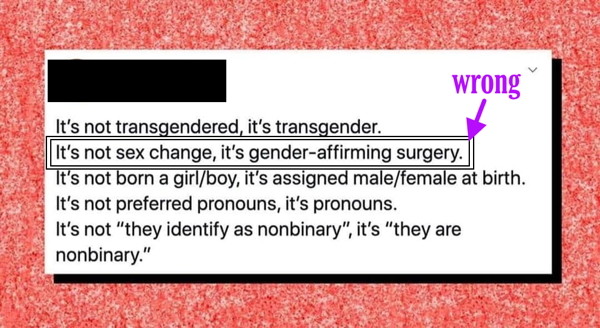
Someone in a Facebook group posted a meme stating "It's not sex change, it's gender-affirming surgery". Well, that's wrong. It's not gender-affirming surgery, its SEX-affirming surgery. If a person's gender identity as a woman is 100% valid whether they have a penis or a vagina, then obtaining surgical services to modify their physical structure so that any visual observers will assign it "vagina" doesn't affirm their gender. It affirms their SEX, as female.
Of course, being attractive to the heterosexual male gaze really is central to some people's sense of their feminine identity. It's what's most emotionally important to them about being a woman, as opposed to singing alto arias or becoming a really good seamstress or something. Nothing wrong with that.
But not everyone who identifies as woman or femme or girl is primarily concerned with appealing to the male gaze. Of having a sexually desirable appearance as filtered through the fakely universalized male gaze.
The centrality of the whole "do you look sexy, can you compete with the sexy women of the world in sexy appearance?" question is often used to invalidate feminine people. It is used to invalidate many cis women for whom it simply isn't the end-all and be-all of their self-worth. It is used to invalidate many trans women for whom being evaluated in terms of how well they "pass" as a sexually desirable specimen gets to be old and tiresome.
Well, it is also used to invalidate the identity of people like me, who definitively do not identify as female, who do not transition, who do not attempt to present as female-bodied people, who distinguish between physical sex and gender and identify as male women, male femmes, male girls.
I get a lot of pushback about it. People who say "It's nobody's business what you got in your underpants" when what they really mean is "You've got no business having that attitude of 'yeah I'm male, so what', that's the wrong attitude about your male parts, we're all supposed to be going around saying 'it doesn't matter'". But what actually doesn't matter to me is being found sexy in that sense. Sexy to the falsely universal male gaze. I am male. Sure I want to be found sexy... to people who specifically like the male physical morphology. Since that's the morphology I've got. And I'm a male girl. My gender-atypical identity doesn't have a damn thing to do with claiming femaleness, regardless of whether yours does or not.
———————
You're secluded in quarantine, and all the performances and events have been cancelled, so it's a good time to read a book!
My book, GenderQueer: A Story From a Different Closet, has been published by Sunstone Press. It is available on Amazon and Barnes & Noble in paperback and ebook, and as ebook only from Apple, Kobo, and directly from Sunstone Press themselves.
Links to published reviews and comments are listed on my Home Page
———————
This LiveJournal blog is echoed on DreamWidth, WordPress, and Blogger. Please friend/link me from any of those environments on which you have an account.
————————
Index of all Blog Posts
Saturday, April 18, 2020
The Inadequacy of Straight / Gay / Bi
"Oh, great", the gay and lesbian readers may be thinking. "First they want in, and make us expand what we call ourselves to include them, and use this ever-expanding acronym. And now they want to kick our identity out!"
Don't worry, you've got company. "Transgender / Cisgender" is inadequate too. I'm not trans. I was assigned male at birth. I identify as male. Not trans, right? I identify as femme, as girl, gal, woman. When I was assigned male, I was also assigned boy. I'm not cis. Because I'm all sissy. I'm not a man.
I'm not kicking anyone out. I'm coming out, which means I'm coming in, and for me to be in, some of the assumptions have to go out, so get used to it, because I'm not going back in, so let me in. It's complicated. Get used to that, too!
Let's start with the simple complicated. You've seen the genderbread person and the gender unicorn posters, right? The ones that give a nice simple explanation of why sexual orientation and gender identity is so much more complicated than "are you a boy or are you a girl" and "so are you straight, gay, or bi", right?


I'm male, that's my sex; I was assigned male at birth. They assigned me that way because they saw a penis. I've never dissented with that. It's the body I was born with and it's not the problem. I'm male. Male is not my gender identity, mind you. I'm one of the girls, that's my gender.
You with me so far? You see where those answers appear on those posters?
OK, then, with that in mind, let's move on to sexual orientation. I'm attracted to female folks.
Straight, gay, or bi?
Umm... sex or gender? I'm a male girlish person. Male people attracted more or less exclusively to female people are het, right? But women loving women, those are lesbians, aren't they?
This time the posters don't clarify much. Gender Unicorn gives me the choice of "physically attracted to "women", "men", or "other genders". Well, that doesn't help. I said I was attracted to female people, I didn't say anything about their gender identities!
Let's try the other poster. Genderbread says I might be "sexuallly attracted" to "women and/or feminine and/or female" people. That's a lot of and/or. The chart also gives me the option of "men and/or masculine and/or male" people. What happens if I'm attracted to masculine female people?
Both posters also address romantic (or emotional) attraction but the options are the same. And neither of them deal with the question of gay or straight or bi. It's just as well, because those terms can't handle the complexity of what's on those charts.
And the charts oversimplify matters too much.
Someone else might be attracted to feminine people, to people whose gender identity is expressed to be "woman". They might find a masculine female person uninteresting from a sexual standpoint. They might find a feminine male person to be of erotic interest. What defines sexual orientation may differ from one person to the next.
There's something else that the charts leave out about sexual orientation. Neither of them mention how the person wishes to be sexually perceived. Both charts have a space for gender expression but that's about gender, and I'm talking about sexual orientation. I'm referring to which of a person's characteristics one wishes to be found sexy on the basis of. That, for example, someone wants to be perceived as a sexually attractive woman, to be appealing to people whose attraction is towards women. It's not necessarily the same as gender or sex. I know several cisgender women who do not like being found sexually attractive as sexy female people. It's not how they prefer to market themselves in the universe of sexual orientation. I know both intersex and trans people who are revolted at the idea of "chasers", of people who are (or would be) turned on by their physical morphology. I know others who would feel very disappointed if their partner was not turned on by their physical morphology.
In my case, I'm into female boyish people who are attracted to male girls. Yeah, try to find that option on your dating app!
———————
You're secluded in quarantine, and all the performances and events have been cancelled, so it's a good time to read a book!
My book has been published by Sunstone Press. It is available on Amazon and Barnes & Noble in paperback and ebook, and as ebook only from Apple, Kobo, and directly from Sunstone Press themselves.
Links to published reviews and comments are listed on my Home Page
———————
This LiveJournal blog is echoed on DreamWidth, WordPress, and Blogger. Please friend/link me from any of those environments on which you have an account.
————————
Index of all Blog Posts
Don't worry, you've got company. "Transgender / Cisgender" is inadequate too. I'm not trans. I was assigned male at birth. I identify as male. Not trans, right? I identify as femme, as girl, gal, woman. When I was assigned male, I was also assigned boy. I'm not cis. Because I'm all sissy. I'm not a man.
I'm not kicking anyone out. I'm coming out, which means I'm coming in, and for me to be in, some of the assumptions have to go out, so get used to it, because I'm not going back in, so let me in. It's complicated. Get used to that, too!
Let's start with the simple complicated. You've seen the genderbread person and the gender unicorn posters, right? The ones that give a nice simple explanation of why sexual orientation and gender identity is so much more complicated than "are you a boy or are you a girl" and "so are you straight, gay, or bi", right?
I'm male, that's my sex; I was assigned male at birth. They assigned me that way because they saw a penis. I've never dissented with that. It's the body I was born with and it's not the problem. I'm male. Male is not my gender identity, mind you. I'm one of the girls, that's my gender.
You with me so far? You see where those answers appear on those posters?
OK, then, with that in mind, let's move on to sexual orientation. I'm attracted to female folks.
Straight, gay, or bi?
Umm... sex or gender? I'm a male girlish person. Male people attracted more or less exclusively to female people are het, right? But women loving women, those are lesbians, aren't they?
This time the posters don't clarify much. Gender Unicorn gives me the choice of "physically attracted to "women", "men", or "other genders". Well, that doesn't help. I said I was attracted to female people, I didn't say anything about their gender identities!
Let's try the other poster. Genderbread says I might be "sexuallly attracted" to "women and/or feminine and/or female" people. That's a lot of and/or. The chart also gives me the option of "men and/or masculine and/or male" people. What happens if I'm attracted to masculine female people?
Both posters also address romantic (or emotional) attraction but the options are the same. And neither of them deal with the question of gay or straight or bi. It's just as well, because those terms can't handle the complexity of what's on those charts.
And the charts oversimplify matters too much.
Someone else might be attracted to feminine people, to people whose gender identity is expressed to be "woman". They might find a masculine female person uninteresting from a sexual standpoint. They might find a feminine male person to be of erotic interest. What defines sexual orientation may differ from one person to the next.
There's something else that the charts leave out about sexual orientation. Neither of them mention how the person wishes to be sexually perceived. Both charts have a space for gender expression but that's about gender, and I'm talking about sexual orientation. I'm referring to which of a person's characteristics one wishes to be found sexy on the basis of. That, for example, someone wants to be perceived as a sexually attractive woman, to be appealing to people whose attraction is towards women. It's not necessarily the same as gender or sex. I know several cisgender women who do not like being found sexually attractive as sexy female people. It's not how they prefer to market themselves in the universe of sexual orientation. I know both intersex and trans people who are revolted at the idea of "chasers", of people who are (or would be) turned on by their physical morphology. I know others who would feel very disappointed if their partner was not turned on by their physical morphology.
In my case, I'm into female boyish people who are attracted to male girls. Yeah, try to find that option on your dating app!
———————
You're secluded in quarantine, and all the performances and events have been cancelled, so it's a good time to read a book!
My book has been published by Sunstone Press. It is available on Amazon and Barnes & Noble in paperback and ebook, and as ebook only from Apple, Kobo, and directly from Sunstone Press themselves.
Links to published reviews and comments are listed on my Home Page
———————
This LiveJournal blog is echoed on DreamWidth, WordPress, and Blogger. Please friend/link me from any of those environments on which you have an account.
————————
Index of all Blog Posts
Thursday, August 29, 2019
Polyamory and the Self-Actualized Sissy
Occasionally it comes out in conversation that I am polyamorous and have had multiple simultaneous partners. This is a fact that often gets misconstrued:
Now, I like occasionally having a moment of solidarity and experience-in-common with the non-hostile incarnations of the conventional male, and it may in fact have some element of compensatory pleasure or “making up for lost time” associated with it, I suppose, but I feel like most folks miss an important connection between being poly and being sissy.
Polarization versus Unification
The conventional portrait of sexuality, gender, and companionship looks something like this. I’ll work from the cis hetero male model since I am male and perceived as male and hence compared to this more often, regardless of how I identify. Ready? He has a cluster of same-sex friends, his “group” or his “buddies”, his “crowd”, and some are closer friends than others; these are easy informal relationships, without definitional structures. They are certainly multiple in nature and he may become closer to one friend over time or more distant with another, all without any need to redefine the relationships (since they don’t have formal definitions anyhow). Meanwhile, entirely separate from that, he has erotic interests in women, and is predisposed to form long-term pair-bonding with one if there is a sufficiently strong emotional attachment formed. Outside (or prior to) such a pair-bond, he may pursue sexual activity with multiple different partners, and may in fact behave in such a way as to preserve this sexual freedom by doing things to postpone or reduce the likelihood of pair-bond emotional passions forming. But it is still assumed that eventually he wants that to occur and that when it does he will be sexually exclusive. Even if not, it is assumed that he will not form similar deep emotionally connected pair-bonds with someone else, that the pair-bond relationship is at least exclusive in its own domain.
I am not going to critique this model for its inherent healthiness or desirability, at least not at the moment. Instead, let’s just toss this masculine model out of the way and bring myself in, a sissy male, and examine what changes from that alone. Well, first of all, instead of all my friends being same-sex, I tend to form friendships with women. Second, in contrast to some notion of a separate “friend zone” versus a “romantic possibility” classification, it’s not a separate phenomenon for me: the people I like as friends, being of the sex that I’m attracted to, are the people with whom there’s a potential for a sexual connection, a romantic connection. At the time that the connections are forming, I don’t know where they’re headed. Sexuality isn’t something foreign to friendship for me. Thirdly, just as the cis hetero guy’s friendships change over time, with him getting closer to some and farther apart from others, my relationships shift, and those shifts include into and out of sexual and romantic expression and feelings. So not only do I not know where they’re headed when they’re starting up, they may change.
That’s what it means, what it’s like, to be a person who is “like” rather than heterodifferent from the sex to whom I feel sexual attraction. It doesn’t make sense to “break up” with someone or to attempt sexual exclusivity or to expect or request it of someone else.
Works for Me
When I describe this to people, they sometimes say that it's a sad and inferior version of sexuality. They also sometimes say that it's a sad and creepy version of friendship. For my part, I think it would be sad and kind of pathological to be unable to be friends with someone you're strongly sexually attracted to. To be unable to feel that attraction without erupting into sexual aggression, sexual harassment, rape, molestation, sexual intrusiveness, etc; to find it necessary to attain that person sexually or else to run for the hills, to get away from them. I don't have that problem. I mean, yeah, I want sex and romantic love to be in my life, with someone, at least now and then; I need to experience that, and it's quite painful to be completely isolated from it. But as long as that's happening now and then in my life, I don't need it to be happening with this particular person, and it's OK to find them exquisitely delicious and not have anything develop out of that. And also, I don't think of sexual feelings as some kind of filthy things that are going to pollute a friendship.
There are people who practice a narrowly constrained form of pseudo-polyamory, wherein a person (nearly always male) is OK with his partner(s) having other partners of their own but only partners that are not of his sex. In other words, a “one penis policy”. In essence, he is isn’t seeing other female partners of his partners as competitive threats, but would see another male as such.
I don’t think I’m particularly inclined to see the sexual realm of life as all about competition, although I suppose some competitive aspects may be inevitable. But there’s another factor there for me, which is that I don’t tend to see other male partners of my partners as direct competition. Female partners either, for that matter. If there’s one flip side to sissyhood as a marginalized and rarefied identity, a structural advantage for a change, it’s the sense of veritable uniqueness. If someone likes being with me, they may also like being with other male people or other femme people but neither of those categories is going to be a snap-in replacement for me, so anyone with a taste for someone like me is going to be inclined to keep me around! I guess the closest approximation to a “one penis policy” in my case would be a “one SISSY policy”, but hey, we don’t exactly grow like weeds, with sissy suitors lurking around every corner, so I’ve never felt the need for that kind of protection either.
———————
This LiveJournal blog is echoed on DreamWidth, WordPress, and Blogger. Please friend/link me from any of those environments on which you have an account.
————————
Index of all Blog Posts
Jake: Whoo, well, sissy or no, I see we have some stuff in common. Rock on! You may not be in to all that masculinity be-a-man stuff but when it comes down to the important things you know how to get what you need, huh?
Maud: Is this like a compensation thing, to make up for being left out and pushed to the sidelines while the manly men were getting all the girls?
Now, I like occasionally having a moment of solidarity and experience-in-common with the non-hostile incarnations of the conventional male, and it may in fact have some element of compensatory pleasure or “making up for lost time” associated with it, I suppose, but I feel like most folks miss an important connection between being poly and being sissy.
Polarization versus Unification
The conventional portrait of sexuality, gender, and companionship looks something like this. I’ll work from the cis hetero male model since I am male and perceived as male and hence compared to this more often, regardless of how I identify. Ready? He has a cluster of same-sex friends, his “group” or his “buddies”, his “crowd”, and some are closer friends than others; these are easy informal relationships, without definitional structures. They are certainly multiple in nature and he may become closer to one friend over time or more distant with another, all without any need to redefine the relationships (since they don’t have formal definitions anyhow). Meanwhile, entirely separate from that, he has erotic interests in women, and is predisposed to form long-term pair-bonding with one if there is a sufficiently strong emotional attachment formed. Outside (or prior to) such a pair-bond, he may pursue sexual activity with multiple different partners, and may in fact behave in such a way as to preserve this sexual freedom by doing things to postpone or reduce the likelihood of pair-bond emotional passions forming. But it is still assumed that eventually he wants that to occur and that when it does he will be sexually exclusive. Even if not, it is assumed that he will not form similar deep emotionally connected pair-bonds with someone else, that the pair-bond relationship is at least exclusive in its own domain.
I am not going to critique this model for its inherent healthiness or desirability, at least not at the moment. Instead, let’s just toss this masculine model out of the way and bring myself in, a sissy male, and examine what changes from that alone. Well, first of all, instead of all my friends being same-sex, I tend to form friendships with women. Second, in contrast to some notion of a separate “friend zone” versus a “romantic possibility” classification, it’s not a separate phenomenon for me: the people I like as friends, being of the sex that I’m attracted to, are the people with whom there’s a potential for a sexual connection, a romantic connection. At the time that the connections are forming, I don’t know where they’re headed. Sexuality isn’t something foreign to friendship for me. Thirdly, just as the cis hetero guy’s friendships change over time, with him getting closer to some and farther apart from others, my relationships shift, and those shifts include into and out of sexual and romantic expression and feelings. So not only do I not know where they’re headed when they’re starting up, they may change.
That’s what it means, what it’s like, to be a person who is “like” rather than heterodifferent from the sex to whom I feel sexual attraction. It doesn’t make sense to “break up” with someone or to attempt sexual exclusivity or to expect or request it of someone else.
Works for Me
When I describe this to people, they sometimes say that it's a sad and inferior version of sexuality. They also sometimes say that it's a sad and creepy version of friendship. For my part, I think it would be sad and kind of pathological to be unable to be friends with someone you're strongly sexually attracted to. To be unable to feel that attraction without erupting into sexual aggression, sexual harassment, rape, molestation, sexual intrusiveness, etc; to find it necessary to attain that person sexually or else to run for the hills, to get away from them. I don't have that problem. I mean, yeah, I want sex and romantic love to be in my life, with someone, at least now and then; I need to experience that, and it's quite painful to be completely isolated from it. But as long as that's happening now and then in my life, I don't need it to be happening with this particular person, and it's OK to find them exquisitely delicious and not have anything develop out of that. And also, I don't think of sexual feelings as some kind of filthy things that are going to pollute a friendship.
There are people who practice a narrowly constrained form of pseudo-polyamory, wherein a person (nearly always male) is OK with his partner(s) having other partners of their own but only partners that are not of his sex. In other words, a “one penis policy”. In essence, he is isn’t seeing other female partners of his partners as competitive threats, but would see another male as such.
I don’t think I’m particularly inclined to see the sexual realm of life as all about competition, although I suppose some competitive aspects may be inevitable. But there’s another factor there for me, which is that I don’t tend to see other male partners of my partners as direct competition. Female partners either, for that matter. If there’s one flip side to sissyhood as a marginalized and rarefied identity, a structural advantage for a change, it’s the sense of veritable uniqueness. If someone likes being with me, they may also like being with other male people or other femme people but neither of those categories is going to be a snap-in replacement for me, so anyone with a taste for someone like me is going to be inclined to keep me around! I guess the closest approximation to a “one penis policy” in my case would be a “one SISSY policy”, but hey, we don’t exactly grow like weeds, with sissy suitors lurking around every corner, so I’ve never felt the need for that kind of protection either.
———————
This LiveJournal blog is echoed on DreamWidth, WordPress, and Blogger. Please friend/link me from any of those environments on which you have an account.
————————
Index of all Blog Posts
Sunday, April 7, 2019
REVIEW -- Britten & Crozier's ALBERT HERRING, performed by Utopia Opera
The premise of this opera lured me to think it might have edgy things to say about gender. A small town wants to anoint a May Queen but has issues with the lax morals of the female residents who would otherwise be the candidates for the position, and they decide to select a chaste and virginal male and dub him May King instead.
The tale is based on "Le Rosier de Madame Husson" by Guy de Maupassant, and the opera itself was written in 1947, which is generally not an era from which sharp-edged points on the subject of gender inequities and unduly gendered assumptions tended to emanate, but I was still curious.
I regretfully have to report that the tale tends to bolster and recapitulate traditional views on gender considerably more than it brings them into question. The eponymous Albert Herring [Cory Gross], the beforementioned chaste and virginal fellow, turns out to be an object of pity and condescending scorn from the more sexually experienced people of his age within the village (represented by Sid [Luke MacMillan], the butcher's son and Nancy [Stephanie Feigenbaum], who works at the bakery, who are in the process of flirting and fooling around a bit) and the village's children (in the form of Emmie, Cis, and Harry [Hannah Madeline Goodman, Zoe Marie Hart, and Jen Wu, respectively], who are prone to singing mocking children's songs about Albert within earshot). The doyenne of Loxford, Lady Billows [Marie Masters Webb], admires him, as does her housemaid Florence Pike [Caroline Tye], but they themselves are more than a little bit set up within the opera as targets for our ridicule. Somewhere in the middle are the various village leaders and authorities (Miss Wordsworth, schoolteacher [Rebecca Richardson], Mayor Upfold [Ethan Fran], Vicar Gedge [Glenn Friedman], and Police Superintendent Budd [Jonathan Harris] who do not dare to contradict Lady Billows in any affair but may or may not share her perspective on all things until they learn what her perspective is. They suggest one female candidate after another, for instance, before bowing to her assessment that none of them is suitable.
Basically the upshot of the plot is that Sid and Nancy (no resemblance to any latter-day punk rockers, just a coincidence) decide it would be cute to impinge a bit upon Albert's spotless moral fibre by slipping some rum into his beverage at the acceptance dinner, and once inebriated by it Albert rebels and, fortified by his drunkenness, goes into the town to revel, perchance to fornicate. This frees him from the apron strings of his domineering controlling Freudian mommy, Mrs Herring [Sarah Marvel Bleasdale], whose strict control, rather than any intrinsic moral backbone, is the real reason that Albert is as pure as he is. The experience permanently changes him and empowers him to seek his own course, while offending and dismaying Lady Billows and Mrs. Herring and Florence Pike.
In short, as is so often the case where males exhibiting characteristics more commonly associated with females are depicted at all, Albert is presented to us as pathetic and controlled by emasculating female people, and the remedy is a big dose of coarse crude masculinity to cure him of his feminine maladies.
A prolonged glance at Nancy gives us--if not the play itself--some perspective. If you examine Nancy's own attitudes, behaviors and feelings, especially drawing on the timeframe when she's feeling remorseful about her role in setting up Albert (which, incidentally, consisted entirely of going along with Sid's initiative) and combining that with her behavior when Sid is trying to kiss her while she demurs because "the windows have eyes," you end up with a Nancy who has a whole lot in common with Albert; both of them would be virginal and pure except that Nancy has Sid in her life, and Sid (as Albert himself later observed) gets what he wants by being direct and going after what he wants. Sid pressures Nancy and doesn't readily take "no" for an answer (he gets the kiss he seeks, windows and their eyes be damned). So Nancy is neither blessed nor cursed by the spectre (or mantle) of the chastity for which Albert is being recognized by Lady Billows and taunted and pranked by Sid, Nancy herself, and the children.
The opera isn't actually titled "The Deflowering of Albert Herring," nor is it explicitly stated that he comes home a nonvirgin. This garners points from me, albeit reluctantly, on the basis of accuracy, insofar as I once wanted to loosen up and let nice naughty things happen as they would, and to that end did attend parties and consume intoxicants, only to find that just as behaving more or less like Nancy doesn't result in a Nancy-like fate when you're male, going forth and consuming substances that lower inhibitions doesn't conjure up the people who would take advantage of your uninhibited receptivities. But if the tale doesn't say so, it equivocates and presents an overall message that if Albert is to loosen up and avail himself of less corseted ways of being in the world, sexual favors as well as the gutter of drunkenness will, in some undisclosed fashion, be his. The crown of flowers with which he is coronated is found before he is, trammeled and abandoned during the course of his escapades, leaving the villagers to think he's dead. You can't symbolize defloration much more directly than that.
The show displays Utopia Opera's usual strengths: there's no wasted investment in glitzy state-of-the-art pyrotechnics of the stage (they've been known to use flashlights with colored cellophane for some special effects); what you get instead is an assortment of spectacular voices singing at you from such close range that if you had a bouquet in hand to present to one of the singers, you could throw it from where you sit in the audience and whack the performer in the head. They convey an exuberant delight at what they're doing, along with a somewhat conspiratorial sense of fun, a company of outstanding opera singers who clearly enjoy doing what they're doing. William Remmers, the person who makes all this happen, is a show unto himself, great entertainment as a conductor and master of ceremonies. The pocket-sized orchestra is very impressive; I'd buy solo albums from either last night's french horn or bassoon player.
A true review of the operatic delivery of the Utopia Opera cast is beyond my level of sufficiently educated assessment. They deserve one and I hope someone better situated than I am will provide it. Benjamin Britten's score does not give the performers equal opportunity to show off their vocal acumen, but, having said that, I'll attest to the rafter-bending power exhibited by Marie Masters Webb as Lady Billows, as well as that of Caroline Tye in her role as housemaid Florence Pike, and Hannah Madeleine Goodman gets off some impressive prolonged shouts as the juvenile Emmie.
There's a nine-part complex vocal tableaux late in the piece, in Act III, that's just mind-blowing. Benjamin Britten is one of those composers who don't stay confined to the conventional restrictions of major and minor and augmented seventh and whatnot, while at the same time managing not to sound like pretentious random clashy white noise; his harmonies and entertwined melodies and countermelodies have a history and a destination, a sense of direction and resolution that one's ears can follow and appreciate, but the individual intervals and chords represent significant obstacles. This ensemble performance would challenge any vocal group.
The show has lots of delightful lighter moments that are well-carried by the Utopia team. You don't want to miss the three schoolchildren being tutored on their choral arrangement by Miss Wordsworth during a rehearsal; Florence the maid practically steals the show with a repertoire of small funny deadpan behaviors; and you'll love the mayor as he takes the opportunity, while ostensibly praising Albert at the award ceremony, to remind us all of his own civic accomplishments.
The pacing and delivery overall is spot-on, as is typical of Utopia's offerings. They know how to tell a tale and keep you involved.
Utopia Opera presents Albert Herring, an opera by Benjamin Britten & Eric Crozier, at Ida K. Lang Recital Hall, Hunter College, 695 Park Ave, NY
(the south side of Park Ave between Park and Lex, 4th floor).
Remaining performances April 12th and 13th, 2019.
Tickets and other inquiries: info@utopiaopera.org
———————
This LiveJournal blog is echoed on DreamWidth, WordPress, and Blogger. Please friend/link me from any of those environments on which you have an account.
————————
Index of all Blog Posts
The tale is based on "Le Rosier de Madame Husson" by Guy de Maupassant, and the opera itself was written in 1947, which is generally not an era from which sharp-edged points on the subject of gender inequities and unduly gendered assumptions tended to emanate, but I was still curious.
I regretfully have to report that the tale tends to bolster and recapitulate traditional views on gender considerably more than it brings them into question. The eponymous Albert Herring [Cory Gross], the beforementioned chaste and virginal fellow, turns out to be an object of pity and condescending scorn from the more sexually experienced people of his age within the village (represented by Sid [Luke MacMillan], the butcher's son and Nancy [Stephanie Feigenbaum], who works at the bakery, who are in the process of flirting and fooling around a bit) and the village's children (in the form of Emmie, Cis, and Harry [Hannah Madeline Goodman, Zoe Marie Hart, and Jen Wu, respectively], who are prone to singing mocking children's songs about Albert within earshot). The doyenne of Loxford, Lady Billows [Marie Masters Webb], admires him, as does her housemaid Florence Pike [Caroline Tye], but they themselves are more than a little bit set up within the opera as targets for our ridicule. Somewhere in the middle are the various village leaders and authorities (Miss Wordsworth, schoolteacher [Rebecca Richardson], Mayor Upfold [Ethan Fran], Vicar Gedge [Glenn Friedman], and Police Superintendent Budd [Jonathan Harris] who do not dare to contradict Lady Billows in any affair but may or may not share her perspective on all things until they learn what her perspective is. They suggest one female candidate after another, for instance, before bowing to her assessment that none of them is suitable.
Basically the upshot of the plot is that Sid and Nancy (no resemblance to any latter-day punk rockers, just a coincidence) decide it would be cute to impinge a bit upon Albert's spotless moral fibre by slipping some rum into his beverage at the acceptance dinner, and once inebriated by it Albert rebels and, fortified by his drunkenness, goes into the town to revel, perchance to fornicate. This frees him from the apron strings of his domineering controlling Freudian mommy, Mrs Herring [Sarah Marvel Bleasdale], whose strict control, rather than any intrinsic moral backbone, is the real reason that Albert is as pure as he is. The experience permanently changes him and empowers him to seek his own course, while offending and dismaying Lady Billows and Mrs. Herring and Florence Pike.
In short, as is so often the case where males exhibiting characteristics more commonly associated with females are depicted at all, Albert is presented to us as pathetic and controlled by emasculating female people, and the remedy is a big dose of coarse crude masculinity to cure him of his feminine maladies.
A prolonged glance at Nancy gives us--if not the play itself--some perspective. If you examine Nancy's own attitudes, behaviors and feelings, especially drawing on the timeframe when she's feeling remorseful about her role in setting up Albert (which, incidentally, consisted entirely of going along with Sid's initiative) and combining that with her behavior when Sid is trying to kiss her while she demurs because "the windows have eyes," you end up with a Nancy who has a whole lot in common with Albert; both of them would be virginal and pure except that Nancy has Sid in her life, and Sid (as Albert himself later observed) gets what he wants by being direct and going after what he wants. Sid pressures Nancy and doesn't readily take "no" for an answer (he gets the kiss he seeks, windows and their eyes be damned). So Nancy is neither blessed nor cursed by the spectre (or mantle) of the chastity for which Albert is being recognized by Lady Billows and taunted and pranked by Sid, Nancy herself, and the children.
The opera isn't actually titled "The Deflowering of Albert Herring," nor is it explicitly stated that he comes home a nonvirgin. This garners points from me, albeit reluctantly, on the basis of accuracy, insofar as I once wanted to loosen up and let nice naughty things happen as they would, and to that end did attend parties and consume intoxicants, only to find that just as behaving more or less like Nancy doesn't result in a Nancy-like fate when you're male, going forth and consuming substances that lower inhibitions doesn't conjure up the people who would take advantage of your uninhibited receptivities. But if the tale doesn't say so, it equivocates and presents an overall message that if Albert is to loosen up and avail himself of less corseted ways of being in the world, sexual favors as well as the gutter of drunkenness will, in some undisclosed fashion, be his. The crown of flowers with which he is coronated is found before he is, trammeled and abandoned during the course of his escapades, leaving the villagers to think he's dead. You can't symbolize defloration much more directly than that.
The show displays Utopia Opera's usual strengths: there's no wasted investment in glitzy state-of-the-art pyrotechnics of the stage (they've been known to use flashlights with colored cellophane for some special effects); what you get instead is an assortment of spectacular voices singing at you from such close range that if you had a bouquet in hand to present to one of the singers, you could throw it from where you sit in the audience and whack the performer in the head. They convey an exuberant delight at what they're doing, along with a somewhat conspiratorial sense of fun, a company of outstanding opera singers who clearly enjoy doing what they're doing. William Remmers, the person who makes all this happen, is a show unto himself, great entertainment as a conductor and master of ceremonies. The pocket-sized orchestra is very impressive; I'd buy solo albums from either last night's french horn or bassoon player.
A true review of the operatic delivery of the Utopia Opera cast is beyond my level of sufficiently educated assessment. They deserve one and I hope someone better situated than I am will provide it. Benjamin Britten's score does not give the performers equal opportunity to show off their vocal acumen, but, having said that, I'll attest to the rafter-bending power exhibited by Marie Masters Webb as Lady Billows, as well as that of Caroline Tye in her role as housemaid Florence Pike, and Hannah Madeleine Goodman gets off some impressive prolonged shouts as the juvenile Emmie.
There's a nine-part complex vocal tableaux late in the piece, in Act III, that's just mind-blowing. Benjamin Britten is one of those composers who don't stay confined to the conventional restrictions of major and minor and augmented seventh and whatnot, while at the same time managing not to sound like pretentious random clashy white noise; his harmonies and entertwined melodies and countermelodies have a history and a destination, a sense of direction and resolution that one's ears can follow and appreciate, but the individual intervals and chords represent significant obstacles. This ensemble performance would challenge any vocal group.
The show has lots of delightful lighter moments that are well-carried by the Utopia team. You don't want to miss the three schoolchildren being tutored on their choral arrangement by Miss Wordsworth during a rehearsal; Florence the maid practically steals the show with a repertoire of small funny deadpan behaviors; and you'll love the mayor as he takes the opportunity, while ostensibly praising Albert at the award ceremony, to remind us all of his own civic accomplishments.
The pacing and delivery overall is spot-on, as is typical of Utopia's offerings. They know how to tell a tale and keep you involved.
Utopia Opera presents Albert Herring, an opera by Benjamin Britten & Eric Crozier, at Ida K. Lang Recital Hall, Hunter College, 695 Park Ave, NY
(the south side of Park Ave between Park and Lex, 4th floor).
Remaining performances April 12th and 13th, 2019.
Tickets and other inquiries: info@utopiaopera.org
———————
This LiveJournal blog is echoed on DreamWidth, WordPress, and Blogger. Please friend/link me from any of those environments on which you have an account.
————————
Index of all Blog Posts
Saturday, March 2, 2019
REVIEW: Boy Erased
I finally got to see Boy Erased after having missed it when it was playing in a few regional theatres.
Jared Eamons (Lucas Hedges) has one of the stormiest coming-of-age and coming-out experiences: he's in college and [CONTENT WARNING / spoiler alert] gets raped by another religiously inclined boy, Henry (Joe Alwyn), who, like so many rapists, doesn't appear to see rape itself as a fundamental moral failure; instead, Henry is focused on the wickedness of same sex erotic behavior and whimpers to Jared afterwards about his remorse for the bad things he's done. When Jared, to Henry's apparent surprise, isn't particularly warm and friendly to him subsequently, Henry becomes worries that Jared will inform on him, so he preempts that by outing Jared to his parents and to people on campus.
You can be excused for wondering why being outed as a rape victim would cause anyone to reach any meaningful conclusion about the victim's sexual orientation, but Henry doesn't allude to his own involvement or factor in the violence involved; he simply tells everyone that Jared has been engaging in homosexual activities.
As it turns out, Jared has indeed been aware of sexual feelings towards males, and when confronted and accused decides to be honest about that.
That sets the stage for Jared's father Marshall (Russell Crowe), a socially conservative clergyman in a southern Alabama church, to arrange for Jared to attend a gay-to-straight conversion program, "Love in Action", a Christian-centric day facility operated by Victor Sykes (Joel Edgerton).
"Love in Action" is a total institution in the classic Erving Goffman sense; Sykes and his staff evaluate the program participants not only on their own behaviors and attitudes but on what opinions and feedback they provide to the others attending. That means they control all of the approval and disapproval that anyone can receive within the program. Denying that you have any problem, any worrisome attitude or unhealthy compensation mechanism, is itself always a symptom, proof that you aren't dealing with your issues, so no one can disagree or differ from anything that they are accused of. And of course this way of treating you is defined as therapeutic, as something you're being subjected to for your own good. It is, after all, love in action.
There is a considerable amount of internalized self-hatred and self-rejection in Boy Erased, and it is convincingly portrayed. Michael (David Joseph Craig) is a rule-worshipping martinet, bristling with disgust and contempt for Jared and the other sinful wicked people brought to the program; Henry the rapist is clearly tied up in revulsion for his own attractions and urges; Jared himself spends much of the movie accepting that he belongs here, worrying that God will condemn him to hell for being this way. There is a scene where Brandon (a camp counselor brought in to give masculinity lessons, played by Flea from the Red Hot Chili Peppers) first berates Jared for going into the toilet unaccompanied and accuses him of going in there to masturbate, and then stands behind him commenting lasciviously on how Jared pees. And from the top, Victor Sykes, an "ex-gay" convert himself, gets a discernable amount of prurient delight from hearing the confessions of his fallen guilty charges; he doesn't believe Jared when Jared details his homosexual sins as consisting in their entirety of laying down next to another guy (Xavier, by Theodore Pellerin) for a spate of platonic hugging. Sykes wants to hear more juicy morsels to pass judgment on.
The scenes where Brandon gives lessons in how to be manly men, instructing the boys on how to stand and what positions to hold their wrists in, etc, are campy and silly and reminiscent of Kevin Kline's sendup in In and Out. But given how silly it actually is to aspire to this thing called masculinity by mindlessly emulation, that's probably not easily avoided.
Boy Erased subtly underscores a fundamentally Christian problem with a homophobic agenda: having already gone on record as disapproving of heterosexual sexual activity except when restricted to marriage, the conservative Christian churches have painted themselves into a bit of a corner; they can't simply run camps like "Love in Action" as boot camps for enthusiastically heterosexual activities without contradicting a lot of what they stand for. As a consequence, throughout this movie we see a somewhat anachronistic approach to the condemnation of gay sexual activity, treating it as an unpicky, polymorphously perverse way of being entirely too interested in sex in general, rather than a failure to lust sufficiently for the opposite sex.
Nicole Kidman plays the mom, Nancy, who is largely ignored and bypassed by her husband in his rush to handle the crisis of his son having gay sexual feelings. She never joins in the judgmental condemnation and later comes to Jared's rescue and stands up to husband Marshall in the process. This is consistent with conservative men being more hostile to gay males than women from the same culture are.
The most important point, though, is that "Love in Action" does not function as a straightening clinic. It's a recloseting clinic. The clients who attend are not reshaped into heterosexual people and there's very little pretense that this is happening. Instead they are told to "fake it until you make it", to go through the motions, to study what passes as normative heterosexual and gender-appropriate and exhibit those characteristics. The camp's pressure on the participants is to go along with the program, to appear to agree more than to understand and be truly motivated by it. Appearances are all. Other boys in the program advise Jared to say what will give the counselors the impression that he is making progress. It's how you get out of here.
Boy Erased is based on Garrard Conley's book Boy Erased: A Memoir of Identity, Faith and Family
———————
This LiveJournal blog is echoed on DreamWidth, WordPress, and Blogger. Please friend/link me from any of those environments on which you have an account.
————————
Index of all Blog Posts
Jared Eamons (Lucas Hedges) has one of the stormiest coming-of-age and coming-out experiences: he's in college and [CONTENT WARNING / spoiler alert] gets raped by another religiously inclined boy, Henry (Joe Alwyn), who, like so many rapists, doesn't appear to see rape itself as a fundamental moral failure; instead, Henry is focused on the wickedness of same sex erotic behavior and whimpers to Jared afterwards about his remorse for the bad things he's done. When Jared, to Henry's apparent surprise, isn't particularly warm and friendly to him subsequently, Henry becomes worries that Jared will inform on him, so he preempts that by outing Jared to his parents and to people on campus.
You can be excused for wondering why being outed as a rape victim would cause anyone to reach any meaningful conclusion about the victim's sexual orientation, but Henry doesn't allude to his own involvement or factor in the violence involved; he simply tells everyone that Jared has been engaging in homosexual activities.
As it turns out, Jared has indeed been aware of sexual feelings towards males, and when confronted and accused decides to be honest about that.
That sets the stage for Jared's father Marshall (Russell Crowe), a socially conservative clergyman in a southern Alabama church, to arrange for Jared to attend a gay-to-straight conversion program, "Love in Action", a Christian-centric day facility operated by Victor Sykes (Joel Edgerton).
"Love in Action" is a total institution in the classic Erving Goffman sense; Sykes and his staff evaluate the program participants not only on their own behaviors and attitudes but on what opinions and feedback they provide to the others attending. That means they control all of the approval and disapproval that anyone can receive within the program. Denying that you have any problem, any worrisome attitude or unhealthy compensation mechanism, is itself always a symptom, proof that you aren't dealing with your issues, so no one can disagree or differ from anything that they are accused of. And of course this way of treating you is defined as therapeutic, as something you're being subjected to for your own good. It is, after all, love in action.
There is a considerable amount of internalized self-hatred and self-rejection in Boy Erased, and it is convincingly portrayed. Michael (David Joseph Craig) is a rule-worshipping martinet, bristling with disgust and contempt for Jared and the other sinful wicked people brought to the program; Henry the rapist is clearly tied up in revulsion for his own attractions and urges; Jared himself spends much of the movie accepting that he belongs here, worrying that God will condemn him to hell for being this way. There is a scene where Brandon (a camp counselor brought in to give masculinity lessons, played by Flea from the Red Hot Chili Peppers) first berates Jared for going into the toilet unaccompanied and accuses him of going in there to masturbate, and then stands behind him commenting lasciviously on how Jared pees. And from the top, Victor Sykes, an "ex-gay" convert himself, gets a discernable amount of prurient delight from hearing the confessions of his fallen guilty charges; he doesn't believe Jared when Jared details his homosexual sins as consisting in their entirety of laying down next to another guy (Xavier, by Theodore Pellerin) for a spate of platonic hugging. Sykes wants to hear more juicy morsels to pass judgment on.
The scenes where Brandon gives lessons in how to be manly men, instructing the boys on how to stand and what positions to hold their wrists in, etc, are campy and silly and reminiscent of Kevin Kline's sendup in In and Out. But given how silly it actually is to aspire to this thing called masculinity by mindlessly emulation, that's probably not easily avoided.
Boy Erased subtly underscores a fundamentally Christian problem with a homophobic agenda: having already gone on record as disapproving of heterosexual sexual activity except when restricted to marriage, the conservative Christian churches have painted themselves into a bit of a corner; they can't simply run camps like "Love in Action" as boot camps for enthusiastically heterosexual activities without contradicting a lot of what they stand for. As a consequence, throughout this movie we see a somewhat anachronistic approach to the condemnation of gay sexual activity, treating it as an unpicky, polymorphously perverse way of being entirely too interested in sex in general, rather than a failure to lust sufficiently for the opposite sex.
Nicole Kidman plays the mom, Nancy, who is largely ignored and bypassed by her husband in his rush to handle the crisis of his son having gay sexual feelings. She never joins in the judgmental condemnation and later comes to Jared's rescue and stands up to husband Marshall in the process. This is consistent with conservative men being more hostile to gay males than women from the same culture are.
The most important point, though, is that "Love in Action" does not function as a straightening clinic. It's a recloseting clinic. The clients who attend are not reshaped into heterosexual people and there's very little pretense that this is happening. Instead they are told to "fake it until you make it", to go through the motions, to study what passes as normative heterosexual and gender-appropriate and exhibit those characteristics. The camp's pressure on the participants is to go along with the program, to appear to agree more than to understand and be truly motivated by it. Appearances are all. Other boys in the program advise Jared to say what will give the counselors the impression that he is making progress. It's how you get out of here.
Boy Erased is based on Garrard Conley's book Boy Erased: A Memoir of Identity, Faith and Family
———————
This LiveJournal blog is echoed on DreamWidth, WordPress, and Blogger. Please friend/link me from any of those environments on which you have an account.
————————
Index of all Blog Posts
Tuesday, September 18, 2018
Different Strokes
I'm with my Mom in her hospital room. Her body flung a bunch of clots into her circulatory system; one of them wiped out some brain functioning, mostly motor and sensory stuff but some cognitive functions are messed up too; the worst of them plugged up her femoral artery and it cost her most of her left leg, so she's in bed with no knee or anything below it on that side; yet another tried its best to claim her other leg as well, but the surgeons sliced deep into her calf muscle and removed the clot, and after a few iffy days she had enough circulation in that foot that they stopped saying they might have to remove her right leg as well.
It's a huge insult to body integrity; it's almost impossible for me to be here without identifying with her situation and recoiling from it in horror, thinking life would not be worth living, that I wouldn't want to continue like that, and of course she does feel and express a lot of that (to everyone else's dismay). But she wants out of the hospital and to regain control of her life, since dying doesn't seem imminent. She sent me downstairs for a grilled cheese sandwich, bypassing the hospital dietician's tasteless pablum (and ate half of it, which is more than she's been eating off the hospital trays), and then asked me to help her sit up and swing her legs over the side of the bed (this is something physical therapy has been working towards, but my Mom is pushing the issue; she wants maximum mobility and she wants it now).
She and my Dad both fall into that difficult-to-explain middle space when it comes to understanding and accepting me as genderqueer. On the one hand, they've never rejected or made an issue of my femininities. Didn't seem bothered by my lack of interest in sports or my preference for girl playmates when I was a little boy. Didn't join their voices to those of other adults — relatives, neighbors' parents, people from church and school — in questioning why I wasn't more like other boys. And there's no way it wasn't brought to their attention, so they had to have dismissed these concerns as immaterial and irrelevant. The way I was was fine with them. They even suggested a career in nursing back when I was in my early 20s.
On the other hand, I've been out and have tried to be vocal about it since 1980, taking a public stand as a male feminine person, explaining it as a social issue, but their reaction has consistently been "Why do you want to talk about that? That's a personal matter, it's private and nobody else's business and it isn't polite to bring it up". In short, they're OK with me being a male person who happens to have some feminine traits or to have made some choices and decisions that are viewed as appropriate for women and girls, but not so OK with me defining who I am in those terms. They don't like me distinguishing myself from other identities, from straight, from cisgender, from transgender, from gay, in order to explain that my identity is different, that it's something else.
My reading material this week has been Hida Viloria's Born Both, an intersex memoir. Once again I'm finding the thoughts and experiences of intersex activists to be very topical and relevant to my own even though I'm not intersex myself. A great deal of the focus of Born Both is the distinction between viewing one's self as an (otherwise) ordinary man or woman with a physical (medical) intersex condition, or viewing one's self as an intersex person, a person whose body is intersex (not male or female) and whose gender is hermaphrodite (not man or woman). That definitely resonates with me, kin as it is to the distinction between viewing myself as an (otherwise) ordinary male guy who has some feminine traits and behaviors or instead as a gender invert, a male girl or male femme.
Late in the book Viloria writes about her discomfort with the formulation "cisgender": it is a term that sometimes been defined as that state where one's gender matches one's birth sex, and sometimes instead as that state where one's gender is consistent with the gender assigned to one at birth. The problem for Viloria (and for intersex people) is that in the case of the first definition for cisgender, a person who identifies as intersex would be cisgender (the birth sex is intersex and so is the gender identity), which is misleading, and in the case of the second definition, intersex people would be labeled transgender instead because virtually no one is assigned "intersex" — but that's misleading too. The possibility of "intersex" gets erased by binary assumptions that are built into transgender versus cisgender definitions.
And again I find myself nodding with recognition, because I often feel erased by the same definitions. In my case, I have a body, which is male, which was assigned male when I was born, and which continues to be assigned male by anyone who views it. So my sex is cisgender, right? Well, I have a gender too: girl, or femme — definitely not guy or boy or man. Yet my assigned gender, both at birth and as an ongoing act of assignment-by-others, is perennially boy, guy, man. So my gender is trans. The problem for me is that there is a very lazy distinction between sex and gender in the definitions of cisgender and transgender. Those definitions erase the possibility of someone having a current sex that does not "match" their current gender. In other words, they erase me.
Viloria also identifies as a "hermaphrodyke". Her gender is hermaphrodite, her sexual orientation is towards women, and she thinks of herself as a lesbian, not as a straight guy. She of all people would not be inclined to box in everyone as either male or female, and hence as objects of attraction to her as either one orientation or the other; but although in her book she describes times when straight women were attracted to her as a straight guy, and gay men to her as a gay guy, her own appetite seems linked to those set of morphological characteristics that make up classical female body structure. That is true for me as well. There do exist viewpoints among people within the LGBTQIA communities to the effect that no one should have a morphological preference. That it is transphobic or chauvinistically binary to go around requiring that the people to whom one is attracted be in possession of a standard-issue penis or that they own a conventionally defined vagina or whatever. Reciprocally, there is a suspicious mistrust for people whose sexual interests are expressed specifically towards transgender people. Trans women and trans men often find it creepy and objectifying in a fetishy and dehumanizing way to encounter folks who want to become sexually involved with a trans woman (or man) when they themselves identify as women and men, not as trans women or trans men.
But among nonbinary people there has emerged the term skoliosexual, i.e., "to be attracted to transgender or non-binary/genderqueer people". Not all non-cisgender people are people whose identify is anchored in the binary identity opposite to the one they were born into (or assigned to at birth), and as a consequence some of us actively prefer to connect with people who are affirmatively attracted to us as we are, for what we are, for our configuration. Viloria proudly described partners who found her intersex body intrinsically attractive and relays similar tales and experiences from other intersex people she's compared notes with.
My mom is an attractive woman. She has nice curves, nice female shapes even at 82. I'm seeing a lot more of it than I'm accustomed to — hospitals are like that in general, and in her case she keeps feeling so hot that she can't get comfortable, so she's almost become a naturist here. There's a first-tier reaction of turning away from it, embarrassed by proxy. She's from an era and a culture where you kept yourself covered up, especially if you were a woman. But being attactive, being perceived as attractive, is a part of her identity, part of how she thinks of herself: she brushes her hair here, and puts on makeup: blusher, powder, lipstick. She isn't seeking to be attractive in order to prompt active sexual behavior from anyone (she's got that situation handled; she's got my Dad), but because it is woven into her concept of who she is. For me to find her so, on the other hand, is inappropriate, disturbingly so to most people. It's supposed to be so taboo that it would be impossible for me to see those contours in sexual terms. We've put a lot of energy into supposed to when it comes to sexuality. As a culture we invest in shoulds and should nots and leave little room for people to feel what they feel, alleged sexual revolutions beside the point. Poke at this particular one and you'll see that under it is the hidden notion that male people can't help acting on any sexual feeling that they experience. The #metoo movement says that's bullshit. I do too. The attraction is there because my mom is female. Not because I'm imposing a litmus test that says I can only find someone attractive if they're female. I'm pretty sure I'm not imposing much in the way of shoulds here if you see what I mean. I can also state with confidence that finding her attractive doesn't make it likely that I'm going to climb into her hospital bed and commit acts of sexual assault. People don't recoil in quite the same way at the notion of a daughter seeing her Dad as a sexually attractive man. But that's because there's a preconceived notion about what male sexuality is like, one that lots of folks hold in their heads without being fully conscious of it.
The difference between being a guy who has some feminine attributes and being a male girl is the same as the difference between being a woman (or man) with some sexually ambiguous characteristics and being an intersex person. It's the difference between noun and adjective, it's the declaration of a phenomenon, a thang. Before 1980 I knew myself to be a male person who had more in common with the girls than with the other boys; I was aware that that made me subject to being classified as a fag, a sissy queerboy, which wasn't right but neither was it right to say that no, I was a regular guy, a straight boy. After 1980 I knew myself to have an entirely separate gender or sexual identity, something just as different as being gay, but not that, and not being male-to-female transgender either. Something else. Something folks hadn't heard about yet, weren't talking about, had no awareness of. It was a sense of identity instead of a box of attributes. It converted the attributes into normative aspects for a male girl instead of peculiar aspects for a guy. It explained my experiences in political terms instead of implying that character defects on my part had brought my experiences upon me. It made a huge difference in my self-esteem.
———————
This LiveJournal blog is echoed on DreamWidth, WordPress, and Blogger. Please friend/link me from any of those environments on which you have an account.
————————
Index of all Blog Posts
It's a huge insult to body integrity; it's almost impossible for me to be here without identifying with her situation and recoiling from it in horror, thinking life would not be worth living, that I wouldn't want to continue like that, and of course she does feel and express a lot of that (to everyone else's dismay). But she wants out of the hospital and to regain control of her life, since dying doesn't seem imminent. She sent me downstairs for a grilled cheese sandwich, bypassing the hospital dietician's tasteless pablum (and ate half of it, which is more than she's been eating off the hospital trays), and then asked me to help her sit up and swing her legs over the side of the bed (this is something physical therapy has been working towards, but my Mom is pushing the issue; she wants maximum mobility and she wants it now).
She and my Dad both fall into that difficult-to-explain middle space when it comes to understanding and accepting me as genderqueer. On the one hand, they've never rejected or made an issue of my femininities. Didn't seem bothered by my lack of interest in sports or my preference for girl playmates when I was a little boy. Didn't join their voices to those of other adults — relatives, neighbors' parents, people from church and school — in questioning why I wasn't more like other boys. And there's no way it wasn't brought to their attention, so they had to have dismissed these concerns as immaterial and irrelevant. The way I was was fine with them. They even suggested a career in nursing back when I was in my early 20s.
On the other hand, I've been out and have tried to be vocal about it since 1980, taking a public stand as a male feminine person, explaining it as a social issue, but their reaction has consistently been "Why do you want to talk about that? That's a personal matter, it's private and nobody else's business and it isn't polite to bring it up". In short, they're OK with me being a male person who happens to have some feminine traits or to have made some choices and decisions that are viewed as appropriate for women and girls, but not so OK with me defining who I am in those terms. They don't like me distinguishing myself from other identities, from straight, from cisgender, from transgender, from gay, in order to explain that my identity is different, that it's something else.
My reading material this week has been Hida Viloria's Born Both, an intersex memoir. Once again I'm finding the thoughts and experiences of intersex activists to be very topical and relevant to my own even though I'm not intersex myself. A great deal of the focus of Born Both is the distinction between viewing one's self as an (otherwise) ordinary man or woman with a physical (medical) intersex condition, or viewing one's self as an intersex person, a person whose body is intersex (not male or female) and whose gender is hermaphrodite (not man or woman). That definitely resonates with me, kin as it is to the distinction between viewing myself as an (otherwise) ordinary male guy who has some feminine traits and behaviors or instead as a gender invert, a male girl or male femme.
Late in the book Viloria writes about her discomfort with the formulation "cisgender": it is a term that sometimes been defined as that state where one's gender matches one's birth sex, and sometimes instead as that state where one's gender is consistent with the gender assigned to one at birth. The problem for Viloria (and for intersex people) is that in the case of the first definition for cisgender, a person who identifies as intersex would be cisgender (the birth sex is intersex and so is the gender identity), which is misleading, and in the case of the second definition, intersex people would be labeled transgender instead because virtually no one is assigned "intersex" — but that's misleading too. The possibility of "intersex" gets erased by binary assumptions that are built into transgender versus cisgender definitions.
And again I find myself nodding with recognition, because I often feel erased by the same definitions. In my case, I have a body, which is male, which was assigned male when I was born, and which continues to be assigned male by anyone who views it. So my sex is cisgender, right? Well, I have a gender too: girl, or femme — definitely not guy or boy or man. Yet my assigned gender, both at birth and as an ongoing act of assignment-by-others, is perennially boy, guy, man. So my gender is trans. The problem for me is that there is a very lazy distinction between sex and gender in the definitions of cisgender and transgender. Those definitions erase the possibility of someone having a current sex that does not "match" their current gender. In other words, they erase me.
Viloria also identifies as a "hermaphrodyke". Her gender is hermaphrodite, her sexual orientation is towards women, and she thinks of herself as a lesbian, not as a straight guy. She of all people would not be inclined to box in everyone as either male or female, and hence as objects of attraction to her as either one orientation or the other; but although in her book she describes times when straight women were attracted to her as a straight guy, and gay men to her as a gay guy, her own appetite seems linked to those set of morphological characteristics that make up classical female body structure. That is true for me as well. There do exist viewpoints among people within the LGBTQIA communities to the effect that no one should have a morphological preference. That it is transphobic or chauvinistically binary to go around requiring that the people to whom one is attracted be in possession of a standard-issue penis or that they own a conventionally defined vagina or whatever. Reciprocally, there is a suspicious mistrust for people whose sexual interests are expressed specifically towards transgender people. Trans women and trans men often find it creepy and objectifying in a fetishy and dehumanizing way to encounter folks who want to become sexually involved with a trans woman (or man) when they themselves identify as women and men, not as trans women or trans men.
But among nonbinary people there has emerged the term skoliosexual, i.e., "to be attracted to transgender or non-binary/genderqueer people". Not all non-cisgender people are people whose identify is anchored in the binary identity opposite to the one they were born into (or assigned to at birth), and as a consequence some of us actively prefer to connect with people who are affirmatively attracted to us as we are, for what we are, for our configuration. Viloria proudly described partners who found her intersex body intrinsically attractive and relays similar tales and experiences from other intersex people she's compared notes with.
My mom is an attractive woman. She has nice curves, nice female shapes even at 82. I'm seeing a lot more of it than I'm accustomed to — hospitals are like that in general, and in her case she keeps feeling so hot that she can't get comfortable, so she's almost become a naturist here. There's a first-tier reaction of turning away from it, embarrassed by proxy. She's from an era and a culture where you kept yourself covered up, especially if you were a woman. But being attactive, being perceived as attractive, is a part of her identity, part of how she thinks of herself: she brushes her hair here, and puts on makeup: blusher, powder, lipstick. She isn't seeking to be attractive in order to prompt active sexual behavior from anyone (she's got that situation handled; she's got my Dad), but because it is woven into her concept of who she is. For me to find her so, on the other hand, is inappropriate, disturbingly so to most people. It's supposed to be so taboo that it would be impossible for me to see those contours in sexual terms. We've put a lot of energy into supposed to when it comes to sexuality. As a culture we invest in shoulds and should nots and leave little room for people to feel what they feel, alleged sexual revolutions beside the point. Poke at this particular one and you'll see that under it is the hidden notion that male people can't help acting on any sexual feeling that they experience. The #metoo movement says that's bullshit. I do too. The attraction is there because my mom is female. Not because I'm imposing a litmus test that says I can only find someone attractive if they're female. I'm pretty sure I'm not imposing much in the way of shoulds here if you see what I mean. I can also state with confidence that finding her attractive doesn't make it likely that I'm going to climb into her hospital bed and commit acts of sexual assault. People don't recoil in quite the same way at the notion of a daughter seeing her Dad as a sexually attractive man. But that's because there's a preconceived notion about what male sexuality is like, one that lots of folks hold in their heads without being fully conscious of it.
The difference between being a guy who has some feminine attributes and being a male girl is the same as the difference between being a woman (or man) with some sexually ambiguous characteristics and being an intersex person. It's the difference between noun and adjective, it's the declaration of a phenomenon, a thang. Before 1980 I knew myself to be a male person who had more in common with the girls than with the other boys; I was aware that that made me subject to being classified as a fag, a sissy queerboy, which wasn't right but neither was it right to say that no, I was a regular guy, a straight boy. After 1980 I knew myself to have an entirely separate gender or sexual identity, something just as different as being gay, but not that, and not being male-to-female transgender either. Something else. Something folks hadn't heard about yet, weren't talking about, had no awareness of. It was a sense of identity instead of a box of attributes. It converted the attributes into normative aspects for a male girl instead of peculiar aspects for a guy. It explained my experiences in political terms instead of implying that character defects on my part had brought my experiences upon me. It made a huge difference in my self-esteem.
———————
This LiveJournal blog is echoed on DreamWidth, WordPress, and Blogger. Please friend/link me from any of those environments on which you have an account.
————————
Index of all Blog Posts
Monday, July 30, 2018
Demisexual
A demisexual is a person who does not experience sexual attraction
unless they form a emotional connection. It's more commonly seen in,
but by no means confined, to romantic relationships. The term
demisexual comes from the orientation being "halfway between" sexual
and asexual.
I first encountered the term "demisexual" in online forums for genderqueer and other gender-variant people. It was as new to me as my own identifying term ("gender invert") is to most people in the LGBTQ scene. I'd heard of demigirl and demiboy (terms used by some genderqueer folks) but demisexual was one I hadn't encountered before.
DEMI means "half" or "halfway" -- so a demigirl would be someone halfway between gender-neutral and feminine, for example. When applied to sexual, though, it was less obvious to me what it would mean to be half-sexual, in addition to which the people who identified as such didn't appear to be using it to mean they were less sexual than most other people; instead they seemed to be using it to mean their sexual interests were confined to relationships in which they had a meaningful emotional connection.
It struck me as a pattern strongly associated with feminine sexuality. We have the cultural notion that women and girls want to have a relationship with a boyfriend, and within that context, to have good sex. That the sexuality of boys and men, by comparison, is considerably less constrained to situations where there's that kind of intimate connection. Female exceptions may exist, but where they do, their femininity is cast into some degree of dubiety by the fact that they are willing to jump into no-strings casual sex with the same non-demi enthusiasm as a typical male. Such women are often assumed to lack appropriate amounts of self-esteem (a suspicion less often aimed at promiscuous male people) and they are tagged with epithets and descriptors like "slut" and "wanton" and "easy" and a host of other nouns and adjectives that all underline their lack of normalcy, their deviance, the fundamental wrongness of them being that way.
It's reasonable to say that being demisexual is prescriptive for women, whether it is accurately descriptive or not. Girls and women are under a great deal of social pressure to take on the trappings of being demisexual, to give it lip service and keep up the superficial appearance of being that way.
It's also reasonable to point out that we have plenty of cultural images of women's sexuality as reactive to sexual attention, in such a way that a popular depiction of the very un-demi male sexuality takes the form of the seducer, the sexual pursuer who elicits female sexual participation not by connecting to women with an emotional bond but by circumventing her obligatory pretense of being demisexual and appealing to her rather non-demi susceptibility to sexual opportunities.
It certainly seems useful to split off the specific notion of being demisexual from the culturally conventional notion of femininity, because there are other characteristics that are also deemed to be part of femininity (and of feminine sexuality), such that a person could participate in being feminine without being demisexual. It gives us specificity; it lets us zero in on one aspect of a person's nature instead of referencing a huge library of loosely-associated characteristics.
I'm not sure I quite qualify as demisexual, myself. I've never craved sexual activity that was deliberately lacking in emotional connection, that's for sure, and I've always wanted to have a close intimate caring relationship. But that's not quite the same as saying I'm utterly without any sexual attraction to a stranger, a casual acquaintance, someone I don't have an emotional connection to. I can have such attractions, and I do. Acting on them is messy and complicated and more trouble than it's worth, and I hate that perpetual accusation that insofar as I'm a male I only care about sex and not for loving relationships. But once again, that's not the same thing as saying I'm incapable of finding someone quite enticingly appetizing, entirely delicious on visual and other superficial grounds. My disinclination to actually engage in casual sex isn't due to a lack of appetite outside of emotionally connected relationships.
That makes me wonder how many self-identified demisexual folks would say much the same thing: whether they'd say they completely do not feel any attraction outside of relationships, or would instead say that satisfying sexual experiences seem to be tied to caring connections and therefore they are uninclined to act on attractions outside of them.
And, because it's kind of one of those fabled living-room elephants, how being demisexual as a female-bodied person differs from being demisexual as a person who presents as male. Because the cultural context is going to paint them quite differently.
And as a gender invert, I'm especially curious about how demisexual male people who are attracted to female folks experience their sexual lives, their sexual orientation, and their gender identity. Because I found that being even as demisexual as I am to be entirely polarizing and gender-invalidating, and a big part of how I came to identify as a gender invert.
———————
This LiveJournal blog is echoed on DreamWidth, WordPress, and Blogger. Please friend/link me from any of those environments on which you have an account.
———————— Index of all Blog Posts
Subscribe to:
Posts (Atom)