When I was born, I was categorized based on visual inspection of my parts, and designated male.
You've heard all this before, over and over. I don't need to repeat objections that you could recite as easily as I could. Let's do something more interesting... let's dive into the head of the people who don't understand what we're objecting to.
I'm picking this guy, let's call him Sammy. He says that as far as he's concerned, the designation and categorization mean exactly the same thing as the parts themselves. "Penis means you're male. I ain't saying that makes you Rambo. Maybe you're into ballet, or you want to be Earth Mom. I don't care if you paint your room pink or blue or you play with dolls or fire engines, you hear what I'm sayin'? Male just means you got a penis and we figure you're gonna grow hair and so on because that's what usually happens."
Sammy is effectively making the claim that he — and most of the rest of the world — doesn't attach any additional meaning to being male.
He is wrong. He does it all the time, I've seen him do it over and over. In a discussion of evolutionary pressures and social status, he said the high status males will naturally be the ones who have sex with the most females, while the highest status females will be the ones who only have sex with a few carefully selected males. That's attaching a significance to "male" that goes far beyond "has a penis". And in discussions of romantic comedy movies, he described a character played by Katharine Hepburn as having "won" against the male lead when he ends up proposing marriage to her — "she got him, he's captured". Sammy can protest all he wants about how he isn't projecting pink versus blue expectations and roles onto people and attaching those things to what sex he considers them to be, but he's definitely doing it, and the society that surrounds us is definitely doing it.
It's hard to know what to say to someone who insists that they are only seeing and thinking in terms of physical body structure when they clearly show that they assume different priorities, different values, different behavioral patterns, different personality characteristics... and different roles that interact with other, equally sex-specific roles.
Maybe it's a good thing to aspire to. Maybe we should all be trying not to assume anything whatsoever about how a person will behave or what's important to them in life based on whether we perceive their bodies to be male, or female instead. Maybe we should all be trying not to interpret the same behavior as meaning a different thing depending on whether we perceive the person to be female or to be male. But pretending that nobody does that any more except for transgender and genderqueer and nonbinary people, as if the rest of the world doesn't attach any meaning to being a man or being a woman other than the physical? Give me a break!
That's not to say that it isn't useful to think of, and speak of, the physical architecture separately from the identity, the gendered self that we have come to believe is not defined by our sexual plumbing. If being born with a clitoris and vagina does not make one a girl or a woman, then you don't need to have a clitoris and a vagina in order to be one, nor to present and pass as a person who has that kind of physical architecture. If your gender identity is valid, then it's valid on the nude beach or the doctor's examining room. It's valid when you're wearing the garments that are typically worn by the people who have the same physical body structure instead of the garments typically worn by the people who have the same gender identity.
Trans people often say "Trans women don't owe you femininity". Well, I don't owe you the need to be thought of as physically female.
There are other people — some of my trans brothers and sisters — whose situation is different from mine. Some of them do need to do a medical transition. And I support them and their rights and their need for social and medical accommodations.
But me, I don't need false breasts. I don't need real breasts. I don't need brassieres. I have no interest in lipstick or rouge, I don't own a single pair of high heels, and I don't paint my fingernails. My face grows hair because of my hormones, and I don't shave it off, nor do I pluck it. It grows there naturally. I don't owe you femaleness. I'm femme. You'll discover who I am soon enough if you interact with me.
———————
You're secluded in quarantine, and all the performances and events have been cancelled, so it's a good time to read a book!
My book, GenderQueer: A Story From a Different Closet, has been published by Sunstone Press. It is available on Amazon and Barnes & Noble in paperback and ebook, and as ebook only from Apple, Kobo, and directly from Sunstone Press themselves.
Links to published reviews and comments are listed on my Home Page
———————
This DreamWidth blog is echoed on LiveJournal, WordPress, and Blogger. Please friend/link me from any of those environments on which you have an account.
————————
Index of all Blog Posts
Showing posts with label transgender. Show all posts
Showing posts with label transgender. Show all posts
Wednesday, December 16, 2020

Sunday, November 29, 2020
A Couple More Reviews
My book was featured by two book bloggers this week, both of whom drew attention to the purpose for which I wrote it in the first place --
"Society has gotten better at describing and acknowledging the many differences in people where sex, gender, and sexual preferences are concerned, but I realized that I didn’t have as good a handle on some of those possibilities. LGBT, I get, but if you’re in that Q+ that gets appended by some people, what does it mean? After reading GenderQueer, I feel like I’ve got a better handle on it."
— Big Al, at Big Al's Books & Pals
"Gender has gotten to be a pretty complicated subject. Personally, I was born female and I identify as female. I know or have met many other people for whom their gender does not match their biological sex. This may result in them deciding to alter their physical form to match their gender identity, as is the case with those who are trans. However, some may not feel out of place in their given body even though it doesn’t match their gender identity. That is the case for Allan D. Hunter, or as they go by in the book, Derek.
This is what is now referred to as “gender queer.” It’s the Q in LGBTQIA...
GenderQueer is very well written. It is not just any memoir that somebody threw together. This one took years of passion and it shows."
— Amanja, at Amanja Reads Too Much
Of the two of them, Big Al was stepping a bit outside his typical reading fare when he chose to read my book, whereas Amanja often reviews books with LGBTQIA themes. So it's reassuring that both reviewers got that sense of my narrated life as "Example A" of a phenomenon that still is not discussed anywhere near as clearly or as often as being transgender is.
———————
You're secluded in quarantine, and all the performances and events have been cancelled, so it's a good time to read a book!
My book, GenderQueer: A Story From a Different Closet, has been published by Sunstone Press. It is available on Amazon and Barnes & Noble in paperback and ebook, and as ebook only from Apple, Kobo, and directly from Sunstone Press themselves.
Links to published reviews and comments are listed on my Home Page
———————
This DreamWidth blog is echoed on LiveJournal, WordPress, and Blogger. Please friend/link me from any of those environments on which you have an account.
————————
Index of all Blog Posts
Saturday, October 17, 2020
BOOK REVIEW: Ciel, by Sophie Labelle
When I saw that Sophie Labelle, author-cartoonist of Assigned Male Comics, had published a book, I ordered a copy. It was described as featuring a gender nonconforming main character coping with high school, and I'm addicted to stories of how people formulate their unconventional gender identities and how they experience themselves during these formative years.
I wanted to see what Labelle would do with more space to expand into, the opportunity to dive deeper into things with more nuance and complexity than a four-panel strip provides.
(Ciel is NOT a graphic novel, by the way. It's concise at 188 pages but it's made up of text, just so you know).
The early part of the book left me feeling a little bit like everything about gender and identity was still being painted in primary colors, all platitudes and overly simplified viewpoints that imply more agreement among LGBTQIA people than actually exists. Labelle's Ciel refers to "another gender...than the one the doctors gave me at birth when they looked at my genitals (which are nobody's business, by the way!)" and goes on to complain that for children in many societies, "they're designated a girl or a boy, their room are painted a certain color, and they're given certain kinds of toys to play with".
But Sophie Labelle shifts to more politically complicated territory later on in the story. Tensions are explored around questions of sexual orientation and how they collide awkwardly with nonbinary gender identities, with characters such as Frank, who is involved with Ciel's best friend Stephie, a trans girl. Frank is starting to get facial hair and unclear on whether or not Stephie, who was assigned male, will also.
"You know, she wouldn't be any less a girl if she had a beard like a Viking, or an Adam's apple, or a low voice", Ciel tells him.
"But it would be a little weird."
"Why?"
"People might think I was going out with a guy, or something."
"And that would be a real tragedy, right?"
"That's not what I mean! Some of my friends say I'm gay becasue I'm going out with Stephie, and I don't care."
"Good."
This conversation gets Ciel wondering about facial hair. Ciel doesn't identify as a boy or a girl. And although Ciel is taking puberty hormone blockers, they're not firmly committed to continuing to do so.
Over and over again, the characters in Labelle's book, in pondering their own identities and their expressions of them, find themselves considering how they are viewed by others. It's an unavoidable part of identity. Sociologists sometimes call it "altercasting" — the act of assigning identities to other people. We all do it, not always with bad intentions, not always with narrowly limited categories, but even when we are aware of all this diversity, we still tend to listen and watch and then regard a person as a trans woman or a genderfluid nonbinary person or a lesbian trans girl or whatever. And we all also spend time and energy imagining how we are perceived, and we take it into account when choosing how to interact, how to present.
In Ciel's case, there is the matter of what name to use. The school's records have Ciel's proper name down as "Alessandro". Ciel is somewhat awkward about asking to be referred to as "Alessandra" instead, more comfortable about asking ahead of time than correcting a teacher who started using the other name. Ciel is even more open and out on their YouTube channel, where videos openly explore what it is like to be trans and gender-nonconforming.
That provokes the most polarized and antagonistically hostile reaction that Ciel experiences in the book — from another transgender person. A video blogger named Bettie Bobbie posts: "Hi everyboy! Today I watched a video that made me want to puke, about a gay boy who invented a gender for himself by saying he's neither a boy nor a girl...if you ask me, this video harms real trans people like me."
Sophie Labelle shows us that the world of LGBTQIA identities is intricate and that we struggle with identification and expression, and that there are hurt feelings and resentments and anger sometimes. This is honest and fair.
Through Ciel's tale, Labelle does a slow exploration of presentation by a gender nonconforming person (I would describe Ciel as genderfluid, myself, but the term isn't embraced in this story). Ciel's choice of clothing is presented as an internal dialog, facing the closet several mornings and deciding against the ostentatiously colorful apparel they're drawn to and instead putting on more drab and mundane garments. Only towards the end of the book does Labelle pull back and let us see that choice against the backdrop of Ciel's expectation of their classmates' attitudes and reactions.
Ciel, by Sophie Labelle, Second Story Press 2020 Toronto CA
https://secondstorypress.ca/kids/ciel
———————
You're secluded in quarantine, and all the performances and events have been cancelled, so it's a good time to read a book!
My book, GenderQueer: A Story From a Different Closet, has been published by Sunstone Press. It is available on Amazon and Barnes & Noble in paperback and ebook, and as ebook only from Apple, Kobo, and directly from Sunstone Press themselves.
Links to published reviews and comments are listed on my Home Page
———————
This DreamWidth blog is echoed on LiveJournal, WordPress, and Blogger. Please friend/link me from any of those environments on which you have an account.
————————
Index of all Blog Posts
Saturday, September 5, 2020
Umbrella
Several times in several different groups somebody has asked about the difference between "transgender" and "genderqueer" and "nonbinary" and then somebody else has posted something like this:
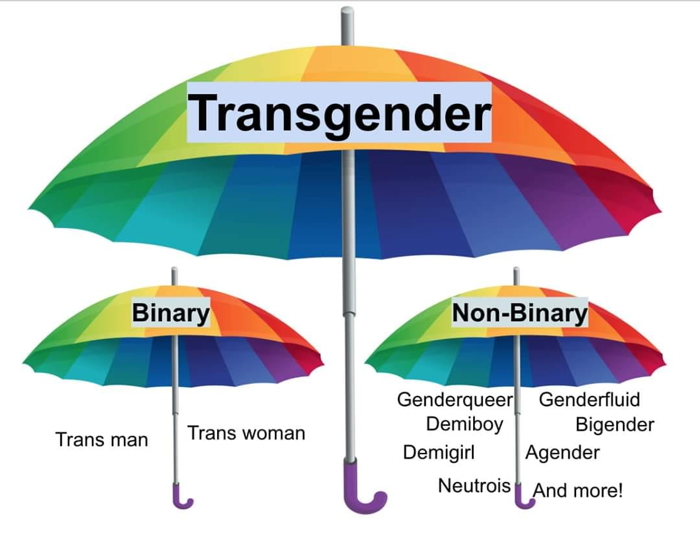
I don't like that illustration.
So what's my problem with it?
I identify as genderqueer and I do not identify as transgender, and that umbrella diagram sticks me into that category whether I like it or not. That diagram creates a hierarchy in which all genderqueer people are transgender (but not vice versa). That means that any statement that transgender people make on behalf of all trans people is going to be considered to apply to me and other people like me. Because we're defined as being under that umbrella.
Let's look at some of the broad all-inclusive statements that many transgender people have made, shall we?
a) A person's gender identity is valid regardless of their physical anatomy. You don't have to have a medical transition in order for your gender identity to be valid. You don't have to "pass" in order for your gender identity to be valid
Well, that one is wonderful, I'm totally on-board with that! It used to be that society's understanding of what it meant to be trans was that you went out and got yourself a medical transition to make your physical anatomy correspond with your gender identity. And that certainly didn't describe me! So this is a good change, a good shift. The problem is with additional assumptions and assertions that they very often attach to that, such as
b) A person's physical anatomy is not a polite topic of consideration. Anatomy is utterly irrelevant to identity and nobody's business. It's totally inappropriate to be identifying a person on the basis of what's inside their underpants
and...
c) You should not use any anatomy-based terms except to refer to the binary sex assignment that our society coercively attributes people to at birth. If someone identifies as a woman or girl, you would be misgendering them if you did not consider them female; if someone identifies as a man or boy, to not regard them as fully male is transphobic and misgendering also
and...
d) Any insistence that sex and gender are two different things is politically offensive and based on wrong out-of-date science that is now disproven. There's no such thing as "biological sex" because intersex people exist and there are multitudes of body variation from chromosomes to organ structures, so the binary is just a social construct and there is no physical sex.
Well, let's unpack some of that. (Because we don't all wear the same packers in here, okay?) In reverse order, my intersex-activist buddies do want to make a distinction between sex and gender. It's important to them and they're tired of "intersex" being used as an argument for why "biological sex doesn't exist" and otherwise ignored. Intersex people have bodies. They have bodies that other people found embarrassingly different. So embarrassing that they often coercively assigned their bodies to male or female with a surgeon's knife, without their consent. Intersex people can't discuss the fact that their body differed at birth from the body of either male people or female people if "male" refers to gender identity instead of physical sex. Intersex people can't identify themselves if people in society are confused and say things like "Oh me too, I've always had a female side, I wanted to dance ballet instead of play baseball". I'm not intersex myself, but I can't even explain that I'm not intersex if the language doesn't let me explain that although I was never a boy or man, my physical configuration wasn't unusual for male people. That it's my gender that's queer, that my sex falls into normative classifications.
I identify as a femme or girl. But unlike Teresa, my transgender sister, I would not be misgendered if you called me male. Teresa would be; she'd find it insulting and demeaning. She identifies as a woman and definitely female. But I'm not Teresa. I identify as male. I identify as femme or girl. My sex and my gender don't match. I'm genderqueer. And if you're going to raise a giant umbrella over my head and say we're all transgender, you can't go around making blanket statements that support Teresa's identity but erase mine.
If it is no longer necessary to "pass", to look like a typical cisgender person of your same gender, then it should not matter if people do make some guesses about what's inside my underwear. Because no matter what's in there, we already agreed that it doesn't invalidate my gender identity, right? So it doesn't have to be kept a shameful secret. I've got the anatomy that most directly caused my mom's obstetrician to designate me as "male". It's an unfortunate social fact that the same anatomy also caused my birth announcements to incorrectly tell everyone "It's a boy!", but the "male" part wasn't wrong and I have no reason to hide it. I was a male girl. Perfectly queer and not typical, and quite healthy and happy with that, thank you.
I propose this umbrella instead:
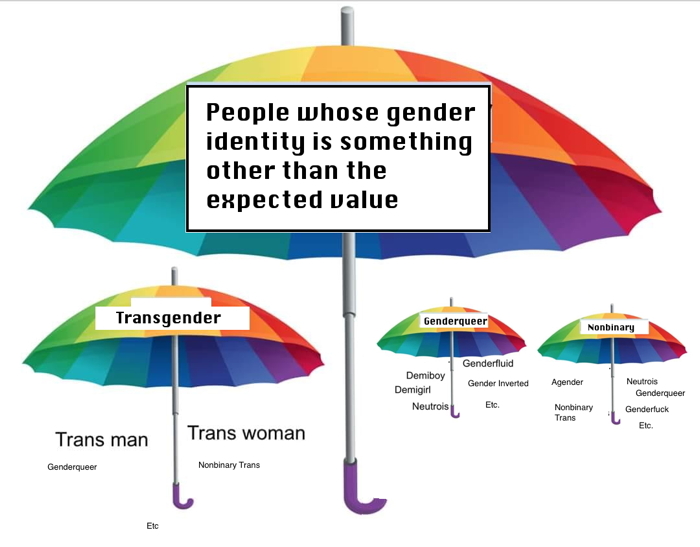
Notice that under this umbrella, several terms appear in multiple places. Because some genderqueer people do identify as transgender, whereas some do not; similarly some nonbinary people identify as transgender and others do not, and some nonbinary people consider themselves genderqueer while others do not, and vice versa and so on.
———————
You're secluded in quarantine, and all the performances and events have been cancelled, so it's a good time to read a book!
My book, GenderQueer: A Story From a Different Closet, has been published by Sunstone Press. It is available on Amazon and Barnes & Noble in paperback and ebook, and as ebook only from Apple, Kobo, and directly from Sunstone Press themselves.
Links to published reviews and comments are listed on my Home Page
———————
This DreamWidth blog is echoed on LiveJournal, WordPress, and Blogger. Please friend/link me from any of those environments on which you have an account.
————————
Index of all Blog Posts
I don't like that illustration.
So what's my problem with it?
I identify as genderqueer and I do not identify as transgender, and that umbrella diagram sticks me into that category whether I like it or not. That diagram creates a hierarchy in which all genderqueer people are transgender (but not vice versa). That means that any statement that transgender people make on behalf of all trans people is going to be considered to apply to me and other people like me. Because we're defined as being under that umbrella.
Let's look at some of the broad all-inclusive statements that many transgender people have made, shall we?
a) A person's gender identity is valid regardless of their physical anatomy. You don't have to have a medical transition in order for your gender identity to be valid. You don't have to "pass" in order for your gender identity to be valid
Well, that one is wonderful, I'm totally on-board with that! It used to be that society's understanding of what it meant to be trans was that you went out and got yourself a medical transition to make your physical anatomy correspond with your gender identity. And that certainly didn't describe me! So this is a good change, a good shift. The problem is with additional assumptions and assertions that they very often attach to that, such as
b) A person's physical anatomy is not a polite topic of consideration. Anatomy is utterly irrelevant to identity and nobody's business. It's totally inappropriate to be identifying a person on the basis of what's inside their underpants
and...
c) You should not use any anatomy-based terms except to refer to the binary sex assignment that our society coercively attributes people to at birth. If someone identifies as a woman or girl, you would be misgendering them if you did not consider them female; if someone identifies as a man or boy, to not regard them as fully male is transphobic and misgendering also
and...
d) Any insistence that sex and gender are two different things is politically offensive and based on wrong out-of-date science that is now disproven. There's no such thing as "biological sex" because intersex people exist and there are multitudes of body variation from chromosomes to organ structures, so the binary is just a social construct and there is no physical sex.
Well, let's unpack some of that. (Because we don't all wear the same packers in here, okay?) In reverse order, my intersex-activist buddies do want to make a distinction between sex and gender. It's important to them and they're tired of "intersex" being used as an argument for why "biological sex doesn't exist" and otherwise ignored. Intersex people have bodies. They have bodies that other people found embarrassingly different. So embarrassing that they often coercively assigned their bodies to male or female with a surgeon's knife, without their consent. Intersex people can't discuss the fact that their body differed at birth from the body of either male people or female people if "male" refers to gender identity instead of physical sex. Intersex people can't identify themselves if people in society are confused and say things like "Oh me too, I've always had a female side, I wanted to dance ballet instead of play baseball". I'm not intersex myself, but I can't even explain that I'm not intersex if the language doesn't let me explain that although I was never a boy or man, my physical configuration wasn't unusual for male people. That it's my gender that's queer, that my sex falls into normative classifications.
I identify as a femme or girl. But unlike Teresa, my transgender sister, I would not be misgendered if you called me male. Teresa would be; she'd find it insulting and demeaning. She identifies as a woman and definitely female. But I'm not Teresa. I identify as male. I identify as femme or girl. My sex and my gender don't match. I'm genderqueer. And if you're going to raise a giant umbrella over my head and say we're all transgender, you can't go around making blanket statements that support Teresa's identity but erase mine.
If it is no longer necessary to "pass", to look like a typical cisgender person of your same gender, then it should not matter if people do make some guesses about what's inside my underwear. Because no matter what's in there, we already agreed that it doesn't invalidate my gender identity, right? So it doesn't have to be kept a shameful secret. I've got the anatomy that most directly caused my mom's obstetrician to designate me as "male". It's an unfortunate social fact that the same anatomy also caused my birth announcements to incorrectly tell everyone "It's a boy!", but the "male" part wasn't wrong and I have no reason to hide it. I was a male girl. Perfectly queer and not typical, and quite healthy and happy with that, thank you.
I propose this umbrella instead:
Notice that under this umbrella, several terms appear in multiple places. Because some genderqueer people do identify as transgender, whereas some do not; similarly some nonbinary people identify as transgender and others do not, and some nonbinary people consider themselves genderqueer while others do not, and vice versa and so on.
———————
You're secluded in quarantine, and all the performances and events have been cancelled, so it's a good time to read a book!
My book, GenderQueer: A Story From a Different Closet, has been published by Sunstone Press. It is available on Amazon and Barnes & Noble in paperback and ebook, and as ebook only from Apple, Kobo, and directly from Sunstone Press themselves.
Links to published reviews and comments are listed on my Home Page
———————
This DreamWidth blog is echoed on LiveJournal, WordPress, and Blogger. Please friend/link me from any of those environments on which you have an account.
————————
Index of all Blog Posts
Friday, July 17, 2020
Hey, Sister...
Hey, sister, got a moment? Any chance we can reconcile?
You find it bewildering that as a femme-identifying person, I refer to myself as male. You find it appalling and maybe even transphobic when I explain that what I mean when I say I'm "male" is that I was born with a set of physical equipment that, in our culture, has historically been designated "male", although many other people (perhaps including you) may have this same set of bodily components and call those physical structures something other than "male".
You say "Why can't you just call it a penis? A penis isn't male. It's just a penis! Girls can have a penis. Boys can have a vulva".
Well, yeah, I know girls can have a penis. I'm a girl and I've got one. Are we both cool and totally down with the notion that having a penis doesn't define our gender? Can we please have a little moment of peace and solidarity and not be quick to hate on each other for using language a bit differently, and for coming at this situation from different angles?
You identify as transgender. I don't. That means you're a part of a subculture, a community; and you folks, collectively, you got your own way of expressing things, and you also got your own history. Let's talk about the history thing for a sec.
I'm 61; forty years ago, when I was 21 and first coming out, trans people explained the situation to the larger surrounding culture like this: trans people realized at some point in their life that their gender was the gender typically found in the other type of body, and so they'd ideally get hormones and surgery and transition, so that their body would match their gender. And what they said they wanted from the surrounding world was to be accepted as a normal and ordinary person of that gender and that sex. And most trans people wanted to "pass" — they didn't want to receive social acceptance only from a handful of people who heard their life story and learned about transsexuals and all that, but instead they wanted to look and otherwise present in such a way that strangers who didn't know them would just automatically treat them as the gender that they were.
Fast forward to the more-or-less present era. Trans activists interact with lots of transgender people who can't afford hormones and surgery even if they want them, and lots of people who are blocked from having access to the medical interventions they want because doctors and insurance companies are playing gatekeeper. They also interact with a lot of transgender people who don't want the whole package of medical options for a variety of reasons. There's a risk of significant loss of sensation and function when doctors rearrange biological tissue, and there are systemic repercussions to hormones with risk factors and so on and so forth.
Well, it's really fundamentally a human rights issue that the body you inhabit should not detract from the legitimacy of your gender identity. So the social message changed, to become a lot more inclusive. You were valid as a trans person (woman or man) whether you passed or did not pass, and, in fact, fuck "pass". Identities are what are valid; your body doesn't matter! And they didn't use "male" and "female" to refer to bodily architecture because that can imply to some trans people that they've got the wrong body for their gender identity.
I apologize if I've misrepresented the transgender movement and its history in that short summary. I'm writing from the outside. I try to learn and listen but if I've distorted things, I'm sorry, but I hope I mostly got it right.
I'm not trans. I heard the 40-years-ago version of what trans was, gave it some thought, decided nope, that's not me. It's something else. I haven't been a part of your community these 40 years.
So I've got a different history, with different understandings and stuff. I'm hoping you'll be compassionate and interested in a story that's different from yours, so you can see how I got to my viewpoint, ok?
I came out in 1980 as a sissy. A person in a male body whose personality and behavior were a mismatch for what's expected of male people, but a good match for the expectations for female people. I did not want to be perceived as an ordinary typical female person any more than I wanted to be perceived as an ordinary male person. I wanted to be perceived as what I'd been harassed about and accused of all my life: an effeminate sissy girlish male person. The world apparently thought I should be ashamed of that, but I was proud of it. And I was finally angry about it and ready to take a stand. To be in your face about it. Yeah, I'm male, and I'm one of the girls. Get used to it. Deal.
My attitude is that until the world nods in agreement that yeah, male girls exist and no, it's not a damn affliction or an embarrassment, a failure to be sufficiently manly... until then, there's always going to be this notion that if you're perceived and recognized as a male-bodied person, you'll be regarded as less of a man than a masculine man and less of a woman than a physically female-structured person who has boobs and vag and all that.
Not only don't I want to pass, I want to "anti-pass". I want, as I said, to be up in people's face about the lack of correspondence between my body and my gender identity. You've got a male girl here. Flying pride flags about it, no less, got that?
So... you don't use "male" to refer to physical stuff like testicles and penis. You basically use "male" to mean the same thing as "man" and "boy" and so on. I, on the other hand, do use it to mean the physical stuff. My attitude is we've already got plenty of gender words ("man", "boy", "masculine", "feminine", "guy", "dude", "gal", etc), and the word "male" is historically about the raw physical architecture (including other species and also things like hose couplings and electrical plugs), so why can't we keep that word for sex and use existing gender words for gender? This isn't about invalidating anybody's gender identity, it's really not. Yeesh, do I sound like J. K. fucking Rowling here? Seriously?
You ask "Well, why can't you just call it a penis, why do you have to say male?". I say "I want a goddam adjective. An already-recognized adjective to describe me as a person-with-penis-and-associated-bits. I don't want to use a long klunky phrase like 'person with a penis and testicles and adam's apple and absence of a vulva and clitoris and breasts, person who happens to be dyadic or endosex as opposed to intersex and most likely has XY chromosomes and doesn't have a period and has spermatotrophic hormone and a vas deferens'".
If I don't specify that when I say "male" I'm talking about my plumbing and not my personality and inclinations, people often assume I'm saying I have a "male side and a female side", like genderfluid or bigender people. Which isn't it at all. I'm not less feminine than you are. I'm not less male than a rooster. I'm not in-between, either sexually (as intersex people may consider themselves to be) or genderwise. I'm solidly male and utterly feminine.
I'm talking about mine. MY parts. I'm not calling your parts male. I'm calling my parts male.
Not everybody is either male or female, just as not everybody who is male is a man and not everybody who is female is a woman. But the fact that sex isn't binary doesn't mean sex doesn't exist. By the way, intersex people can't talk about being intersex — and distinguish intersex from being nonbinary or intergender or genderfluid or whatever — if they can't talk about bodies and why their atypical body has marked them as different and marginalized them. Most of the intersex activists I know really want to distinguish sex from gender. Because otherwise they get erased.
In a similar way, I can't do the political activity of getting in people's face about being a male girl if I can't say "male girl" and can't talk about the body that caused my girlness to be perceived as something wrong and in need of fixing, or as reason to provoke dismissive contempt.
I personally identify as genderqueer and, more specifically, as a gender invert. I'm a speaker, a blogger, and an author. I just got a book published (and BTW you should read it if you have any appetite for coming-of-age / coming-out stories). I'm not going to go away or shut up.
Does this help?
———————
You're secluded in quarantine, and all the performances and events have been cancelled, so it's a good time to read a book!
My book, GenderQueer: A Story From a Different Closet, has been published by Sunstone Press. It is available on Amazon and Barnes & Noble in paperback and ebook, and as ebook only from Apple, Kobo, and directly from Sunstone Press themselves.
Links to published reviews and comments are listed on my Home Page
———————
This DreamWidth blog is echoed on LiveJournal, WordPress, and Blogger. Please friend/link me from any of those environments on which you have an account.
————————
Index of all Blog Posts
Saturday, June 6, 2020
Gender Invert, or Nonbinary Trans?
Like most people born with a penis and testicles, I was AMAB: assigned male at birth.
I don't refer to myself as transgender because I don't seek to be perceived as a female person. And I don't tend to identify as nonbinary because I don't seek to be perceived as someone who is neither male nor female.
I identify as genderqueer and, more specifically, as a gender invert.
* * *
There are a lot of ongoing discussions, especially within the trans communities, about how you don't have to be on hormones, don't have to get an operation, to be valid as a transgender person. About how the legitimacy of one's identity as transgender does not depend on changing one's body.
The ones who do — the people conventionally designated as "male to female" or "female to male" — are nowadays often referred to as "binary transgender". And the assertion that you don't have to be binary trans in order to be authentically trans is an affirmation of nonbinary transgender identities.
The fact that there are so many posts and statements saying so is a clear sign that a lot of people think "transgender" means that if you were assigned male at birth you wish to be perceived as female, accepted as a woman, not differentiated from cisgender women, that you present as female, that you do everything at your disposal to do so successfully, that you seek to pass. And reciprocally the other way around if you were assigned female at birth.
That's what the term "transgender" means to a lot of people out there, both within the trans community itself and in the mainstream.
Hello. I am a person who could identify as a "nonbinary transgender" person.
I don't choose to do so. I don't feel like it communicates. I feel like it just confuses people. They make one set of wrong assumptions when they see me and mentally assign me as a male person. If I tell them I'm transgender they make a different set of wrong assumptions and I'm no better off.
Meanwhile, out there are a bunch of male-to-female and female-to-male transgender folks. A handful of them are "truscum" or "transmedicalist" and don't consider anyone to be authentically trans unless they seek a medical transition. Then there are quite a few more who don't have that kind of absolute judgemental definitional thing going on, but who will admit to missing the days when the only kind of trans people were binary trans. I'm not going to say they're right, especially since so many of my friends and colleagues identify as nonbinary transgender. But I have to confess, I sympathize with them and their viewpoint. Many of them have been around as long as I have. That means they lived through decades when most of society had only heard dirty jokes and porn references to trans people. And some of them feel like they did the hard work to get transgender issues in front of the social consciousness and now all these newfangled nonbinary trans people want to be a part of the phenomenon.
There's a reason why there aren't more people identifying as I do, as gender invert. It's because they haven't heard the term. Nobody offered it to them as an option to consider. So they went with "transgender". Or "nonbinary". Or "nonbinary transgender".
But what if you were assigned male at birth, you consider your body to be, in fact, male, but your gender isn't masculine, isn't man, isn't guy, isn't boy, that instead you are femme, one of the girls? Or if you were assigned female at birth, recognize your body to be female, but have never been a girl or a woman, and instead you're all man, all guy, all boy, totally a masculine individual?
If you say "transgender" and folks know you were AFAB they'll almost universally assume you identify as "male". If you say "transgender" and they understand you were AMAB, they'll assume you to identify as "female".
Specifying "nonbinary transgender" just shifts the problem. Now people are likely to assume that you don't want to be identified as any named sex or gender. That you're declaring yourself to be neither male nor female, neither man nor woman.
If what I'm saying resonates for you, you're welcome to come join me as a gender invert instead.
———————
You're secluded in quarantine, and all the performances and events have been cancelled, so it's a good time to read a book!
My book, GenderQueer: A Story From a Different Closet, has been published by Sunstone Press. It is available on Amazon and Barnes & Noble in paperback and ebook, and as ebook only from Apple, Kobo, and directly from Sunstone Press themselves.
Links to published reviews and comments are listed on my Home Page
———————
This LiveJournal blog is echoed on DreamWidth, WordPress, and Blogger. Please friend/link me from any of those environments on which you have an account.
————————
Index of all Blog Posts
Friday, May 15, 2020
I Want My Two Months Back
So I was asked to participate in a dialog involving gender-critical feminists and transgender activists.
There's a political group with chapters sprinkled all around the country. One chapter endorsed a statement from some women's group about womens' "Sex Based Rights". An LGBTQIA action group within that same political group said that by doing so, that chapter had done something transphobic and transmisogynistic and that they needed to retract their endorsement and apologize to all the transgender women who might have been offended by their endorsement, or else get kicked out of the political group.
And what were these "sex based rights"?
Content warning: Potentially inflammatory material from here on out. And serious, guaranteed-inflammatory content as you go farther down. Trigger warning issued. Trigger warning with flames and radioactive emblems. Proceed at your own risk:
Well, some of the supporters of that local chapter said this was about remedies that had been designed to address women's exclusion from various forms of political and social participation. A sort of affirmative action for women to offset the effects of patriarchy, of women's oppression. They said that including transgender women ran the risk of diluting that original intention, and that it made more sense to use language that guaranteed representation of transgender women AND transgender men but did so separately from the original remedies, which had been designed with cisgender women in mind, i.e., women who had been regarded and labeled and treated as female people for their entire lives. They also said some women's political groups wished to operate as cisgender-women only because they had always been separatist, not allowing men to participate, and the lifetime experience of transgender women was a mixture of factors making their situation different from that of the women who'd been in those groups all along.
"I can see where that's going to be a problematic position for trans people", I said. "Still, there may be a way to bridge some gaps here. They do have a point about experience and identity. As a genderqueer person who identifies as a male girl, I respect transgender people who don't want to include people like me, because they believe being trans is biologically built in, that if I'm a woman I'm female, and that the only healthy thing to do about being transgender is to transition. My situation is different from theirs. As long as they're not denying the validity of my gender issues I don't mind if they want to run groups that I'm not welcome in".
I checked in with the LGBTQIA Action Group, the LAGs. "Oh, yes", they said, "we sent those demands to the chapter that endorsed that horrible statement. We want them to take our concerns seriously. We'd love it if they'd have a dialog with us, but they refuse to respond!"
Then I went back to the local chapter supporters, the pro-discussion folks calling themselves Dialog. I told them "I got the impression the LAG folks are open to listening if the people in Dialog and the specific chapter that endorsed that statement will listen to them in turn".
Then I went off to read a copy of the original "Sex Based Rights" statement, the endorsement of which had kicked off all this. Winced a lot. Yeah, the statement has a lot of language that, if not blatantly transphobic, felt like it was chock-full of dog whistle terms and phrases. I decided I didn't like the phrase "sex-based rights" itself. In general, I think people don't have rights based on their sex. You may have remedies that have been made available to your sex on affirmative action grounds but a right is an intrinsic entitlement. Men aren't entitled to something intrinsically as a consequence of being men, or male, or both. Whatever they're entitled to is either because they're human, or human adults, or else it's situationally male or about being men because of something that they and only they experience. Are women? I could formulate some rights that all pregnant or potentially pregnant people should have, perhaps, or that all menstruating or potentially menstruating people should have, but if I did, those rights came from those situations. Whatever. I sure wouldn't have endorsed the statement I was reading. But it didn't seem so horrible that I'd demand that anyone who did be kicked out of the organization.
"I'm ready to discuss the matter with Dialog", the LAG activist said, "but I have no interest in wasting my time with TERFs who say I'm not a woman. If they want to talk with us and apologize for what they've done, hey I'm right here, but in this organization it is already an accepted principle that trans women are women. That means in any situation where we're talking about women, if they try to excluse trans women, that's a hate crime and they don't belong in our organization!"
I said, "Look, some of them seem to be trying to incorporate and accommodate an understanding of trans people. Many of them don't like the term 'cisgender' for themselves but they aren't all insisting that trans women aren't women. One person suggested the phrase 'natal women'. Do you acknowledge a reason why they might legitimately want to meet politically by themselves as 'natal women'?"
"Trans women are natal women", the LAG activist replied.
"Wait, not even all transgender people claim that being transgender means you were born that way. I know it's a popular viewpoint but you wouldn't kick someone out of a transgender group for saying they weren't born trans, would you?"
"You're wasting your time with those TERFs. If they want to apologize and retract their message of hate, I'm right here. But they won't because they're bigoted fascists".
"Listen", I said, exasperated. "you've clearly got the stronger political position. Inclusiveness is always going to look more justified than a reason to exclude someone. So I'm sure you can pressure them into saying the kinds of things you want to hear, or get the organization to boot them out if they won't. But this is also a public education opportunity. Do you want them to see the light, or do you just want them to feel the heat?"
The LAG activist shrugged. "It's a settled issue. If they're going to be doing hate crimes I want them kicked out, simple as that".
"Frankly", declared the Dialog member, "I don't care what their viewpoint is. Not while they're calling us 'TERFs'. That's a slur. It's used to discredit us. They call us that while they're beating us, there was a women's march in London, did you hear about that? These men, calling themselves transgender women, barged in and chased women down side streets, attacking them. And the police did nothing!"
"So you don't like being called 'TERF'. You don't like the word that they use for you", I said. "You see the irony in that, don't you?"
"Transgenders are trying to invade our women's spaces and take away our rights as women. They want to erase women's identities. They aren't women. They're men. They're male. The correct word for adult male people is 'men'. Not 'women'. They want to invade women's prisons with their penises and rape women. They want to hide in women's bathroom stalls and molest little girls. And we're not gonna put up with it!"
"Okay, Dialog folks", I said, addressing the group. "Even if you don't think the LAG people are genuinely open to listening to anything they don't already agree with, you need to care about public opinion. You need to care about how the rest of the organization is going to view you. And although the LAG folks sound inflexible, you are managing to sound even more so and it's not a good look".

I picked up my old battered copy of The Women's Room, the book cover that has "LADIES" crossed out and "WOMEN'S" inked in over it. "I understand why you value the word 'women'. I think it was either Robin Morgan or Gloria Steinem, relating the story of having a sit-down with the newspaper editor, and explaining why they didn't like the newspaper referring to adult female people as 'girls' since adult males were always designated as 'men'.
"And the editor said, 'So what would you prefer...ladies?'. And the feminist women practically held their noses and winced. That term, 'ladies', was polluted with notions of screening out those who aren't ladylike, all that 'act like a lady' crap, you know? They wanted the newspaper to use the term 'women', they told him.
"The word 'woman' was nearly entirely associated with the physical body. In our society, girls become women not by 'proving' you are one, the way boys 'become' men, but by going through biological puberty. Even the creepier social associations, like 'Has he made a woman out of you yet' — like being heterosexually active 'makes you a woman' — even those had mostly biological meanings, more than social attributes. So by choosing the word 'woman', it wouldn't look like feminists wanted to be the new arbiters of which adult females get to qualify.
"I get that. Why you liked the word. And I get that it's been in political use by feminists since then.
"But you aren't going to convince anybody, anywhere, that you're being anything other than bigoted and biased by saying transgender women are factually wrong about being women. I'd think feminist women more than anyone would understand that word use is politically loaded. Think back to how 'man' was supposed to mean 'any human being' but it excluded women, and how 'he' and 'him' were used to mean any person. The dictionary said that was correct. But feminists said word use changes when society changes. And the feminists made our language change. You also sound pretty silly saying biology is destiny, by the way."
LAG people: "But trans women were not born with male organs. If she is a woman those are her organs so they're female organs. And those Dialog...persons... they are TERFs. It means Trans Exclusive Radical Feminists. That's what they are. I don't see why they don't like being called what they actually are".
Dialog people: "No one is denying their right to exist. They have a right to dress and behave however they want. They can see themselves however they like and have any understanding of themselves they feel comfortable with, but they have no right to impose their ideas on others or claim rights that were originally based on addressing the historical denial of women's rights as a sex".
LAG people: "See, we told you. Hateful transphobes. Kick them out. I don't have time for this shit"
Dialog people: "Words have meanings. Male people are men. Men are male people. A person with a penis is male. These men calling themselves transgender women are mentally ill. Men are not women. Males are not women. A person with a penis is not a woman. See, we told you, hateful patriarchal misogynists. You can't make us agree with their bullshit".
LAG people: "See, they're bad. Bad people are bad. Which is bad. Which makes them bad. The things they are saying are defined as bad. Sure, we're open to a dialog. A dialog about how they are bad".
Dialog people: "Four legs good. Two legs bad. Four legs good. Two legs bad..."
I want my two months back. I'm particularly disgusted with some of the Dialog folks, who seemed determined to live up to the worst things said about them by the LAG contingent seeking to have them kicked out. But both sides had some participants who originally seemed to be trying to find language that the other side would accept, at least long enough to have a conversation. People who were making the attempt in good faith. And there were other people trying to speak to activists on both sides, I wasn't the only one doing this diplomacy act. But our louder and more insistent colleagues shouted us down on both sides.
They should all be glad I'm not God. Because you know what I'd do if I were? You know those cruise ships that are languishing out in the ocean because of coronavirus? I'd like to put everyone from both groups onto those ships, and I'd confine one Dialog member and one LAG member to each cabin and quarantine them there together. They deserve each other.
———————
You're secluded in quarantine yourself, come to think of it, and all the performances and events have been cancelled, so it's a good time to read a book!
My book has been published by Sunstone Press. It is available on Amazon and Barnes & Noble in paperback and ebook, and as ebook from Apple, Kobo, and directly from Sunstone Press themselves.
Links to published reviews and comments are listed on my Home Page
———————
This LiveJournal blog is echoed on DreamWidth, WordPress, and Blogger. Please friend/link me from any of those environments on which you have an account.
————————
Index of all Blog Posts
There's a political group with chapters sprinkled all around the country. One chapter endorsed a statement from some women's group about womens' "Sex Based Rights". An LGBTQIA action group within that same political group said that by doing so, that chapter had done something transphobic and transmisogynistic and that they needed to retract their endorsement and apologize to all the transgender women who might have been offended by their endorsement, or else get kicked out of the political group.
And what were these "sex based rights"?
Content warning: Potentially inflammatory material from here on out. And serious, guaranteed-inflammatory content as you go farther down. Trigger warning issued. Trigger warning with flames and radioactive emblems. Proceed at your own risk:
Well, some of the supporters of that local chapter said this was about remedies that had been designed to address women's exclusion from various forms of political and social participation. A sort of affirmative action for women to offset the effects of patriarchy, of women's oppression. They said that including transgender women ran the risk of diluting that original intention, and that it made more sense to use language that guaranteed representation of transgender women AND transgender men but did so separately from the original remedies, which had been designed with cisgender women in mind, i.e., women who had been regarded and labeled and treated as female people for their entire lives. They also said some women's political groups wished to operate as cisgender-women only because they had always been separatist, not allowing men to participate, and the lifetime experience of transgender women was a mixture of factors making their situation different from that of the women who'd been in those groups all along.
"I can see where that's going to be a problematic position for trans people", I said. "Still, there may be a way to bridge some gaps here. They do have a point about experience and identity. As a genderqueer person who identifies as a male girl, I respect transgender people who don't want to include people like me, because they believe being trans is biologically built in, that if I'm a woman I'm female, and that the only healthy thing to do about being transgender is to transition. My situation is different from theirs. As long as they're not denying the validity of my gender issues I don't mind if they want to run groups that I'm not welcome in".
I checked in with the LGBTQIA Action Group, the LAGs. "Oh, yes", they said, "we sent those demands to the chapter that endorsed that horrible statement. We want them to take our concerns seriously. We'd love it if they'd have a dialog with us, but they refuse to respond!"
Then I went back to the local chapter supporters, the pro-discussion folks calling themselves Dialog. I told them "I got the impression the LAG folks are open to listening if the people in Dialog and the specific chapter that endorsed that statement will listen to them in turn".
Then I went off to read a copy of the original "Sex Based Rights" statement, the endorsement of which had kicked off all this. Winced a lot. Yeah, the statement has a lot of language that, if not blatantly transphobic, felt like it was chock-full of dog whistle terms and phrases. I decided I didn't like the phrase "sex-based rights" itself. In general, I think people don't have rights based on their sex. You may have remedies that have been made available to your sex on affirmative action grounds but a right is an intrinsic entitlement. Men aren't entitled to something intrinsically as a consequence of being men, or male, or both. Whatever they're entitled to is either because they're human, or human adults, or else it's situationally male or about being men because of something that they and only they experience. Are women? I could formulate some rights that all pregnant or potentially pregnant people should have, perhaps, or that all menstruating or potentially menstruating people should have, but if I did, those rights came from those situations. Whatever. I sure wouldn't have endorsed the statement I was reading. But it didn't seem so horrible that I'd demand that anyone who did be kicked out of the organization.
"I'm ready to discuss the matter with Dialog", the LAG activist said, "but I have no interest in wasting my time with TERFs who say I'm not a woman. If they want to talk with us and apologize for what they've done, hey I'm right here, but in this organization it is already an accepted principle that trans women are women. That means in any situation where we're talking about women, if they try to excluse trans women, that's a hate crime and they don't belong in our organization!"
I said, "Look, some of them seem to be trying to incorporate and accommodate an understanding of trans people. Many of them don't like the term 'cisgender' for themselves but they aren't all insisting that trans women aren't women. One person suggested the phrase 'natal women'. Do you acknowledge a reason why they might legitimately want to meet politically by themselves as 'natal women'?"
"Trans women are natal women", the LAG activist replied.
"Wait, not even all transgender people claim that being transgender means you were born that way. I know it's a popular viewpoint but you wouldn't kick someone out of a transgender group for saying they weren't born trans, would you?"
"You're wasting your time with those TERFs. If they want to apologize and retract their message of hate, I'm right here. But they won't because they're bigoted fascists".
"Listen", I said, exasperated. "you've clearly got the stronger political position. Inclusiveness is always going to look more justified than a reason to exclude someone. So I'm sure you can pressure them into saying the kinds of things you want to hear, or get the organization to boot them out if they won't. But this is also a public education opportunity. Do you want them to see the light, or do you just want them to feel the heat?"
The LAG activist shrugged. "It's a settled issue. If they're going to be doing hate crimes I want them kicked out, simple as that".
"Frankly", declared the Dialog member, "I don't care what their viewpoint is. Not while they're calling us 'TERFs'. That's a slur. It's used to discredit us. They call us that while they're beating us, there was a women's march in London, did you hear about that? These men, calling themselves transgender women, barged in and chased women down side streets, attacking them. And the police did nothing!"
"So you don't like being called 'TERF'. You don't like the word that they use for you", I said. "You see the irony in that, don't you?"
"Transgenders are trying to invade our women's spaces and take away our rights as women. They want to erase women's identities. They aren't women. They're men. They're male. The correct word for adult male people is 'men'. Not 'women'. They want to invade women's prisons with their penises and rape women. They want to hide in women's bathroom stalls and molest little girls. And we're not gonna put up with it!"
"Okay, Dialog folks", I said, addressing the group. "Even if you don't think the LAG people are genuinely open to listening to anything they don't already agree with, you need to care about public opinion. You need to care about how the rest of the organization is going to view you. And although the LAG folks sound inflexible, you are managing to sound even more so and it's not a good look".
I picked up my old battered copy of The Women's Room, the book cover that has "LADIES" crossed out and "WOMEN'S" inked in over it. "I understand why you value the word 'women'. I think it was either Robin Morgan or Gloria Steinem, relating the story of having a sit-down with the newspaper editor, and explaining why they didn't like the newspaper referring to adult female people as 'girls' since adult males were always designated as 'men'.
"And the editor said, 'So what would you prefer...ladies?'. And the feminist women practically held their noses and winced. That term, 'ladies', was polluted with notions of screening out those who aren't ladylike, all that 'act like a lady' crap, you know? They wanted the newspaper to use the term 'women', they told him.
"The word 'woman' was nearly entirely associated with the physical body. In our society, girls become women not by 'proving' you are one, the way boys 'become' men, but by going through biological puberty. Even the creepier social associations, like 'Has he made a woman out of you yet' — like being heterosexually active 'makes you a woman' — even those had mostly biological meanings, more than social attributes. So by choosing the word 'woman', it wouldn't look like feminists wanted to be the new arbiters of which adult females get to qualify.
"I get that. Why you liked the word. And I get that it's been in political use by feminists since then.
"But you aren't going to convince anybody, anywhere, that you're being anything other than bigoted and biased by saying transgender women are factually wrong about being women. I'd think feminist women more than anyone would understand that word use is politically loaded. Think back to how 'man' was supposed to mean 'any human being' but it excluded women, and how 'he' and 'him' were used to mean any person. The dictionary said that was correct. But feminists said word use changes when society changes. And the feminists made our language change. You also sound pretty silly saying biology is destiny, by the way."
LAG people: "But trans women were not born with male organs. If she is a woman those are her organs so they're female organs. And those Dialog...persons... they are TERFs. It means Trans Exclusive Radical Feminists. That's what they are. I don't see why they don't like being called what they actually are".
Dialog people: "No one is denying their right to exist. They have a right to dress and behave however they want. They can see themselves however they like and have any understanding of themselves they feel comfortable with, but they have no right to impose their ideas on others or claim rights that were originally based on addressing the historical denial of women's rights as a sex".
LAG people: "See, we told you. Hateful transphobes. Kick them out. I don't have time for this shit"
Dialog people: "Words have meanings. Male people are men. Men are male people. A person with a penis is male. These men calling themselves transgender women are mentally ill. Men are not women. Males are not women. A person with a penis is not a woman. See, we told you, hateful patriarchal misogynists. You can't make us agree with their bullshit".
LAG people: "See, they're bad. Bad people are bad. Which is bad. Which makes them bad. The things they are saying are defined as bad. Sure, we're open to a dialog. A dialog about how they are bad".
Dialog people: "Four legs good. Two legs bad. Four legs good. Two legs bad..."
I want my two months back. I'm particularly disgusted with some of the Dialog folks, who seemed determined to live up to the worst things said about them by the LAG contingent seeking to have them kicked out. But both sides had some participants who originally seemed to be trying to find language that the other side would accept, at least long enough to have a conversation. People who were making the attempt in good faith. And there were other people trying to speak to activists on both sides, I wasn't the only one doing this diplomacy act. But our louder and more insistent colleagues shouted us down on both sides.
They should all be glad I'm not God. Because you know what I'd do if I were? You know those cruise ships that are languishing out in the ocean because of coronavirus? I'd like to put everyone from both groups onto those ships, and I'd confine one Dialog member and one LAG member to each cabin and quarantine them there together. They deserve each other.
———————
You're secluded in quarantine yourself, come to think of it, and all the performances and events have been cancelled, so it's a good time to read a book!
My book has been published by Sunstone Press. It is available on Amazon and Barnes & Noble in paperback and ebook, and as ebook from Apple, Kobo, and directly from Sunstone Press themselves.
Links to published reviews and comments are listed on my Home Page
———————
This LiveJournal blog is echoed on DreamWidth, WordPress, and Blogger. Please friend/link me from any of those environments on which you have an account.
————————
Index of all Blog Posts
Saturday, April 25, 2020
Sex vs Gender: A Working Definition?
For an organization's position paper, I was asked to come up with definitions for "sex" and "gender".
SEX is whatever biological built-in differences distinguish people as being male, female, or in some cases a different value from either of those two.
GENDER is any and all notions about differences between the sexes that are not directly based on things biologically built in.
I've written about it pretty extensively over the years. The distinction between my identity and situation and that of the mainstream narrative describing transgender people is that whereas they transition visually (and perhaps medically) so as to be perceived as the sex that matches their gender, I present to the world as a person with a mismatched sex and gender and press for acceptance as such. So the distinction between sex and gender has been useful to me. I've blogged about it often, for example here, here, and here. But like most people discussing such things, I've seldom defined the terms and instead have described them, like listing a batch of individual characteristics and saying "etc" at the end and saying "that's sex" and doing the same for gender.
Here's what I like about the definition at the top of this page: it leaves plenty of room for people to dissent about what things belong in each box.
A person with traditional, socially conservative views, for example, might believe that the socially shared and historically established views about the respective natures of men and women reflect how they really are. For them, gender is an example of an "empty set" -- you remember empty sets from that math class we were in back in school, right?
A person who considers the belief in the biological differentiation of male and female to be all ideological hype, and says sex is a social construct the same as gender and says that real science disproves that there's any clear distinction or division into two sex categories... that person basically views sex as an empty set, it's all gender.
Transgender men and women often speak of having something biologicallly different in their brains that makes them inherently trans, that they were born this way, and hence all the matrix of behaviors and desires and nuances and personality characteristics that they share in common with cisgender people of the same gender are built in for them. If it's built in, it's sex. The bodies with which they were born have other physical characteristics, making for an inconsistency, an apparently contradiction, but that's natural -- there are people with XY chromosomes who have androgen insensitivity and hence the morphology of the female body, which is also an inconsistency. Nature does that. Sex isn't binary except as a generalization.
Gender is a word that often followed by the word "role". I've tended to wince at the reduction of gender to social roles, as in "Joe goes to the office to work and Sue stays home watches the kids and cleans the house, those are gender roles". But there's a less klunky way to think of the term "role" -- movie and stage and television acting, where the actor brings a role to life.
We see a professional actor on the screen or stage rendering a character. He's sardonic, world-weary, casual in a mildly insulting way, easily familiar and a whiff dismissive, yet caring when he can be effectively caring without making himself vulnerable. He evinces wry amusement. He saunters when he walks. The actor's portrayal fits in with our prior experience of such people and resonates for us if the portrayal is done well, and some of us identify with that character and think he's like us; we may carry that performance around in our heads afterwards and aspire to be more like him, even, seeing in that role a model for how we want to be.
In that sense of the word, then, yes, gender includes and is largely composed of roles, a great many of them, ways of being a woman or a man that are embued with their own forms of dignity and strength, vulnerability and concerns, sexiness and spark, and forms of expression thereof. Our gender identities are significantly composed of juxtaposing our self-image against the backdrop of these and embracing the ones that validate us and inspire us as, well, role models.
Gender also is about being perceived. In other words it's not limited to the interior world of self. Other people gender us, they see us the same way we see the actors on the stage, looking from the outside at our performance and from it attributing characteristics to us, believing things about us, that may or may not match up well with the self-image we carry around inside us.
In our society, one of the very first people attribute to us when they encounter us is a sex category. Transgender people often speak of being assigned female at birth (AFAB) or assigned male at birth (AMAB); this is that same process although it's not "at birth", it's "at first encounter" and people do it to us generally while we're fully clothed, and it relies on social cues and clues (such as a given garment being considered women's clothes or mens' clothes, or the style of one's haircut being considered men's or women's hair style), so the act of attribution is at best only partially on the basis of biological characteristics. But the belief that they are forming is a belief about biological body structure nonetheless, so let's call it a sex attribution.
In our society what happens along with that is a gender attribution, of course, the projection of whatever that person tends to think about the sex they just assigned us that isn't necessarily built-in as part of our biology.
And therein lies the social problem. To whatever extent the people "sexing" us are also "gendering" us with a large batch of beliefs and attitudes that interpret our performance of ourself through the lens of a role we aren't considering ourselves to be playing, that's misgendering.
———————
You're secluded in quarantine, and all the performances and events have been cancelled, so it's a good time to read a book!
My book has been published by Sunstone Press. It is available on Amazon and Barnes & Noble in paperback and ebook, and as ebook only from Apple, Kobo, and directly from Sunstone Press themselves.
Links to published reviews and comments are listed on my Home Page
———————
This LiveJournal blog is echoed on DreamWidth, WordPress, and Blogger. Please friend/link me from any of those environments on which you have an account.
————————
Index of all Blog Posts
Saturday, April 18, 2020
The Inadequacy of Straight / Gay / Bi
"Oh, great", the gay and lesbian readers may be thinking. "First they want in, and make us expand what we call ourselves to include them, and use this ever-expanding acronym. And now they want to kick our identity out!"
Don't worry, you've got company. "Transgender / Cisgender" is inadequate too. I'm not trans. I was assigned male at birth. I identify as male. Not trans, right? I identify as femme, as girl, gal, woman. When I was assigned male, I was also assigned boy. I'm not cis. Because I'm all sissy. I'm not a man.
I'm not kicking anyone out. I'm coming out, which means I'm coming in, and for me to be in, some of the assumptions have to go out, so get used to it, because I'm not going back in, so let me in. It's complicated. Get used to that, too!
Let's start with the simple complicated. You've seen the genderbread person and the gender unicorn posters, right? The ones that give a nice simple explanation of why sexual orientation and gender identity is so much more complicated than "are you a boy or are you a girl" and "so are you straight, gay, or bi", right?


I'm male, that's my sex; I was assigned male at birth. They assigned me that way because they saw a penis. I've never dissented with that. It's the body I was born with and it's not the problem. I'm male. Male is not my gender identity, mind you. I'm one of the girls, that's my gender.
You with me so far? You see where those answers appear on those posters?
OK, then, with that in mind, let's move on to sexual orientation. I'm attracted to female folks.
Straight, gay, or bi?
Umm... sex or gender? I'm a male girlish person. Male people attracted more or less exclusively to female people are het, right? But women loving women, those are lesbians, aren't they?
This time the posters don't clarify much. Gender Unicorn gives me the choice of "physically attracted to "women", "men", or "other genders". Well, that doesn't help. I said I was attracted to female people, I didn't say anything about their gender identities!
Let's try the other poster. Genderbread says I might be "sexuallly attracted" to "women and/or feminine and/or female" people. That's a lot of and/or. The chart also gives me the option of "men and/or masculine and/or male" people. What happens if I'm attracted to masculine female people?
Both posters also address romantic (or emotional) attraction but the options are the same. And neither of them deal with the question of gay or straight or bi. It's just as well, because those terms can't handle the complexity of what's on those charts.
And the charts oversimplify matters too much.
Someone else might be attracted to feminine people, to people whose gender identity is expressed to be "woman". They might find a masculine female person uninteresting from a sexual standpoint. They might find a feminine male person to be of erotic interest. What defines sexual orientation may differ from one person to the next.
There's something else that the charts leave out about sexual orientation. Neither of them mention how the person wishes to be sexually perceived. Both charts have a space for gender expression but that's about gender, and I'm talking about sexual orientation. I'm referring to which of a person's characteristics one wishes to be found sexy on the basis of. That, for example, someone wants to be perceived as a sexually attractive woman, to be appealing to people whose attraction is towards women. It's not necessarily the same as gender or sex. I know several cisgender women who do not like being found sexually attractive as sexy female people. It's not how they prefer to market themselves in the universe of sexual orientation. I know both intersex and trans people who are revolted at the idea of "chasers", of people who are (or would be) turned on by their physical morphology. I know others who would feel very disappointed if their partner was not turned on by their physical morphology.
In my case, I'm into female boyish people who are attracted to male girls. Yeah, try to find that option on your dating app!
———————
You're secluded in quarantine, and all the performances and events have been cancelled, so it's a good time to read a book!
My book has been published by Sunstone Press. It is available on Amazon and Barnes & Noble in paperback and ebook, and as ebook only from Apple, Kobo, and directly from Sunstone Press themselves.
Links to published reviews and comments are listed on my Home Page
———————
This LiveJournal blog is echoed on DreamWidth, WordPress, and Blogger. Please friend/link me from any of those environments on which you have an account.
————————
Index of all Blog Posts
Don't worry, you've got company. "Transgender / Cisgender" is inadequate too. I'm not trans. I was assigned male at birth. I identify as male. Not trans, right? I identify as femme, as girl, gal, woman. When I was assigned male, I was also assigned boy. I'm not cis. Because I'm all sissy. I'm not a man.
I'm not kicking anyone out. I'm coming out, which means I'm coming in, and for me to be in, some of the assumptions have to go out, so get used to it, because I'm not going back in, so let me in. It's complicated. Get used to that, too!
Let's start with the simple complicated. You've seen the genderbread person and the gender unicorn posters, right? The ones that give a nice simple explanation of why sexual orientation and gender identity is so much more complicated than "are you a boy or are you a girl" and "so are you straight, gay, or bi", right?
I'm male, that's my sex; I was assigned male at birth. They assigned me that way because they saw a penis. I've never dissented with that. It's the body I was born with and it's not the problem. I'm male. Male is not my gender identity, mind you. I'm one of the girls, that's my gender.
You with me so far? You see where those answers appear on those posters?
OK, then, with that in mind, let's move on to sexual orientation. I'm attracted to female folks.
Straight, gay, or bi?
Umm... sex or gender? I'm a male girlish person. Male people attracted more or less exclusively to female people are het, right? But women loving women, those are lesbians, aren't they?
This time the posters don't clarify much. Gender Unicorn gives me the choice of "physically attracted to "women", "men", or "other genders". Well, that doesn't help. I said I was attracted to female people, I didn't say anything about their gender identities!
Let's try the other poster. Genderbread says I might be "sexuallly attracted" to "women and/or feminine and/or female" people. That's a lot of and/or. The chart also gives me the option of "men and/or masculine and/or male" people. What happens if I'm attracted to masculine female people?
Both posters also address romantic (or emotional) attraction but the options are the same. And neither of them deal with the question of gay or straight or bi. It's just as well, because those terms can't handle the complexity of what's on those charts.
And the charts oversimplify matters too much.
Someone else might be attracted to feminine people, to people whose gender identity is expressed to be "woman". They might find a masculine female person uninteresting from a sexual standpoint. They might find a feminine male person to be of erotic interest. What defines sexual orientation may differ from one person to the next.
There's something else that the charts leave out about sexual orientation. Neither of them mention how the person wishes to be sexually perceived. Both charts have a space for gender expression but that's about gender, and I'm talking about sexual orientation. I'm referring to which of a person's characteristics one wishes to be found sexy on the basis of. That, for example, someone wants to be perceived as a sexually attractive woman, to be appealing to people whose attraction is towards women. It's not necessarily the same as gender or sex. I know several cisgender women who do not like being found sexually attractive as sexy female people. It's not how they prefer to market themselves in the universe of sexual orientation. I know both intersex and trans people who are revolted at the idea of "chasers", of people who are (or would be) turned on by their physical morphology. I know others who would feel very disappointed if their partner was not turned on by their physical morphology.
In my case, I'm into female boyish people who are attracted to male girls. Yeah, try to find that option on your dating app!
———————
You're secluded in quarantine, and all the performances and events have been cancelled, so it's a good time to read a book!
My book has been published by Sunstone Press. It is available on Amazon and Barnes & Noble in paperback and ebook, and as ebook only from Apple, Kobo, and directly from Sunstone Press themselves.
Links to published reviews and comments are listed on my Home Page
———————
This LiveJournal blog is echoed on DreamWidth, WordPress, and Blogger. Please friend/link me from any of those environments on which you have an account.
————————
Index of all Blog Posts
Friday, March 20, 2020
Binary 2.0
Gender used to be narrowly restrictive and inflexible: you were born with a penis or with a vagina, and that determined your identity. Many folks think that except for the stodgy dinosaurs holding on to those older notions, we're past all that, enlightened. Mostly, we're not. We're immersed in what I refer to as Binary 2.0. It's larger and wider than the 1.0 version and yes, there's more room in it, it feels less constrained--but it's still confining.
Superficially, yes, our mainstream media touts the existence of genderqueer and nonbinary celebrities and celebrates their attractiveness and marketability.
But at the local level, the support groups and safe spaces for nonbinary and gender nonconforming people are chock-full of people who were assigned as something at birth; and they've been treated and regarded as either boys or girls for most of their lives. The problem for them is that the assignment they were given at birth wasn't random and arbitrary. If I saw them on the nude beach I could guess with better than 99% accuracy what designation their mom's obstetrician jotted down on their birth certificate. Yes, physical sex is a social construct. But we are part of the society that does the constructing, and we know the criteria, we've learned it well and we know how it works whether we choose to opt out of it or not. So the young genderqueer and nonbinary folks keep posting selfies and asking whether they look sufficiently other than their at-birth sex designations.
There's a determined pushing-away from those body-based identities, with a lot of adopting of the adornments and stylings associated with the opposite sex. Because since sex is, as stated, a social construct, there's still an opposite sex. The primary manifestation of nonbinary identity is one form or another of "between the two", and it is still anchored in those two.
The spaces for young transgender people are rife with their version of the same issue. Medical transitioning is complicated and expensive and although puberty blockers and hormones can be located, there are a lot of people participating whose physical morphology still matches up with the socially constructed pattern that corresponds with how they were designated at birth. In recognition of this, and not wanting to invalidate trans people's identities by implying that they are less valid than for folks who have done a medical transition, we focus on people's gender identities and we refer to their sex, if we do so at all, by considering it to match their gender. The plumbing inside someone's underwear is nobody's business. So sex is the same as gender (yet again, or still) since sex is assumed to match gender (whereas the assumption used to work the other way around, that gender matches physical sex).
Transgender women tend to feel obliged to do makeup and hair and to wear a lot of designated-female apparel, in order to signal that they wish to be perceived and recognized as female, as women. Meanwhile most cisgender women, born with the contours and configurations that our society relies on to designate a person female, can wear jeans and a t-shirt, cut their hair short, and go makekup-free without much concern about the possibility of being misgendered.
To say "misgendered" should cause us to realize that gender is a verb, that we get "gendered" by other people all the time -- "mis" or otherwise. We still gender people based on perceptions anchored in binary sex, so we're still in the shadows of assumptions about what our bodies mean.
My colleague Annunaki Ray Marquez, an intersex activist, points out that the terms "cisgender" and "transgender" contain assumptions. An intersex person isn't likely to have been assigned intersex at birth, but to conflate the situation of intersex people with that of transgender people is to erase them, especially since one of the central issues for intersex people is genital surgery done without their consent as infants or children, whereas medical transitioning is generally seen as a positive solution -- one for which medical insurance coverage is a political objective -- within the transgender community. ""Not all intersex people assigned wrong at birth will be comfortable being called 'transgender', although some will", says Marquez.
What made me nonbinary was that I ran into a two-options conundrum, either I was male and a boy (or man) which was not true; or that I was female and a girl (or woman) which was also not true. I was male and yet one of the girls. I encountered the socially-recognized physical configuration that got me designated male any time I saw my body. I didn't have any dysphoria about it, it wasn't wrong.
I want to be accepted as a male femme, a male gal. I should not have to present as female in order to be known as one of the girls. I should not have to push away from maleness in order to assert girlness. my maleness and the experiences that come from being a male girl are part of my identity. I am NOT a cisgender female person; being seen and thought of as such would NOT recognize me. It's not who I am. I'm a male girl.
I should be able to go to the nude beach and be who I am, a girl. I should be able to go the nude beach without obtaining medical intervention to transition by body and be accepted for who I am, a male girl.
My transgender sister should be able to go to the nude beach -- with or without medical intervention -- and accepted for who she is as well. She considers herself female and woman. She shouldn't have to "pass". She shouldn't have to adorn herself and fix up her appearance in order to elicit our approval of her identity. She shouldn't have to keep her body under wraps if she can't afford or hasn't opted for medical transitioning.
Neither should my intersex brother. His body is intersex. His gender identity isn't a consequence of either of the two conventional physical sex constructs. He also needs to be able to walk here on this beach.
Until we can do that, until acceptance of gender identity isn't dependent on having the "right" body, until acceptance of gender identity doesn't depend on erasing the body either, we're still stuck in Binary 2.0.
———————
My book, GenderQueer: A Story From a Different Closet, has been published by Sunstone Press. It is available on Amazon and Barnes & Noble in paperback and ebook, and as ebook only from Apple, Kobo, and directly from Sunstone Press themselves.
Links to published reviews and comments are listed on my Home Page
———————
This LiveJournal blog is echoed on DreamWidth, WordPress, and Blogger. Please friend/link me from any of those environments on which you have an account.
————————
Index of all Blog Posts
Saturday, December 28, 2019
Accommodations
1970, the start of a new decade. I was in fifth grade, attending Sallas-Mahone Elementary in Valdosta GA.
We weren't exactly forbidden to use the bathrooms during classroom hours, but you couldn't just rise from your seat and go when you felt like it. You had to raise your hand and ask. Even without the possibility of the teacher asking "Can't you just hold it?" or "Why didn't you go during break?", the necessity of making a request was probably enough to ensure that we mostly used the facilities in the mornings before classes, after classes, or during lunch break.
What that meant was that you were going to be in the bathroom at the same time as a handful of the kids from your classroom. To be more precise, other male kids from your classroom, if you were designated male. As I was.
I've never cared for the expression "assigned male at birth". It always seems to me to imply that my mom's obstetrician said "it's a boy" when I was born, and everyone else just went with that. That he did the assigning and no one else did, they just deferred to his judgment. That's not how it was. The same set of physiological characteristics that led the physician attending my birth to declare me male were intermittently referenced as sufficient reason to assign me male throughout my life, and when they weren't directly being observed, they were assumed from other cues and clues. When I lowered my underwear to pee, the evidence was right there in front of me, and I didn't question it: I was male.
But I did not like being in there, in the boys' bathroom. I wasn't like them, the boys, and I knew it, and they knew it. I didn't like having to go in there with THEM and being exposed.
Do you recall fifth grade? Well, do you perhaps recall Beavis and Butthead? The very epitome of being potty-mouthed rests with fifth grade boys. Everything pertaining to bathroom functions, the body parts involved in those functions, and half-understood sexual matters that also involve the same body parts, were the most interesting and prurient source material possible for the raunchiest and crudest storytelling and discussions, often called "jokes" although I rarely understood what the humorous portion was supposed to be.
Those boys were invasive. Peering, commenting, using filthy language about all this stuff.
They found me prim and hilariously prissy and so I became a focus for their attention when I was in there.
I myself identify as a gender invert, not as a transgender transitioning (and/or presenting) as female. I'm not directly affected by the laws and policies and social discussions about sex segregated bathrooms and the presence of transgender people in them. A law or policy saying I can utlize the women's bathroom instead doesn't really address any of my current issues or social situations. I manifest and present as a male-bodied person and any greater comfort I might otherwise feel to not be in the men's toilets would be offset by worrying that my presence would be disturbing to women in the women's room. And I'm used to it, to using the men's room, and aside from that, adult men aren't as awful as a batch of fifth graders, so not only am I used to it, I've been through far worse than what I currently experience in there.
But yeah, I can relate.
It's not just symbolic. It's not just wanting to be regarded and treated like the rest of the folks of the gender with which one identifies. It's also direct and real. Being in the wrong segregated space can be severely uncomfortable.
———————
This LiveJournal blog is echoed on DreamWidth, WordPress, and Blogger. Please friend/link me from any of those environments on which you have an account.
————————
Index of all Blog Posts
Home Page
Friday, November 8, 2019
TERF Wars (Part Two)
If you’re a radical feminist and you’ve raised objections to transgender women being in certain women-only spaces – separatist feminist groups, perhaps, or other events designated for women only – please do me a favor and list the times and places where you have written about or spoken about transgender people as a challenge or a noncompliant response to patriarchal definitions of sex and gender.
If you can’t—if you never refer to transgender people except to accuse transgender women of invading women’s or feminists’ space—you’re a bigot. You could easily enough define a group or an event as being for people who have endured the experience of being, being seen as, and being treated as women and girls for a lifetime, without rejecting transgender women’s self-identification as women.
More to the point, radical feminism in particular has identified masculine behaviors, masculine priorities, masculine value systems, and the rest of what constitutes the identity “man” in this patriarchal society, as politically and socially harmful. Radical feminists have shown that these personal, individual-level traits and characteristics are reflected and writ large in our institutions, where they represent a threat to all life on this planet and are responsible for imperialism and colonialism, slavery and racism, hierchical authority and autocratic concentration of power, the obsession with control and the fondness for coercion, and the myriad forms of oppression that our species has suffered from for millennia.
In light of that, it’s extremely difficult to shrug away your complete lack of recognition and interest when significant numbers of male-born people have tossed aside the identity “man” and opted to join women instead.
Radical feminism has indicted males for being men. It has refused to excuse male behavior as natural and therefore inevitable. I grew up hearing this. I grew up nodding along with it, agreeing, because I, too, found these behaviors and attitudes and values detestable and inexcusably wrong. I grew up male. It’s the body in which I was born.
I’m not asking you to call me “woman”. I’m demanding that you recognize my situation, regardless of what label gets attached to it. You’ve demanded that males change, that they cease to behave as men. You need to come to some kind of terms with males who reject an identity as men, since a hypothetical success in your overall endeavor implies exactly that outcome, does it not?
Surely you do not believe that someone born male has an inherent nature different from your own (and inherently patriarchal in its effects)? If you think the set of social problems associated with men that feminism has identified are inherent in people born male, if you think patriarchy is that nature writ large, you’ve declared an Enemy. You’ve declared us inherently evil, our presence intolerable on a biological level. If that’s actually what you think, feel, and believe, then...
Own it, embrace the vision as espoused by Valerie Solanas, but be honest about it and where you’re coming from.
But most of you, you don’t. Most of you aren’t in this space, this world-view. You just aren’t inclined to point fingers at any sisters who might be; you don’t want to divide women from women. As I said last week, when I was blasting transgender people who only speak of radical feminists in order to label them TERFs,
Most radical feminists do not hate males categorically, nor do they regard anyone or anything as their enemy. This is obvious to me from reading and listening. But be that as it may, “most” is not “all” and you do have among your tribe those whose hatred for patriarchy and for the ways and behaviors and institutions of men goes on to exist as a categorical hatred for male people, and, with it, the belief that we are innately your enemy and that it is inherenly in our nature that you cannot trust us. You know it as well as I do; you’ve heard your sisters say so just as I have. Of course a good feminist has better things to occupy her time and energy than to spend it criticizing her sisters and being divisive. If legitimate and understandable anger gets warped into hatred sometimes, so what? Look at all the people and institutions that have chosen to treat radical feminism as their enemy! Yes, I get that. But that does not mean you should join your voices to theirs, and it does not mean you don’t really and truly need to come to terms with our existence.
By “come to terms” I mean in a non-kneejerk fashion, a nuanced consideration of transgender women as women, of antipatriarchal males as people who are not men, of people assigned and treated as male being activists who speak within the feminist tradition.
Gender is socially defined; that process of defining is very much a PLURAL process — that is to say, Joe Jones and Sue Smith do not each define gender inside their own heads as if in a vacuum, but rather instead they do so in interaction with the culture of which they are a part.
Out of all the Joe Joneses and Sue Smiths of the world, there are some for whom it is true and correct that WHO THEY ARE is at odds with the gender expectations of the world around them but the plumbing, the bodies themselves, is not at issue, because FOR THEM gender as they apprehend it in their minds leaves room for them to be who they are (despite being at odds with expectations) and be physically the sex that they were born as. Then there are some for whom gender and plumbing are irreconcilable; WHO THEY ARE is not only at odds with other folks' expectations but also cannot be apprehended in their minds as making sense in the bodies in which they were born.
In between, perhaps, are those who might accept that in some hypothetical alternative reality, where their biological sex would NOT have the social meaning it has to everyone around them that it does in this reality, who they are might NOT be at odds with the world's gender expectations, but that's not the world they get to live in.
You are perhaps unimpressed with the transgender phenomenon because you perceive it as people hopping the fence and fitting in on the other side, leaving the fence intact. I understand that sentiment too, but unless you intend to point fingers at each and every person who makes concessions to the things they don’t have the power to change, it’s an uncharitable jump from there to rejection and condemnation of transgender people. It harkens back to the 1970s and the hostility of some early feminist activists towards women who wore makeup, lived as stay-at-home moms, or married wealth and live ensconced in jewels and furs as some male’s trophy. You outgrew that. Outgrow this. People do what they decide they must do.
Aside from which, you’re way out of date if you think of transgender people strictly in binary “male to female” (or “female to male”) terms and the imperative to “pass”.
It’s just a matter of time before you have to take a principled stand. Phyllis Schlafly was born female and Camille Paglia was both born female and chooses to identify as a feminist. I think I’m not being unfair to posit myself as a better feminist ally than either of them.
———————
This LiveJournal blog is echoed on DreamWidth, WordPress, and Blogger. Please friend/link me from any of those environments on which you have an account.
————————
Index of all Blog Posts
If you can’t—if you never refer to transgender people except to accuse transgender women of invading women’s or feminists’ space—you’re a bigot. You could easily enough define a group or an event as being for people who have endured the experience of being, being seen as, and being treated as women and girls for a lifetime, without rejecting transgender women’s self-identification as women.
More to the point, radical feminism in particular has identified masculine behaviors, masculine priorities, masculine value systems, and the rest of what constitutes the identity “man” in this patriarchal society, as politically and socially harmful. Radical feminists have shown that these personal, individual-level traits and characteristics are reflected and writ large in our institutions, where they represent a threat to all life on this planet and are responsible for imperialism and colonialism, slavery and racism, hierchical authority and autocratic concentration of power, the obsession with control and the fondness for coercion, and the myriad forms of oppression that our species has suffered from for millennia.
In light of that, it’s extremely difficult to shrug away your complete lack of recognition and interest when significant numbers of male-born people have tossed aside the identity “man” and opted to join women instead.
Radical feminism has indicted males for being men. It has refused to excuse male behavior as natural and therefore inevitable. I grew up hearing this. I grew up nodding along with it, agreeing, because I, too, found these behaviors and attitudes and values detestable and inexcusably wrong. I grew up male. It’s the body in which I was born.
I’m not asking you to call me “woman”. I’m demanding that you recognize my situation, regardless of what label gets attached to it. You’ve demanded that males change, that they cease to behave as men. You need to come to some kind of terms with males who reject an identity as men, since a hypothetical success in your overall endeavor implies exactly that outcome, does it not?
Surely you do not believe that someone born male has an inherent nature different from your own (and inherently patriarchal in its effects)? If you think the set of social problems associated with men that feminism has identified are inherent in people born male, if you think patriarchy is that nature writ large, you’ve declared an Enemy. You’ve declared us inherently evil, our presence intolerable on a biological level. If that’s actually what you think, feel, and believe, then...
Own it, embrace the vision as espoused by Valerie Solanas, but be honest about it and where you’re coming from.
But most of you, you don’t. Most of you aren’t in this space, this world-view. You just aren’t inclined to point fingers at any sisters who might be; you don’t want to divide women from women. As I said last week, when I was blasting transgender people who only speak of radical feminists in order to label them TERFs,
in any social movement, there’s a tendency to embrace the participation of people who come to the same conclusion for different reasons. This is especially true if the different reasons don’t appear to divide the people into groups who disagree about important goals and objectives.
Most radical feminists do not hate males categorically, nor do they regard anyone or anything as their enemy. This is obvious to me from reading and listening. But be that as it may, “most” is not “all” and you do have among your tribe those whose hatred for patriarchy and for the ways and behaviors and institutions of men goes on to exist as a categorical hatred for male people, and, with it, the belief that we are innately your enemy and that it is inherenly in our nature that you cannot trust us. You know it as well as I do; you’ve heard your sisters say so just as I have. Of course a good feminist has better things to occupy her time and energy than to spend it criticizing her sisters and being divisive. If legitimate and understandable anger gets warped into hatred sometimes, so what? Look at all the people and institutions that have chosen to treat radical feminism as their enemy! Yes, I get that. But that does not mean you should join your voices to theirs, and it does not mean you don’t really and truly need to come to terms with our existence.
By “come to terms” I mean in a non-kneejerk fashion, a nuanced consideration of transgender women as women, of antipatriarchal males as people who are not men, of people assigned and treated as male being activists who speak within the feminist tradition.
Gender is socially defined; that process of defining is very much a PLURAL process — that is to say, Joe Jones and Sue Smith do not each define gender inside their own heads as if in a vacuum, but rather instead they do so in interaction with the culture of which they are a part.
Out of all the Joe Joneses and Sue Smiths of the world, there are some for whom it is true and correct that WHO THEY ARE is at odds with the gender expectations of the world around them but the plumbing, the bodies themselves, is not at issue, because FOR THEM gender as they apprehend it in their minds leaves room for them to be who they are (despite being at odds with expectations) and be physically the sex that they were born as. Then there are some for whom gender and plumbing are irreconcilable; WHO THEY ARE is not only at odds with other folks' expectations but also cannot be apprehended in their minds as making sense in the bodies in which they were born.
In between, perhaps, are those who might accept that in some hypothetical alternative reality, where their biological sex would NOT have the social meaning it has to everyone around them that it does in this reality, who they are might NOT be at odds with the world's gender expectations, but that's not the world they get to live in.
You are perhaps unimpressed with the transgender phenomenon because you perceive it as people hopping the fence and fitting in on the other side, leaving the fence intact. I understand that sentiment too, but unless you intend to point fingers at each and every person who makes concessions to the things they don’t have the power to change, it’s an uncharitable jump from there to rejection and condemnation of transgender people. It harkens back to the 1970s and the hostility of some early feminist activists towards women who wore makeup, lived as stay-at-home moms, or married wealth and live ensconced in jewels and furs as some male’s trophy. You outgrew that. Outgrow this. People do what they decide they must do.
Aside from which, you’re way out of date if you think of transgender people strictly in binary “male to female” (or “female to male”) terms and the imperative to “pass”.
It’s just a matter of time before you have to take a principled stand. Phyllis Schlafly was born female and Camille Paglia was both born female and chooses to identify as a feminist. I think I’m not being unfair to posit myself as a better feminist ally than either of them.
———————
This LiveJournal blog is echoed on DreamWidth, WordPress, and Blogger. Please friend/link me from any of those environments on which you have an account.
————————
Index of all Blog Posts
Friday, November 1, 2019
TERF Wars (Part One)
If you have sometimes called someone a TERF (Trans Exclusive Radical Feminist), do me a favor: list some non trans-exclusive radical feminist activists, radical feminist writings and books, etc. Describe the radical feminist insights and concepts you find most inspiring. Tell me which radical feminists you respect the most.
If you can’t – if you only use the phrase “radical feminist” as part of the larger phrase “trans exclusive radical feminist” – you’re trolling. You could have just said “transphobes” and left it at that, without throwing hostility vibes at radical feminism.
If you encountered a person of color who was heavily involved in racial justice politics, and you discovered they had transphobic attitudes and didn’t want trans people participating, would you call such a person a “Trans Exclusive Race Activist”? If you went to a discussion of economic stratification and found the socialists in attendance there to be hostile to transgender people and inclined to bar them, would you launch a tirade about “Trans Exclusive Marxist Socialists”?
Yes, I’m fully aware that gender is a central concern for radical feminists: unlike racial justice activists and marxist socialists, they are specifically organized as women, speaking about gender inequality and patriarchal oppression. And therefore that excluding transgender women is specifically about excluding transgender women from the definition of “women” around which radical feminists define themselves. So, fine: if you want to be a part of that, say some affirmative things about the feminist actions, insights, accomplishments that make you want to be a part of it.
You should want to celebrate radical feminism. We all should. I tend to view patriarchy deniers as being as out of touch with reality as holocaust deniers. Patriarchy is our past and defined a great many of our ways of understanding things, including our mores and moral values and beliefs and assumptions about many things. We're coming out of it but that is something that is still in process. And the vanguard of social change-makers who showed us how to think in those terms and see beyond our entrenched patriarchal world-view, they were radical feminists.
Now, meanwhile... radical feminists have effectively indicted male people for the spectrum of behavior and priorities and worldview called masculinity, in other words for being MEN. They have said that no, this is not males expressing their innate built-in bio characteristics, this is political. So radical feminists are hardly in a good position to object to males coming forth and bailing on the identity “man”.
Let’s take a moment to acknowledge that in any social movement, there’s a tendency to embrace the participation of people who come to the same conclusion for different reasons. This is especially true if the different reasons don’t appear to divide the people into groups who disagree about important goals and objectives. For instance, let’s say there were some inner city residents who were motivated by a desire for social and economic equality, and there were other inner city residents who wanted the best possible outcome for people living in the inner city. For as long as the inner city area is an economically depressed area with a lot of socially marginalized people, there’s no reason to pit these two factions against each other, not when they’re pretty obviously going to be working towards the same immediate objectives, right? But now suppose over a long course of time the inner city becomes gentrified, schools improve, services get vastly better, safety is excellent, and wealthier people and socially successful people move in. Now there’s a lot more opportunity for real conflict of interest between those who want whatever is best for the inner city and whose who want social and economic fairness overall.
Feminism – including radical feminism – has included two overlapping contingents, both of them very much aligned with the same values and purposes for the most part (with many women, I suspect, not inclined to see any meaning in making this distinction): those who wish to bring the social system called patriarchy to an end and eliminate the oppositional polarization of the sexes, and those who want the best possible outcome for women and to promote women’s issues, eliminating sexist barriers to women’s activity. Now, patriarchy is no gentrified inner city by any means – it most certainly has not become the case that to be a woman is to be in a privileged class. (In other words, that's not where I was going with that analogy). But there has always been the potential for individual issues where women’s situation as women might not be directly improved by a specific dismantling of a sexually polarized distinction.
Mostly—to feminism’s overall credit—feminists have supported gender parity even on issues such as child custody and alimony and the military draft, recognizing that even when sexist laws or policies appeared to protect or benefit women, differential treatment as a whole did not.
But the question of who gets to speak as a feminist, to participate in defining what is or is not a feminist issue—that one spirals down into a paradox. Radical feminists have long believed that women’s experience gives women a vantage point from which to see matters in a way that even a well-intentioned man who ostensibly believes in sexual equality would not be so able to. And they know from history and experience that it’s entirely within the realm of possibility that if “being a feminist” were a social role equally available to men, it could become the accepted conventional wisdom that the best feminists are men. It happened with gynecologists, didn’t it? It’s a frightening prospect, that the quoted voices representing feminism might be male, that the published works of feminist theory could be male-authored. What protection would they have against political taxidermy, of feminism being killed from within by being taken over by men, who would start as participants then become obsessed with being leaders, and end up being deferred to as the best and most leaderly leaders by a still-patriarchal general public?
I do think there is space in our definitions for radical feminists to organize and define themselves as those people who have had that lifetime experience, the experience of being, and being perceived as, and being treated as, girls and women. Such a definition does not, in fact, automatically include transgender women, but nor does it exclude them by misgendering them as non-women.
But radical feminism has been a home not only for women who think of men and masculinity as an outcome of social processing, an outcome of socialization that patriarchy nourishes in males; it has also been a home for women who tend to think of the “man” identity and of masculinity as males expressing themselves to a self-satisfied conclusion either because they can (that they are privileged, that they have the opportunity to become that way) or because it is intrinsically a part of their nature, that males are just like that. I’ll remind you of what I just said about movements not tending to divide their membership for as long as the difference doesn’t make a difference. In the absense of large hordes of males rising up to say “patriarchy has to go!” and declaring it their number one political priority, in the absence of people who were born, assigned, treated, and regarded as male saying they wanted nothing to do with this “manhood” thing, it was a distinction that didn’t matter much internally.
Well, now it does.
———————
This LiveJournal blog is echoed on DreamWidth, WordPress, and Blogger. Please friend/link me from any of those environments on which you have an account.
————————
Index of all Blog Posts
Saturday, September 28, 2019
Reality and the Physical Sex Binary Thing
To explain the difference between sex and gender, I often say that as a generalization, there are two sexes, male and female, plus an assortment of exceptions that are largely ignored and erased; and that further generalizations are made about the personality, behavior, nuances, priorities, etc of those two sexes, and some non-factual stuff imposed on it as well for ideological purposes, and those generalizations (distortions included) are what gender is.
I wrote something along those lines two weeks ago in my blog post titled "Clarifying Gender Inversion".
And, as I often do, I received responses from some people denying that, even as a generalization, we can be said to fall into two sexual categories. For instance, eroticawriter wrote this comment on LiveJournal:
"There's nothing oppressive about making a generalization", I often reply; "the problem comes when the exceptions are treated like there's something wrong with them! Believe me, as a sissy feminine male I'm fully acquainted with the experience of being treated like there's something wrong with me for being an exception to the rule, I've been told that I'm not the way boys or men are supposed to be all my damn life. Legitimacy doesn't require numbers and numbers don't convey legitimacy; cisgender normative people outnumber us but that doesn't make their way of being in the world correct and ours incorrect or sick or wrong".
But my critics are adamant: no, "the binary" is an oppressive ideology, our sexes do not divide up into two categories even as a generalization, and I need to get with the program. (eroticawriter was not the only person to make such a comment; someone within one of the Facebook groups I belong to did likewise, and then later deleted their post and, along with it, my reply to it, perhaps because they did not like the way the discussion was playing out)
I consider them to be wrong about this. More about this below, I promise.
But first, I want to talk about the larger phenomenon I think this is a part of: the notion that there's not a "real" reality in life or nature; instead there's the white male cis hetero able-bodied English-speaking privileged reality... and then there are different, equally legitimate, realities for the rest of us.
That is technically true, 100% true, but in a truly vast number of situations it's irrelevantly true. Let me explain.
Point to the North Star, would you? If it's not visible for you at the moment, wait until it is. Every one of us occupies a different position, so the direction of the North Star is going to be different for each and every one of us. That's 100% true. But if you drew a perfect straight line from every single one of our pointing fingers to the center of the North Star, you'd end up with almost the exact same thing as what you'd get if you just drew a line from the center of our sun to the center of the North Star. All our differences are so minor in comparison to what we have in common that we can ignore them. Even having some of us do our pointing in midwinter while others aim their fingers on the summer solstice, when the earth is on the opposite side of the sun, just doesn't make enough difference to count. And that's the usefulness of the notion of objectivity — not that things really do have a single meaning regardless of the viewer to whom they have meaning, but that many things, perhaps most things, have so little variance in what they mean that we can safely ignore the differences in our social and physical locations.
And it's politically dangerous to discard the notion that anything has actual real meaning. If oppression is all a matter of perspective, then gee, develop a new perspective and get over it. Or at least quit complaining about it because to me (or so says the clever social conservative, at any rate), you're not oppressed and hey, that's my reality and you just went on record as saying there's no objective reality just your reality and my reality and his reality and her reality and so on. (See the problem?)
Like the story of the blind folks and the elephant, we may each only have a partial picture of the truth, and we should keep that in mind when we communicate, but we should also remember that there was a real elephant with a real elephant-reality and elephant-truth about its self whether any individual blind guy had a comprehension of it or not.
OK, back to the physical sex binary, as I promised. Let's posit, for the sake of discussion only, that my critics are right and that I'm wrong. That the majority of human being do not, in fact, fall into the two categories "male" and "female" and instead there are a multiplicity of varied sexes about which no generalizatons can be made that would divide them up neatly into two camps like that, even with the exceptions left over as a minority. What if that's true?
* Well, that makes cisgender people a minority, for starters. Most people were assigned either male or female at birth. But we just posited that it's NOT true that male and female people are a majority. That means most people's actual sex is something other than what they were assigned at birth.
* Defining heterosexuality becomes complicated. There's no coherent meaning to the notion of "opposite" sex if we're not in a two-sexes-generally-speaking kind of world. I suppose we could say that a person is heterosexual if they are attracted to any of the multiple sexes that differ from their own. But heterosexuality the institution -- the structure of expectations and interlocking behavioral dance steps, the courting and flirting and other romantic and sexual behaviors that assume two opposite sexes? That becomes divorced from any underlying pair of sex categories to which the majority of people have ever belonged. It's a restrictive ideology without any visible anchor and it's going to require some explaining to show how it could have gotten there.
* It's unlikely that we would have a single broad category called "intersex" to describe all the people who are neither male nor female. That's not how people tend to generalize. Remember that the people we now call "intersex" are not a single sex that differs from male and from female, a third sex, but are instead a plethora of multi-varied sexes. Here's a person with XY chromosomes who has a vagina and labia, and testicles inside her labia. Here's a person with a four inch clitoris who penetrates his female partners during sex and uses tampons when he gets his period. Here's someone with a vagina but no uterus and who has never developed breast tissue and who has a full dense mass of facial hair. All those people exist in the world that I recognize as reality, of course, but in the world that we are positing, the world in which male and female people are not a majority, all these people we're describing would not be regarded as an exception to the rule, because we have no general rule, remember? Instead, I suspect we would have a name for each of the ten or fifteen most common sexes. Perhaps we'd have some kind of "etcetera" category for the smallest minorities left over. We don't have that, though; we have a situation where we have categories male, female, and, just barely acknowledged in a whisper, intersex, the "etcetera" category into which we cast all the exceptions. If the males and females together don't constitute the majority, indeed the overwhelming majority, this needs explaining, just like the ideology of heterosexuality.
* Insofar as most people identify as either "male" or "female", in order for it to be true that the majority of people are not either male or female, we're saying that most people Insofar as most people identify as either "male" or "female", in order for it to be true that the majority of people are not either male or female, we're saying that most people do not correctly know their own sex.. And that is a rather pompous assertion that certainly needs some explaining! Oh, it's possible, I suppose... we could say people have "false consciousness", that the notion of a sexual binary has been imposed on us all and we've been socialized and brainwashed into believing in it, even though it doesn't really exist in the real world. But who is responsible for this illusion? The cisgender people? They're a minority within this supposition, remember!? And while minorities can sometimes oppress the majority, they don't tend to do so by making the majority believe everyone has the same identity as the oppressive minority; instead, they usually establish their own identity as a privileged special identity that justifies their position over the others, an identity that they can lord over the others.
It's possible but I don't see a compelling case for it, and all my experience has been to the contrary. I've been to the nude beach and I've been inside locker rooms and I've been in a neonatal nursery full of newborns. I'm not going to pretend that I am not socialized into awareness of categories used by my culture, but I don't seem to have to shoehorn a huge bunch of not-really-either people into categories they don't fit into in order for a two-sex categorical system to work for the overwhelming majority of human beings.
If you wish to put forth a theory that explains how an ideology supporting a completely fictitional belief in a physical sexual binary was created and is maintained against the evidence of a non-matching physical reality, feel welcome to do so, but I regard that as an extraordinary claim, one that is not necessary in order to acknowledge the existence, dignity, and self-determination of intersex people, or the similar legitimate existence of people who do not fit general patterns that describe the two primary sexes, such as gender inverts and genderfluid people and agender folks and demiboys and demigirls and so on.
———————
This LiveJournal blog is echoed on DreamWidth, WordPress, and Blogger. Please friend/link me from any of those environments on which you have an account.
————————
Index of all Blog Posts
I wrote something along those lines two weeks ago in my blog post titled "Clarifying Gender Inversion".
And, as I often do, I received responses from some people denying that, even as a generalization, we can be said to fall into two sexual categories. For instance, eroticawriter wrote this comment on LiveJournal:
While I agree with a lot of what you've said here, you're wrong that "on a biological basis there are two sexes, and a handful of variations that we can dump into 'intersex'". When it comes to sex, gender, sexuality, etc. there is no binary except the cultural constructs imposed by patriarchy and colonialism.
"There's nothing oppressive about making a generalization", I often reply; "the problem comes when the exceptions are treated like there's something wrong with them! Believe me, as a sissy feminine male I'm fully acquainted with the experience of being treated like there's something wrong with me for being an exception to the rule, I've been told that I'm not the way boys or men are supposed to be all my damn life. Legitimacy doesn't require numbers and numbers don't convey legitimacy; cisgender normative people outnumber us but that doesn't make their way of being in the world correct and ours incorrect or sick or wrong".
But my critics are adamant: no, "the binary" is an oppressive ideology, our sexes do not divide up into two categories even as a generalization, and I need to get with the program. (eroticawriter was not the only person to make such a comment; someone within one of the Facebook groups I belong to did likewise, and then later deleted their post and, along with it, my reply to it, perhaps because they did not like the way the discussion was playing out)
I consider them to be wrong about this. More about this below, I promise.
But first, I want to talk about the larger phenomenon I think this is a part of: the notion that there's not a "real" reality in life or nature; instead there's the white male cis hetero able-bodied English-speaking privileged reality... and then there are different, equally legitimate, realities for the rest of us.
That is technically true, 100% true, but in a truly vast number of situations it's irrelevantly true. Let me explain.
Point to the North Star, would you? If it's not visible for you at the moment, wait until it is. Every one of us occupies a different position, so the direction of the North Star is going to be different for each and every one of us. That's 100% true. But if you drew a perfect straight line from every single one of our pointing fingers to the center of the North Star, you'd end up with almost the exact same thing as what you'd get if you just drew a line from the center of our sun to the center of the North Star. All our differences are so minor in comparison to what we have in common that we can ignore them. Even having some of us do our pointing in midwinter while others aim their fingers on the summer solstice, when the earth is on the opposite side of the sun, just doesn't make enough difference to count. And that's the usefulness of the notion of objectivity — not that things really do have a single meaning regardless of the viewer to whom they have meaning, but that many things, perhaps most things, have so little variance in what they mean that we can safely ignore the differences in our social and physical locations.
And it's politically dangerous to discard the notion that anything has actual real meaning. If oppression is all a matter of perspective, then gee, develop a new perspective and get over it. Or at least quit complaining about it because to me (or so says the clever social conservative, at any rate), you're not oppressed and hey, that's my reality and you just went on record as saying there's no objective reality just your reality and my reality and his reality and her reality and so on. (See the problem?)
Like the story of the blind folks and the elephant, we may each only have a partial picture of the truth, and we should keep that in mind when we communicate, but we should also remember that there was a real elephant with a real elephant-reality and elephant-truth about its self whether any individual blind guy had a comprehension of it or not.
OK, back to the physical sex binary, as I promised. Let's posit, for the sake of discussion only, that my critics are right and that I'm wrong. That the majority of human being do not, in fact, fall into the two categories "male" and "female" and instead there are a multiplicity of varied sexes about which no generalizatons can be made that would divide them up neatly into two camps like that, even with the exceptions left over as a minority. What if that's true?
* Well, that makes cisgender people a minority, for starters. Most people were assigned either male or female at birth. But we just posited that it's NOT true that male and female people are a majority. That means most people's actual sex is something other than what they were assigned at birth.
* Defining heterosexuality becomes complicated. There's no coherent meaning to the notion of "opposite" sex if we're not in a two-sexes-generally-speaking kind of world. I suppose we could say that a person is heterosexual if they are attracted to any of the multiple sexes that differ from their own. But heterosexuality the institution -- the structure of expectations and interlocking behavioral dance steps, the courting and flirting and other romantic and sexual behaviors that assume two opposite sexes? That becomes divorced from any underlying pair of sex categories to which the majority of people have ever belonged. It's a restrictive ideology without any visible anchor and it's going to require some explaining to show how it could have gotten there.
* It's unlikely that we would have a single broad category called "intersex" to describe all the people who are neither male nor female. That's not how people tend to generalize. Remember that the people we now call "intersex" are not a single sex that differs from male and from female, a third sex, but are instead a plethora of multi-varied sexes. Here's a person with XY chromosomes who has a vagina and labia, and testicles inside her labia. Here's a person with a four inch clitoris who penetrates his female partners during sex and uses tampons when he gets his period. Here's someone with a vagina but no uterus and who has never developed breast tissue and who has a full dense mass of facial hair. All those people exist in the world that I recognize as reality, of course, but in the world that we are positing, the world in which male and female people are not a majority, all these people we're describing would not be regarded as an exception to the rule, because we have no general rule, remember? Instead, I suspect we would have a name for each of the ten or fifteen most common sexes. Perhaps we'd have some kind of "etcetera" category for the smallest minorities left over. We don't have that, though; we have a situation where we have categories male, female, and, just barely acknowledged in a whisper, intersex, the "etcetera" category into which we cast all the exceptions. If the males and females together don't constitute the majority, indeed the overwhelming majority, this needs explaining, just like the ideology of heterosexuality.
* Insofar as most people identify as either "male" or "female", in order for it to be true that the majority of people are not either male or female, we're saying that most people Insofar as most people identify as either "male" or "female", in order for it to be true that the majority of people are not either male or female, we're saying that most people do not correctly know their own sex.. And that is a rather pompous assertion that certainly needs some explaining! Oh, it's possible, I suppose... we could say people have "false consciousness", that the notion of a sexual binary has been imposed on us all and we've been socialized and brainwashed into believing in it, even though it doesn't really exist in the real world. But who is responsible for this illusion? The cisgender people? They're a minority within this supposition, remember!? And while minorities can sometimes oppress the majority, they don't tend to do so by making the majority believe everyone has the same identity as the oppressive minority; instead, they usually establish their own identity as a privileged special identity that justifies their position over the others, an identity that they can lord over the others.
It's possible but I don't see a compelling case for it, and all my experience has been to the contrary. I've been to the nude beach and I've been inside locker rooms and I've been in a neonatal nursery full of newborns. I'm not going to pretend that I am not socialized into awareness of categories used by my culture, but I don't seem to have to shoehorn a huge bunch of not-really-either people into categories they don't fit into in order for a two-sex categorical system to work for the overwhelming majority of human beings.
If you wish to put forth a theory that explains how an ideology supporting a completely fictitional belief in a physical sexual binary was created and is maintained against the evidence of a non-matching physical reality, feel welcome to do so, but I regard that as an extraordinary claim, one that is not necessary in order to acknowledge the existence, dignity, and self-determination of intersex people, or the similar legitimate existence of people who do not fit general patterns that describe the two primary sexes, such as gender inverts and genderfluid people and agender folks and demiboys and demigirls and so on.
———————
This LiveJournal blog is echoed on DreamWidth, WordPress, and Blogger. Please friend/link me from any of those environments on which you have an account.
————————
Index of all Blog Posts
Subscribe to:
Posts (Atom)