Showing posts with label frustration. Show all posts

Sunday, December 6, 2020

The Tomato Manifest

I often feel like a tomato.

You know that a tomato is a fruit, yes? A fruit is a ripened flower ovary and it contains seeds. I often feel like a tomato in a world where fruits are generally sweet and vegetables are generally savory. I clearly fit in with the veggies, but my fruitness isn't invalid or wrong, I really am a fruit. It would be wrong to measure me against oranges and lemons and strawberries and say "Ewww, this tomato isn't sweet AT ALL, it completely flunks as a fruit!" because I don't aspire to those standards. I want to be measured against the potatoes and onions and kale, where you can see that I shine. But that doesn't mean I want to pass as a vegetable. I'm not ashamed of my seeds. My fruit-ness is every bit as valid as my savory-ness and dammit you folks have got to get over your attitude that fruits are sweet and veggies are savory. You have to accept specimens like me as valid in our own right.


Let's talk about dysphoria for a moment. Author Julia Serano makes an important distinction between being alienated from one's own body structure and being unhappy about other folks' social expectations:

Perhaps the best way to describe how my subconscious sex feels to me is to say that it seems as if, on some level, my brain expects my body to be female...

I am sure that some people will object to me referring to this aspect of my person as a subconscious "sex" rather than "gender.". I prefer "sex" because I have experienced it as being rather exclusively about my physical sex, and because for me this subconscious desire to be female has existed independently of the social phenomena commonly associated with the word "gender".


— Julia Serano, Whipping Girl pgs 80, 82

The common phrase is "gender dysphoria" but in light of what Serano is specifying here, I'm going to replace that term with "sex dysphoria".


Now let's talk about sexist stereotypes, and feminists, gender-critical feminists and even the feminists who nowadays get called "TERFs". They reject sexist expectations and sexist restrictions, you know that, right? Well, even the ones who don't spend their energy arguing against transgender people's identities often find it hard to understand dysphoria. "Oh, I hate to see so many people feeling like in order to be the kind of person they are, they have to reject their body", they will say. "Don't they realize that if we got rid of sexist attitudes, there wouldn't be a different set of expectations foisted off on you depending on whether your body has a penis or not?"

So their ideal world would get rid of those sexist social attitudes, which would mean that if your body was of the sort that gets designated female, you would not be expected to be alluring and seductive, nurturant and sensitive and understanding, verbal and emotional, delicate and able to be vulnerable without severe discomfort. Nor would you be expected to be decisive and authoritative, bluntly-spoken and aggressive, rationally logical and spatial, and bravely courageous in the face of frontal attacks, for that matter.

But that would not fix the dysphoria that Julia Serano is talking about. Do you see that?

So we're talking about two separate things here: sex dysphoria and sexist expectations.

Now follow me, because we're doing to dive right between them.

Check out the elementary school classroom, 4th grade.

Many girls who in 4th grade were happy with and proud of their bodies internalize a lot of social messages — from fashion magazines, diet ads, beauty contests, Instagram and Tik Tok, from their peers and their parents — that they should be skinny and slender and waiflike. And by 8th grade many of these same girls hate their bodies, consider their bodies to be *all wrong*.

From the outside we say "there is nothing wrong with this person's body, the problem is with harmful social messaging that has made her feel otherwise", but that's not how the anorexic herself sees it. We realize that and along with that we realize that we need to provide positive body-confirming alternative messages if we want to make this phenomenon dissipate; we realize that saying "Oh c'mon, girl, you are mentally ill to think that, and by going around repeating that you're too fat you are contributing to the harmful message that's got you destroying yourself" would not be productive, and surely would not be supportive.

I bet you see where I'm headed with this. This is a person who would be okay with her body if it weren't for society's messaging, but because of society's messaging is not okay with her body. And yes, this can happen with gender messaging the same way.

SOCIAL DYSPHORIA is where a person would be okay with their body if it weren't for social messaging — sexist expectations to use the feminist terms — but BECAUSE of social messaging has come to hate their body and to see it as being wrong for them.

This phenomenon definitely exists.

Saying it exists doesn't erase the realness of the kind of dysphoria that Julia Serano talks about. So it has to be okay within the trans community to recognize it, and to not see this as an attack on their trans identities.

Julia Serano ALSO wrote:


Perhaps the most underacknowledged issue with regard to the transgender community... is the fact that many...strategies and identities that trans people gravitate towards in order to relieve their gender dissonance are also shared by people who do not experience any discomfort with regards to their subconscious and physical sex....


— Julia Serano, Whipping Girl pgs 27-28


Neither the feminist community (which often tends to reject transgender people for their apparent rejection of feminist understanding of sexist expectations being the problem, not the body) nor the transgender community (which is often suspicious of any perspective that looks like it might invalidate transitioning) has provided much of a home for folks whose problem is social dysphoria.


I don't have social dysphoria myself. They didn't get to me. They didn't make me reject my body. I'm a proud tomato.


I get to be an activist. I get to tell people that YES your gender identity doesn't have to match your physical sex.

It doesn't make me a transphobic TERF and it also doesn't make me an antifeminist person who is propping up gender ideology. If what I've written upsets you on occasion, check your own privilege as a participant in a social voice that's larger than mine is.


———————

You're secluded in quarantine, and all the performances and events have been cancelled, so it's a good time to read a book!

My book, GenderQueer: A Story From a Different Closet, has been published by Sunstone Press. It is available on Amazon and Barnes & Noble in paperback and ebook, and as ebook only from Apple, Kobo, and directly from Sunstone Press themselves.


Links to published reviews and comments are listed on my Home Page

———————

This DreamWidth blog is echoed on LiveJournal, WordPress, and Blogger. Please friend/link me from any of those environments on which you have an account.

————————


Index of all Blog Posts

Monday, November 9, 2020

Sexual Dimorphism and Gender

Imagine walking down the hall and encountering this argument:


BOB: I don't know what you folks are going on about. Look, there are two sexes, male and female. If you're female, you're a woman. If you're male, you're a man.

KIM: You're wrong. Sex isn't binary. People aren't just male or female. There are intersex people. That proves that gender is a lot more complicated than what you just said. There are a lot of different genders, not just two!


If I were the one walking down the hall and hearing this, I would want to tell them that they're both wrong. First off, sex isn't gender. Sex is your physical morphology. Gender is identity and role, all that social stuff.

If you were a person who basically agreed with Bob, you most likely wouldn't be here reading my blog. So I'm not going to waste your time and mine developing the counterarguments to Bob that you've already heard and can make as well as I can.

But to Kim, I would want to say: "We don't need it to be true that there are more than two sexes in order for our nonbinary gender identities to be valid. You shouldn't even bring up physical biological sex in this argument. It just confuses the issue. I've got all the parts that caused my mom's obstetrician to mark down that I was a male baby. I'm not remotely intersex. My body fits the textbook description of male. I'm femme, though. I'm all gal. I was never into that boy stuff, I always knew I was one of the girls. Saying that the plurality of binary physical sexes is what makes nonconforming gender identities valid implies that our gender identity isn't legit otherwise".


I do get crossways with transgender activists and nonbinary activists over this physical-body stuff on occasion. They'll sometimes respond to what I said about having conventional textbook-description male parts and saying I'm a male girl or a male femme with a burst of defensive anger: "Excuse me but having a penis doesn't make you male. Biological sex IS A MYTH! You shouldn't go around saying that having your set of physical parts makes you male because then you're saying that if I have a penis that makes me male, and honey don't start that shit with me, I have never been male. I was mistakenly assigned male at birth!"

But no, biological sex is not a myth. The notion that biological sex defines gender, that is a myth. The notion that everyone is supposed to be either male or female, and that anyone who isn't is an embarrassment who needs to be corrected surgically as soon as possible, that is a myth. But it is indeed one's physical bits that defines one's sex. So we need to discuss sexual physiology, even though it's not determinant of a person's gender identity. Or maybe precisely because it is not determinant of a person's gender identity.


Despite the existence of real intersex people, we are a sexually dimorphic species. In general, like most complex animal life forms, we're either male or we're female. Our species is not a species that reproduces through the interaction of three, five, or thirty-seven different sexes doing a wide variety of reproductive behaviors. It's a species that reproduces though the interaction of two fundamental body designs, and intersex people who reproduce don't really modify that fact. Nobody alive today or at any time in recorded human history gestated in an organ that was not a uterus. Nobody ever got their chromosomes from gametes that were neither sperm nor ova. There isn't a sex that is neither male nor female that produces sex chromosomes that are Z or W instead of being X or Y and which encode the sexual possibility of developing into a specific body that isn't male or female. You could write a great science fiction tale about a species that was like that, but that's a fictional and imaginary idea of intersex, not a real one. And since real intersex people exist, we should pay real attention to them for a minute instead of just using them as a rhetorical argument about how human biological sex is nonbinary.


Some intersex people are CAH (i.e, they have Congenital Adrenal Hyperplasia). These are people whose sex-encoding genes are just like those of most people whose bodies present as female, but where a variation in the adrenal gland's behavior causes them to have a lot of the type of hormones that make a person's body take on male attributes. This adrenal gland behavior is caused by their genes, but not the ones on their sex chromosomes, so the biological roulette of what sperm's codes went into the egg isn't causing this. At birth, CAH people's bodies may be designated male. More problematic, their bodies are often recognized as intersex and the doctors reach for their sharp scalpels and whack away the offending phallic clitoris. This -- and not the rhetorical flourish of discarding the entire notion that biological sex exists at all -- is probably the most significant political concern of real-life intersex activists. To get doctors to quit doing this. To let CAH babies make their own decisions about their own bodies when they are old enough to do so.

Other intersex people are CAIS (i.e., they have Complete Androgen Insensitivity Syndrome). These are people whose sex-encoding genes are just like those of most people whose bodies present as male, but other genes of theirs (not on their sex chromosomes but elsewhere in their genetic code) make their body unresponsive to the hormones that make the body take on male structures. So their bodies at the time of their birth will nearly always be designated female. Unlike the CAH people, they aren't at high risk for being carved up by surgeons when they're still infants, but at puberty they won't get periods; the fact that they have undescended testes (usually) instead of ovaries may be discovered, and even though they are old enough to voice an opinion, doctors sometimes pick up those sharp knives and cut out their testes without asking. Or the doctors may mislead the CAIS patient (and their parents, who typically have medical authority) about the risks and consequences. This is another of the intersex activists' political concerns, fully informed consent for CAIS intersex people.


CAH and CAIS intersex people can generally reproduce. But despite being intersex, the physical architecture and the chromosomal arrangement with which they participate is going to follow either a male textbook description or a female textbook description.

But what about intersex people who are neither XX nor XY at the genetic level?

The Turner pattern, where a person has a single X instead of two, also called XO configuration, creates a female-structured body with some modified shapes (shorter, broader chest, some differences in the face, and so on). They are often infertile. They don't tend to be designated anything other than female at the time of birth. A few do not have a uterus or ovaries. If they are able to reproduce, they do so with the structures and capabilities of female people, and their genetic contributions will work within the sexually dimorphic reproductive pattern like those of female people.

The Klinefelter pattern, where a person has an XXY configuration, creates a male-structured body with some mildly modified shapes. They are almost always designated male at birth. At puberty they may not develop secondary sex characteristics, or may develop them less strongly than other males.

There is an XYY pattern as well, the Jacobs pattern. They are almost always designated male at birth. There are some mild differences in body shape but it often goes undetected.

There are also mosaic situations, such as XO/XY where some of a person's cells have XO and others have XY. A person with this configuration may be born with a body that presents as typical female, typical male, or ambiguously intersex. Or even more rarely, there is XX/XY, the closest to the legend of hermaphrodite, wherein, depending on which cells in which part of the body have developed according to which structural patterns, may result in both ovaries AND testes developing. There is the theoretical possibility that a person could produce both viable sperm and viable ova and could therefore participate reproductively as a source of sperm and/or as the person providing the egg, but there's no case of this on record.

I haven't said anything about the political intersex considerations for people with these forms of intersex because I'm less familiar with them. Self-determination, certainly. The right to choose whether to receive supplemental hormones (or hormone blockers), the right to fully-informed consent not muddled by the outdated attitude that any variation needs to be hidden and "fixed", the attitude that difference is shameful and inferior and wrong.


The takeaway from intersex awareness is not that sexual dimorphism is an evil lie that supports the gender binary and the "anatomy is destiny" conservative belief systems, but that people who vary should have the right to make their own decisions about their own bodies, and should be regarded as normal variations, not sick pathologies.


———————

You're secluded in quarantine, and all the performances and events have been cancelled, so it's a good time to read a book!

My book, GenderQueer: A Story From a Different Closet, has been published by Sunstone Press. It is available on Amazon and Barnes & Noble in paperback and ebook, and as ebook only from Apple, Kobo, and directly from Sunstone Press themselves.


Links to published reviews and comments are listed on my Home Page

———————

This DreamWidth blog is echoed on LiveJournal, WordPress, and Blogger. Please friend/link me from any of those environments on which you have an account.

————————


Index of all Blog Posts
Saturday, July 4, 2020

Femininity in Contrast to Femaleness

affirming_negating


Femininity and womanhood are gender identity terms, but more fundamentally than that, they are socially shared notions, and what they are notions about, historically speaking, are female people.

I have male parts (or at least the parts that led my mom's obstetrician to put "male" on my birth certificate—and for the record I call them male parts myself). But I'm definitely a femme, and I'm happy to be living in 2020 where gender identity has been somewhat split off from physical bodily architecture.

But it doesn't avail us anything to pretend that the feminine gender identities don't have diddly squat to do with physical femaleness. The socially shared concepts and roles, and the accompanying notions about a feminine person's beliefs and attitudes and priorities, personality and behavioral nuances and tastes and so on, didn't originate independently and then somehow get ideologically and artificially attached to the female physical morphology. The notions were originally notions about female people. They may not have correctly or adequately described female people in general, and they certainly did not correctly or adequatly describe all female people; and because this has long been a patriarchy, this human society of ours, there may indeed have been ideological content stirred into the pot along with the generalizations. But the gender identity is social; it exists as a bundle of shared concepts, and the subject matter that the concepts were originally and historically concepts about were people who had vaginas and ovaries and fallopian tubes, the biological females of our species.

Now, even as increasing numbers of us find personal validation in gender identities that don't correspond to the physical morphology to which those identities were originally and historically attached, some of that past still haunts us.

You'll recall that I said this society has historically been a patriarchy. One thing that means is that the most established socially shared notions about pretty much anything are men's ideas. To be more specific, cisgender heterosexual men's ideas. Because the viewpoints of other people weren't being spoken in public, weren't being published. So views and attitudes that were really only the views and attitudes of these men got put out there as default views and attitudes. That applies to a lot of subjects, but at the moment let's focus on the definition of women.

Top of the list: sexual attractiveness, the desirability quotient, one's value as a sexual commodity. These days we refer to it as the "male gaze" but it used to be discussed as if women's sexual appeal was intrinsic to the women and men were just noticing it. Because "attractive to cis het men" was defaulted, universalized into "attractive". Because women's usefulness in patriarchy was largely constrained to their usefulness as mates to men.

Women may have meant more to each other, and to themselves, but their opinions weren't being enshrined. I wrote earlier of a feminine person's beliefs and attitudes and priorities, personality and behavioral nuances and tastes and so on — all components of her gender identity as a woman. Those are all aspects of the self that a woman may find validation in, may take pride in, but all that has tended to be overshadowed by the focus on sexual desirability, aka sexual desirability as determined by an audience of cis het male people and their appetites.

Why is this relevant to today's gender identity discussion? Because sexual attraction often tends to be "to a body structure". (And that, too, has been culturally emphasized.) In short, sexual orientation has been geared not so much towards what we speak of as gender identity, but to the physical morphology, to shape and contour. So the most emphasized, the most underlined, aspect of what it means to be a woman is to have female curves and contours and the relevant female organs. That shoves beliefs and attitudes and priorities, personality and behavioral nuances and tastes, etc, into the background.

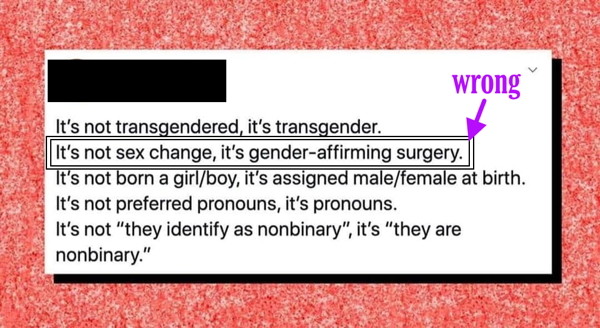
Someone in a Facebook group posted a meme stating "It's not sex change, it's gender-affirming surgery". Well, that's wrong. It's not gender-affirming surgery, its SEX-affirming surgery. If a person's gender identity as a woman is 100% valid whether they have a penis or a vagina, then obtaining surgical services to modify their physical structure so that any visual observers will assign it "vagina" doesn't affirm their gender. It affirms their SEX, as female.

Of course, being attractive to the heterosexual male gaze really is central to some people's sense of their feminine identity. It's what's most emotionally important to them about being a woman, as opposed to singing alto arias or becoming a really good seamstress or something. Nothing wrong with that.

But not everyone who identifies as woman or femme or girl is primarily concerned with appealing to the male gaze. Of having a sexually desirable appearance as filtered through the fakely universalized male gaze.


The centrality of the whole "do you look sexy, can you compete with the sexy women of the world in sexy appearance?" question is often used to invalidate feminine people. It is used to invalidate many cis women for whom it simply isn't the end-all and be-all of their self-worth. It is used to invalidate many trans women for whom being evaluated in terms of how well they "pass" as a sexually desirable specimen gets to be old and tiresome.

Well, it is also used to invalidate the identity of people like me, who definitively do not identify as female, who do not transition, who do not attempt to present as female-bodied people, who distinguish between physical sex and gender and identify as male women, male femmes, male girls.

I get a lot of pushback about it. People who say "It's nobody's business what you got in your underpants" when what they really mean is "You've got no business having that attitude of 'yeah I'm male, so what', that's the wrong attitude about your male parts, we're all supposed to be going around saying 'it doesn't matter'". But what actually doesn't matter to me is being found sexy in that sense. Sexy to the falsely universal male gaze. I am male. Sure I want to be found sexy... to people who specifically like the male physical morphology. Since that's the morphology I've got. And I'm a male girl. My gender-atypical identity doesn't have a damn thing to do with claiming femaleness, regardless of whether yours does or not.

———————

You're secluded in quarantine, and all the performances and events have been cancelled, so it's a good time to read a book!

My book, GenderQueer: A Story From a Different Closet, has been published by Sunstone Press. It is available on Amazon and Barnes & Noble in paperback and ebook, and as ebook only from Apple, Kobo, and directly from Sunstone Press themselves.


Links to published reviews and comments are listed on my Home Page

———————

This LiveJournal blog is echoed on DreamWidth, WordPress, and Blogger. Please friend/link me from any of those environments on which you have an account.

————————


Index of all Blog Posts

Friday, May 15, 2020

I Want My Two Months Back

So I was asked to participate in a dialog involving gender-critical feminists and transgender activists.

There's a political group with chapters sprinkled all around the country. One chapter endorsed a statement from some women's group about womens' "Sex Based Rights". An LGBTQIA action group within that same political group said that by doing so, that chapter had done something transphobic and transmisogynistic and that they needed to retract their endorsement and apologize to all the transgender women who might have been offended by their endorsement, or else get kicked out of the political group.

And what were these "sex based rights"?


Content warning: Potentially inflammatory material from here on out. And serious, guaranteed-inflammatory content as you go farther down. Trigger warning issued. Trigger warning with flames and radioactive emblems. Proceed at your own risk:

Well, some of the supporters of that local chapter said this was about remedies that had been designed to address women's exclusion from various forms of political and social participation. A sort of affirmative action for women to offset the effects of patriarchy, of women's oppression. They said that including transgender women ran the risk of diluting that original intention, and that it made more sense to use language that guaranteed representation of transgender women AND transgender men but did so separately from the original remedies, which had been designed with cisgender women in mind, i.e., women who had been regarded and labeled and treated as female people for their entire lives. They also said some women's political groups wished to operate as cisgender-women only because they had always been separatist, not allowing men to participate, and the lifetime experience of transgender women was a mixture of factors making their situation different from that of the women who'd been in those groups all along.


"I can see where that's going to be a problematic position for trans people", I said. "Still, there may be a way to bridge some gaps here. They do have a point about experience and identity. As a genderqueer person who identifies as a male girl, I respect transgender people who don't want to include people like me, because they believe being trans is biologically built in, that if I'm a woman I'm female, and that the only healthy thing to do about being transgender is to transition. My situation is different from theirs. As long as they're not denying the validity of my gender issues I don't mind if they want to run groups that I'm not welcome in".

I checked in with the LGBTQIA Action Group, the LAGs. "Oh, yes", they said, "we sent those demands to the chapter that endorsed that horrible statement. We want them to take our concerns seriously. We'd love it if they'd have a dialog with us, but they refuse to respond!"

Then I went back to the local chapter supporters, the pro-discussion folks calling themselves Dialog. I told them "I got the impression the LAG folks are open to listening if the people in Dialog and the specific chapter that endorsed that statement will listen to them in turn".


Then I went off to read a copy of the original "Sex Based Rights" statement, the endorsement of which had kicked off all this. Winced a lot. Yeah, the statement has a lot of language that, if not blatantly transphobic, felt like it was chock-full of dog whistle terms and phrases. I decided I didn't like the phrase "sex-based rights" itself. In general, I think people don't have rights based on their sex. You may have remedies that have been made available to your sex on affirmative action grounds but a right is an intrinsic entitlement. Men aren't entitled to something intrinsically as a consequence of being men, or male, or both. Whatever they're entitled to is either because they're human, or human adults, or else it's situationally male or about being men because of something that they and only they experience. Are women? I could formulate some rights that all pregnant or potentially pregnant people should have, perhaps, or that all menstruating or potentially menstruating people should have, but if I did, those rights came from those situations. Whatever. I sure wouldn't have endorsed the statement I was reading. But it didn't seem so horrible that I'd demand that anyone who did be kicked out of the organization.


"I'm ready to discuss the matter with Dialog", the LAG activist said, "but I have no interest in wasting my time with TERFs who say I'm not a woman. If they want to talk with us and apologize for what they've done, hey I'm right here, but in this organization it is already an accepted principle that trans women are women. That means in any situation where we're talking about women, if they try to excluse trans women, that's a hate crime and they don't belong in our organization!"

I said, "Look, some of them seem to be trying to incorporate and accommodate an understanding of trans people. Many of them don't like the term 'cisgender' for themselves but they aren't all insisting that trans women aren't women. One person suggested the phrase 'natal women'. Do you acknowledge a reason why they might legitimately want to meet politically by themselves as 'natal women'?"

"Trans women are natal women", the LAG activist replied.

"Wait, not even all transgender people claim that being transgender means you were born that way. I know it's a popular viewpoint but you wouldn't kick someone out of a transgender group for saying they weren't born trans, would you?"

"You're wasting your time with those TERFs. If they want to apologize and retract their message of hate, I'm right here. But they won't because they're bigoted fascists".

"Listen", I said, exasperated. "you've clearly got the stronger political position. Inclusiveness is always going to look more justified than a reason to exclude someone. So I'm sure you can pressure them into saying the kinds of things you want to hear, or get the organization to boot them out if they won't. But this is also a public education opportunity. Do you want them to see the light, or do you just want them to feel the heat?"

The LAG activist shrugged. "It's a settled issue. If they're going to be doing hate crimes I want them kicked out, simple as that".


"Frankly", declared the Dialog member, "I don't care what their viewpoint is. Not while they're calling us 'TERFs'. That's a slur. It's used to discredit us. They call us that while they're beating us, there was a women's march in London, did you hear about that? These men, calling themselves transgender women, barged in and chased women down side streets, attacking them. And the police did nothing!"

"So you don't like being called 'TERF'. You don't like the word that they use for you", I said. "You see the irony in that, don't you?"

"Transgenders are trying to invade our women's spaces and take away our rights as women. They want to erase women's identities. They aren't women. They're men. They're male. The correct word for adult male people is 'men'. Not 'women'. They want to invade women's prisons with their penises and rape women. They want to hide in women's bathroom stalls and molest little girls. And we're not gonna put up with it!"


"Okay, Dialog folks", I said, addressing the group. "Even if you don't think the LAG people are genuinely open to listening to anything they don't already agree with, you need to care about public opinion. You need to care about how the rest of the organization is going to view you. And although the LAG folks sound inflexible, you are managing to sound even more so and it's not a good look".


I picked up my old battered copy of The Women's Room, the book cover that has "LADIES" crossed out and "WOMEN'S" inked in over it. "I understand why you value the word 'women'. I think it was either Robin Morgan or Gloria Steinem, relating the story of having a sit-down with the newspaper editor, and explaining why they didn't like the newspaper referring to adult female people as 'girls' since adult males were always designated as 'men'.

"And the editor said, 'So what would you prefer...ladies?'. And the feminist women practically held their noses and winced. That term, 'ladies', was polluted with notions of screening out those who aren't ladylike, all that 'act like a lady' crap, you know? They wanted the newspaper to use the term 'women', they told him.

"The word 'woman' was nearly entirely associated with the physical body. In our society, girls become women not by 'proving' you are one, the way boys 'become' men, but by going through biological puberty. Even the creepier social associations, like 'Has he made a woman out of you yet' — like being heterosexually active 'makes you a woman' — even those had mostly biological meanings, more than social attributes. So by choosing the word 'woman', it wouldn't look like feminists wanted to be the new arbiters of which adult females get to qualify.

"I get that. Why you liked the word. And I get that it's been in political use by feminists since then.

"But you aren't going to convince anybody, anywhere, that you're being anything other than bigoted and biased by saying transgender women are factually wrong about being women. I'd think feminist women more than anyone would understand that word use is politically loaded. Think back to how 'man' was supposed to mean 'any human being' but it excluded women, and how 'he' and 'him' were used to mean any person. The dictionary said that was correct. But feminists said word use changes when society changes. And the feminists made our language change. You also sound pretty silly saying biology is destiny, by the way."


LAG people: "But trans women were not born with male organs. If she is a woman those are her organs so they're female organs. And those Dialog...persons... they are TERFs. It means Trans Exclusive Radical Feminists. That's what they are. I don't see why they don't like being called what they actually are".

Dialog people: "No one is denying their right to exist. They have a right to dress and behave however they want. They can see themselves however they like and have any understanding of themselves they feel comfortable with, but they have no right to impose their ideas on others or claim rights that were originally based on addressing the historical denial of women's rights as a sex".

LAG people: "See, we told you. Hateful transphobes. Kick them out. I don't have time for this shit"

Dialog people: "Words have meanings. Male people are men. Men are male people. A person with a penis is male. These men calling themselves transgender women are mentally ill. Men are not women. Males are not women. A person with a penis is not a woman. See, we told you, hateful patriarchal misogynists. You can't make us agree with their bullshit".

LAG people: "See, they're bad. Bad people are bad. Which is bad. Which makes them bad. The things they are saying are defined as bad. Sure, we're open to a dialog. A dialog about how they are bad".

Dialog people: "Four legs good. Two legs bad. Four legs good. Two legs bad..."


I want my two months back. I'm particularly disgusted with some of the Dialog folks, who seemed determined to live up to the worst things said about them by the LAG contingent seeking to have them kicked out. But both sides had some participants who originally seemed to be trying to find language that the other side would accept, at least long enough to have a conversation. People who were making the attempt in good faith. And there were other people trying to speak to activists on both sides, I wasn't the only one doing this diplomacy act. But our louder and more insistent colleagues shouted us down on both sides.

They should all be glad I'm not God. Because you know what I'd do if I were? You know those cruise ships that are languishing out in the ocean because of coronavirus? I'd like to put everyone from both groups onto those ships, and I'd confine one Dialog member and one LAG member to each cabin and quarantine them there together. They deserve each other.

———————

You're secluded in quarantine yourself, come to think of it, and all the performances and events have been cancelled, so it's a good time to read a book!

My book has been published by Sunstone Press. It is available on Amazon and Barnes & Noble in paperback and ebook, and as ebook from Apple, Kobo, and directly from Sunstone Press themselves.


Links to published reviews and comments are listed on my Home Page

———————

This LiveJournal blog is echoed on DreamWidth, WordPress, and Blogger. Please friend/link me from any of those environments on which you have an account.

————————


Index of all Blog Posts

Saturday, March 28, 2020

Anatomy of a Review: Karen Bernard's LAKESIDE

Event: Salon: Karen Bernard's LAKESIDE
Date: February 06, 2020 8:00 PM
Douglas Dunn's Studio
541 Broadway
New York, NY 10012


My friend and I share our guilty secret: we prefer narrative forms of dance and performance art, where there is a message or a plot line. It's akin to admitting you mostly like representational art when you're coming back from a show of abstract oil paintings. It tends to brand one as less sophisticated.

I find that the lack of a defined meaning creates a challenge for someone seeking to do a review. One could restrict one's self to how the performer moved, their talent and grace on stage. But that dismisses the performance itself as exercise. The problem is that my mind wants the piece to be "about something" and so it seizes on a message, a "something" that may originate entirely in my own head, making any review more about me and what I made out of this Rorschach choreography than about the performance that anyone else may have seen.

Hence the title "Anatomy of a Review".

I bring with me to the audience member seat a pair of tools, if you will, my main everyday obsessions: feminist theory and gender theory. When the only tool you own is a hammer, everything looks like a nail, they say. Well, here's what I saw:


A garment is in view in front of a kneeling performer (K. Bernard) under a tightly focused light. She and it. She stays that way for a prolonged duration, and doesn't react. Then very very slowly extends her hand, until the elbow is completely straightened, the arm as distant from the core of her body as she can make it, before she slowly pinches the fabric between fingertips and with agonizing slowness lifts it towards her.

Do I see a facial expression, or am I imagining it? I interpret something repellent, a displeasure, that makes the slow approach shot through with reluctance.

The outfit turns out to be a skirt and blouse. I see: gendered clothing. It has pastel colors, lacy ruffles, and once she (slowly) dons it, I see it is cut in a style that draws visual attention to legs and breasts, curve of torso, neck, and arms.

Once she's finally in the thing, she strikes poses and begins to move in it. I see: mockery, revulsion. I see: mincing and prancing, acting out in overstated compliance that which is expected of her. I see: resistance to femininization, trivialization, sexual fetishism and objectification. Her costume is a garment that renders one as an object for others' visual consumption, and it's not designed primarily for the wearer's convenience and comfort. These aren't, I think, interpretations that the clothing in and of itself would conjure for me, but by her body language as she interacted with it.

Due to my gender identity activities, I'm quick to attach the extreme reluctance and disgust that I see to the act of being misgendered. An expression not so much of resentment towards the costume per se as towards the package of feelings and attitudes towards anyone who would wear it, a rejection of femme. "Yes, that's it", I nod affirmatively in my seat. I imagine the cartoon thought-balloons over her head: "I don't want to wear this girly-girl thing, this so is not me. I'm supposed to be in this and prance around like this and pretend I'm eye candy and shit. Fuck this, gimme a goddam suit and a tie and a fedora, willya?"


The piece was presented without program notes, and was not followed by one of those "talkbacks" where the audience or a panel of people discuss the piece and what they got out of it, so we made our exit with only each other to consult.

We agreed that the dancing, the timing, the expressiveness were superb. She creates suspense and delivers an almost nerve-wracking intensity at times in her performance.

Had I seen anything that the artist had intended? Had the things that I did see reside at all in the performance piece, or strictly within my head as a gender-variant person and a feminist theory junkie?

"I saw an earlier version", my companion told me. "There were things she took out. I always thought it was about a murder. But that could have just been me, that's what I thought the piece was about, and she took out the parts that made me think so, so who knows?


Now to be fair, we do that to everyday life. The events of the real world aren't written with a plot, a clear storyline. We weren't handed a program explaining what the life we're about to experience is supposed to be about.
(Or, for those of us who were, we came to doubt the authority of the ushers who handed it to us). Some of us embraced a viewpoint, a political social theory about what's going on in life. We have come to use concepts of gender and identity and narrow confining gender-boxes that people are imprisoned in and struggle with. We embraced the concepts because they explained a lot to us, they clicked into place inside our heads and caused a lot of what we saw on the stage called World to make sense to us.

I believe in theory. I believe in the process of analyzing things. For the record, I don't think it leads to seeing things that your theoretical model say are there when it really all comes from you, the person observing life, inventing meaning where none actually exists. We share these analyses as communities of people who believe these explanations fit well, that they make sense of life. If they didn't offer us much explanatory power, it wouldn't be very satisfying to use them and we'd switch to one that did.

But I do think a lot of it is involves filling in a lot of everyday blank spots with what our theory says is going on. We see a behavior and without access to the thoughts in the behaving person's head, we make assumptions about their attitudes and intentions.

Being self-aware means reminding ourselves occasionally that we do that.


———————

You're secluded in quarantine, and all the performances and events have been cancelled, so it's a good time to read a book!

My book has been published by Sunstone Press. It is available on Amazon and Barnes & Noble in paperback and ebook, and as ebook only from Apple, Kobo, and directly from Sunstone Press themselves.

Links to published reviews and comments are listed on my Home Page

———————

This LiveJournal blog is echoed on DreamWidth, WordPress, and Blogger. Please friend/link me from any of those environments on which you have an account.

————————

Index of all Blog Posts

Saturday, December 14, 2019

Memes and Message Themes

Meme (n.) -- an element of a culture or system of behavior that may be considered to be passed from one individual to another by nongenetic means, especially imitation.


When I first came out as an identity not yet on people’s maps, I was intrigued by the rapid spread of popular snippets, little ideas that raced through communities as trendy notions you were supposed to know about if you were cognizant. “Hey”, I said to myself, “if I could figure out what makes an idea catch on and take off like that, I could leverage that to get the word out, to spread awareness of people like me existing in the world!”

And although I was not particularly witty and clever nor anything akin to popular, I watched people’s behavior to see what caused them to latch on to one thing instead of another as an item to pass on as if it were the Most Brilliant Thing Ever.

Eventually I decided that there was no identifying characteristic that was making the phenomenon happen around any specific morsel of an idea. If anything, the near-emptiness in content made it slightly more likely to become the newest trend, rather than any element of profundity or exceptionally clever twist. What I saw were people listening to the crowd and trying to discern early on what was being embraced so they could embrace it a little bit before other people, who would then copy them by embracing it themselves.

That’s not strictly 100% true (some appreciation of quirkiness does seem to play a role), but by and large these trendy ideas were being popularized because they were popular. People were competing to see who could jump on the next bandwagon before it became fully crowded, and would jump to the next one when they could sense it, but it was bandwagon behavior at the root. People weren’t adopting these memes because they agreed with them or thought they were insightful or cute. They were adopting them because they were catching on.


One of my friends, a performance artist, ends one of her pieces with the final line “If you live long enough, you become relevant”. After 40 years of trying to come out as a sissy-esque femme who accepts his nature and his physically male body, I may have lived long enough to attain relevancy, as genderqueer is trending. It isn’t all specifically my version of genderqueer, but yes, there are more and more people pushing away from the expectation of transgender “passing”, of asserting the vlable identity of their gender independent of their physiology or their presentation.


I spend a lot of time and energy complaining that MOGII / gender-variant communities are too much geared towards a kind of groupthink, where there is hostility and condemnation for anyone who doesn’t use the right words or echo the sentiments and viewpoints that have been embraced as the Right Way to Think of It. I shouldn’t let it surprise me. People within communities – any type of communities – tend to engage in the bandwagon-hopping because it is how human networks operate, it’s how the collective self, the “us” that forms a community, does its thinking. But I do, I grouse and snarl and complain about it, expecting all the individuals to examine ideas carefully and to be ready and willing to dissent from those around them and offer a different perspective at least a dozen times per week, and to quit chasing the bandwagons.

That may seem natural to me simply because I’ve been a loner for so long, a social hermit without a group. Like so many other MOGII kids, I was a misfit growing up. But in my case, coming out didn’t provide me with entry into a group of like-minded misfits. I sought it, fervently and desperately, wishing to belong. But because it didn’t happen for me, I suppose I developed less of the interactional patterns that lend themselves to bandwagon-jumping.

Which (I should keep in mind) means I’m not necessarily “a more independent thinker” so much as my tendency to independence has been an accident of not having found a place to fit in.


———————

This LiveJournal blog is echoed on DreamWidth, WordPress, and Blogger. Please friend/link me from any of those environments on which you have an account.

————————

Index of all Blog Posts

Saturday, September 28, 2019

Reality and the Physical Sex Binary Thing

To explain the difference between sex and gender, I often say that as a generalization, there are two sexes, male and female, plus an assortment of exceptions that are largely ignored and erased; and that further generalizations are made about the personality, behavior, nuances, priorities, etc of those two sexes, and some non-factual stuff imposed on it as well for ideological purposes, and those generalizations (distortions included) are what gender is.

I wrote something along those lines two weeks ago in my blog post titled "Clarifying Gender Inversion".

And, as I often do, I received responses from some people denying that, even as a generalization, we can be said to fall into two sexual categories. For instance, eroticawriter wrote this comment on LiveJournal:


While I agree with a lot of what you've said here, you're wrong that "on a biological basis there are two sexes, and a handful of variations that we can dump into 'intersex'". When it comes to sex, gender, sexuality, etc. there is no binary except the cultural constructs imposed by patriarchy and colonialism.


"There's nothing oppressive about making a generalization", I often reply; "the problem comes when the exceptions are treated like there's something wrong with them! Believe me, as a sissy feminine male I'm fully acquainted with the experience of being treated like there's something wrong with me for being an exception to the rule, I've been told that I'm not the way boys or men are supposed to be all my damn life. Legitimacy doesn't require numbers and numbers don't convey legitimacy; cisgender normative people outnumber us but that doesn't make their way of being in the world correct and ours incorrect or sick or wrong".

But my critics are adamant: no, "the binary" is an oppressive ideology, our sexes do not divide up into two categories even as a generalization, and I need to get with the program. (eroticawriter was not the only person to make such a comment; someone within one of the Facebook groups I belong to did likewise, and then later deleted their post and, along with it, my reply to it, perhaps because they did not like the way the discussion was playing out)

I consider them to be wrong about this. More about this below, I promise.

But first, I want to talk about the larger phenomenon I think this is a part of: the notion that there's not a "real" reality in life or nature; instead there's the white male cis hetero able-bodied English-speaking privileged reality... and then there are different, equally legitimate, realities for the rest of us.

That is technically true, 100% true, but in a truly vast number of situations it's irrelevantly true. Let me explain.

Point to the North Star, would you? If it's not visible for you at the moment, wait until it is. Every one of us occupies a different position, so the direction of the North Star is going to be different for each and every one of us. That's 100% true. But if you drew a perfect straight line from every single one of our pointing fingers to the center of the North Star, you'd end up with almost the exact same thing as what you'd get if you just drew a line from the center of our sun to the center of the North Star. All our differences are so minor in comparison to what we have in common that we can ignore them. Even having some of us do our pointing in midwinter while others aim their fingers on the summer solstice, when the earth is on the opposite side of the sun, just doesn't make enough difference to count. And that's the usefulness of the notion of objectivity — not that things really do have a single meaning regardless of the viewer to whom they have meaning, but that many things, perhaps most things, have so little variance in what they mean that we can safely ignore the differences in our social and physical locations.

And it's politically dangerous to discard the notion that anything has actual real meaning. If oppression is all a matter of perspective, then gee, develop a new perspective and get over it. Or at least quit complaining about it because to me (or so says the clever social conservative, at any rate), you're not oppressed and hey, that's my reality and you just went on record as saying there's no objective reality just your reality and my reality and his reality and her reality and so on. (See the problem?)

Like the story of the blind folks and the elephant, we may each only have a partial picture of the truth, and we should keep that in mind when we communicate, but we should also remember that there was a real elephant with a real elephant-reality and elephant-truth about its self whether any individual blind guy had a comprehension of it or not.

OK, back to the physical sex binary, as I promised. Let's posit, for the sake of discussion only, that my critics are right and that I'm wrong. That the majority of human being do not, in fact, fall into the two categories "male" and "female" and instead there are a multiplicity of varied sexes about which no generalizatons can be made that would divide them up neatly into two camps like that, even with the exceptions left over as a minority. What if that's true?

* Well, that makes cisgender people a minority, for starters. Most people were assigned either male or female at birth. But we just posited that it's NOT true that male and female people are a majority. That means most people's actual sex is something other than what they were assigned at birth.

* Defining heterosexuality becomes complicated. There's no coherent meaning to the notion of "opposite" sex if we're not in a two-sexes-generally-speaking kind of world. I suppose we could say that a person is heterosexual if they are attracted to any of the multiple sexes that differ from their own. But heterosexuality the institution -- the structure of expectations and interlocking behavioral dance steps, the courting and flirting and other romantic and sexual behaviors that assume two opposite sexes? That becomes divorced from any underlying pair of sex categories to which the majority of people have ever belonged. It's a restrictive ideology without any visible anchor and it's going to require some explaining to show how it could have gotten there.

* It's unlikely that we would have a single broad category called "intersex" to describe all the people who are neither male nor female. That's not how people tend to generalize. Remember that the people we now call "intersex" are not a single sex that differs from male and from female, a third sex, but are instead a plethora of multi-varied sexes. Here's a person with XY chromosomes who has a vagina and labia, and testicles inside her labia. Here's a person with a four inch clitoris who penetrates his female partners during sex and uses tampons when he gets his period. Here's someone with a vagina but no uterus and who has never developed breast tissue and who has a full dense mass of facial hair. All those people exist in the world that I recognize as reality, of course, but in the world that we are positing, the world in which male and female people are not a majority, all these people we're describing would not be regarded as an exception to the rule, because we have no general rule, remember? Instead, I suspect we would have a name for each of the ten or fifteen most common sexes. Perhaps we'd have some kind of "etcetera" category for the smallest minorities left over. We don't have that, though; we have a situation where we have categories male, female, and, just barely acknowledged in a whisper, intersex, the "etcetera" category into which we cast all the exceptions. If the males and females together don't constitute the majority, indeed the overwhelming majority, this needs explaining, just like the ideology of heterosexuality.

* Insofar as most people identify as either "male" or "female", in order for it to be true that the majority of people are not either male or female, we're saying that most people Insofar as most people identify as either "male" or "female", in order for it to be true that the majority of people are not either male or female, we're saying that most people do not correctly know their own sex.. And that is a rather pompous assertion that certainly needs some explaining! Oh, it's possible, I suppose... we could say people have "false consciousness", that the notion of a sexual binary has been imposed on us all and we've been socialized and brainwashed into believing in it, even though it doesn't really exist in the real world. But who is responsible for this illusion? The cisgender people? They're a minority within this supposition, remember!? And while minorities can sometimes oppress the majority, they don't tend to do so by making the majority believe everyone has the same identity as the oppressive minority; instead, they usually establish their own identity as a privileged special identity that justifies their position over the others, an identity that they can lord over the others.

It's possible but I don't see a compelling case for it, and all my experience has been to the contrary. I've been to the nude beach and I've been inside locker rooms and I've been in a neonatal nursery full of newborns. I'm not going to pretend that I am not socialized into awareness of categories used by my culture, but I don't seem to have to shoehorn a huge bunch of not-really-either people into categories they don't fit into in order for a two-sex categorical system to work for the overwhelming majority of human beings.

If you wish to put forth a theory that explains how an ideology supporting a completely fictitional belief in a physical sexual binary was created and is maintained against the evidence of a non-matching physical reality, feel welcome to do so, but I regard that as an extraordinary claim, one that is not necessary in order to acknowledge the existence, dignity, and self-determination of intersex people, or the similar legitimate existence of people who do not fit general patterns that describe the two primary sexes, such as gender inverts and genderfluid people and agender folks and demiboys and demigirls and so on.


———————

This LiveJournal blog is echoed on DreamWidth, WordPress, and Blogger. Please friend/link me from any of those environments on which you have an account.

————————

Index of all Blog Posts

Saturday, June 1, 2019

Depression

I'm in a dismal mood.

Doesn't happen very often. I'm seldom depressed. When I first obtained a clear sense of my variant identity, I received along with it a political explanation for why I felt pushed aside, why I was so often reviled and hated when I hadn't done anything to hurt anybody, why I didn't make friends, was perennially unpopular, and so on. It was also a political analysis that explained a lot of the worrisome aspects of the larger world to me, things like tyranny and oppression, poverty and inequality, even morality and spiritual meaning in life. So it was very empowering, and gave me optimism, courage, even some modicum of patience.

And you can sort of see why having that kind of understanding in my head made me want to share it, figuring it would offer those things to a lot of other people as well. And why wanting to share it gave me a mission and a purpose in life.

But I do get discouraged and trammeled down sometimes and it's been like that these last couple weeks.


I had a publisher on the line. I had a contract in my hands. There were problems and concerns -- I never quite felt that the editor I was interacting with had a clear understanding of the gender identity thing, either mine or MOGII* identities in general, beyond the average person's mainstream popularized shorthand stuff, and he didn't seem curious or sufficiently intellectually engaged to see what it was that I was trying to say to the world. It was more like "Hey, you write well, this could be an interesting entertaining book with a bit of effort".

I thought maybe I could work with that but the lack of any sense of being on the same channel worried me. He also gave every sign of wanting to be heavy-handed about changes. "I think you should add a scene where you muse about this, and then a scene where you blast out of town and flip off the city limits sign as you drive into the sunset... and I'd get rid of these scenes in this next section..." I got mixed messages about how much of these editorial suggestions I could veto and still have them publish the book. On the one hand, he stipulated that the publisher would not make any changes that the author did not approve, and when I did a preliminary round of edits , adding some scenes he suggested but not deleting material that I wanted to keep, he replied (somewhat sourly, I thought), "Well, do it your way, it's your book, and we don't want you to look back after publication and wish you'd never heard of us". Alongside of these ambivalent-sounding reassurances about my authorial authority, I received periodic comments about how the publisher could not afford to put a book out there that had so many flaws and weaknesses that it simply would not sell, or that would be an embarrassment to the publishing company.

I was sent a document to review and sign, titled "draft contract", and I wanted to modify some clauses to safeguard that the book would come out my way (final word on the book's cover, title, back-cover blurbs, publicity descriptions or synopsis, etc) and also push for a better deal in some places (better % royalties beyond the 2500th copy, because I'd be financing most of the publicity efforts, as tends to be the case with small publishers) -- I figured it did say draft proposal, after all, and that they might say "nope, you can't have that" and if so we'd negotiate to a compromise and then I'd sign and they'd sign and I'd hold my breath and hope we could work together on the edits, right?

Uh uh. I got a reply email stating that the publisher had decided they had too many projects going on and had decided not to publish my book after all, best of luck with it elsewhere, etc. After a day to cool off I wrote a letter of inquiry (and of hubris-acknowledgment). He confirmed that yeah, it was because I'd given them pushback instead of just signing the contract as is. And nope, no room at this point for continuing the discussion, sorry. So that was that.


What are your symptoms when you get down and despondent and mopey?

For me, it's like this:


* I get mad at myself and start blaming myself for the outcome, even though I'm still capable of an intellectual analysis that tells me I didn't do self-destructive things here. I blew it. I had a contract in my hands and managed to drive away the publisher. I must not really want to get my book published, I sabotage myself. Heck, I probably sabotage myself right and left every day, finding ways to not network or communicate, so that I can be a fucking dilettante and keep pretending to be an "activist" or a gender "revolutionary" when I'm really just Walter Mitty and none of this is real.

* I question my beliefs and understandings. Intellectually, I could tell you that it is good for anyone to question what they purport to believe; it makes the beliefs that withstand such questions more valid and sound, and it makes the person who subscribes to them less defensive and more genuinely confident and all that -- but in this mood, the belief-questioning is very dark and takes this form: "My difference probably isn't that I'm differently gendered. That's just an excuse. I'm inferior, there's something fundamentally wrong with me. People mocked and harassed me as a kid because I was pathetic, not because I was a sissy. I have had problems making friends and getting accepted socially because I'm not fun, not friendly, don't remember what is important to other people, and in particular because I don't properly soak up how to be, the little memes and clues, so I am not a part of things. I'm probably impaired neurologically or psychologically. Maybe I'm autistic, or I have some personality deficit so that I'm capable of doing mechanical things like dress myself or do data entry or write term papers for college classes but my brain isn't wired correctly to do people-interaction. Yeah, there's something wrong with me.

* The dark stuff isn't all of the self-blame variety. I have other forms of gloom to wallow in. Why have I gotten so little traction out of forty years of trying to share and explain these ideas? Well it's because I belong to a sexually dimorphic species, and I'm a sissy male, a feminine male, hence a minority and marginalized because of that; and I can try to call that "political" and make an "issue" of it all I want, but my species isn't buying it, there are evolutionary forces that select against it becoming okay for males like me to be accepted and embraced by society. Or (brain switches channels to a different gloomy perspective) it's a conspiracy of sorts, my set of theories and explanations is a potential meme that conflicts in parts with the predominant rising body of thought, which at the moment is the mainstream transgender narrative, What I am saying or trying to say is rejected because the popular social dialog only has room for a few prevailing ideas to proliferate. My notions are no doubt seen as transphobic, or at least they’re seen as incorrect and inaccurate when people compare them with the established transgender explanations. And back in the earlier years, before transgender viewpoints were established, my ideas were probably worrisome to gay people and their supporters, and were perceived as homophobic. So, you see, communication between an individual and the rest of their surrounding culture isn't free exchange; ideas that are not the ones chosen by the consensus get pinched off and blocked because they introduce too much noise, and mine are noise, not the memes that have been embraced and selected for wider audiences. Or (switching channels to one with even less light in it)…

* Ha, so silly to dwell on how poorly I fit as a male, when I should take note of how poorly I fit as a human being. I am not doing this "being a person" thing very well. I was born to a species whose tasks of life and patterns of behavior and interaction and challenges and so forth are a bad fit for me, and not much fun. I am tired of this. Not in the sense of wanting to be dead, not in the sense of craving non-consciousness and non-existence, but, yeesh, if I die and get to come back, I really hope I can come back on some other planet as some other species with a different nature, different characteristics. Or I could come back as a kitty cat, and live in back alleys and prey on mice and if I'm lucky get adopted and taken indoors. Or I could try my hand at being a sycamore tree, or bread mold or something. But this "being a human being" thing doesn't seem to be shaping up to anything like a passing grade. I'm just no damn good at it.


Meh. My way of coping with depression is to ride it out, and to wallow in it self-indulgently and immersively, until I get annoyed and angry and break out of it. I don't think I'm very pleasant company for the duration of these moods (I get even more self-immersed than I usually am, which is admittedly a rather narcissistic threshold to start with); I only listen to the loved ones and important associates and colleagues in my life in a sporadic and distracted way, and I get very forgetful (more spacy than usual, and again I have an embarrassingly bad baseline to start with). And I'm awake much of the time I should be sleeping and dozing off when I should be alert and awake.

But it's not like I don't understand why I would be feeling depressed. I got sufficient reason. So it's normal and natural and part of life for me.

I'll bounce back.


* MOGII = "minority orientations, gender identities, and intersex" -- an alternative to the ever-expanding LGBTQIAA++ acronym


———————

This LiveJournal blog is echoed on DreamWidth, WordPress, and Blogger. Please friend/link me from any of those environments on which you have an account.

————————

Index of all Blog Posts

Wednesday, January 30, 2019

Critical Mass: Chicken or Egg Questions

In order to get published, promoted, distributed, represented, featured, etc, you first need to have a critical mass of people paying attention to what you're saying. People begin taking you seriously enough to pay attention to you once they realize that other people, not just themselves, are encountering what you've written or said, which in turn is largely dependent on being published, promoted, distributed, etc.

This is the "platform" conundrum I am up against. Publishers (and literary agents too) want to know if the authors who query them already have a built-in audience of people. People who read their blogs, who watch their YouTube videos, who read and follow their tweets and retweet them, who come to hear them lecture.

I have had some of them informing me that getting a book published is no longer a mechanism for reaching people with your ideas. It is something that you do when you are already successfully reaching people with your ideas.


I have a prepared "about the author" statement that I include in my queries when the instructions for submitting to them say to give some background information about yourself, your prior publications (if any), your education (if relevant), position of employment or expertise (ditto), and, yes, your platform. At the end of it, after describing my academic background and history of being a gender activist and so forth, I have this:


About the Author's "Platform" — Many literary agencies and publishers, when they request the nonfiction author's bio, are primarily interested in knowing who will buy the book based on the author's reputation and stature in the field. This isn't that kind of memoir. No one (except maybe my Mommy) will read it simply because I'm the author; the book is interesting (and marketable) as a "representative" or "illustrative" memoir, the story of what it is like to be a particular TYPE of person (genderqueer, in this case).

Yes, I'm aware that that's probably not what you meant by "platform", that you're less interested in whether I'm a household name than in whether or not I have a following of potential readers and purchasers of my book. Well, I blog weekly; in this day and age, no one leaves comments directly on blog pages, but I post links to my new blog entries in a couple dozen gender-centric Facebook groups and I have a modest but supportive audience who follow me there.


The whole situation is frustrating, but I believe it makes it difficult, not impossible, to get traction. I keep reminding myself that I have twice had a publishing contract for this book, and if it had indeed gone into print I would have reached many people and more people would pay attention to the things that I say and write because I was a published author on the subject.

It's also useful to remind myself that only some people will not pay serious attention to a person's thoughts and ideas until and unless they believe that a lot of other people are also being exposed to what that person thinks. There are, fortunately, people who will get quite excited about or supportive of a line of thought that "clicks" for them, no matter where it comes from or who else is likely to be exposed to it.

Getting to critical mass is to some extent a random thing, a matter of chance. The longer I keep doing this, the more likely it is that my writings will affect someone who has something of a platform of their own, either in the sense of having the ears and eyes of a lot of people or in the sense of knowing some specific key personnel whose attention to this project could help propel it forward. That would, of course, include literary agents and publishers, who certainly possess the power to make my book a success.


Meanwhile, none of the other modalities of communicating with people make more sense to pursue instead of focusing on trying to get my book published. I already have a blog; a small handful of people read it and I don't know how I would increase that. I already post links to my new blog posts all over Facebook, and that's one reason I have the handful of readers that I do have, but again I don't know any magic tricks for drawing more attention to them. I have a Twitter account and I tweet about my blog posts, but I'm a clumsy and clueless twitterer and I'm not likely to suddenly become adept at expressing myself usefully in postage-stamp sized textmorsels. I've addressed some groups, giving presentations and leading discussions, but it's not easy getting booked when one has no authoritative position or official role and does not have a book published. I've even made a few YouTube videos, but they don't tend to pull in people any more rapidly than my blog posts do. And meanwhile, I've got a book, already written, so it kind of makes sense to continue to try to get it into print.

(Be all that as it may, if you have suggestions for how to get more people to tune into my thoughts and words, or for more useful ways in which for me to render them and make them available, by all means give them)

I probably should hire someone to make a home page for me, perhaps with the table of contents (i.e., "Index of all Blog Posts", see below) embedded in it. Or at least find out if I could afford it, etc. I could do something along those lines myself, but graphic design is not my strong suit and my HTML skills are pre-CSS, HTML 1.1 edition stuff at best.


———————

This LiveJournal blog is echoed on DreamWidth, WordPress, and Blogger. Please friend/link me from any of those environments on which you have an account.

————————

Index of all Blog Posts

Monday, November 26, 2018

Difference and Marginalization

At a certain point in my life, I began saying something that other males around me were not saying. Something that men in general had historically not been saying. I was stating that certain things were true for me personally, and in making this statement I was contradicting a whole lot of what men in general had said about male experience, about being one, what it was like, what it meant.

Did this mean that I was different?

What if, in saying these things, I was actually speaking for all men, saying things about the male experience that never get said but which basically all men, not just me, have to confront in their lives?

Or maybe I was not speaking for all men but for a minority of males, a hitherto silent minority, a group of males who were different from the rest, a group who didn't yet have a name and a voice?

Or perhaps I was only speaking for myself and myself alone.

I didn't know. I spoke without knowing.

I've received my share of dismissive reactions. I'm a special snowflake. I'm a boringly normal hetero cis guy who desperately wants to be edgy. I have a lot of nerve using a slur term ("queer") that was hurled at other people, as if that were my right. I've been told countless times that I lack any relevant difference. Meanwhile I've only now and then been told that what I say is true for me is true for them too.

Marginalization is a word you hear bandied about quite a bit these days, especially in MOGII (aka LGBTQIA)* communities. It literally means to exist right on the margin, or edge, of things, pushed to the side.

Well, here's what marginalization is like. It's when most of the time you get treated as part of an undifferentiated group you don't consider yourself to belong to, and the rest of the time you get singled out as weird and peculiar, and treated and thought of as such, with your difference defined by other people as they see it, without any input from your own self-definition.

And yes, it is edgy.


* MOGII = Minority Orientation, Gender Identity, and Intersex. LGBTQIA = Lesbian, Gay, Bisexual, Transgender, Queer (etc/other) and/or Questioning, Intersex, Asexual/Agender. I like MOGII better.


———————

This LiveJournal blog is echoed on DreamWidth, WordPress, and Blogger. Please friend/link me from any of those environments on which you have an account.

————————

Index of all Blog Posts

Monday, November 12, 2018

Almost Quit My Job...

I have a temporary job working at a Montessori School. Not in the classroom but in the office, where interaction with the children isn't really an expected part of my job. But we're understaffed. The other day, the teacher in the classroom for 3 to 6 year olds needed a bathroom break and there was no teacher's assistant to cover, so I was asked to step in. Except not quite exactly step in. "Just stand at the entrance to the classroom until she gets back", the administrator told me. "I don't want to send a man in with the children, some of the parents won't like that".

I fumed while I waited there, not liking this. (The children know me from the front office; they're alert and bright and know all the adults by name from early September on. They called to me from within the classroom and asked why I didn't come on in). So I stood there doing a slow burn, and rehearsed telling my boss I was unwilling to work there any more because of this.

This, by the way, is what dysphoria is for me. For other gender-variant people, misgendering may occur when people use the wrong pronoun, or when they are referred to as "male" when they identify as "female" or vice versa. In my case, I consider myself to have both a sex and a gender, and don't have a preferred pronoun; I don't mind being referred to as male because I am male, and most of the time being referred to as a man doesn't provoke my ire, either, because in most cases the person speaking isn't using it offensively, just ignorantly. But when I get lumped in with other men, with my attributes extrapolated from what is known or thought of men in general, and distinguished from women, that's misgendering and I hate it personally and viscerally and with shocking pain, personally affronted by it.

When the teacher returned, I stalked down to the administrator's office. "You told me to wait outside the classroom because the parents would not like a man being in the classroom with their children. So you would not have said the same thing to a female office worker if she was asked to cover?" I crossed my arms, already preparing my I-quit sentence within my head.

"I am not willing to expose any of the men who work for me to the horrible attitudes of some of these parents", she replied. "Let me tell you about Brian. He was a student here, honor student, really nice boy. I had him working in my office for awhile when he was a young adult. One day the police showed up and demanded to know if I had Brian Jones working here, because they needed to arrest him on suspicion of child molestation. He would never do such a thing, everyone who knew him agreed with that. What had happened was the children were playing flag football during gym class and one of the girls lost her flag from where they tuck it in, in the back of their shorts at the waistband, you know, and she had trouble reaching back there to get it back in, so he helped her. But her mother heard that there was a man working with the children and she asked the girl if he had ever touched her and she had no idea what her mother meant by that. Anyway, I'm not willing to put you or any other man in that kind of situation".

Hmmph.

That does put a different spin on things. If she had said "I am not willing to expose my children to any risk of sexual misconduct" or "I am not willing to expose my school to the risk of such accusations", I would have been so out of there. Because my maleness doesn't make me a threat to children and I'll be damned if I'll tolerate that kind of insinuation. But she'd couched it in terms of the risk to me of being targeted by that kind of bigotry.

Oh, it's still the wrong answer. There exists what I call "The Weather Approach" to social problems. Someone addresses all the incoming women students on campus and warns them not to dress revealingly or to be out unaccompanied by themselves, because there's a risk of rape, and in doing that they are treating the behavior of the men on campus as if they were the weather--no responsibility for their own behavior, so those who might get exposed to it have all the responsibility of dressing for it and carrying an umbrella. We don't expect the weather to develop a consciousness of how it treats the people it rains on, so it makes rational sense to tell people to take the weather into account and plan accordingly. But men are not the weather. Neither are bigoted parents with sexist attitudes. So it's the wrong answer. Ideally she should have spoken to me about what I might be exposing myself to, risk-wise, but not acted so as to protect me without my having chosen to be protected.

The "Weather Approach" always tends to be complicated and convoluted. Does a parent of an oppressed and vilified raise his children to be free and untrammeled and unimpeded by societal labels, or to be savvy and wary of racists and haters?


I listened and went back to my desk, still employed there at least for now.


———————

This LiveJournal blog is echoed on DreamWidth, WordPress, and Blogger. Please friend/link me from any of those environments on which you have an account.

————————

Index of all Blog Posts

Monday, November 5, 2018

Summarizing a Life

As a consequence of my mother dying and an unusually high volume of other friends', relatives', and associates' lives coming to an end within the last year or so, I've heard a lot of summaries of people's lives, condensations of who those people were around some ongoing themes or primary accomplishments.

I've been doing this all my life. Or all my adult life at any rate. I started when I was 21.

Trying to explain being a person whose body is male and yet whose persona is feminine. Trying to become understood by other people in those terms. Trying to get people to add that to the list of possibilities and accept it as a valid identity.

I've had limited traction. I've put a lot of energy into it but it has mostly gone into spinning my wheels without propelling me very far forward. I've had limited effect. Perhaps I am not very good at what I set out to do; perhaps I lack the talent or the appropriate skill-set or something. I don't have a significant following of people listening or reading what I have to say on the subject.

I've occasionally seriously considered putting this down and walking away from it. I mean, the problem with being Don Quixote is that you do not merely fail to defeat your windmills, you don't even get the satisfaction of having the windmills become aware that you're making the attempt. It gets discouraging.

When I was 22, at the end of a year in which my initial efforts had caused me to be detained in a psychiatric facility and disenrolled from college, and in which attempts to "find my people" had gotten me nowhere, I began to question whether these ideas really made sense, or even if they did, whether they were anywhere near as important as they'd seemed when they first came into my head. I came out of that period of questioning convinced of two things: I didn't have to do this, it was not my duty; but yeah, they made sense of my life and they made sense of society around me, and without them there was a boiling meaningless chaos, and so I was inclined to continue to hold onto them, and in believing in them I was driven to continue to try to communicate.

Many years later, at the end of my 30s, my plans appeared to have collapsed around me with no significant progress made: I'd come to the New York area again seeking to "find my people" but the lesbian gay and bisexual scene such as it existed in Manhattan in the 1980s was just starting to open to transsexual (now called transgender) people, very few of whom were coming to participate; and I didn't find a space in which I could explain my own situation and find anyone with similar identity or experience. I'd also latched onto the idea of majoring in feminist studies: I'd write about this stuff and interact with classmates and teachers and I'd connect with people instead of just finding kindred souls within the pages of feminist theory books! But that hadn't quite panned out either, and now my graduate school career was over with no PhD or teaching position in sight. But I'd obtained an MSW in social work along the way and landed a job and figured over the years I'd make professional connections and get to inform policy makers and write grant proposals and create relevant services to bring my people together somehow. But the social work organization had disbanded and I'd been cast adrift and, finding myself unable to get a job offer in social work, had taken an office job developing database software. Lucrative but not relevant to my "mission". And I'd connected romantically with people several times only to always have them unravel, leaving me concerned that I couldn't maintain a relationship or that I wasn't a desirable partner. So I started to think of myself as someone in early retirement, a social activist driven from the field with nothing to show for it.

Over the course of my 40s I retraced my steps, mental ones and actual physical locations, trying to get a clear sense of what had happened in my life and whether or not this was still something I wanted to do, and if so how I was going to proceed. It took awhile but increasingly as I looked back on who I had been and what I'd attempted, I saw it as worthwhile and began to think about what to do next.

From the self-examination activity there came an autobiography, and at it took form I began to think "this is what to do next; show people what it is like, don't theorize about it, show them!" And from the autobiography came the distilled and augmented story that I'm trying to market as GENDERQUEER: A STORY FROM A DIFFERENT CLOSET. My memoir and coming-out and coming-of-age story.

Five years into the process of trying to get it into print, I still don't have much to point to except a massive pile of rejection slips (mostly digital, and hence a virtual pile in an email program's folder). It continues to be frustrating.

I've had an occasional success though! Firstly, back when I was a grad student I got an article printed in an academic journal, and it has generated discussion and affected some of the people who've read it over the years. It's some of my best writing and I'm quite proud of it. Same Door, Different Closet: A Heterosexual Sissy's Coming-out Party

Secondly, I've twice had signed contracts with publishers who were promising to publish this book. It didn't happen, but that's a different situation than if I'd been querying for five years and never gotten a serious nibble.

I blog and I post into Facebook groups for genderqueer and other gender-variant groups and/or LGBTQ-in-general groups. I don't have the audience I wish that I had, with a multitude of followers subscribing and commenting. But I reach a few people.

And I've had the opportunity to speak to some LGBT groups and to college women's studies / gender studies classes on campus and in some other venues (including BDSM lifestyle conventions, interestingly enough) and although my audiences have not been huge, I've had people come up to me later and say how relevant my presentation was, and that they've never had those thoughts or feelings validated in that way before.

Anyway, I am now on the cusp of turning 60. It seems increasingly likely that yes, this is going to be "what I did with my life". My life's work. My primary lifetime project.

So... if you encounter someone like me -- perhaps someone who wanders into your Facebook group and says "I don't know what to call myself... I was thinking maybe genderqueer, or perhaps nonbinary... my body is male and I don't think it is wrong, and I don't want people to think of me as a female person, I'm not... but who I am, my identity, is feminine or femme or like basically I'm one of the girls or women" -- do me a favor and tell them about me. Tell them I call it being a "gender invert". Refer them to some of these blog posts. And if my book is published by then, tell them to read my book.


———————

This LiveJournal blog is echoed on DreamWidth, WordPress, and Blogger. Please friend/link me from any of those environments on which you have an account.

————————

Index of all Blog Posts

Sunday, August 26, 2018

The Arrogance of Claiming to Be a Social Change Activist

On an authors' message board someone started a thread asking if we authors were perhaps an arrogant lot.

I replied,


Damn right I'm arrogant. I have a story to tell. I'd prefer that folks fork over the cover price and voluntarily submit themselves to my thoroughly entertaining written word, but I would strongly consider chaining each and every member of my species to a convenient chair and prying their eyelids open with toothpicks and reading it out loud to them. I haven't worked out the logistics of that yet but morally and intellectually I have no intervening compunctions. (You have been forewarned). Hmm, now if I just went after the literary agents, maybe...


Before long, another author answered that with


Yeah..... admirable confidence. I can't help but want to applaud it.

But... nah... we don't all deserve to be read. We are not entitled. I hope you understand. We all have our causes.


Now, my instinctive initial reaction to that is to respond that this isn't about being an author, an artist, a creative person wanting to share an artistic work; it's about being a marginalized mistreated person, a victim of a systemic wrong that needs to be righted, and that yes, dammit it is too my right to speak and to insist that I be heard. The ethics of social justice says I have the right to rise up and do what I must. And so forth.

But like so many other things, that, too, is an oversimplification. And because indulging in that oversimplification really is a bit arrogant, it's appropriate and occasionally necessary to embrace a little self-doubt now and then. Come along with me, if you will...

* Authority — There's a built-in claim in my social justice assertions, that the way I see things is damned well the way things actually are. That sissy femme males are unjustly treated by society in general, that it does make sense to think of us (or to think of ourselves) in the specific manner that I'm advocating, as differently gendered people who aren't wrong or inferior, that society as a whole becomes better in its entirety if it changes so as to accommodate our existence and begin accepting us on our own terms, and so forth. Well, yeah, I do think exactly that, I do believe those things. But there are plenty of people who think otherwise. Some of them think that the things I'm making a big deal about are no big deal. Some of them think I'm as silly and my arguments as useless as someone screaming that gravity is unfair and should be repealed because skinned knees hurt. Some of them question the authenticity of my conscious motives ("You're trying to jump onto the LGBTQ bandwagon because you're a boring white hetero cis male who desperately wants to be edgy") or the coherence of my mind ("You admit you were diagnosed with a mental illness for spouting this stuff so pardon me if I don't take you seriously"). From what source other than unadorned arrogance does someone like me derive the confidence that right is on my side?

* Objective Meaning — Then there's the bandying about of these aggregate terms and the assignment to them of social meaning and significance, as if they existed and have always existed objectively, just like I describe them, whether people at any given time recognized them that way or not. The notion that in human society there exists a bunch of male people who are essentially girls, who have the same gender polarity as the girls have, and that this category exists independent of physical sex or from sexual orientation, and that I'm shining my spotlight on this phenomenon so that everyone will see it and realize it and recognize us and start thinking of us in a different manner. Yeah, so what's wrong with that? I mean, yes, that's exactly what I've been saying. What's wrong with it is that it assumes that human experiences have a meaning in and of themselves. And that isn't true. Human experiences have meaning to someone or else they don't have that meaning at all. Meaning in general is "to an observer", not divorced from interaction and embedded in things apart from people. And that is all the more important, as philosophical truths go, when the subject matter is our own human experience. If there are no sissy femme male people who think of ourselves as being of girlish gender yet male of physical body, then it isn't that we exist but think of ourselves wrongly or inaccurately, is it, so much as we don't exist as described in the first place?

You probably suspect that I have an answer to that. That I'm not really engaging in a bunch of self-doubt and purpose-questioning, and that I'm actually tossing all that out there in order to pontificate intellectually?

Of course I am. Wait, no I'm not. Um, well... the self-doubt is real, and questioning my arrogant self is genuinely important. But no, I'm not paralyzed by self-doubt and derailed from being able to continue. I said certain things were an oversimplification. I didn't say they were fundamentally wrong. Oversimplifications tend to contain quite a bit of truth. I think these do. That's why I continue to embrace them and behave as if they were entirely the truth (most of the time). Sometimes a simplified understanding of something is more useful than the fully accurate version. Earlier tonight I drove to and from the village of Huntington, behaving as if I were on the surface of a more or less flat and motionless terrain. I know the earth is round and is plummeting around the sun as well as spinning around its own axis, but it's just easier to drive when I bracket that stuff off as irrelevant to what I'm doing. You get what I'm saying?

So here's a somewhat less oversimplified notion of the social activism thing:

* How people think of themselves and their experience and identity is not limited to concepts that they could put into words and stick labels onto. Most people, at some point in their lives, recognize themselves in a description that they hear. Prior to hearing that description, they might not have thought of themselves in quite those terms, or seen the same connections, but the fact that they do recognize themselves in the description means that it resonates with what they understand about themselves emotionally or connects up a lot of little pieces that they understand about themselves cognitively. So there's no need to make it an either/or proposition. Yes, meaning is "to a subject", especially the meaning of human experiences themselves, but meaning is not the same as a specific verbal description.

* Verbal description is an art, not a precision science. There is not an exact set of verbal terms lying in a box, each one corresponding to a specific human experience. So none of the attempts to explain human experience are "objectively correct" but all of them echo something truthful and accurate, and the better ones resonate with people as truly significant expressions of what our lives are like.

* It is still arrogant to be so insistent about expressing my verbal description on the theory that it will, in fact, resonate with people. That it will shed light on the human condition, that it can change things. Arrogance is a form of being pushy, less than fully delicate with other people's sensitivities and perhaps their disinterest in considering a set of ideas that seem foreign and strange to them. I have often described my coming out to myself in 1980 as an act of permanently losing my temper about the whole gender situation. I act fueled by anger, by a constant glowing rage that makes me willing and able to be pushy in that fashion. That a marginalized and ostracized person would feel and react with anger and stand up for herself is predictable and natural. And socially healthy. It's not practical for me to chain people to their chairs and force-feed them my thoughts, so the social world surrounding me is not at risk from my anger — I can't attain my objectives coercively whether I'm arrogant enough to consider myself entitled to do so or not. And that's true of others in my position, specifically or generally.

As a practical matter, our fury reconciles as determination. Or stubbornness if you prefer.

The arrogance is something you're just going to have to live with.


———————

This LiveJournal blog is echoed on DreamWidth, WordPress, and Blogger. Please friend/link me from any of those environments on which you have an account.

————————

Index of all Blog Posts