When I was born, I was categorized based on visual inspection of my parts, and designated male.
You've heard all this before, over and over. I don't need to repeat objections that you could recite as easily as I could. Let's do something more interesting... let's dive into the head of the people who don't understand what we're objecting to.
I'm picking this guy, let's call him Sammy. He says that as far as he's concerned, the designation and categorization mean exactly the same thing as the parts themselves. "Penis means you're male. I ain't saying that makes you Rambo. Maybe you're into ballet, or you want to be Earth Mom. I don't care if you paint your room pink or blue or you play with dolls or fire engines, you hear what I'm sayin'? Male just means you got a penis and we figure you're gonna grow hair and so on because that's what usually happens."
Sammy is effectively making the claim that he — and most of the rest of the world — doesn't attach any additional meaning to being male.
He is wrong. He does it all the time, I've seen him do it over and over. In a discussion of evolutionary pressures and social status, he said the high status males will naturally be the ones who have sex with the most females, while the highest status females will be the ones who only have sex with a few carefully selected males. That's attaching a significance to "male" that goes far beyond "has a penis". And in discussions of romantic comedy movies, he described a character played by Katharine Hepburn as having "won" against the male lead when he ends up proposing marriage to her — "she got him, he's captured". Sammy can protest all he wants about how he isn't projecting pink versus blue expectations and roles onto people and attaching those things to what sex he considers them to be, but he's definitely doing it, and the society that surrounds us is definitely doing it.
It's hard to know what to say to someone who insists that they are only seeing and thinking in terms of physical body structure when they clearly show that they assume different priorities, different values, different behavioral patterns, different personality characteristics... and different roles that interact with other, equally sex-specific roles.
Maybe it's a good thing to aspire to. Maybe we should all be trying not to assume anything whatsoever about how a person will behave or what's important to them in life based on whether we perceive their bodies to be male, or female instead. Maybe we should all be trying not to interpret the same behavior as meaning a different thing depending on whether we perceive the person to be female or to be male. But pretending that nobody does that any more except for transgender and genderqueer and nonbinary people, as if the rest of the world doesn't attach any meaning to being a man or being a woman other than the physical? Give me a break!
That's not to say that it isn't useful to think of, and speak of, the physical architecture separately from the identity, the gendered self that we have come to believe is not defined by our sexual plumbing. If being born with a clitoris and vagina does not make one a girl or a woman, then you don't need to have a clitoris and a vagina in order to be one, nor to present and pass as a person who has that kind of physical architecture. If your gender identity is valid, then it's valid on the nude beach or the doctor's examining room. It's valid when you're wearing the garments that are typically worn by the people who have the same physical body structure instead of the garments typically worn by the people who have the same gender identity.
Trans people often say "Trans women don't owe you femininity". Well, I don't owe you the need to be thought of as physically female.
There are other people — some of my trans brothers and sisters — whose situation is different from mine. Some of them do need to do a medical transition. And I support them and their rights and their need for social and medical accommodations.
But me, I don't need false breasts. I don't need real breasts. I don't need brassieres. I have no interest in lipstick or rouge, I don't own a single pair of high heels, and I don't paint my fingernails. My face grows hair because of my hormones, and I don't shave it off, nor do I pluck it. It grows there naturally. I don't owe you femaleness. I'm femme. You'll discover who I am soon enough if you interact with me.
———————
You're secluded in quarantine, and all the performances and events have been cancelled, so it's a good time to read a book!
My book, GenderQueer: A Story From a Different Closet, has been published by Sunstone Press. It is available on Amazon and Barnes & Noble in paperback and ebook, and as ebook only from Apple, Kobo, and directly from Sunstone Press themselves.
Links to published reviews and comments are listed on my Home Page
———————
This DreamWidth blog is echoed on LiveJournal, WordPress, and Blogger. Please friend/link me from any of those environments on which you have an account.
————————
Index of all Blog Posts
Showing posts with label genderqueer. Show all posts
Showing posts with label genderqueer. Show all posts
Wednesday, December 16, 2020

Sunday, November 29, 2020
A Couple More Reviews
My book was featured by two book bloggers this week, both of whom drew attention to the purpose for which I wrote it in the first place --
"Society has gotten better at describing and acknowledging the many differences in people where sex, gender, and sexual preferences are concerned, but I realized that I didn’t have as good a handle on some of those possibilities. LGBT, I get, but if you’re in that Q+ that gets appended by some people, what does it mean? After reading GenderQueer, I feel like I’ve got a better handle on it."
— Big Al, at Big Al's Books & Pals
"Gender has gotten to be a pretty complicated subject. Personally, I was born female and I identify as female. I know or have met many other people for whom their gender does not match their biological sex. This may result in them deciding to alter their physical form to match their gender identity, as is the case with those who are trans. However, some may not feel out of place in their given body even though it doesn’t match their gender identity. That is the case for Allan D. Hunter, or as they go by in the book, Derek.
This is what is now referred to as “gender queer.” It’s the Q in LGBTQIA...
GenderQueer is very well written. It is not just any memoir that somebody threw together. This one took years of passion and it shows."
— Amanja, at Amanja Reads Too Much
Of the two of them, Big Al was stepping a bit outside his typical reading fare when he chose to read my book, whereas Amanja often reviews books with LGBTQIA themes. So it's reassuring that both reviewers got that sense of my narrated life as "Example A" of a phenomenon that still is not discussed anywhere near as clearly or as often as being transgender is.
———————
You're secluded in quarantine, and all the performances and events have been cancelled, so it's a good time to read a book!
My book, GenderQueer: A Story From a Different Closet, has been published by Sunstone Press. It is available on Amazon and Barnes & Noble in paperback and ebook, and as ebook only from Apple, Kobo, and directly from Sunstone Press themselves.
Links to published reviews and comments are listed on my Home Page
———————
This DreamWidth blog is echoed on LiveJournal, WordPress, and Blogger. Please friend/link me from any of those environments on which you have an account.
————————
Index of all Blog Posts
"Society has gotten better at describing and acknowledging the many differences in people where sex, gender, and sexual preferences are concerned, but I realized that I didn’t have as good a handle on some of those possibilities. LGBT, I get, but if you’re in that Q+ that gets appended by some people, what does it mean? After reading GenderQueer, I feel like I’ve got a better handle on it."
— Big Al, at Big Al's Books & Pals
"Gender has gotten to be a pretty complicated subject. Personally, I was born female and I identify as female. I know or have met many other people for whom their gender does not match their biological sex. This may result in them deciding to alter their physical form to match their gender identity, as is the case with those who are trans. However, some may not feel out of place in their given body even though it doesn’t match their gender identity. That is the case for Allan D. Hunter, or as they go by in the book, Derek.
This is what is now referred to as “gender queer.” It’s the Q in LGBTQIA...
GenderQueer is very well written. It is not just any memoir that somebody threw together. This one took years of passion and it shows."
— Amanja, at Amanja Reads Too Much
Of the two of them, Big Al was stepping a bit outside his typical reading fare when he chose to read my book, whereas Amanja often reviews books with LGBTQIA themes. So it's reassuring that both reviewers got that sense of my narrated life as "Example A" of a phenomenon that still is not discussed anywhere near as clearly or as often as being transgender is.
———————
You're secluded in quarantine, and all the performances and events have been cancelled, so it's a good time to read a book!
My book, GenderQueer: A Story From a Different Closet, has been published by Sunstone Press. It is available on Amazon and Barnes & Noble in paperback and ebook, and as ebook only from Apple, Kobo, and directly from Sunstone Press themselves.
Links to published reviews and comments are listed on my Home Page
———————
This DreamWidth blog is echoed on LiveJournal, WordPress, and Blogger. Please friend/link me from any of those environments on which you have an account.
————————
Index of all Blog Posts
Sunday, November 22, 2020
I Presented at Santa Fe Public Library
Last Thursday's author reading, lecture, and Q & A is now available on YouTube.
It was quite well-attended with forty people joining the Zoom session, and I had a good time.
———————
You're secluded in quarantine, and all the performances and events have been cancelled, so it's a good time to read a book!
My book, GenderQueer: A Story From a Different Closet, has been published by Sunstone Press. It is available on Amazon and Barnes & Noble in paperback and ebook, and as ebook only from Apple, Kobo, and directly from Sunstone Press themselves.
Links to published reviews and comments are listed on my Home Page
———————
This DreamWidth blog is echoed on LiveJournal, WordPress, and Blogger. Please friend/link me from any of those environments on which you have an account.
————————
Index of all Blog Posts
It was quite well-attended with forty people joining the Zoom session, and I had a good time.
———————
You're secluded in quarantine, and all the performances and events have been cancelled, so it's a good time to read a book!
My book, GenderQueer: A Story From a Different Closet, has been published by Sunstone Press. It is available on Amazon and Barnes & Noble in paperback and ebook, and as ebook only from Apple, Kobo, and directly from Sunstone Press themselves.
Links to published reviews and comments are listed on my Home Page
———————
This DreamWidth blog is echoed on LiveJournal, WordPress, and Blogger. Please friend/link me from any of those environments on which you have an account.
————————
Index of all Blog Posts
Monday, November 16, 2020
Author Event with Allan D. Hunter -- Santa Fe Public Library
https://santafelibrary.org/event/18334/
GENDERQUEER: A STORY FROM A DIFFERENT CLOSET
AUTHOR EVENT WITH ALLAN D. HUNTER
ONLINE
THURSDAY, NOVEMBER 19TH, 2020, 6 P.M.

REGISTER TO ATTEND HERE:
https://tinyurl.com/DEREKISAGIRL
I will be reading from the book for about 20 minutes, then lecturing for another 20, completing the hour with a question-and-answers session.
———————
You're secluded in quarantine, and all the performances and events have been cancelled, so it's a good time to read a book!
My book, GenderQueer: A Story From a Different Closet, has been published by Sunstone Press. It is available on Amazon and Barnes & Noble in paperback and ebook, and as ebook only from Apple, Kobo, and directly from Sunstone Press themselves.
Links to published reviews and comments are listed on my Home Page
———————
This DreamWidth blog is echoed on LiveJournal, WordPress, and Blogger. Please friend/link me from any of those environments on which you have an account.
————————
Index of all Blog Posts
GENDERQUEER: A STORY FROM A DIFFERENT CLOSET
AUTHOR EVENT WITH ALLAN D. HUNTER
ONLINE
THURSDAY, NOVEMBER 19TH, 2020, 6 P.M.
REGISTER TO ATTEND HERE:
https://tinyurl.com/DEREKISAGIRL
I will be reading from the book for about 20 minutes, then lecturing for another 20, completing the hour with a question-and-answers session.
———————
You're secluded in quarantine, and all the performances and events have been cancelled, so it's a good time to read a book!
My book, GenderQueer: A Story From a Different Closet, has been published by Sunstone Press. It is available on Amazon and Barnes & Noble in paperback and ebook, and as ebook only from Apple, Kobo, and directly from Sunstone Press themselves.
Links to published reviews and comments are listed on my Home Page
———————
This DreamWidth blog is echoed on LiveJournal, WordPress, and Blogger. Please friend/link me from any of those environments on which you have an account.
————————
Index of all Blog Posts
Saturday, October 24, 2020
The Future (or Lack Thereof) of Gender
What do you think gender will look like in the future? Fifteen years from now? Twenty-five or fifty years?
A lot of people agree that the characteristics of a person's physical body shouldn't be used by society to attribute gender to them.
"A person's gender identity is valid", someone will say, "regardless of whether they have a penis or a vagina".
"Oh", says another person, "not just that, but whether they have a beard or not. Or breasts or no breasts. Or whether they have wide hips or wide shoulders. People shouldn't go around telling people their body isn't right for their gender identity!"
A smaller minority -- some nonbinary transgender, gender-critical feminists, genderqueer, gender-outlaw activists, etc -- explicitly want gender to utterly disappear:
"Gender doesn't exist except as harmful sexist propaganda about what it means if you have a certain kind of body", says one feminist.
An activist in a t-shirt that says FUCK GENDER says, "I don't see the point of being 'genderfluid', really. Having a gender is all about limitations, so what's the point of bouncing around from one set of limitations to another set when you can just be outside of all that?"
This question is for the rest of you, the ones who don't think gender itself is a bad thing, but don't want it to be connected to any specific physical body configuration: how do you think gender will survive being split off from an essentially physical anchor?
Let's review how gender has traditionally worked in human society. It was believed that people come in two (usually; occasionally more than two) essential types, which were different from each other in physical ways which was how you knew which type you were dealing with; and that each of these types were fundamentally different in other, less immediately visible ways. Personality differences. Differences in attitude towards what they want out of life. Different ways of behaving. Different ways of signalling what they want, both consciously and unconsciously, which meant differences in how you, the observer, should interpet behaviors. Different ways of experiencing sex and sexuality. Different values, different priorities, different obligations, different purposes in life.
So now, we're saying we're not going to attribute all that stuff to a person based on their bodies. Instead we're going to open up all those identities, and also add a bunch more that people have started identifying as, and establish throughout society that anyone can be any of these gender identities regardless of what body they were born with. So let's assume that really does happen. That people cease to see a person's physical body and mentally paste a batch of expectations of what that person is like.
Well, if it's not based on the body, what one (or three, or six) feature(s) of a person's dress or behavior determines which other expectations society ought to glue onto them?
If no expectations are being glued on from a handful of initial observations, how is that different from a world that doesn't have gender identities? If you don't have expectations from having mentally categorized a person, that person might do or be absolutely anything next. We aren't thinking of them as being "like" other people in that category and "different" from people who are in other categories.
So if you don't think gender will evaporate once we get rid of body-based stereotyped expectations, why wouldn't it? What's your theory on how gendered identities will persist? Will we preserve historically established identities, along with their roles and expected traits? Will we keep the traditional "man" and "woman"? How about the others, like "demigirl" and "demiboy" and "bigender" and "genderfluid" and so on, will we keep those too? Is there an upper limit to how many gender identities we'll believe people fit into, or will it expand to almost infinite numbers of identities?
Or maybe we won't impose expectations on others as part of understanding and accepting someone else's gender identity, but instead wait for them to explain to us how they want us to see them. But if we don't have any preformed notions in our heads, like "what it means to be a man" or "what women are like" or whatever, won't they be in the same situation they'd be in in a world without genders, where each person exists as a unique individual and as "one more person" not not as part of any divisional category?
What are your thoughts?
———————
You're secluded in quarantine, and all the performances and events have been cancelled, so it's a good time to read a book!
My book, GenderQueer: A Story From a Different Closet, has been published by Sunstone Press. It is available on Amazon and Barnes & Noble in paperback and ebook, and as ebook only from Apple, Kobo, and directly from Sunstone Press themselves.
Links to published reviews and comments are listed on my Home Page
———————
This DreamWidth blog is echoed on LiveJournal, WordPress, and Blogger. Please friend/link me from any of those environments on which you have an account.
————————
Index of all Blog Posts
A lot of people agree that the characteristics of a person's physical body shouldn't be used by society to attribute gender to them.
"A person's gender identity is valid", someone will say, "regardless of whether they have a penis or a vagina".
"Oh", says another person, "not just that, but whether they have a beard or not. Or breasts or no breasts. Or whether they have wide hips or wide shoulders. People shouldn't go around telling people their body isn't right for their gender identity!"
A smaller minority -- some nonbinary transgender, gender-critical feminists, genderqueer, gender-outlaw activists, etc -- explicitly want gender to utterly disappear:
"Gender doesn't exist except as harmful sexist propaganda about what it means if you have a certain kind of body", says one feminist.
An activist in a t-shirt that says FUCK GENDER says, "I don't see the point of being 'genderfluid', really. Having a gender is all about limitations, so what's the point of bouncing around from one set of limitations to another set when you can just be outside of all that?"
This question is for the rest of you, the ones who don't think gender itself is a bad thing, but don't want it to be connected to any specific physical body configuration: how do you think gender will survive being split off from an essentially physical anchor?
Let's review how gender has traditionally worked in human society. It was believed that people come in two (usually; occasionally more than two) essential types, which were different from each other in physical ways which was how you knew which type you were dealing with; and that each of these types were fundamentally different in other, less immediately visible ways. Personality differences. Differences in attitude towards what they want out of life. Different ways of behaving. Different ways of signalling what they want, both consciously and unconsciously, which meant differences in how you, the observer, should interpet behaviors. Different ways of experiencing sex and sexuality. Different values, different priorities, different obligations, different purposes in life.
So now, we're saying we're not going to attribute all that stuff to a person based on their bodies. Instead we're going to open up all those identities, and also add a bunch more that people have started identifying as, and establish throughout society that anyone can be any of these gender identities regardless of what body they were born with. So let's assume that really does happen. That people cease to see a person's physical body and mentally paste a batch of expectations of what that person is like.
Well, if it's not based on the body, what one (or three, or six) feature(s) of a person's dress or behavior determines which other expectations society ought to glue onto them?
If no expectations are being glued on from a handful of initial observations, how is that different from a world that doesn't have gender identities? If you don't have expectations from having mentally categorized a person, that person might do or be absolutely anything next. We aren't thinking of them as being "like" other people in that category and "different" from people who are in other categories.
So if you don't think gender will evaporate once we get rid of body-based stereotyped expectations, why wouldn't it? What's your theory on how gendered identities will persist? Will we preserve historically established identities, along with their roles and expected traits? Will we keep the traditional "man" and "woman"? How about the others, like "demigirl" and "demiboy" and "bigender" and "genderfluid" and so on, will we keep those too? Is there an upper limit to how many gender identities we'll believe people fit into, or will it expand to almost infinite numbers of identities?
Or maybe we won't impose expectations on others as part of understanding and accepting someone else's gender identity, but instead wait for them to explain to us how they want us to see them. But if we don't have any preformed notions in our heads, like "what it means to be a man" or "what women are like" or whatever, won't they be in the same situation they'd be in in a world without genders, where each person exists as a unique individual and as "one more person" not not as part of any divisional category?
What are your thoughts?
———————
You're secluded in quarantine, and all the performances and events have been cancelled, so it's a good time to read a book!
My book, GenderQueer: A Story From a Different Closet, has been published by Sunstone Press. It is available on Amazon and Barnes & Noble in paperback and ebook, and as ebook only from Apple, Kobo, and directly from Sunstone Press themselves.
Links to published reviews and comments are listed on my Home Page
———————
This DreamWidth blog is echoed on LiveJournal, WordPress, and Blogger. Please friend/link me from any of those environments on which you have an account.
————————
Index of all Blog Posts
Sunday, October 11, 2020
I Get a Really Nice Interview! FiftyShadesOfGender!
Podcast host Esther Lemmens maintains Fifty Shades of Gender, a series in which she interviews a different individual in each episode to do a deep dive into gender, sex, and sexuality. "Come with us on a journey of inclusion, acceptance and respect", she invites.
Esther Lemmens has a gift for asking the right questions to let her subjects introduce or explain the things most important to them. She senses areas where the person might want to elaborate or make things clearer, and probes in such a way as to give that opportunity.
I've been interviewed several times as a book author with a book being published, but often came away from them feeling less than overjoyed about how my gender identity, or my book, were being presented. But Lemmens has elicited from me the best spoken overview I've ever given.
A Conversation with Allan D. Hunter, Podcast Episode 14, 2 October 2020.
You should check out her other episodes as well.
———————
You're secluded in quarantine, and all the performances and events have been cancelled, so it's a good time to read a book!
My book, GenderQueer: A Story From a Different Closet, has been published by Sunstone Press. It is available on Amazon and Barnes & Noble in paperback and ebook, and as ebook only from Apple, Kobo, and directly from Sunstone Press themselves.
Links to published reviews and comments are listed on my Home Page
———————
This DreamWidth blog is echoed on LiveJournal, WordPress, and Blogger. Please friend/link me from any of those environments on which you have an account.
————————
Index of all Blog Posts
Esther Lemmens has a gift for asking the right questions to let her subjects introduce or explain the things most important to them. She senses areas where the person might want to elaborate or make things clearer, and probes in such a way as to give that opportunity.
I've been interviewed several times as a book author with a book being published, but often came away from them feeling less than overjoyed about how my gender identity, or my book, were being presented. But Lemmens has elicited from me the best spoken overview I've ever given.
A Conversation with Allan D. Hunter, Podcast Episode 14, 2 October 2020.
You should check out her other episodes as well.
———————
You're secluded in quarantine, and all the performances and events have been cancelled, so it's a good time to read a book!
My book, GenderQueer: A Story From a Different Closet, has been published by Sunstone Press. It is available on Amazon and Barnes & Noble in paperback and ebook, and as ebook only from Apple, Kobo, and directly from Sunstone Press themselves.
Links to published reviews and comments are listed on my Home Page
———————
This DreamWidth blog is echoed on LiveJournal, WordPress, and Blogger. Please friend/link me from any of those environments on which you have an account.
————————
Index of all Blog Posts
Monday, September 28, 2020
Thoughts From a Song: Running Up That Hill
In gender outlaw and other LGBTQIA Facebook groups and internet forums, someone will occasionally ask "What songs really reached out to you and made you feel recognized and understood?"
I need to remember to nominate Kate Bush's "Running Up That Hill" the next time someone asks.
It may not have a giant billboard sign on it proclaiming it to be relevant to gender inversion and being genderqueer, but that's where my head went when I first heard it, and how I interpret any time I've heard it since. "If only I could", Kate sings, "I'd make a deal with God and I'd get him to swap our places". Many of my trans friends, who have often plaintively wished that the transgender women who didn't want their penises could donate them to the transgender men who did, and receive a uterus and fallopian tubes and vagina in exchange, should be able to relate.
But that's not quite how Kate came to wish for the exchange of positions, to be sure. Her angle of approach has more to do with a concern specific to sexuality of the non-same-sex variety: "It doesn't hurt me; do you want to feel how it feels? Do you want to know that it doesn't hurt me?" Not every listener seems to immediately think that the "it" she speaks of is sex, but that's totally where my head went. She's conversing with a male lover who is concerned about how this is for her. Because he doesn't know, never having been female.
My feminist women friends are ready to hoot in derision. "Men don't spend much time worrying about whether any sex practice hurts women. They think that's what we're there for. And that whatever gets done to us must be hot for us if they find it hot, whether it's the joy of gagging on a dick or being raped and choked or just the everyday joy of being objectified and catcalled to by strangers, men never try to put themselves in our position and imagine what it must be like to be us. Or if they do, they have pathetically impaired imaginations!"
But not everyone who is male of body is a man, and not all sexuality involving a male person and a female person is heterosexuality. Because heterosexuality is an institution, one that is defined by and depends on seeing the sexual partner as Other, as utterly alien, one whose feelings and thoughts can't be approached by imagining what it would be like, because, well, because It's Different For Them. Because They're Different. And reciprocally, for people whose interactions and attractions are not defined around that alienating difference, there is likely to be that fervent wish to understand, to know what it's like.
"Let's exchange the experience", Kate says. That's intimacy. It's empathy.
Our current social politics often teaches us that empathy isn't real, that it's illusory. "Don't speak for them. You aren't them and you don't know what it's like". It is entirely valid to say "You should not speak for people when they can speak for themselves, especially if they've been kept voiceless by their marginalization". I agree with that. But some go on to say "Don't think that you know what it's like. You don't. You can't. It is arrogant of you to think that you do. You aren't them". It's not a nuanced position, as stated; and if it discourages people from thinking it possible to know what it's like, it can turn away their inclination to try. To imagine, to wonder, to watch from the outside and attempt to conjure up an awareness of what it must be like from the inside.
We can't even identify as part of a group without empathy. Transgender feminist author Julia Serano acknowledges the legitimacy of the statement that some have made to her: "How do you know you are 'a woman'? How do you know that who you are is the person that women are? You've never been one, you've only been yourself!" Serano agrees that she's never been anyone but herself, but, well, that's true for the person directing the question. How does a cisgender woman know she's a woman in the sense of having an identity in common with other women? She's never been any of those other women either, how does she know what it's like to be any of them, and to claim a commonality of identity? Only by observation from the outside. Which is how Serano knows the same thing. It's how I know I'm a femme; it's how I knew I was one of the girls (despite being male) when I was in grade school. It's empathy. The power to look across the divide and bridge the gaps and recognize and relate.
"We both matter, don't we?", Kate Bush asks.
Yeah, we do.
———————
You're secluded in quarantine, and all the performances and events have been cancelled, so it's a good time to read a book!
My book, GenderQueer: A Story From a Different Closet, has been published by Sunstone Press. It is available on Amazon and Barnes & Noble in paperback and ebook, and as ebook only from Apple, Kobo, and directly from Sunstone Press themselves.
Links to published reviews and comments are listed on my Home Page
———————
This DreamWidth blog is echoed on LiveJournal, WordPress, and Blogger. Please friend/link me from any of those environments on which you have an account.
————————
I need to remember to nominate Kate Bush's "Running Up That Hill" the next time someone asks.
It may not have a giant billboard sign on it proclaiming it to be relevant to gender inversion and being genderqueer, but that's where my head went when I first heard it, and how I interpret any time I've heard it since. "If only I could", Kate sings, "I'd make a deal with God and I'd get him to swap our places". Many of my trans friends, who have often plaintively wished that the transgender women who didn't want their penises could donate them to the transgender men who did, and receive a uterus and fallopian tubes and vagina in exchange, should be able to relate.
But that's not quite how Kate came to wish for the exchange of positions, to be sure. Her angle of approach has more to do with a concern specific to sexuality of the non-same-sex variety: "It doesn't hurt me; do you want to feel how it feels? Do you want to know that it doesn't hurt me?" Not every listener seems to immediately think that the "it" she speaks of is sex, but that's totally where my head went. She's conversing with a male lover who is concerned about how this is for her. Because he doesn't know, never having been female.
My feminist women friends are ready to hoot in derision. "Men don't spend much time worrying about whether any sex practice hurts women. They think that's what we're there for. And that whatever gets done to us must be hot for us if they find it hot, whether it's the joy of gagging on a dick or being raped and choked or just the everyday joy of being objectified and catcalled to by strangers, men never try to put themselves in our position and imagine what it must be like to be us. Or if they do, they have pathetically impaired imaginations!"
But not everyone who is male of body is a man, and not all sexuality involving a male person and a female person is heterosexuality. Because heterosexuality is an institution, one that is defined by and depends on seeing the sexual partner as Other, as utterly alien, one whose feelings and thoughts can't be approached by imagining what it would be like, because, well, because It's Different For Them. Because They're Different. And reciprocally, for people whose interactions and attractions are not defined around that alienating difference, there is likely to be that fervent wish to understand, to know what it's like.
"Let's exchange the experience", Kate says. That's intimacy. It's empathy.
Our current social politics often teaches us that empathy isn't real, that it's illusory. "Don't speak for them. You aren't them and you don't know what it's like". It is entirely valid to say "You should not speak for people when they can speak for themselves, especially if they've been kept voiceless by their marginalization". I agree with that. But some go on to say "Don't think that you know what it's like. You don't. You can't. It is arrogant of you to think that you do. You aren't them". It's not a nuanced position, as stated; and if it discourages people from thinking it possible to know what it's like, it can turn away their inclination to try. To imagine, to wonder, to watch from the outside and attempt to conjure up an awareness of what it must be like from the inside.
We can't even identify as part of a group without empathy. Transgender feminist author Julia Serano acknowledges the legitimacy of the statement that some have made to her: "How do you know you are 'a woman'? How do you know that who you are is the person that women are? You've never been one, you've only been yourself!" Serano agrees that she's never been anyone but herself, but, well, that's true for the person directing the question. How does a cisgender woman know she's a woman in the sense of having an identity in common with other women? She's never been any of those other women either, how does she know what it's like to be any of them, and to claim a commonality of identity? Only by observation from the outside. Which is how Serano knows the same thing. It's how I know I'm a femme; it's how I knew I was one of the girls (despite being male) when I was in grade school. It's empathy. The power to look across the divide and bridge the gaps and recognize and relate.
"We both matter, don't we?", Kate Bush asks.
Yeah, we do.
———————
You're secluded in quarantine, and all the performances and events have been cancelled, so it's a good time to read a book!
My book, GenderQueer: A Story From a Different Closet, has been published by Sunstone Press. It is available on Amazon and Barnes & Noble in paperback and ebook, and as ebook only from Apple, Kobo, and directly from Sunstone Press themselves.
Links to published reviews and comments are listed on my Home Page
———————
This DreamWidth blog is echoed on LiveJournal, WordPress, and Blogger. Please friend/link me from any of those environments on which you have an account.
————————
Saturday, September 5, 2020
Umbrella
Several times in several different groups somebody has asked about the difference between "transgender" and "genderqueer" and "nonbinary" and then somebody else has posted something like this:
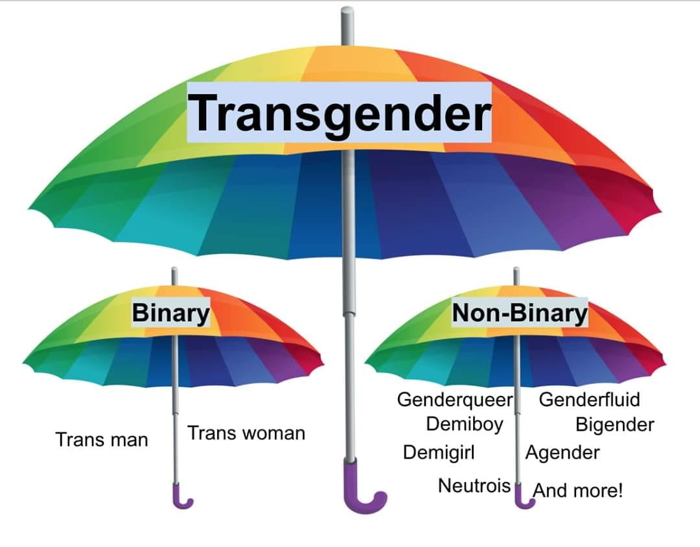
I don't like that illustration.
So what's my problem with it?
I identify as genderqueer and I do not identify as transgender, and that umbrella diagram sticks me into that category whether I like it or not. That diagram creates a hierarchy in which all genderqueer people are transgender (but not vice versa). That means that any statement that transgender people make on behalf of all trans people is going to be considered to apply to me and other people like me. Because we're defined as being under that umbrella.
Let's look at some of the broad all-inclusive statements that many transgender people have made, shall we?
a) A person's gender identity is valid regardless of their physical anatomy. You don't have to have a medical transition in order for your gender identity to be valid. You don't have to "pass" in order for your gender identity to be valid
Well, that one is wonderful, I'm totally on-board with that! It used to be that society's understanding of what it meant to be trans was that you went out and got yourself a medical transition to make your physical anatomy correspond with your gender identity. And that certainly didn't describe me! So this is a good change, a good shift. The problem is with additional assumptions and assertions that they very often attach to that, such as
b) A person's physical anatomy is not a polite topic of consideration. Anatomy is utterly irrelevant to identity and nobody's business. It's totally inappropriate to be identifying a person on the basis of what's inside their underpants
and...
c) You should not use any anatomy-based terms except to refer to the binary sex assignment that our society coercively attributes people to at birth. If someone identifies as a woman or girl, you would be misgendering them if you did not consider them female; if someone identifies as a man or boy, to not regard them as fully male is transphobic and misgendering also
and...
d) Any insistence that sex and gender are two different things is politically offensive and based on wrong out-of-date science that is now disproven. There's no such thing as "biological sex" because intersex people exist and there are multitudes of body variation from chromosomes to organ structures, so the binary is just a social construct and there is no physical sex.
Well, let's unpack some of that. (Because we don't all wear the same packers in here, okay?) In reverse order, my intersex-activist buddies do want to make a distinction between sex and gender. It's important to them and they're tired of "intersex" being used as an argument for why "biological sex doesn't exist" and otherwise ignored. Intersex people have bodies. They have bodies that other people found embarrassingly different. So embarrassing that they often coercively assigned their bodies to male or female with a surgeon's knife, without their consent. Intersex people can't discuss the fact that their body differed at birth from the body of either male people or female people if "male" refers to gender identity instead of physical sex. Intersex people can't identify themselves if people in society are confused and say things like "Oh me too, I've always had a female side, I wanted to dance ballet instead of play baseball". I'm not intersex myself, but I can't even explain that I'm not intersex if the language doesn't let me explain that although I was never a boy or man, my physical configuration wasn't unusual for male people. That it's my gender that's queer, that my sex falls into normative classifications.
I identify as a femme or girl. But unlike Teresa, my transgender sister, I would not be misgendered if you called me male. Teresa would be; she'd find it insulting and demeaning. She identifies as a woman and definitely female. But I'm not Teresa. I identify as male. I identify as femme or girl. My sex and my gender don't match. I'm genderqueer. And if you're going to raise a giant umbrella over my head and say we're all transgender, you can't go around making blanket statements that support Teresa's identity but erase mine.
If it is no longer necessary to "pass", to look like a typical cisgender person of your same gender, then it should not matter if people do make some guesses about what's inside my underwear. Because no matter what's in there, we already agreed that it doesn't invalidate my gender identity, right? So it doesn't have to be kept a shameful secret. I've got the anatomy that most directly caused my mom's obstetrician to designate me as "male". It's an unfortunate social fact that the same anatomy also caused my birth announcements to incorrectly tell everyone "It's a boy!", but the "male" part wasn't wrong and I have no reason to hide it. I was a male girl. Perfectly queer and not typical, and quite healthy and happy with that, thank you.
I propose this umbrella instead:
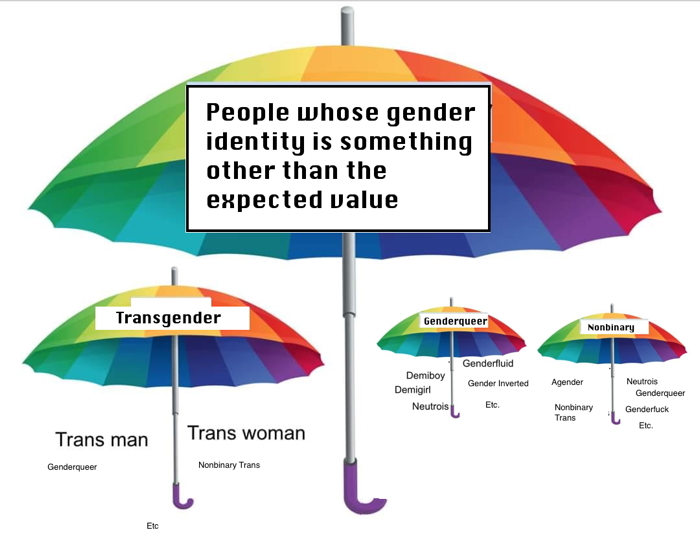
Notice that under this umbrella, several terms appear in multiple places. Because some genderqueer people do identify as transgender, whereas some do not; similarly some nonbinary people identify as transgender and others do not, and some nonbinary people consider themselves genderqueer while others do not, and vice versa and so on.
———————
You're secluded in quarantine, and all the performances and events have been cancelled, so it's a good time to read a book!
My book, GenderQueer: A Story From a Different Closet, has been published by Sunstone Press. It is available on Amazon and Barnes & Noble in paperback and ebook, and as ebook only from Apple, Kobo, and directly from Sunstone Press themselves.
Links to published reviews and comments are listed on my Home Page
———————
This DreamWidth blog is echoed on LiveJournal, WordPress, and Blogger. Please friend/link me from any of those environments on which you have an account.
————————
Index of all Blog Posts
I don't like that illustration.
So what's my problem with it?
I identify as genderqueer and I do not identify as transgender, and that umbrella diagram sticks me into that category whether I like it or not. That diagram creates a hierarchy in which all genderqueer people are transgender (but not vice versa). That means that any statement that transgender people make on behalf of all trans people is going to be considered to apply to me and other people like me. Because we're defined as being under that umbrella.
Let's look at some of the broad all-inclusive statements that many transgender people have made, shall we?
a) A person's gender identity is valid regardless of their physical anatomy. You don't have to have a medical transition in order for your gender identity to be valid. You don't have to "pass" in order for your gender identity to be valid
Well, that one is wonderful, I'm totally on-board with that! It used to be that society's understanding of what it meant to be trans was that you went out and got yourself a medical transition to make your physical anatomy correspond with your gender identity. And that certainly didn't describe me! So this is a good change, a good shift. The problem is with additional assumptions and assertions that they very often attach to that, such as
b) A person's physical anatomy is not a polite topic of consideration. Anatomy is utterly irrelevant to identity and nobody's business. It's totally inappropriate to be identifying a person on the basis of what's inside their underpants
and...
c) You should not use any anatomy-based terms except to refer to the binary sex assignment that our society coercively attributes people to at birth. If someone identifies as a woman or girl, you would be misgendering them if you did not consider them female; if someone identifies as a man or boy, to not regard them as fully male is transphobic and misgendering also
and...
d) Any insistence that sex and gender are two different things is politically offensive and based on wrong out-of-date science that is now disproven. There's no such thing as "biological sex" because intersex people exist and there are multitudes of body variation from chromosomes to organ structures, so the binary is just a social construct and there is no physical sex.
Well, let's unpack some of that. (Because we don't all wear the same packers in here, okay?) In reverse order, my intersex-activist buddies do want to make a distinction between sex and gender. It's important to them and they're tired of "intersex" being used as an argument for why "biological sex doesn't exist" and otherwise ignored. Intersex people have bodies. They have bodies that other people found embarrassingly different. So embarrassing that they often coercively assigned their bodies to male or female with a surgeon's knife, without their consent. Intersex people can't discuss the fact that their body differed at birth from the body of either male people or female people if "male" refers to gender identity instead of physical sex. Intersex people can't identify themselves if people in society are confused and say things like "Oh me too, I've always had a female side, I wanted to dance ballet instead of play baseball". I'm not intersex myself, but I can't even explain that I'm not intersex if the language doesn't let me explain that although I was never a boy or man, my physical configuration wasn't unusual for male people. That it's my gender that's queer, that my sex falls into normative classifications.
I identify as a femme or girl. But unlike Teresa, my transgender sister, I would not be misgendered if you called me male. Teresa would be; she'd find it insulting and demeaning. She identifies as a woman and definitely female. But I'm not Teresa. I identify as male. I identify as femme or girl. My sex and my gender don't match. I'm genderqueer. And if you're going to raise a giant umbrella over my head and say we're all transgender, you can't go around making blanket statements that support Teresa's identity but erase mine.
If it is no longer necessary to "pass", to look like a typical cisgender person of your same gender, then it should not matter if people do make some guesses about what's inside my underwear. Because no matter what's in there, we already agreed that it doesn't invalidate my gender identity, right? So it doesn't have to be kept a shameful secret. I've got the anatomy that most directly caused my mom's obstetrician to designate me as "male". It's an unfortunate social fact that the same anatomy also caused my birth announcements to incorrectly tell everyone "It's a boy!", but the "male" part wasn't wrong and I have no reason to hide it. I was a male girl. Perfectly queer and not typical, and quite healthy and happy with that, thank you.
I propose this umbrella instead:
Notice that under this umbrella, several terms appear in multiple places. Because some genderqueer people do identify as transgender, whereas some do not; similarly some nonbinary people identify as transgender and others do not, and some nonbinary people consider themselves genderqueer while others do not, and vice versa and so on.
———————
You're secluded in quarantine, and all the performances and events have been cancelled, so it's a good time to read a book!
My book, GenderQueer: A Story From a Different Closet, has been published by Sunstone Press. It is available on Amazon and Barnes & Noble in paperback and ebook, and as ebook only from Apple, Kobo, and directly from Sunstone Press themselves.
Links to published reviews and comments are listed on my Home Page
———————
This DreamWidth blog is echoed on LiveJournal, WordPress, and Blogger. Please friend/link me from any of those environments on which you have an account.
————————
Index of all Blog Posts
Sunday, August 30, 2020
I Get Reviewed by the Taos News!
After months and months of getting nice reviews in college newspapers and, at a lower volume, LGBTQIA press publications, I'm finally getting some reviews published in mainstream newspapers. Two weeks ago I made the Los Alamos Daily Post and now, extending my coverage in the New Mexican press, I'm in the Taos News.
Taos, like Los Alamos, is an eclectic little village, with a diverse and culturally savvy population and many farflung former residents who may still subscribe to the local paper.
— María Dolores Gonzales, Taos News https://www.taosnews.com/tempo/dont-forget-we-are-mexican/article_0b71eca2-1303-5733-b2b1-3d5a2c5151e1.html
———————
You're secluded in quarantine, and all the performances and events have been cancelled, so it's a good time to read a book!
My book, GenderQueer: A Story From a Different Closet, has been published by Sunstone Press. It is available on Amazon and Barnes & Noble in paperback and ebook, and as ebook only from Apple, Kobo, and directly from Sunstone Press themselves.
Links to published reviews and comments are listed on my Home Page
———————
This DreamWidth blog is echoed on LiveJournal, WordPress, and Blogger. Please friend/link me from any of those environments on which you have an account.
————————
Index of all Blog Posts
Taos, like Los Alamos, is an eclectic little village, with a diverse and culturally savvy population and many farflung former residents who may still subscribe to the local paper.
"When Derek Hunter moves to Los Alamos from Valdosta, Georgia, in eighth grade, he is bullied mercilessly. A tall, thin boy with glasses, who likes to wear stovepipe pants and slicked-back hair instead of bell-bottoms and long tresses (this is 1974), he embraces nonconformism mostly because he has nothing in common with boys his age.
What he knows about boys is "ribald and crude" and a "constant undercurrent of threat." He favors the company of girls, who are more accepting and physically attractive. Boys he begins to think of as "them," as the enemy. And they return the favor in terms of verbal and physical bullying.
In this tortured litany of harassment mostly set in Northern New Mexico, author Hunter, who lived in New Mexico until the mid-1980s, before moving to New York to become an activist in gender theory, presents a coming-of-age novel of ambivalent identity that the protagonist ultimately figures out on his own."
— María Dolores Gonzales, Taos News https://www.taosnews.com/tempo/dont-forget-we-are-mexican/article_0b71eca2-1303-5733-b2b1-3d5a2c5151e1.html
———————
You're secluded in quarantine, and all the performances and events have been cancelled, so it's a good time to read a book!
My book, GenderQueer: A Story From a Different Closet, has been published by Sunstone Press. It is available on Amazon and Barnes & Noble in paperback and ebook, and as ebook only from Apple, Kobo, and directly from Sunstone Press themselves.
Links to published reviews and comments are listed on my Home Page
———————
This DreamWidth blog is echoed on LiveJournal, WordPress, and Blogger. Please friend/link me from any of those environments on which you have an account.
————————
Index of all Blog Posts
Friday, August 14, 2020
Los Alamos Home Town Newspaper Reviews My Book
I have had many nice reviews printed in college newspapers and I've been reviewed in the LGBTQIA press. And I've had notices and interviews in mainstream papers that speak to the existence of the book, but which weren't actually reviews of it. But until this week I did not have an actual review of GenderQueer printed in a mainstream municipal newspaper.
So it seems utterly appropriate that the first to do so would be the Los Alamos Daily Post, the newspaper from the town where I attended junior high and high school. The newspaper from the town where most of the action in the book takes place.
Lifestyles Editor Bonne Gordon was a great interviewer; when she called me to ask questions about my book and my experiences, it was obvious that she had not only been giving the book a close read but was also familiar on a deep level with the relevant backdrop issues. We discussed gender from the standpoint of LGBTQIA experiences and feminism, and how things have changed (and how they haven't) over the forty years since the events described in the book.
Los Alamos is both a small community and a special, well-known one. It's received far more literary attention than a typical village of 12,000 inhabitants would, but not so much that the people who live there don't become interested when a book about living there goes to press. So with any luck, the article will spark some local interest in reading my book.
Putting the Q in LGBTQ: Growing Up 'Different' In Los Alamos — Bonnie Gordon, The Los Alamos Daily Post
———————
You're secluded in quarantine, and all the performances and events have been cancelled, so it's a good time to read a book!
My book, GenderQueer: A Story From a Different Closet, has been published by Sunstone Press. It is available on Amazon and Barnes & Noble in paperback and ebook, and as ebook only from Apple, Kobo, and directly from Sunstone Press themselves.
Links to published reviews and comments are listed on my Home Page
———————
This DreamWidth blog is echoed on LiveJournal, WordPress, and Blogger. Please friend/link me from any of those environments on which you have an account.
————————
Index of all Blog Posts
So it seems utterly appropriate that the first to do so would be the Los Alamos Daily Post, the newspaper from the town where I attended junior high and high school. The newspaper from the town where most of the action in the book takes place.
Lifestyles Editor Bonne Gordon was a great interviewer; when she called me to ask questions about my book and my experiences, it was obvious that she had not only been giving the book a close read but was also familiar on a deep level with the relevant backdrop issues. We discussed gender from the standpoint of LGBTQIA experiences and feminism, and how things have changed (and how they haven't) over the forty years since the events described in the book.
Los Alamos is both a small community and a special, well-known one. It's received far more literary attention than a typical village of 12,000 inhabitants would, but not so much that the people who live there don't become interested when a book about living there goes to press. So with any luck, the article will spark some local interest in reading my book.
Putting the Q in LGBTQ: Growing Up 'Different' In Los Alamos — Bonnie Gordon, The Los Alamos Daily Post
———————
You're secluded in quarantine, and all the performances and events have been cancelled, so it's a good time to read a book!
My book, GenderQueer: A Story From a Different Closet, has been published by Sunstone Press. It is available on Amazon and Barnes & Noble in paperback and ebook, and as ebook only from Apple, Kobo, and directly from Sunstone Press themselves.
Links to published reviews and comments are listed on my Home Page
———————
This DreamWidth blog is echoed on LiveJournal, WordPress, and Blogger. Please friend/link me from any of those environments on which you have an account.
————————
Index of all Blog Posts
Saturday, August 1, 2020
Two New Reviews from Book Bloggers
A couple of really nice reviews of GenderQueer were posted this week by book bloggers, with any luck drawing some more attention to my book and luring more people to read it!
"In a world which is still conservative at large and prejudiced for the most part, Derek's story is agonizing despite being inspirational. I say this because it shows us just how hurtful and indifferent people can be, especially if you are trying to tell the truth about something that they'd much rather pretend doesn't exist...
No amount of research into theoretical assumptions and claims can replace the experience of reading someone's life story and knowing what they've been through. The narrative style is simple yet powerful. By the time you reach the final page, you'll feel like you've had quite the journey...
Characters: This is obviously about the main character or the author himself. I don't think its necessary to mention again how moved I was by his story. I, however, would like to talk about the brilliant way in which the others are depicted. Some characters represent a particular way of thinking. No matter what we think about stereotyping, it's true that some people share the same sort of antagonism and hatred when it comes to the LGBTQ+ community and this group appears pretty frequently in the book, needless to say. The author has merged several like minded people into a few characters because they are significant only because of their point of view. This has resulted in a story not overcrowded with characters and has left enough space for Derek to reveal himself to the reader...
Genderqueer succeeds greatly as a memoir because it excels in every sub-category."
Saradia Chatterjee (Blogger: Crazy Curious Sara) Crazy Curious Reader
"I guess I'd shot my mouth off. - First Sentence, Part One: School. At A Party: 1979
This is who I am, how I am. Get used to it! I will never again tolerate people being mean and nasty to me and acting like I deserve it because I don't act like a guy. From now on being all worried about that is gonna be their problem. - Memorable Moment, Page 166
I ...had thought to use the metaphor 'like a round peg in a square hole' but somehow that didn't feel strong enough so, abnormal, there I've said it - the author was made to feel abnormal, for the most part this wasn't comfortable reading and arguably the former portions spent on the author's early life experiences were a tad too drawn out, and yet that said ...
Not always a journey easily travelled (and especially not then) I think that not to have chronicled these events and, perhaps more importantly, the feelings they gave rise to, in such detail would have been to do a disservice to the experiences of not only Derek but also to generations of people who have rarely been represented; whose stories have never been told.
A very human story but one that provides an important insight into gender and identity."
Felicity Grace Terry (Blogger) Pen and Paper
More reviews and book purchase information available here on my author web site
In other news, I've begun querying lit agents and small publishers about my second book, That Guy in our Women's Studies Class, and next week I'm thinking I'll post the query letter than I'm using for it. On the one hand, I think it will be a more difficult sell: the topic of being genderqueer is about as hot at the moment as its ever been, whereas the second book, while still tangentially about that (the main character, i.e., me, is genderqueer, and that both informs a lot of the character's interactions with the other characters and also is the reason for majoring in women's studies in the first place), is a lot more focused on the presence of a male person (or man, or person perceived to be male or a man at any rate) within feminism and the larger questions of privilege and marginalization... and that's probably going to be perceived by lit agents and publishers as a lot more intellectual and less mainstream. On the other hand, I'll have the advantage of being a published author already this time around. The author of a book that's being nominated by the publisher as their entry for the Aspen Prize, in fact!
*preen*
So I may be able to pull it off, to get my second book published.
I'm still soliciting beta readers, by the way. It's only recently out of the oven and I want to get some folks to do taste tests, so if you're up for a novel-length nonfiction book about a sissy who hitches to New York to major in women's studies, give me a holler.
———————
You're secluded in quarantine, and all the performances and events have been cancelled, so it's a good time to read a book!
My book, GenderQueer: A Story From a Different Closet, has been published by Sunstone Press. It is available on Amazon and Barnes & Noble in paperback and ebook, and as ebook only from Apple, Kobo, and directly from Sunstone Press themselves.
Links to published reviews and comments are listed on my Home Page
———————
This DreamWidth blog is echoed on LiveJournal, WordPress, and Blogger. Please friend/link me from any of those environments on which you have an account.
————————
Index of all Blog Posts
"In a world which is still conservative at large and prejudiced for the most part, Derek's story is agonizing despite being inspirational. I say this because it shows us just how hurtful and indifferent people can be, especially if you are trying to tell the truth about something that they'd much rather pretend doesn't exist...
No amount of research into theoretical assumptions and claims can replace the experience of reading someone's life story and knowing what they've been through. The narrative style is simple yet powerful. By the time you reach the final page, you'll feel like you've had quite the journey...
Characters: This is obviously about the main character or the author himself. I don't think its necessary to mention again how moved I was by his story. I, however, would like to talk about the brilliant way in which the others are depicted. Some characters represent a particular way of thinking. No matter what we think about stereotyping, it's true that some people share the same sort of antagonism and hatred when it comes to the LGBTQ+ community and this group appears pretty frequently in the book, needless to say. The author has merged several like minded people into a few characters because they are significant only because of their point of view. This has resulted in a story not overcrowded with characters and has left enough space for Derek to reveal himself to the reader...
Genderqueer succeeds greatly as a memoir because it excels in every sub-category."
Saradia Chatterjee (Blogger: Crazy Curious Sara) Crazy Curious Reader
"I guess I'd shot my mouth off. - First Sentence, Part One: School. At A Party: 1979
This is who I am, how I am. Get used to it! I will never again tolerate people being mean and nasty to me and acting like I deserve it because I don't act like a guy. From now on being all worried about that is gonna be their problem. - Memorable Moment, Page 166
I ...had thought to use the metaphor 'like a round peg in a square hole' but somehow that didn't feel strong enough so, abnormal, there I've said it - the author was made to feel abnormal, for the most part this wasn't comfortable reading and arguably the former portions spent on the author's early life experiences were a tad too drawn out, and yet that said ...
Not always a journey easily travelled (and especially not then) I think that not to have chronicled these events and, perhaps more importantly, the feelings they gave rise to, in such detail would have been to do a disservice to the experiences of not only Derek but also to generations of people who have rarely been represented; whose stories have never been told.
A very human story but one that provides an important insight into gender and identity."
Felicity Grace Terry (Blogger) Pen and Paper
More reviews and book purchase information available here on my author web site
In other news, I've begun querying lit agents and small publishers about my second book, That Guy in our Women's Studies Class, and next week I'm thinking I'll post the query letter than I'm using for it. On the one hand, I think it will be a more difficult sell: the topic of being genderqueer is about as hot at the moment as its ever been, whereas the second book, while still tangentially about that (the main character, i.e., me, is genderqueer, and that both informs a lot of the character's interactions with the other characters and also is the reason for majoring in women's studies in the first place), is a lot more focused on the presence of a male person (or man, or person perceived to be male or a man at any rate) within feminism and the larger questions of privilege and marginalization... and that's probably going to be perceived by lit agents and publishers as a lot more intellectual and less mainstream. On the other hand, I'll have the advantage of being a published author already this time around. The author of a book that's being nominated by the publisher as their entry for the Aspen Prize, in fact!
*preen*
So I may be able to pull it off, to get my second book published.
I'm still soliciting beta readers, by the way. It's only recently out of the oven and I want to get some folks to do taste tests, so if you're up for a novel-length nonfiction book about a sissy who hitches to New York to major in women's studies, give me a holler.
———————
You're secluded in quarantine, and all the performances and events have been cancelled, so it's a good time to read a book!
My book, GenderQueer: A Story From a Different Closet, has been published by Sunstone Press. It is available on Amazon and Barnes & Noble in paperback and ebook, and as ebook only from Apple, Kobo, and directly from Sunstone Press themselves.
Links to published reviews and comments are listed on my Home Page
———————
This DreamWidth blog is echoed on LiveJournal, WordPress, and Blogger. Please friend/link me from any of those environments on which you have an account.
————————
Index of all Blog Posts
Friday, July 17, 2020
Hey, Sister...
Hey, sister, got a moment? Any chance we can reconcile?
You find it bewildering that as a femme-identifying person, I refer to myself as male. You find it appalling and maybe even transphobic when I explain that what I mean when I say I'm "male" is that I was born with a set of physical equipment that, in our culture, has historically been designated "male", although many other people (perhaps including you) may have this same set of bodily components and call those physical structures something other than "male".
You say "Why can't you just call it a penis? A penis isn't male. It's just a penis! Girls can have a penis. Boys can have a vulva".
Well, yeah, I know girls can have a penis. I'm a girl and I've got one. Are we both cool and totally down with the notion that having a penis doesn't define our gender? Can we please have a little moment of peace and solidarity and not be quick to hate on each other for using language a bit differently, and for coming at this situation from different angles?
You identify as transgender. I don't. That means you're a part of a subculture, a community; and you folks, collectively, you got your own way of expressing things, and you also got your own history. Let's talk about the history thing for a sec.
I'm 61; forty years ago, when I was 21 and first coming out, trans people explained the situation to the larger surrounding culture like this: trans people realized at some point in their life that their gender was the gender typically found in the other type of body, and so they'd ideally get hormones and surgery and transition, so that their body would match their gender. And what they said they wanted from the surrounding world was to be accepted as a normal and ordinary person of that gender and that sex. And most trans people wanted to "pass" — they didn't want to receive social acceptance only from a handful of people who heard their life story and learned about transsexuals and all that, but instead they wanted to look and otherwise present in such a way that strangers who didn't know them would just automatically treat them as the gender that they were.
Fast forward to the more-or-less present era. Trans activists interact with lots of transgender people who can't afford hormones and surgery even if they want them, and lots of people who are blocked from having access to the medical interventions they want because doctors and insurance companies are playing gatekeeper. They also interact with a lot of transgender people who don't want the whole package of medical options for a variety of reasons. There's a risk of significant loss of sensation and function when doctors rearrange biological tissue, and there are systemic repercussions to hormones with risk factors and so on and so forth.
Well, it's really fundamentally a human rights issue that the body you inhabit should not detract from the legitimacy of your gender identity. So the social message changed, to become a lot more inclusive. You were valid as a trans person (woman or man) whether you passed or did not pass, and, in fact, fuck "pass". Identities are what are valid; your body doesn't matter! And they didn't use "male" and "female" to refer to bodily architecture because that can imply to some trans people that they've got the wrong body for their gender identity.
I apologize if I've misrepresented the transgender movement and its history in that short summary. I'm writing from the outside. I try to learn and listen but if I've distorted things, I'm sorry, but I hope I mostly got it right.
I'm not trans. I heard the 40-years-ago version of what trans was, gave it some thought, decided nope, that's not me. It's something else. I haven't been a part of your community these 40 years.
So I've got a different history, with different understandings and stuff. I'm hoping you'll be compassionate and interested in a story that's different from yours, so you can see how I got to my viewpoint, ok?
I came out in 1980 as a sissy. A person in a male body whose personality and behavior were a mismatch for what's expected of male people, but a good match for the expectations for female people. I did not want to be perceived as an ordinary typical female person any more than I wanted to be perceived as an ordinary male person. I wanted to be perceived as what I'd been harassed about and accused of all my life: an effeminate sissy girlish male person. The world apparently thought I should be ashamed of that, but I was proud of it. And I was finally angry about it and ready to take a stand. To be in your face about it. Yeah, I'm male, and I'm one of the girls. Get used to it. Deal.
My attitude is that until the world nods in agreement that yeah, male girls exist and no, it's not a damn affliction or an embarrassment, a failure to be sufficiently manly... until then, there's always going to be this notion that if you're perceived and recognized as a male-bodied person, you'll be regarded as less of a man than a masculine man and less of a woman than a physically female-structured person who has boobs and vag and all that.
Not only don't I want to pass, I want to "anti-pass". I want, as I said, to be up in people's face about the lack of correspondence between my body and my gender identity. You've got a male girl here. Flying pride flags about it, no less, got that?
So... you don't use "male" to refer to physical stuff like testicles and penis. You basically use "male" to mean the same thing as "man" and "boy" and so on. I, on the other hand, do use it to mean the physical stuff. My attitude is we've already got plenty of gender words ("man", "boy", "masculine", "feminine", "guy", "dude", "gal", etc), and the word "male" is historically about the raw physical architecture (including other species and also things like hose couplings and electrical plugs), so why can't we keep that word for sex and use existing gender words for gender? This isn't about invalidating anybody's gender identity, it's really not. Yeesh, do I sound like J. K. fucking Rowling here? Seriously?
You ask "Well, why can't you just call it a penis, why do you have to say male?". I say "I want a goddam adjective. An already-recognized adjective to describe me as a person-with-penis-and-associated-bits. I don't want to use a long klunky phrase like 'person with a penis and testicles and adam's apple and absence of a vulva and clitoris and breasts, person who happens to be dyadic or endosex as opposed to intersex and most likely has XY chromosomes and doesn't have a period and has spermatotrophic hormone and a vas deferens'".
If I don't specify that when I say "male" I'm talking about my plumbing and not my personality and inclinations, people often assume I'm saying I have a "male side and a female side", like genderfluid or bigender people. Which isn't it at all. I'm not less feminine than you are. I'm not less male than a rooster. I'm not in-between, either sexually (as intersex people may consider themselves to be) or genderwise. I'm solidly male and utterly feminine.
I'm talking about mine. MY parts. I'm not calling your parts male. I'm calling my parts male.
Not everybody is either male or female, just as not everybody who is male is a man and not everybody who is female is a woman. But the fact that sex isn't binary doesn't mean sex doesn't exist. By the way, intersex people can't talk about being intersex — and distinguish intersex from being nonbinary or intergender or genderfluid or whatever — if they can't talk about bodies and why their atypical body has marked them as different and marginalized them. Most of the intersex activists I know really want to distinguish sex from gender. Because otherwise they get erased.
In a similar way, I can't do the political activity of getting in people's face about being a male girl if I can't say "male girl" and can't talk about the body that caused my girlness to be perceived as something wrong and in need of fixing, or as reason to provoke dismissive contempt.
I personally identify as genderqueer and, more specifically, as a gender invert. I'm a speaker, a blogger, and an author. I just got a book published (and BTW you should read it if you have any appetite for coming-of-age / coming-out stories). I'm not going to go away or shut up.
Does this help?
———————
You're secluded in quarantine, and all the performances and events have been cancelled, so it's a good time to read a book!
My book, GenderQueer: A Story From a Different Closet, has been published by Sunstone Press. It is available on Amazon and Barnes & Noble in paperback and ebook, and as ebook only from Apple, Kobo, and directly from Sunstone Press themselves.
Links to published reviews and comments are listed on my Home Page
———————
This DreamWidth blog is echoed on LiveJournal, WordPress, and Blogger. Please friend/link me from any of those environments on which you have an account.
————————
Index of all Blog Posts
You find it bewildering that as a femme-identifying person, I refer to myself as male. You find it appalling and maybe even transphobic when I explain that what I mean when I say I'm "male" is that I was born with a set of physical equipment that, in our culture, has historically been designated "male", although many other people (perhaps including you) may have this same set of bodily components and call those physical structures something other than "male".
You say "Why can't you just call it a penis? A penis isn't male. It's just a penis! Girls can have a penis. Boys can have a vulva".
Well, yeah, I know girls can have a penis. I'm a girl and I've got one. Are we both cool and totally down with the notion that having a penis doesn't define our gender? Can we please have a little moment of peace and solidarity and not be quick to hate on each other for using language a bit differently, and for coming at this situation from different angles?
You identify as transgender. I don't. That means you're a part of a subculture, a community; and you folks, collectively, you got your own way of expressing things, and you also got your own history. Let's talk about the history thing for a sec.
I'm 61; forty years ago, when I was 21 and first coming out, trans people explained the situation to the larger surrounding culture like this: trans people realized at some point in their life that their gender was the gender typically found in the other type of body, and so they'd ideally get hormones and surgery and transition, so that their body would match their gender. And what they said they wanted from the surrounding world was to be accepted as a normal and ordinary person of that gender and that sex. And most trans people wanted to "pass" — they didn't want to receive social acceptance only from a handful of people who heard their life story and learned about transsexuals and all that, but instead they wanted to look and otherwise present in such a way that strangers who didn't know them would just automatically treat them as the gender that they were.
Fast forward to the more-or-less present era. Trans activists interact with lots of transgender people who can't afford hormones and surgery even if they want them, and lots of people who are blocked from having access to the medical interventions they want because doctors and insurance companies are playing gatekeeper. They also interact with a lot of transgender people who don't want the whole package of medical options for a variety of reasons. There's a risk of significant loss of sensation and function when doctors rearrange biological tissue, and there are systemic repercussions to hormones with risk factors and so on and so forth.
Well, it's really fundamentally a human rights issue that the body you inhabit should not detract from the legitimacy of your gender identity. So the social message changed, to become a lot more inclusive. You were valid as a trans person (woman or man) whether you passed or did not pass, and, in fact, fuck "pass". Identities are what are valid; your body doesn't matter! And they didn't use "male" and "female" to refer to bodily architecture because that can imply to some trans people that they've got the wrong body for their gender identity.
I apologize if I've misrepresented the transgender movement and its history in that short summary. I'm writing from the outside. I try to learn and listen but if I've distorted things, I'm sorry, but I hope I mostly got it right.
I'm not trans. I heard the 40-years-ago version of what trans was, gave it some thought, decided nope, that's not me. It's something else. I haven't been a part of your community these 40 years.
So I've got a different history, with different understandings and stuff. I'm hoping you'll be compassionate and interested in a story that's different from yours, so you can see how I got to my viewpoint, ok?
I came out in 1980 as a sissy. A person in a male body whose personality and behavior were a mismatch for what's expected of male people, but a good match for the expectations for female people. I did not want to be perceived as an ordinary typical female person any more than I wanted to be perceived as an ordinary male person. I wanted to be perceived as what I'd been harassed about and accused of all my life: an effeminate sissy girlish male person. The world apparently thought I should be ashamed of that, but I was proud of it. And I was finally angry about it and ready to take a stand. To be in your face about it. Yeah, I'm male, and I'm one of the girls. Get used to it. Deal.
My attitude is that until the world nods in agreement that yeah, male girls exist and no, it's not a damn affliction or an embarrassment, a failure to be sufficiently manly... until then, there's always going to be this notion that if you're perceived and recognized as a male-bodied person, you'll be regarded as less of a man than a masculine man and less of a woman than a physically female-structured person who has boobs and vag and all that.
Not only don't I want to pass, I want to "anti-pass". I want, as I said, to be up in people's face about the lack of correspondence between my body and my gender identity. You've got a male girl here. Flying pride flags about it, no less, got that?
So... you don't use "male" to refer to physical stuff like testicles and penis. You basically use "male" to mean the same thing as "man" and "boy" and so on. I, on the other hand, do use it to mean the physical stuff. My attitude is we've already got plenty of gender words ("man", "boy", "masculine", "feminine", "guy", "dude", "gal", etc), and the word "male" is historically about the raw physical architecture (including other species and also things like hose couplings and electrical plugs), so why can't we keep that word for sex and use existing gender words for gender? This isn't about invalidating anybody's gender identity, it's really not. Yeesh, do I sound like J. K. fucking Rowling here? Seriously?
You ask "Well, why can't you just call it a penis, why do you have to say male?". I say "I want a goddam adjective. An already-recognized adjective to describe me as a person-with-penis-and-associated-bits. I don't want to use a long klunky phrase like 'person with a penis and testicles and adam's apple and absence of a vulva and clitoris and breasts, person who happens to be dyadic or endosex as opposed to intersex and most likely has XY chromosomes and doesn't have a period and has spermatotrophic hormone and a vas deferens'".
If I don't specify that when I say "male" I'm talking about my plumbing and not my personality and inclinations, people often assume I'm saying I have a "male side and a female side", like genderfluid or bigender people. Which isn't it at all. I'm not less feminine than you are. I'm not less male than a rooster. I'm not in-between, either sexually (as intersex people may consider themselves to be) or genderwise. I'm solidly male and utterly feminine.
I'm talking about mine. MY parts. I'm not calling your parts male. I'm calling my parts male.
Not everybody is either male or female, just as not everybody who is male is a man and not everybody who is female is a woman. But the fact that sex isn't binary doesn't mean sex doesn't exist. By the way, intersex people can't talk about being intersex — and distinguish intersex from being nonbinary or intergender or genderfluid or whatever — if they can't talk about bodies and why their atypical body has marked them as different and marginalized them. Most of the intersex activists I know really want to distinguish sex from gender. Because otherwise they get erased.
In a similar way, I can't do the political activity of getting in people's face about being a male girl if I can't say "male girl" and can't talk about the body that caused my girlness to be perceived as something wrong and in need of fixing, or as reason to provoke dismissive contempt.
I personally identify as genderqueer and, more specifically, as a gender invert. I'm a speaker, a blogger, and an author. I just got a book published (and BTW you should read it if you have any appetite for coming-of-age / coming-out stories). I'm not going to go away or shut up.
Does this help?
———————
You're secluded in quarantine, and all the performances and events have been cancelled, so it's a good time to read a book!
My book, GenderQueer: A Story From a Different Closet, has been published by Sunstone Press. It is available on Amazon and Barnes & Noble in paperback and ebook, and as ebook only from Apple, Kobo, and directly from Sunstone Press themselves.
Links to published reviews and comments are listed on my Home Page
———————
This DreamWidth blog is echoed on LiveJournal, WordPress, and Blogger. Please friend/link me from any of those environments on which you have an account.
————————
Index of all Blog Posts
Saturday, June 20, 2020
Just
"I don't see why that makes it a different gender identity", someone asks me. (I visualize them with their arms crossed and scowling). "Why can't you just say you're a man with a lot of traits that are generally associated with women?"
OK, I'll give you your answer.
It's sitting there inside your question. You said just.
We often say "just" to mean merely, or less than: "Why do I have to mop the floor? Can't I just sweep up the crumbs and dirt with a broom?"
When you suggest I should "just" identify as a man with a bunch of feminine traits, it sounds like you're saying that the identity terms I'm using -- genderqueer, gender invert, being a male girl -- is more audacious, a stronger statement. That I'm making a bigger deal out of the difference than you think I ought to.
But it is a big deal. That's the point.
On the other hand, sometimes we say "just" to mean simpler even when it isn't less than: "It's taking forever to clip the burrs out of Blackie's fur. Why don't we just dip him in a vat of Nair and wait for his hair to grow back, it would be easier!"
You're not doing that. You're not using "just" in that way. I could, though: "Why would I want to spend my life explaining that I'm a male with a lot of traits and tastes that are more typically associated with women than with men? Why can't I just say I'm a male girl?"
The way I express my identity has a "let's cut to the chase" simplicity to it.
———————
You're secluded in quarantine, and all the performances and events have been cancelled, so it's a good time to read a book!
My book, GenderQueer: A Story From a Different Closet, has been published by Sunstone Press. It is available on Amazon and Barnes & Noble in paperback and ebook, and as ebook only from Apple, Kobo, and directly from Sunstone Press themselves.
Links to published reviews and comments are listed on my Home Page
———————
This LiveJournal blog is echoed on DreamWidth, WordPress, and Blogger. Please friend/link me from any of those environments on which you have an account.
————————
Index of all Blog Posts
OK, I'll give you your answer.
It's sitting there inside your question. You said just.
We often say "just" to mean merely, or less than: "Why do I have to mop the floor? Can't I just sweep up the crumbs and dirt with a broom?"
When you suggest I should "just" identify as a man with a bunch of feminine traits, it sounds like you're saying that the identity terms I'm using -- genderqueer, gender invert, being a male girl -- is more audacious, a stronger statement. That I'm making a bigger deal out of the difference than you think I ought to.
But it is a big deal. That's the point.
On the other hand, sometimes we say "just" to mean simpler even when it isn't less than: "It's taking forever to clip the burrs out of Blackie's fur. Why don't we just dip him in a vat of Nair and wait for his hair to grow back, it would be easier!"
You're not doing that. You're not using "just" in that way. I could, though: "Why would I want to spend my life explaining that I'm a male with a lot of traits and tastes that are more typically associated with women than with men? Why can't I just say I'm a male girl?"
The way I express my identity has a "let's cut to the chase" simplicity to it.
———————
You're secluded in quarantine, and all the performances and events have been cancelled, so it's a good time to read a book!
My book, GenderQueer: A Story From a Different Closet, has been published by Sunstone Press. It is available on Amazon and Barnes & Noble in paperback and ebook, and as ebook only from Apple, Kobo, and directly from Sunstone Press themselves.
Links to published reviews and comments are listed on my Home Page
———————
This LiveJournal blog is echoed on DreamWidth, WordPress, and Blogger. Please friend/link me from any of those environments on which you have an account.
————————
Index of all Blog Posts
Friday, June 12, 2020
My Book's First Review in an LGBTQIA+ Publication
From Sherri Rase, Out In Jersey:
"Three Great Books for LGBTQ Summer Reading"
I've had nice reviews in college newspapers and an interview in the mainstream press (Newsday), but this is my first review in an LGBTQIA-centric publication, and I'm excited about it!
———————
You're secluded in quarantine, and all the performances and events have been cancelled, so it's a good time to read a book!
My book, GenderQueer: A Story From a Different Closet, has been published by Sunstone Press. It is available on Amazon and Barnes & Noble in paperback and ebook, and as ebook only from Apple, Kobo, and directly from Sunstone Press themselves.
Links to published reviews and comments are listed on my Home Page
———————
This LiveJournal blog is echoed on DreamWidth, WordPress, and Blogger. Please friend/link me from any of those environments on which you have an account.
————————
Index of all Blog Posts
Allan D. Hunter’s GenderQueer: A Story from a Different Closet is an eye-opening first-person account of Derek, born male, who identifies as a girl. While this hardly raises an eyebrow in the 21st century, in the 1970s, Derek had no role models and no points of reference.
If you are of a generation with Derek, give or take, you thrill with him at his first car, put wings on his heart. You feel the rush of first love, and first touch, when attraction becomes physical. You feel the pain of rejection and being misunderstood.
You may not be able to read the book in one sitting—it takes time to absorb.
"Three Great Books for LGBTQ Summer Reading"
I've had nice reviews in college newspapers and an interview in the mainstream press (Newsday), but this is my first review in an LGBTQIA-centric publication, and I'm excited about it!
———————
You're secluded in quarantine, and all the performances and events have been cancelled, so it's a good time to read a book!
My book, GenderQueer: A Story From a Different Closet, has been published by Sunstone Press. It is available on Amazon and Barnes & Noble in paperback and ebook, and as ebook only from Apple, Kobo, and directly from Sunstone Press themselves.
Links to published reviews and comments are listed on my Home Page
———————
This LiveJournal blog is echoed on DreamWidth, WordPress, and Blogger. Please friend/link me from any of those environments on which you have an account.
————————
Index of all Blog Posts
Saturday, June 6, 2020
Gender Invert, or Nonbinary Trans?
Like most people born with a penis and testicles, I was AMAB: assigned male at birth.
I don't refer to myself as transgender because I don't seek to be perceived as a female person. And I don't tend to identify as nonbinary because I don't seek to be perceived as someone who is neither male nor female.
I identify as genderqueer and, more specifically, as a gender invert.
* * *
There are a lot of ongoing discussions, especially within the trans communities, about how you don't have to be on hormones, don't have to get an operation, to be valid as a transgender person. About how the legitimacy of one's identity as transgender does not depend on changing one's body.
The ones who do — the people conventionally designated as "male to female" or "female to male" — are nowadays often referred to as "binary transgender". And the assertion that you don't have to be binary trans in order to be authentically trans is an affirmation of nonbinary transgender identities.
The fact that there are so many posts and statements saying so is a clear sign that a lot of people think "transgender" means that if you were assigned male at birth you wish to be perceived as female, accepted as a woman, not differentiated from cisgender women, that you present as female, that you do everything at your disposal to do so successfully, that you seek to pass. And reciprocally the other way around if you were assigned female at birth.
That's what the term "transgender" means to a lot of people out there, both within the trans community itself and in the mainstream.
Hello. I am a person who could identify as a "nonbinary transgender" person.
I don't choose to do so. I don't feel like it communicates. I feel like it just confuses people. They make one set of wrong assumptions when they see me and mentally assign me as a male person. If I tell them I'm transgender they make a different set of wrong assumptions and I'm no better off.
Meanwhile, out there are a bunch of male-to-female and female-to-male transgender folks. A handful of them are "truscum" or "transmedicalist" and don't consider anyone to be authentically trans unless they seek a medical transition. Then there are quite a few more who don't have that kind of absolute judgemental definitional thing going on, but who will admit to missing the days when the only kind of trans people were binary trans. I'm not going to say they're right, especially since so many of my friends and colleagues identify as nonbinary transgender. But I have to confess, I sympathize with them and their viewpoint. Many of them have been around as long as I have. That means they lived through decades when most of society had only heard dirty jokes and porn references to trans people. And some of them feel like they did the hard work to get transgender issues in front of the social consciousness and now all these newfangled nonbinary trans people want to be a part of the phenomenon.
There's a reason why there aren't more people identifying as I do, as gender invert. It's because they haven't heard the term. Nobody offered it to them as an option to consider. So they went with "transgender". Or "nonbinary". Or "nonbinary transgender".
But what if you were assigned male at birth, you consider your body to be, in fact, male, but your gender isn't masculine, isn't man, isn't guy, isn't boy, that instead you are femme, one of the girls? Or if you were assigned female at birth, recognize your body to be female, but have never been a girl or a woman, and instead you're all man, all guy, all boy, totally a masculine individual?
If you say "transgender" and folks know you were AFAB they'll almost universally assume you identify as "male". If you say "transgender" and they understand you were AMAB, they'll assume you to identify as "female".
Specifying "nonbinary transgender" just shifts the problem. Now people are likely to assume that you don't want to be identified as any named sex or gender. That you're declaring yourself to be neither male nor female, neither man nor woman.
If what I'm saying resonates for you, you're welcome to come join me as a gender invert instead.
———————
You're secluded in quarantine, and all the performances and events have been cancelled, so it's a good time to read a book!
My book, GenderQueer: A Story From a Different Closet, has been published by Sunstone Press. It is available on Amazon and Barnes & Noble in paperback and ebook, and as ebook only from Apple, Kobo, and directly from Sunstone Press themselves.
Links to published reviews and comments are listed on my Home Page
———————
This LiveJournal blog is echoed on DreamWidth, WordPress, and Blogger. Please friend/link me from any of those environments on which you have an account.
————————
Index of all Blog Posts
I don't refer to myself as transgender because I don't seek to be perceived as a female person. And I don't tend to identify as nonbinary because I don't seek to be perceived as someone who is neither male nor female.
I identify as genderqueer and, more specifically, as a gender invert.
* * *
There are a lot of ongoing discussions, especially within the trans communities, about how you don't have to be on hormones, don't have to get an operation, to be valid as a transgender person. About how the legitimacy of one's identity as transgender does not depend on changing one's body.
The ones who do — the people conventionally designated as "male to female" or "female to male" — are nowadays often referred to as "binary transgender". And the assertion that you don't have to be binary trans in order to be authentically trans is an affirmation of nonbinary transgender identities.
The fact that there are so many posts and statements saying so is a clear sign that a lot of people think "transgender" means that if you were assigned male at birth you wish to be perceived as female, accepted as a woman, not differentiated from cisgender women, that you present as female, that you do everything at your disposal to do so successfully, that you seek to pass. And reciprocally the other way around if you were assigned female at birth.
That's what the term "transgender" means to a lot of people out there, both within the trans community itself and in the mainstream.
Hello. I am a person who could identify as a "nonbinary transgender" person.
I don't choose to do so. I don't feel like it communicates. I feel like it just confuses people. They make one set of wrong assumptions when they see me and mentally assign me as a male person. If I tell them I'm transgender they make a different set of wrong assumptions and I'm no better off.
Meanwhile, out there are a bunch of male-to-female and female-to-male transgender folks. A handful of them are "truscum" or "transmedicalist" and don't consider anyone to be authentically trans unless they seek a medical transition. Then there are quite a few more who don't have that kind of absolute judgemental definitional thing going on, but who will admit to missing the days when the only kind of trans people were binary trans. I'm not going to say they're right, especially since so many of my friends and colleagues identify as nonbinary transgender. But I have to confess, I sympathize with them and their viewpoint. Many of them have been around as long as I have. That means they lived through decades when most of society had only heard dirty jokes and porn references to trans people. And some of them feel like they did the hard work to get transgender issues in front of the social consciousness and now all these newfangled nonbinary trans people want to be a part of the phenomenon.
There's a reason why there aren't more people identifying as I do, as gender invert. It's because they haven't heard the term. Nobody offered it to them as an option to consider. So they went with "transgender". Or "nonbinary". Or "nonbinary transgender".
But what if you were assigned male at birth, you consider your body to be, in fact, male, but your gender isn't masculine, isn't man, isn't guy, isn't boy, that instead you are femme, one of the girls? Or if you were assigned female at birth, recognize your body to be female, but have never been a girl or a woman, and instead you're all man, all guy, all boy, totally a masculine individual?
If you say "transgender" and folks know you were AFAB they'll almost universally assume you identify as "male". If you say "transgender" and they understand you were AMAB, they'll assume you to identify as "female".
Specifying "nonbinary transgender" just shifts the problem. Now people are likely to assume that you don't want to be identified as any named sex or gender. That you're declaring yourself to be neither male nor female, neither man nor woman.
If what I'm saying resonates for you, you're welcome to come join me as a gender invert instead.
———————
You're secluded in quarantine, and all the performances and events have been cancelled, so it's a good time to read a book!
My book, GenderQueer: A Story From a Different Closet, has been published by Sunstone Press. It is available on Amazon and Barnes & Noble in paperback and ebook, and as ebook only from Apple, Kobo, and directly from Sunstone Press themselves.
Links to published reviews and comments are listed on my Home Page
———————
This LiveJournal blog is echoed on DreamWidth, WordPress, and Blogger. Please friend/link me from any of those environments on which you have an account.
————————
Index of all Blog Posts
Friday, May 29, 2020
Interviewed for a PodCast — Off The Cuffs
On May 20, I was invited back to Off The Cuffs, a Kink and BDSM Podcast, to talk about my book and about gender identity and being genderqueer.
I say "invited back" because this was a reinterview. Back in 2016, during the interval between signing a contract with Ellora's Cave and Ellora's Cave going bankrupt and cancelling all outstanding contracts, I had made arrangements to be the guest on Off The Cuffs. But by the December episode date, my book's fate was back in limbo. As it turned out, that was the least of the difficulties with my appearance on their show: the recording equipment or the software, one or the other, misbehaved and the sound file from that evening was unusable.
The episode this time sprawled out somewhat, in part because the hosts, Dick and Max, knew me and had already discussed the book and its subject matter with me once before and had had time to think about it since then, and in part because there were some really good questions posed by audience members which prompted long discussions of their own. So the occasion was split into two consecutive Podcasts:
212 – We Have To Go Back
by Off the Cuffs: a Kink & BDSM Podcast | May 20, 2020 | Podcast
This week we sat down with Allan Hunter for part one of our discussion about the journey of coming out as gender queer in the 80s, long before the concept was in the cultural conversation.
213 – Jump to Conclusions
by Off the Cuffs: a Kink & BDSM Podcast | May 27, 2020 | Podcast
This week we continue our chat with Allan Hunter in part two of our discussion about the journey of coming out as gender queer in the 80s. We have some questions from our listeners...
———————
You're secluded in quarantine, and all the performances and events have been cancelled, so it's a good time to read a book!
My book, GenderQueer: A Story From a Different Closet, has been published by Sunstone Press. It is available on Amazon and Barnes & Noble in paperback and ebook, and as ebook only from Apple, Kobo, and directly from Sunstone Press themselves.
Links to published reviews and comments are listed on my Home Page
———————
This LiveJournal blog is echoed on DreamWidth, WordPress, and Blogger. Please friend/link me from any of those environments on which you have an account.
————————
Index of all Blog Posts
I say "invited back" because this was a reinterview. Back in 2016, during the interval between signing a contract with Ellora's Cave and Ellora's Cave going bankrupt and cancelling all outstanding contracts, I had made arrangements to be the guest on Off The Cuffs. But by the December episode date, my book's fate was back in limbo. As it turned out, that was the least of the difficulties with my appearance on their show: the recording equipment or the software, one or the other, misbehaved and the sound file from that evening was unusable.
The episode this time sprawled out somewhat, in part because the hosts, Dick and Max, knew me and had already discussed the book and its subject matter with me once before and had had time to think about it since then, and in part because there were some really good questions posed by audience members which prompted long discussions of their own. So the occasion was split into two consecutive Podcasts:
212 – We Have To Go Back
by Off the Cuffs: a Kink & BDSM Podcast | May 20, 2020 | Podcast
This week we sat down with Allan Hunter for part one of our discussion about the journey of coming out as gender queer in the 80s, long before the concept was in the cultural conversation.
Dick: "Allan, when we did this before...I kind of remember not understanding where you were coming from and I think just with... learning from other people and about gender identities and such, I remember from things I said back then. I feel like I'm more prepared to have a conversation with you than I was four year ago. Just in the past few years as a society we've been coming to this, but Allan, this was in the 1980s... the only ideas back then was like if you were transgender and wanting to change from one body to another ..."
Max: "Or things like men who like to wear women's clothing..."
Dick: "Yeah, it was a time when there wasn't even a glimpse of the language that we have to describe these things now."
213 – Jump to Conclusions
by Off the Cuffs: a Kink & BDSM Podcast | May 27, 2020 | Podcast
This week we continue our chat with Allan Hunter in part two of our discussion about the journey of coming out as gender queer in the 80s. We have some questions from our listeners...
Two questions -- first, as you began your journey of self discovery to genderqueer sometime ago, have you found attitudes have changed much in how other gender nonconforming people respond to you? It seems at times very human for people to become attached to very dogmatic veiws on what a word means especially when attached to how they identify themselves, to the point that people trying to find a space for themselves within a identy word can try to reject others trying to do the same with a different perspective on the same word? If that has been in your experience it would be interesting to know how that changed over time. Secondly, have you found any conversation tools to help change the focus from the word someone identifies with to the lived experience of each individual?
Do you feel it is your responsibility to educate people on your gender identity, or on the gender spectrum in general, due to your divergence from what's considered the norm? How much is up to the public to self educate and much is up to us to spread awareness about our own existence throughout history?
How can people buy your book?
Do you feel that since gender queer identities are more normal nowadays, that your experiences with folks in regards to "I'm queer" conversations are different from when you first came out? How so?
What do you, or could one, do to help present better as gender-queer?
———————
You're secluded in quarantine, and all the performances and events have been cancelled, so it's a good time to read a book!
My book, GenderQueer: A Story From a Different Closet, has been published by Sunstone Press. It is available on Amazon and Barnes & Noble in paperback and ebook, and as ebook only from Apple, Kobo, and directly from Sunstone Press themselves.
Links to published reviews and comments are listed on my Home Page
———————
This LiveJournal blog is echoed on DreamWidth, WordPress, and Blogger. Please friend/link me from any of those environments on which you have an account.
————————
Index of all Blog Posts
Friday, May 15, 2020
I Want My Two Months Back
So I was asked to participate in a dialog involving gender-critical feminists and transgender activists.
There's a political group with chapters sprinkled all around the country. One chapter endorsed a statement from some women's group about womens' "Sex Based Rights". An LGBTQIA action group within that same political group said that by doing so, that chapter had done something transphobic and transmisogynistic and that they needed to retract their endorsement and apologize to all the transgender women who might have been offended by their endorsement, or else get kicked out of the political group.
And what were these "sex based rights"?
Content warning: Potentially inflammatory material from here on out. And serious, guaranteed-inflammatory content as you go farther down. Trigger warning issued. Trigger warning with flames and radioactive emblems. Proceed at your own risk:
Well, some of the supporters of that local chapter said this was about remedies that had been designed to address women's exclusion from various forms of political and social participation. A sort of affirmative action for women to offset the effects of patriarchy, of women's oppression. They said that including transgender women ran the risk of diluting that original intention, and that it made more sense to use language that guaranteed representation of transgender women AND transgender men but did so separately from the original remedies, which had been designed with cisgender women in mind, i.e., women who had been regarded and labeled and treated as female people for their entire lives. They also said some women's political groups wished to operate as cisgender-women only because they had always been separatist, not allowing men to participate, and the lifetime experience of transgender women was a mixture of factors making their situation different from that of the women who'd been in those groups all along.
"I can see where that's going to be a problematic position for trans people", I said. "Still, there may be a way to bridge some gaps here. They do have a point about experience and identity. As a genderqueer person who identifies as a male girl, I respect transgender people who don't want to include people like me, because they believe being trans is biologically built in, that if I'm a woman I'm female, and that the only healthy thing to do about being transgender is to transition. My situation is different from theirs. As long as they're not denying the validity of my gender issues I don't mind if they want to run groups that I'm not welcome in".
I checked in with the LGBTQIA Action Group, the LAGs. "Oh, yes", they said, "we sent those demands to the chapter that endorsed that horrible statement. We want them to take our concerns seriously. We'd love it if they'd have a dialog with us, but they refuse to respond!"
Then I went back to the local chapter supporters, the pro-discussion folks calling themselves Dialog. I told them "I got the impression the LAG folks are open to listening if the people in Dialog and the specific chapter that endorsed that statement will listen to them in turn".
Then I went off to read a copy of the original "Sex Based Rights" statement, the endorsement of which had kicked off all this. Winced a lot. Yeah, the statement has a lot of language that, if not blatantly transphobic, felt like it was chock-full of dog whistle terms and phrases. I decided I didn't like the phrase "sex-based rights" itself. In general, I think people don't have rights based on their sex. You may have remedies that have been made available to your sex on affirmative action grounds but a right is an intrinsic entitlement. Men aren't entitled to something intrinsically as a consequence of being men, or male, or both. Whatever they're entitled to is either because they're human, or human adults, or else it's situationally male or about being men because of something that they and only they experience. Are women? I could formulate some rights that all pregnant or potentially pregnant people should have, perhaps, or that all menstruating or potentially menstruating people should have, but if I did, those rights came from those situations. Whatever. I sure wouldn't have endorsed the statement I was reading. But it didn't seem so horrible that I'd demand that anyone who did be kicked out of the organization.
"I'm ready to discuss the matter with Dialog", the LAG activist said, "but I have no interest in wasting my time with TERFs who say I'm not a woman. If they want to talk with us and apologize for what they've done, hey I'm right here, but in this organization it is already an accepted principle that trans women are women. That means in any situation where we're talking about women, if they try to excluse trans women, that's a hate crime and they don't belong in our organization!"
I said, "Look, some of them seem to be trying to incorporate and accommodate an understanding of trans people. Many of them don't like the term 'cisgender' for themselves but they aren't all insisting that trans women aren't women. One person suggested the phrase 'natal women'. Do you acknowledge a reason why they might legitimately want to meet politically by themselves as 'natal women'?"
"Trans women are natal women", the LAG activist replied.
"Wait, not even all transgender people claim that being transgender means you were born that way. I know it's a popular viewpoint but you wouldn't kick someone out of a transgender group for saying they weren't born trans, would you?"
"You're wasting your time with those TERFs. If they want to apologize and retract their message of hate, I'm right here. But they won't because they're bigoted fascists".
"Listen", I said, exasperated. "you've clearly got the stronger political position. Inclusiveness is always going to look more justified than a reason to exclude someone. So I'm sure you can pressure them into saying the kinds of things you want to hear, or get the organization to boot them out if they won't. But this is also a public education opportunity. Do you want them to see the light, or do you just want them to feel the heat?"
The LAG activist shrugged. "It's a settled issue. If they're going to be doing hate crimes I want them kicked out, simple as that".
"Frankly", declared the Dialog member, "I don't care what their viewpoint is. Not while they're calling us 'TERFs'. That's a slur. It's used to discredit us. They call us that while they're beating us, there was a women's march in London, did you hear about that? These men, calling themselves transgender women, barged in and chased women down side streets, attacking them. And the police did nothing!"
"So you don't like being called 'TERF'. You don't like the word that they use for you", I said. "You see the irony in that, don't you?"
"Transgenders are trying to invade our women's spaces and take away our rights as women. They want to erase women's identities. They aren't women. They're men. They're male. The correct word for adult male people is 'men'. Not 'women'. They want to invade women's prisons with their penises and rape women. They want to hide in women's bathroom stalls and molest little girls. And we're not gonna put up with it!"
"Okay, Dialog folks", I said, addressing the group. "Even if you don't think the LAG people are genuinely open to listening to anything they don't already agree with, you need to care about public opinion. You need to care about how the rest of the organization is going to view you. And although the LAG folks sound inflexible, you are managing to sound even more so and it's not a good look".

I picked up my old battered copy of The Women's Room, the book cover that has "LADIES" crossed out and "WOMEN'S" inked in over it. "I understand why you value the word 'women'. I think it was either Robin Morgan or Gloria Steinem, relating the story of having a sit-down with the newspaper editor, and explaining why they didn't like the newspaper referring to adult female people as 'girls' since adult males were always designated as 'men'.
"And the editor said, 'So what would you prefer...ladies?'. And the feminist women practically held their noses and winced. That term, 'ladies', was polluted with notions of screening out those who aren't ladylike, all that 'act like a lady' crap, you know? They wanted the newspaper to use the term 'women', they told him.
"The word 'woman' was nearly entirely associated with the physical body. In our society, girls become women not by 'proving' you are one, the way boys 'become' men, but by going through biological puberty. Even the creepier social associations, like 'Has he made a woman out of you yet' — like being heterosexually active 'makes you a woman' — even those had mostly biological meanings, more than social attributes. So by choosing the word 'woman', it wouldn't look like feminists wanted to be the new arbiters of which adult females get to qualify.
"I get that. Why you liked the word. And I get that it's been in political use by feminists since then.
"But you aren't going to convince anybody, anywhere, that you're being anything other than bigoted and biased by saying transgender women are factually wrong about being women. I'd think feminist women more than anyone would understand that word use is politically loaded. Think back to how 'man' was supposed to mean 'any human being' but it excluded women, and how 'he' and 'him' were used to mean any person. The dictionary said that was correct. But feminists said word use changes when society changes. And the feminists made our language change. You also sound pretty silly saying biology is destiny, by the way."
LAG people: "But trans women were not born with male organs. If she is a woman those are her organs so they're female organs. And those Dialog...persons... they are TERFs. It means Trans Exclusive Radical Feminists. That's what they are. I don't see why they don't like being called what they actually are".
Dialog people: "No one is denying their right to exist. They have a right to dress and behave however they want. They can see themselves however they like and have any understanding of themselves they feel comfortable with, but they have no right to impose their ideas on others or claim rights that were originally based on addressing the historical denial of women's rights as a sex".
LAG people: "See, we told you. Hateful transphobes. Kick them out. I don't have time for this shit"
Dialog people: "Words have meanings. Male people are men. Men are male people. A person with a penis is male. These men calling themselves transgender women are mentally ill. Men are not women. Males are not women. A person with a penis is not a woman. See, we told you, hateful patriarchal misogynists. You can't make us agree with their bullshit".
LAG people: "See, they're bad. Bad people are bad. Which is bad. Which makes them bad. The things they are saying are defined as bad. Sure, we're open to a dialog. A dialog about how they are bad".
Dialog people: "Four legs good. Two legs bad. Four legs good. Two legs bad..."
I want my two months back. I'm particularly disgusted with some of the Dialog folks, who seemed determined to live up to the worst things said about them by the LAG contingent seeking to have them kicked out. But both sides had some participants who originally seemed to be trying to find language that the other side would accept, at least long enough to have a conversation. People who were making the attempt in good faith. And there were other people trying to speak to activists on both sides, I wasn't the only one doing this diplomacy act. But our louder and more insistent colleagues shouted us down on both sides.
They should all be glad I'm not God. Because you know what I'd do if I were? You know those cruise ships that are languishing out in the ocean because of coronavirus? I'd like to put everyone from both groups onto those ships, and I'd confine one Dialog member and one LAG member to each cabin and quarantine them there together. They deserve each other.
———————
You're secluded in quarantine yourself, come to think of it, and all the performances and events have been cancelled, so it's a good time to read a book!
My book has been published by Sunstone Press. It is available on Amazon and Barnes & Noble in paperback and ebook, and as ebook from Apple, Kobo, and directly from Sunstone Press themselves.
Links to published reviews and comments are listed on my Home Page
———————
This LiveJournal blog is echoed on DreamWidth, WordPress, and Blogger. Please friend/link me from any of those environments on which you have an account.
————————
Index of all Blog Posts
There's a political group with chapters sprinkled all around the country. One chapter endorsed a statement from some women's group about womens' "Sex Based Rights". An LGBTQIA action group within that same political group said that by doing so, that chapter had done something transphobic and transmisogynistic and that they needed to retract their endorsement and apologize to all the transgender women who might have been offended by their endorsement, or else get kicked out of the political group.
And what were these "sex based rights"?
Content warning: Potentially inflammatory material from here on out. And serious, guaranteed-inflammatory content as you go farther down. Trigger warning issued. Trigger warning with flames and radioactive emblems. Proceed at your own risk:
Well, some of the supporters of that local chapter said this was about remedies that had been designed to address women's exclusion from various forms of political and social participation. A sort of affirmative action for women to offset the effects of patriarchy, of women's oppression. They said that including transgender women ran the risk of diluting that original intention, and that it made more sense to use language that guaranteed representation of transgender women AND transgender men but did so separately from the original remedies, which had been designed with cisgender women in mind, i.e., women who had been regarded and labeled and treated as female people for their entire lives. They also said some women's political groups wished to operate as cisgender-women only because they had always been separatist, not allowing men to participate, and the lifetime experience of transgender women was a mixture of factors making their situation different from that of the women who'd been in those groups all along.
"I can see where that's going to be a problematic position for trans people", I said. "Still, there may be a way to bridge some gaps here. They do have a point about experience and identity. As a genderqueer person who identifies as a male girl, I respect transgender people who don't want to include people like me, because they believe being trans is biologically built in, that if I'm a woman I'm female, and that the only healthy thing to do about being transgender is to transition. My situation is different from theirs. As long as they're not denying the validity of my gender issues I don't mind if they want to run groups that I'm not welcome in".
I checked in with the LGBTQIA Action Group, the LAGs. "Oh, yes", they said, "we sent those demands to the chapter that endorsed that horrible statement. We want them to take our concerns seriously. We'd love it if they'd have a dialog with us, but they refuse to respond!"
Then I went back to the local chapter supporters, the pro-discussion folks calling themselves Dialog. I told them "I got the impression the LAG folks are open to listening if the people in Dialog and the specific chapter that endorsed that statement will listen to them in turn".
Then I went off to read a copy of the original "Sex Based Rights" statement, the endorsement of which had kicked off all this. Winced a lot. Yeah, the statement has a lot of language that, if not blatantly transphobic, felt like it was chock-full of dog whistle terms and phrases. I decided I didn't like the phrase "sex-based rights" itself. In general, I think people don't have rights based on their sex. You may have remedies that have been made available to your sex on affirmative action grounds but a right is an intrinsic entitlement. Men aren't entitled to something intrinsically as a consequence of being men, or male, or both. Whatever they're entitled to is either because they're human, or human adults, or else it's situationally male or about being men because of something that they and only they experience. Are women? I could formulate some rights that all pregnant or potentially pregnant people should have, perhaps, or that all menstruating or potentially menstruating people should have, but if I did, those rights came from those situations. Whatever. I sure wouldn't have endorsed the statement I was reading. But it didn't seem so horrible that I'd demand that anyone who did be kicked out of the organization.
"I'm ready to discuss the matter with Dialog", the LAG activist said, "but I have no interest in wasting my time with TERFs who say I'm not a woman. If they want to talk with us and apologize for what they've done, hey I'm right here, but in this organization it is already an accepted principle that trans women are women. That means in any situation where we're talking about women, if they try to excluse trans women, that's a hate crime and they don't belong in our organization!"
I said, "Look, some of them seem to be trying to incorporate and accommodate an understanding of trans people. Many of them don't like the term 'cisgender' for themselves but they aren't all insisting that trans women aren't women. One person suggested the phrase 'natal women'. Do you acknowledge a reason why they might legitimately want to meet politically by themselves as 'natal women'?"
"Trans women are natal women", the LAG activist replied.
"Wait, not even all transgender people claim that being transgender means you were born that way. I know it's a popular viewpoint but you wouldn't kick someone out of a transgender group for saying they weren't born trans, would you?"
"You're wasting your time with those TERFs. If they want to apologize and retract their message of hate, I'm right here. But they won't because they're bigoted fascists".
"Listen", I said, exasperated. "you've clearly got the stronger political position. Inclusiveness is always going to look more justified than a reason to exclude someone. So I'm sure you can pressure them into saying the kinds of things you want to hear, or get the organization to boot them out if they won't. But this is also a public education opportunity. Do you want them to see the light, or do you just want them to feel the heat?"
The LAG activist shrugged. "It's a settled issue. If they're going to be doing hate crimes I want them kicked out, simple as that".
"Frankly", declared the Dialog member, "I don't care what their viewpoint is. Not while they're calling us 'TERFs'. That's a slur. It's used to discredit us. They call us that while they're beating us, there was a women's march in London, did you hear about that? These men, calling themselves transgender women, barged in and chased women down side streets, attacking them. And the police did nothing!"
"So you don't like being called 'TERF'. You don't like the word that they use for you", I said. "You see the irony in that, don't you?"
"Transgenders are trying to invade our women's spaces and take away our rights as women. They want to erase women's identities. They aren't women. They're men. They're male. The correct word for adult male people is 'men'. Not 'women'. They want to invade women's prisons with their penises and rape women. They want to hide in women's bathroom stalls and molest little girls. And we're not gonna put up with it!"
"Okay, Dialog folks", I said, addressing the group. "Even if you don't think the LAG people are genuinely open to listening to anything they don't already agree with, you need to care about public opinion. You need to care about how the rest of the organization is going to view you. And although the LAG folks sound inflexible, you are managing to sound even more so and it's not a good look".
I picked up my old battered copy of The Women's Room, the book cover that has "LADIES" crossed out and "WOMEN'S" inked in over it. "I understand why you value the word 'women'. I think it was either Robin Morgan or Gloria Steinem, relating the story of having a sit-down with the newspaper editor, and explaining why they didn't like the newspaper referring to adult female people as 'girls' since adult males were always designated as 'men'.
"And the editor said, 'So what would you prefer...ladies?'. And the feminist women practically held their noses and winced. That term, 'ladies', was polluted with notions of screening out those who aren't ladylike, all that 'act like a lady' crap, you know? They wanted the newspaper to use the term 'women', they told him.
"The word 'woman' was nearly entirely associated with the physical body. In our society, girls become women not by 'proving' you are one, the way boys 'become' men, but by going through biological puberty. Even the creepier social associations, like 'Has he made a woman out of you yet' — like being heterosexually active 'makes you a woman' — even those had mostly biological meanings, more than social attributes. So by choosing the word 'woman', it wouldn't look like feminists wanted to be the new arbiters of which adult females get to qualify.
"I get that. Why you liked the word. And I get that it's been in political use by feminists since then.
"But you aren't going to convince anybody, anywhere, that you're being anything other than bigoted and biased by saying transgender women are factually wrong about being women. I'd think feminist women more than anyone would understand that word use is politically loaded. Think back to how 'man' was supposed to mean 'any human being' but it excluded women, and how 'he' and 'him' were used to mean any person. The dictionary said that was correct. But feminists said word use changes when society changes. And the feminists made our language change. You also sound pretty silly saying biology is destiny, by the way."
LAG people: "But trans women were not born with male organs. If she is a woman those are her organs so they're female organs. And those Dialog...persons... they are TERFs. It means Trans Exclusive Radical Feminists. That's what they are. I don't see why they don't like being called what they actually are".
Dialog people: "No one is denying their right to exist. They have a right to dress and behave however they want. They can see themselves however they like and have any understanding of themselves they feel comfortable with, but they have no right to impose their ideas on others or claim rights that were originally based on addressing the historical denial of women's rights as a sex".
LAG people: "See, we told you. Hateful transphobes. Kick them out. I don't have time for this shit"
Dialog people: "Words have meanings. Male people are men. Men are male people. A person with a penis is male. These men calling themselves transgender women are mentally ill. Men are not women. Males are not women. A person with a penis is not a woman. See, we told you, hateful patriarchal misogynists. You can't make us agree with their bullshit".
LAG people: "See, they're bad. Bad people are bad. Which is bad. Which makes them bad. The things they are saying are defined as bad. Sure, we're open to a dialog. A dialog about how they are bad".
Dialog people: "Four legs good. Two legs bad. Four legs good. Two legs bad..."
I want my two months back. I'm particularly disgusted with some of the Dialog folks, who seemed determined to live up to the worst things said about them by the LAG contingent seeking to have them kicked out. But both sides had some participants who originally seemed to be trying to find language that the other side would accept, at least long enough to have a conversation. People who were making the attempt in good faith. And there were other people trying to speak to activists on both sides, I wasn't the only one doing this diplomacy act. But our louder and more insistent colleagues shouted us down on both sides.
They should all be glad I'm not God. Because you know what I'd do if I were? You know those cruise ships that are languishing out in the ocean because of coronavirus? I'd like to put everyone from both groups onto those ships, and I'd confine one Dialog member and one LAG member to each cabin and quarantine them there together. They deserve each other.
———————
You're secluded in quarantine yourself, come to think of it, and all the performances and events have been cancelled, so it's a good time to read a book!
My book has been published by Sunstone Press. It is available on Amazon and Barnes & Noble in paperback and ebook, and as ebook from Apple, Kobo, and directly from Sunstone Press themselves.
Links to published reviews and comments are listed on my Home Page
———————
This LiveJournal blog is echoed on DreamWidth, WordPress, and Blogger. Please friend/link me from any of those environments on which you have an account.
————————
Index of all Blog Posts
Saturday, May 9, 2020
Diminishing Returns
My transgender woman friend is replying to a comment that she finds annoying. Somebody has said that they have nothing against transgender women, "but why do you embrace all of the most phony and stereotypical trappings of restrictive femininity? It's all pink lipstick and false eyelashes and nylons and pointy shoes with you. Don't you see how that comes across to us cis women? It's like you think that's what being a woman is all about!"
My friend finds the comment annoying because she feels like she keeps answering it over and over, it's a reoccurring theme and she's tired of it. She writes, "We don't like being misgendered. I happen to be tall for a woman, with more narrow hips and a more angular jaw. I grew up before puberty blockers. Many of us need to send as many signals as possible or we run the risk of being addressed as 'sir' or 'mister'. Why is that hard for you to understand?"
She uses socially recognized indicators of gender. Things that men don't do, things that men don't wear. That only works as long as men, in general, don't do those things, don't wear those items.
Meanwhile, we cheer when we hear stories of boys in preschool who aren't chased away from the fairy princess costumes. We celebrate the decline in rigid notions of what boys can do, what girls can do. We agree that the body with which one is born should not artificially limit one's choices, that people should have the maximum freedom to be and do any of the things that other people get to be and do in our society.
Many nonbinary and agender people say they would be glad to see gender disappear entirely: just treat people for who they are, don't categorize people as genders at all. But at the same time, many of them continue to be assigned to a gender by the people who encounter them. The assignment tends to be the same assignment they were given at birth--not because of actual genitalia, necessarily, but assorted visibly discernable physical characteristics that are the product of our sex hormones and the effects they have on our bodies. The same things that my transgender friend has to work against to avoid being misgendered. So it happens with nonbinary and agender people, too, they get misgendered and to try to keep that from happening, they, too, make use of garments and grooming styles to "look more masc" or "look more femme", to offset those traits.
I could identify as transgender or as nonbinary, but mostly I don't. I don't seek to be perceived as a female person, and I don't seek to be perceived as someone who is neither male nor female. I most often call myself genderqueer instead, and explain to people that I am a gender invert, a male girl (or male femme if you prefer), that I have a body and I have a personality, a sex and a gender, and what makes me genderqueer is that they are a mixed bag, an apparent mismatch.
Like the transgender and the nonbinary people, I, too, use some signals to convey visually a bit of who I am. I wear my hair long, I wear some jewelry that's not typical for males to wear, and I wear some apparel that isn't considered men's clothes (especially skirts). Since I present (nevertheless) as a male person (the facial hair being a pretty distinctive marker, and a prominent male larynx also makes that statement), it's a mixed signal, which is more or less as good as I can accomplish in the absense of a widespread social expectation that there are such people as male girls out there.
If there were a lot of other male people doing that, though, using items that socially symbolize femininity without attempting to be perceived as physically female, wouldn't it just dilute and eventually erase the perception of those items as feminine? Or is there a way to create the identity "male girl" and be recognized as a feminine male instead of being seen as a longhaired man in a skirt?
And is it a problem anyway? If the world had not insisted on a bunch of rigid notions about how girls and boys are supposed to be different from each other, would I have ever pushed away from the "boy" identity and decided I was more like one of the girls?
Maybe. Maybe not. I think the answer to that depends on whether males in general have different traits (other than the physical, I mean) from females in general. If there are such differences at the generalization level, I might still have come to see myself as an exception, even without the excessively rigid and proscriptive attitudes I grew up with.
People might want to hold on to artificial signals, signals that have historically said "feminine" or "masculine", not to gild the lily of their body's own physical manifestations but to signal where on the spectrum of masculinity to femininity they consider themselves to belong. There's no innate reason for most of these markers to convey the meaning that they currently convey, but that's true of the sounds that constitute our language and yet we continue to use language to communicate.
But if, on the other hand, there are no real non-physical-body differences between the sexes, it does seem like gender would disappear if there were no ideology propping it up. So notions of "masculinity" and "femininity" might fade away, along with any possible signals to convey them.
———————
You're secluded in quarantine, and all the performances and events have been cancelled, so it's a good time to read a book!
My book has been published by Sunstone Press. It is available on Amazon and Barnes & Noble in paperback and ebook, and as ebook only from Apple, Kobo, and directly from Sunstone Press themselves.
Links to published reviews and comments are listed on my Home Page
———————
This LiveJournal blog is echoed on DreamWidth, WordPress, and Blogger. Please friend/link me from any of those environments on which you have an account.
————————
Index of all Blog Posts
My friend finds the comment annoying because she feels like she keeps answering it over and over, it's a reoccurring theme and she's tired of it. She writes, "We don't like being misgendered. I happen to be tall for a woman, with more narrow hips and a more angular jaw. I grew up before puberty blockers. Many of us need to send as many signals as possible or we run the risk of being addressed as 'sir' or 'mister'. Why is that hard for you to understand?"
She uses socially recognized indicators of gender. Things that men don't do, things that men don't wear. That only works as long as men, in general, don't do those things, don't wear those items.
Meanwhile, we cheer when we hear stories of boys in preschool who aren't chased away from the fairy princess costumes. We celebrate the decline in rigid notions of what boys can do, what girls can do. We agree that the body with which one is born should not artificially limit one's choices, that people should have the maximum freedom to be and do any of the things that other people get to be and do in our society.
Many nonbinary and agender people say they would be glad to see gender disappear entirely: just treat people for who they are, don't categorize people as genders at all. But at the same time, many of them continue to be assigned to a gender by the people who encounter them. The assignment tends to be the same assignment they were given at birth--not because of actual genitalia, necessarily, but assorted visibly discernable physical characteristics that are the product of our sex hormones and the effects they have on our bodies. The same things that my transgender friend has to work against to avoid being misgendered. So it happens with nonbinary and agender people, too, they get misgendered and to try to keep that from happening, they, too, make use of garments and grooming styles to "look more masc" or "look more femme", to offset those traits.
I could identify as transgender or as nonbinary, but mostly I don't. I don't seek to be perceived as a female person, and I don't seek to be perceived as someone who is neither male nor female. I most often call myself genderqueer instead, and explain to people that I am a gender invert, a male girl (or male femme if you prefer), that I have a body and I have a personality, a sex and a gender, and what makes me genderqueer is that they are a mixed bag, an apparent mismatch.
Like the transgender and the nonbinary people, I, too, use some signals to convey visually a bit of who I am. I wear my hair long, I wear some jewelry that's not typical for males to wear, and I wear some apparel that isn't considered men's clothes (especially skirts). Since I present (nevertheless) as a male person (the facial hair being a pretty distinctive marker, and a prominent male larynx also makes that statement), it's a mixed signal, which is more or less as good as I can accomplish in the absense of a widespread social expectation that there are such people as male girls out there.
If there were a lot of other male people doing that, though, using items that socially symbolize femininity without attempting to be perceived as physically female, wouldn't it just dilute and eventually erase the perception of those items as feminine? Or is there a way to create the identity "male girl" and be recognized as a feminine male instead of being seen as a longhaired man in a skirt?
And is it a problem anyway? If the world had not insisted on a bunch of rigid notions about how girls and boys are supposed to be different from each other, would I have ever pushed away from the "boy" identity and decided I was more like one of the girls?
Maybe. Maybe not. I think the answer to that depends on whether males in general have different traits (other than the physical, I mean) from females in general. If there are such differences at the generalization level, I might still have come to see myself as an exception, even without the excessively rigid and proscriptive attitudes I grew up with.
People might want to hold on to artificial signals, signals that have historically said "feminine" or "masculine", not to gild the lily of their body's own physical manifestations but to signal where on the spectrum of masculinity to femininity they consider themselves to belong. There's no innate reason for most of these markers to convey the meaning that they currently convey, but that's true of the sounds that constitute our language and yet we continue to use language to communicate.
But if, on the other hand, there are no real non-physical-body differences between the sexes, it does seem like gender would disappear if there were no ideology propping it up. So notions of "masculinity" and "femininity" might fade away, along with any possible signals to convey them.
———————
You're secluded in quarantine, and all the performances and events have been cancelled, so it's a good time to read a book!
My book has been published by Sunstone Press. It is available on Amazon and Barnes & Noble in paperback and ebook, and as ebook only from Apple, Kobo, and directly from Sunstone Press themselves.
Links to published reviews and comments are listed on my Home Page
———————
This LiveJournal blog is echoed on DreamWidth, WordPress, and Blogger. Please friend/link me from any of those environments on which you have an account.
————————
Index of all Blog Posts
Saturday, May 2, 2020
I'm in Newsday! (aka Mainstream Press Coverage); + More Reviews
Newsday, Long Island's primary newspaper, Sunday circulation 495,000, is featuring an interview with me as the lead in Arts & Entertainment section of tomorrow's (Sunday May 3) issue. Author: Brian Alessandro, literary critic
Link goes to the online copy of the article, but it's behind a paywall which will put it out of reach for most people who aren't subscribers of Newsday or one of its partners.
It's not a review of the book. The questions were about my motivations as an author and the political situation of genderqueer people within LGBTQIA and how I feel about putting such personal information about the events in my life out there for public consumption -- most of which I've discussed at length in these blog posts.
Getting a spread in Newsday is excellent publicity and I hope it will direct a significant amount of local and regional attention to my book. Public awareness is very much a snowball phenomenon. When people think something is happening that other people in their community are paying attention to, they want to be at least somewhat acquainted with it and what it's about in case someone asks them.
Meanwhile, I'm continuing to get college newspaper reviews. The corona virus has of course delayed many such endeavors so they are being spread out over the course of months instead of being more closely packed together. That has the beneficial effect of lengthening the time when I'm popping up in print and affecting search engines and whatnot. That works in my favor, ameliorating the effect of being unable to make guest-speaker appearances and do book signings etc.
Here are the reviews that have come in since my April 3 post:
— Anna Vanseveran. St. Norbert Times — St. Norbert College
— Camryn DeLuca. The Diamondback — University of Maryland
— Josh Rittberg The Snapper — Millersville University
— Celia Brockert The Times-Delphic — Drake University
— Zarqua Ansari The Beacon — Wilkes University
I've also gradually accumulated reviews on GoodReads, with eight readers leaving review comments behind.
———————
You're secluded in quarantine, and all the performances and events have been cancelled, so it's a good time to read a book!
My book has been published by Sunstone Press. It is available on Amazon and Barnes & Noble in paperback and ebook, and as ebook only from Apple, Kobo, and directly from Sunstone Press themselves.
Links to published reviews and comments are listed on my Home Page
———————
This LiveJournal blog is echoed on DreamWidth, WordPress, and Blogger. Please friend/link me from any of those environments on which you have an account.
————————
Index of all Blog Posts
Link goes to the online copy of the article, but it's behind a paywall which will put it out of reach for most people who aren't subscribers of Newsday or one of its partners.
It's not a review of the book. The questions were about my motivations as an author and the political situation of genderqueer people within LGBTQIA and how I feel about putting such personal information about the events in my life out there for public consumption -- most of which I've discussed at length in these blog posts.
Getting a spread in Newsday is excellent publicity and I hope it will direct a significant amount of local and regional attention to my book. Public awareness is very much a snowball phenomenon. When people think something is happening that other people in their community are paying attention to, they want to be at least somewhat acquainted with it and what it's about in case someone asks them.
Meanwhile, I'm continuing to get college newspaper reviews. The corona virus has of course delayed many such endeavors so they are being spread out over the course of months instead of being more closely packed together. That has the beneficial effect of lengthening the time when I'm popping up in print and affecting search engines and whatnot. That works in my favor, ameliorating the effect of being unable to make guest-speaker appearances and do book signings etc.
Here are the reviews that have come in since my April 3 post:
"First and foremost, what this book does really well is testify to the importance of the 'Q' in LGBTQ. When many people furrowed their eyebrows at the addition to another letter in the acronym, people like this author were fighting to show how necessary it was. Derek’s story takes place in a time way before the 'Q' was introduced, way before most began to understand or care about gender issues.
However, even though Genderqueer takes place in the 70s, there are many parallels to today’s world that will make the story resonate with today’s LGBTQ youth. Derek’s confusion and desperation to understand who he is is so palpable that anyone who has gone through anything similar, or is currently going through anything similar, will be able to relate. With this story, Alan D. Hunter sheds light on a gender identity that is relatively unknown to the general public while also giving others who share a similar story to him validation that there is nothing wrong with who they are."
— Anna Vanseveran. St. Norbert Times — St. Norbert College
"The discussion around gender identity and sexual orientation has progressed exponentially in the past decade. Same-sex marriage became legal nationwide only five years ago, and the LGBTQ community continues to fight for equal rights. With this constant push for change, some can only imagine the struggles of coming to terms with your gender identity during the late 1960s and 1970s.
GenderQueer: A Story From a Different Closet offers an eye-opening view into the upbringing of a gender-nonconforming person in an era when many people didn’t know such an identity existed..."
— Camryn DeLuca. The Diamondback — University of Maryland
"This is a novel that is bracingly raw and personal, yet always feels authentic in its sense of place and voice. Its visibility gives an insight into a point of view that doesn’t live in the “traditional” gender boxes...
It is in the last half of the book, when Derek starts to realize the whole person he is inside where the book reaches its peak...it is incredibly satisfying to see Derek hit his stride and finally find his sense of place and belonging in the world. "
— Josh Rittberg The Snapper — Millersville University
"...it’s clear from the beginning of the novel where the story is heading. Hunter introduces their ideas of gender at the start of the novel when they talk about their personality as a child – how they don’t identify with the rough behavior usually prescribed to the male gender – and these thoughts stay with them and influence their growing up.
When the revelation is made, it’s not something that comes out of left field. Because of course it’s not – these things don’t just appear one day like a magic trick. It’s always there, even if it’s not super obvious at first."
— Celia Brockert The Times-Delphic — Drake University
"...a treacherous and often realistic tale that’s packed with frustration, desperation and yearning. Hunter does an amazing job of captivating the raw emotions of a person seeking their own truths in a world where everyone else seems to know who they are and what their place is in the world...
We see Derek from a very young age get picked on and beat up. He tries time and time again not to let the bullies get into his head, but it proves more and more difficult. All the while he starts to believe the things they say about him. He seeks out answers in both healthy and unhealthy ways, often getting him in all sorts of trouble...
Overall this book is very eye-opening. It puts into words a story for people that are almost never represented. It shakes its metaphoric fist in the face of erasure, saying, 'I’m here and I will not be forgotten.'"
— Zarqua Ansari The Beacon — Wilkes University
I've also gradually accumulated reviews on GoodReads, with eight readers leaving review comments behind.
———————
You're secluded in quarantine, and all the performances and events have been cancelled, so it's a good time to read a book!
My book has been published by Sunstone Press. It is available on Amazon and Barnes & Noble in paperback and ebook, and as ebook only from Apple, Kobo, and directly from Sunstone Press themselves.
Links to published reviews and comments are listed on my Home Page
———————
This LiveJournal blog is echoed on DreamWidth, WordPress, and Blogger. Please friend/link me from any of those environments on which you have an account.
————————
Index of all Blog Posts
Subscribe to:
Posts (Atom)