For an organization's position paper, I was asked to come up with definitions for "sex" and "gender".
SEX is whatever biological built-in differences distinguish people as being male, female, or in some cases a different value from either of those two.
GENDER is any and all notions about differences between the sexes that are not directly based on things biologically built in.
I've written about it pretty extensively over the years. The distinction between my identity and situation and that of the mainstream narrative describing transgender people is that whereas they transition visually (and perhaps medically) so as to be perceived as the sex that matches their gender, I present to the world as a person with a mismatched sex and gender and press for acceptance as such. So the distinction between sex and gender has been useful to me. I've blogged about it often, for example here, here, and here. But like most people discussing such things, I've seldom defined the terms and instead have described them, like listing a batch of individual characteristics and saying "etc" at the end and saying "that's sex" and doing the same for gender.
Here's what I like about the definition at the top of this page: it leaves plenty of room for people to dissent about what things belong in each box.
A person with traditional, socially conservative views, for example, might believe that the socially shared and historically established views about the respective natures of men and women reflect how they really are. For them, gender is an example of an "empty set" -- you remember empty sets from that math class we were in back in school, right?
A person who considers the belief in the biological differentiation of male and female to be all ideological hype, and says sex is a social construct the same as gender and says that real science disproves that there's any clear distinction or division into two sex categories... that person basically views sex as an empty set, it's all gender.
Transgender men and women often speak of having something biologicallly different in their brains that makes them inherently trans, that they were born this way, and hence all the matrix of behaviors and desires and nuances and personality characteristics that they share in common with cisgender people of the same gender are built in for them. If it's built in, it's sex. The bodies with which they were born have other physical characteristics, making for an inconsistency, an apparently contradiction, but that's natural -- there are people with XY chromosomes who have androgen insensitivity and hence the morphology of the female body, which is also an inconsistency. Nature does that. Sex isn't binary except as a generalization.
Gender is a word that often followed by the word "role". I've tended to wince at the reduction of gender to social roles, as in "Joe goes to the office to work and Sue stays home watches the kids and cleans the house, those are gender roles". But there's a less klunky way to think of the term "role" -- movie and stage and television acting, where the actor brings a role to life.
We see a professional actor on the screen or stage rendering a character. He's sardonic, world-weary, casual in a mildly insulting way, easily familiar and a whiff dismissive, yet caring when he can be effectively caring without making himself vulnerable. He evinces wry amusement. He saunters when he walks. The actor's portrayal fits in with our prior experience of such people and resonates for us if the portrayal is done well, and some of us identify with that character and think he's like us; we may carry that performance around in our heads afterwards and aspire to be more like him, even, seeing in that role a model for how we want to be.
In that sense of the word, then, yes, gender includes and is largely composed of roles, a great many of them, ways of being a woman or a man that are embued with their own forms of dignity and strength, vulnerability and concerns, sexiness and spark, and forms of expression thereof. Our gender identities are significantly composed of juxtaposing our self-image against the backdrop of these and embracing the ones that validate us and inspire us as, well, role models.
Gender also is about being perceived. In other words it's not limited to the interior world of self. Other people gender us, they see us the same way we see the actors on the stage, looking from the outside at our performance and from it attributing characteristics to us, believing things about us, that may or may not match up well with the self-image we carry around inside us.
In our society, one of the very first people attribute to us when they encounter us is a sex category. Transgender people often speak of being assigned female at birth (AFAB) or assigned male at birth (AMAB); this is that same process although it's not "at birth", it's "at first encounter" and people do it to us generally while we're fully clothed, and it relies on social cues and clues (such as a given garment being considered women's clothes or mens' clothes, or the style of one's haircut being considered men's or women's hair style), so the act of attribution is at best only partially on the basis of biological characteristics. But the belief that they are forming is a belief about biological body structure nonetheless, so let's call it a sex attribution.
In our society what happens along with that is a gender attribution, of course, the projection of whatever that person tends to think about the sex they just assigned us that isn't necessarily built-in as part of our biology.
And therein lies the social problem. To whatever extent the people "sexing" us are also "gendering" us with a large batch of beliefs and attitudes that interpret our performance of ourself through the lens of a role we aren't considering ourselves to be playing, that's misgendering.
———————
You're secluded in quarantine, and all the performances and events have been cancelled, so it's a good time to read a book!
My book has been published by Sunstone Press. It is available on Amazon and Barnes & Noble in paperback and ebook, and as ebook only from Apple, Kobo, and directly from Sunstone Press themselves.
Links to published reviews and comments are listed on my Home Page
———————
This LiveJournal blog is echoed on DreamWidth, WordPress, and Blogger. Please friend/link me from any of those environments on which you have an account.
————————
Index of all Blog Posts
Saturday, April 25, 2020

Saturday, April 18, 2020
The Inadequacy of Straight / Gay / Bi
"Oh, great", the gay and lesbian readers may be thinking. "First they want in, and make us expand what we call ourselves to include them, and use this ever-expanding acronym. And now they want to kick our identity out!"
Don't worry, you've got company. "Transgender / Cisgender" is inadequate too. I'm not trans. I was assigned male at birth. I identify as male. Not trans, right? I identify as femme, as girl, gal, woman. When I was assigned male, I was also assigned boy. I'm not cis. Because I'm all sissy. I'm not a man.
I'm not kicking anyone out. I'm coming out, which means I'm coming in, and for me to be in, some of the assumptions have to go out, so get used to it, because I'm not going back in, so let me in. It's complicated. Get used to that, too!
Let's start with the simple complicated. You've seen the genderbread person and the gender unicorn posters, right? The ones that give a nice simple explanation of why sexual orientation and gender identity is so much more complicated than "are you a boy or are you a girl" and "so are you straight, gay, or bi", right?


I'm male, that's my sex; I was assigned male at birth. They assigned me that way because they saw a penis. I've never dissented with that. It's the body I was born with and it's not the problem. I'm male. Male is not my gender identity, mind you. I'm one of the girls, that's my gender.
You with me so far? You see where those answers appear on those posters?
OK, then, with that in mind, let's move on to sexual orientation. I'm attracted to female folks.
Straight, gay, or bi?
Umm... sex or gender? I'm a male girlish person. Male people attracted more or less exclusively to female people are het, right? But women loving women, those are lesbians, aren't they?
This time the posters don't clarify much. Gender Unicorn gives me the choice of "physically attracted to "women", "men", or "other genders". Well, that doesn't help. I said I was attracted to female people, I didn't say anything about their gender identities!
Let's try the other poster. Genderbread says I might be "sexuallly attracted" to "women and/or feminine and/or female" people. That's a lot of and/or. The chart also gives me the option of "men and/or masculine and/or male" people. What happens if I'm attracted to masculine female people?
Both posters also address romantic (or emotional) attraction but the options are the same. And neither of them deal with the question of gay or straight or bi. It's just as well, because those terms can't handle the complexity of what's on those charts.
And the charts oversimplify matters too much.
Someone else might be attracted to feminine people, to people whose gender identity is expressed to be "woman". They might find a masculine female person uninteresting from a sexual standpoint. They might find a feminine male person to be of erotic interest. What defines sexual orientation may differ from one person to the next.
There's something else that the charts leave out about sexual orientation. Neither of them mention how the person wishes to be sexually perceived. Both charts have a space for gender expression but that's about gender, and I'm talking about sexual orientation. I'm referring to which of a person's characteristics one wishes to be found sexy on the basis of. That, for example, someone wants to be perceived as a sexually attractive woman, to be appealing to people whose attraction is towards women. It's not necessarily the same as gender or sex. I know several cisgender women who do not like being found sexually attractive as sexy female people. It's not how they prefer to market themselves in the universe of sexual orientation. I know both intersex and trans people who are revolted at the idea of "chasers", of people who are (or would be) turned on by their physical morphology. I know others who would feel very disappointed if their partner was not turned on by their physical morphology.
In my case, I'm into female boyish people who are attracted to male girls. Yeah, try to find that option on your dating app!
———————
You're secluded in quarantine, and all the performances and events have been cancelled, so it's a good time to read a book!
My book has been published by Sunstone Press. It is available on Amazon and Barnes & Noble in paperback and ebook, and as ebook only from Apple, Kobo, and directly from Sunstone Press themselves.
Links to published reviews and comments are listed on my Home Page
———————
This LiveJournal blog is echoed on DreamWidth, WordPress, and Blogger. Please friend/link me from any of those environments on which you have an account.
————————
Index of all Blog Posts
Don't worry, you've got company. "Transgender / Cisgender" is inadequate too. I'm not trans. I was assigned male at birth. I identify as male. Not trans, right? I identify as femme, as girl, gal, woman. When I was assigned male, I was also assigned boy. I'm not cis. Because I'm all sissy. I'm not a man.
I'm not kicking anyone out. I'm coming out, which means I'm coming in, and for me to be in, some of the assumptions have to go out, so get used to it, because I'm not going back in, so let me in. It's complicated. Get used to that, too!
Let's start with the simple complicated. You've seen the genderbread person and the gender unicorn posters, right? The ones that give a nice simple explanation of why sexual orientation and gender identity is so much more complicated than "are you a boy or are you a girl" and "so are you straight, gay, or bi", right?
I'm male, that's my sex; I was assigned male at birth. They assigned me that way because they saw a penis. I've never dissented with that. It's the body I was born with and it's not the problem. I'm male. Male is not my gender identity, mind you. I'm one of the girls, that's my gender.
You with me so far? You see where those answers appear on those posters?
OK, then, with that in mind, let's move on to sexual orientation. I'm attracted to female folks.
Straight, gay, or bi?
Umm... sex or gender? I'm a male girlish person. Male people attracted more or less exclusively to female people are het, right? But women loving women, those are lesbians, aren't they?
This time the posters don't clarify much. Gender Unicorn gives me the choice of "physically attracted to "women", "men", or "other genders". Well, that doesn't help. I said I was attracted to female people, I didn't say anything about their gender identities!
Let's try the other poster. Genderbread says I might be "sexuallly attracted" to "women and/or feminine and/or female" people. That's a lot of and/or. The chart also gives me the option of "men and/or masculine and/or male" people. What happens if I'm attracted to masculine female people?
Both posters also address romantic (or emotional) attraction but the options are the same. And neither of them deal with the question of gay or straight or bi. It's just as well, because those terms can't handle the complexity of what's on those charts.
And the charts oversimplify matters too much.
Someone else might be attracted to feminine people, to people whose gender identity is expressed to be "woman". They might find a masculine female person uninteresting from a sexual standpoint. They might find a feminine male person to be of erotic interest. What defines sexual orientation may differ from one person to the next.
There's something else that the charts leave out about sexual orientation. Neither of them mention how the person wishes to be sexually perceived. Both charts have a space for gender expression but that's about gender, and I'm talking about sexual orientation. I'm referring to which of a person's characteristics one wishes to be found sexy on the basis of. That, for example, someone wants to be perceived as a sexually attractive woman, to be appealing to people whose attraction is towards women. It's not necessarily the same as gender or sex. I know several cisgender women who do not like being found sexually attractive as sexy female people. It's not how they prefer to market themselves in the universe of sexual orientation. I know both intersex and trans people who are revolted at the idea of "chasers", of people who are (or would be) turned on by their physical morphology. I know others who would feel very disappointed if their partner was not turned on by their physical morphology.
In my case, I'm into female boyish people who are attracted to male girls. Yeah, try to find that option on your dating app!
———————
You're secluded in quarantine, and all the performances and events have been cancelled, so it's a good time to read a book!
My book has been published by Sunstone Press. It is available on Amazon and Barnes & Noble in paperback and ebook, and as ebook only from Apple, Kobo, and directly from Sunstone Press themselves.
Links to published reviews and comments are listed on my Home Page
———————
This LiveJournal blog is echoed on DreamWidth, WordPress, and Blogger. Please friend/link me from any of those environments on which you have an account.
————————
Index of all Blog Posts
Saturday, April 11, 2020
Identify and Identification
Just a couple decades ago, even the people at your local Stonewall Center didn't have concepts that recognized your identity. Does the LGBTQIA++ community do so now? Do you assume we've "arrived" now and know all the identities that exist?
Of course we don't. A moment's consideration of the question should tell you that. Every year there are new terms, new expressions, new explanations about gender and sexuality, so it is very much all still happening.
YOU, yes you, there, who asked "I've been thinking I was nonbinary but I was AFAB and I like to wear makeup and a skirt with lace, and I wonder if my identity is valid, what do you think?" And YOU, who administrate the Facebook group where a dozen questions like that appear every month if not every week, and always reply "Every identity is valid, you are valid, no one else gets to decide that for you". Yeah, you, too...
All those identity terms came from us. From people who had an identity that did not have a name yet, and who described how they were in detail and then put a name on it. Perhaps they linked up with others who said "Oh, you too? I never met anyone besides myself who said that. What else?", and the new term and new description got hammered out from a dialog. Perhaps they developed their statement and gave their identity a name all alone, as one voice.
All of you folks who are sorting out your identities? Please don't feel like you need to confine yourself to trying on all the existing identities until you find the one that fits.
We need your story. We need to know how it has been for you. We need to honor your experience and, if your experience makes it so that none of the existing identity-terms fits you very well, we need to understand your story and your identity, and perhaps your label for it, in order to be better prepared to understand other people like you. For the same reason that the Gay & Lesbian Centre from 1989 really needed to listen to bisexual people and transgender people and intersex people and widen their sense of who "us" is.
And about that "every identity is valid, don't worry about it" response, if I may: that's well-intentioned and warm but it can unintentionally convey the message that "oh, whatever and however you are is all fine and fabulous, so the specifics of how and who you are doesn't matter, just chill and don't fret about it".
But it does matter.
Way back in the 1970s, the people on the cutting edge of gender work were the participants in the women's liberation movement. And the people who were involved back then have said over and over again how empowering it was to have consciousness-raising groups. Where women came together and talked about how it was for them, individually. And from their discussions, from the truths that had been realized from individual people examining their own individual lives, came feminist theory, the philosophy of a movement.
Now we're the cutting edge. If we want to remain relevant, we need to continue to be a space in which individual people's experiences contribute to our understandings.
———————
You're secluded in quarantine, and all the performances and events have been cancelled, so it's a good time to read a book!
My book has been published by Sunstone Press. It is available on Amazon and Barnes & Noble in paperback and ebook, and as ebook only from Apple, Kobo, and directly from Sunstone Press themselves.
Links to published reviews and comments are listed on my Home Page
———————
This LiveJournal blog is echoed on DreamWidth, WordPress, and Blogger. Please friend/link me from any of those environments on which you have an account.
————————
Index of all Blog Posts
Friday, April 3, 2020
A Bouquet of Reviews of My Book
Because I figured that my book would be of particular relevance to the college communities, both students and faculty, I solicited reviews from student newspapers. Several college newspapers have now posted reviews of GenderQueer online!
Here are some choice comments, with links to the full reviews.
— Noah Young. The Clock — Plymouth State Univerity
— Arielle Gulley. Daily Utah Chronicle — University of Utah
— Never Retallack. The Western Howl — Western Oregon University
— Jaime Fields. The Whitman Wire — Whitman College
— Camryn DeLuca. The Diamondback — University of Maryland
— Aazan Ahmad. The Pinnacle — Berea College
— Maryam Javed The Lake Forest Stentor — Lake Forest College
--
There are also a handful of reviews on GoodReads and Amazon as well.
———————
You're secluded in quarantine, and all the performances and events have been cancelled, so it's a good time to read a book!
My book has been published by Sunstone Press. It is available on Amazon and Barnes & Noble in paperback and ebook, and as ebook only from Apple, Kobo, and directly from Sunstone Press themselves.
Links to published reviews and comments are listed on my Home Page
———————
This LiveJournal blog is echoed on DreamWidth, WordPress, and Blogger. Please friend/link me from any of those environments on which you have an account.
————————
Index of all Blog Posts
Here are some choice comments, with links to the full reviews.
"The book makes it plain that the 'Q' recently added to the LGBTQIA+ is necessary because the "T" for transgender doesn’t necessarily cover all of the individuals in the category of 'anyone whose gender is different from what people originally assumed it to be...' "
— Noah Young. The Clock — Plymouth State Univerity
"Allan Hunter’s debut book Genderqueer: A Story from a Different Closet takes a personal look at the topic of gender and the dilemma that comes from not conforming to gender norms. The book brings up an important conversation that needs to be addressed while taking a deep dive into the term genderqueer."
— Arielle Gulley. Daily Utah Chronicle — University of Utah
"This memoir is a personal journey about a person who has lived a life struggling to accept who they are based on the reactions of those around them. A lot of the book is hard to read, hearing how cruel people can be. But I recommend this book to anyone who wants to understand gender and sexuality on a deeper and more intimate level."
— Never Retallack. The Western Howl — Western Oregon University
GenderQueer is honest, intimate and at times, uncomfortable. The protagonist is extremely vulnerable, bringing the audience into private moments and personal thoughts."
"Although the book is described as a memoir, it reads like fiction. This makes the book compelling and enjoyable to read, and it is far more effective than if the author had approached the topic as a textbook might...
— Jaime Fields. The Whitman Wire — Whitman College
"The discussion around gender identity and sexual orientation has progressed exponentially in the past decade. Same-sex marriage became legal nationwide only five years ago, and the LGBTQ community continues to fight for equal rights. With this constant push for change, some can only imagine the struggles of coming to terms with your gender identity during the late 1960s and 1970s.
GenderQueer: A Story From a Different Closet offers an eye-opening view into the upbringing of a gender-nonconforming person in an era when many people didn’t know such an identity existed..."
— Camryn DeLuca. The Diamondback — University of Maryland
"Derek says he came out of a different closet, but the same door. The “door” represents the struggle one faces about discovering his identity and/or his sexual orientation. The “closet” represents the harboring of one’s gender identity and/or sexual orientation, a secret that is not meant to be a secret. Derek’s decision to wear a denim wraparound skirt showcased he had come to terms with his identity and was no longer inside the closet"
— Aazan Ahmad. The Pinnacle — Berea College
"GenderQueer: A Story from a Different Closet is a coming-out and coming-of-age story of a gender non-conforming individual...the story takes place during the 1970s and 1980s, a time period in which many individuals of the LGBT community were treated with more hostility than today...
[One] group that was not necessarily included was the genderqueer community, now commonly symbolized as the “Q” in LGBTQ, and this is precisely what this book focuses on. Many people are not familiar with the genderqueer identity and this book gives a first-hand account of what someone with this identity experiences. Hunter delves into serious and intimate topics throughout the book, making it very realistic and raw, which was overwhelming at times...despite the fact it may make some of us uncomfortable, it is crucial to aiding our understanding of Hunter’s experience "
— Maryam Javed The Lake Forest Stentor — Lake Forest College
--
There are also a handful of reviews on GoodReads and Amazon as well.
———————
You're secluded in quarantine, and all the performances and events have been cancelled, so it's a good time to read a book!
My book has been published by Sunstone Press. It is available on Amazon and Barnes & Noble in paperback and ebook, and as ebook only from Apple, Kobo, and directly from Sunstone Press themselves.
Links to published reviews and comments are listed on my Home Page
———————
This LiveJournal blog is echoed on DreamWidth, WordPress, and Blogger. Please friend/link me from any of those environments on which you have an account.
————————
Index of all Blog Posts
Saturday, March 28, 2020
Anatomy of a Review: Karen Bernard's LAKESIDE
Event: Salon: Karen Bernard's LAKESIDE
Date: February 06, 2020 8:00 PM
Douglas Dunn's Studio
541 Broadway
New York, NY 10012
My friend and I share our guilty secret: we prefer narrative forms of dance and performance art, where there is a message or a plot line. It's akin to admitting you mostly like representational art when you're coming back from a show of abstract oil paintings. It tends to brand one as less sophisticated.
I find that the lack of a defined meaning creates a challenge for someone seeking to do a review. One could restrict one's self to how the performer moved, their talent and grace on stage. But that dismisses the performance itself as exercise. The problem is that my mind wants the piece to be "about something" and so it seizes on a message, a "something" that may originate entirely in my own head, making any review more about me and what I made out of this Rorschach choreography than about the performance that anyone else may have seen.
Hence the title "Anatomy of a Review".
I bring with me to the audience member seat a pair of tools, if you will, my main everyday obsessions: feminist theory and gender theory. When the only tool you own is a hammer, everything looks like a nail, they say. Well, here's what I saw:
A garment is in view in front of a kneeling performer (K. Bernard) under a tightly focused light. She and it. She stays that way for a prolonged duration, and doesn't react. Then very very slowly extends her hand, until the elbow is completely straightened, the arm as distant from the core of her body as she can make it, before she slowly pinches the fabric between fingertips and with agonizing slowness lifts it towards her.
Do I see a facial expression, or am I imagining it? I interpret something repellent, a displeasure, that makes the slow approach shot through with reluctance.
The outfit turns out to be a skirt and blouse. I see: gendered clothing. It has pastel colors, lacy ruffles, and once she (slowly) dons it, I see it is cut in a style that draws visual attention to legs and breasts, curve of torso, neck, and arms.
Once she's finally in the thing, she strikes poses and begins to move in it. I see: mockery, revulsion. I see: mincing and prancing, acting out in overstated compliance that which is expected of her. I see: resistance to femininization, trivialization, sexual fetishism and objectification. Her costume is a garment that renders one as an object for others' visual consumption, and it's not designed primarily for the wearer's convenience and comfort. These aren't, I think, interpretations that the clothing in and of itself would conjure for me, but by her body language as she interacted with it.
Due to my gender identity activities, I'm quick to attach the extreme reluctance and disgust that I see to the act of being misgendered. An expression not so much of resentment towards the costume per se as towards the package of feelings and attitudes towards anyone who would wear it, a rejection of femme. "Yes, that's it", I nod affirmatively in my seat. I imagine the cartoon thought-balloons over her head: "I don't want to wear this girly-girl thing, this so is not me. I'm supposed to be in this and prance around like this and pretend I'm eye candy and shit. Fuck this, gimme a goddam suit and a tie and a fedora, willya?"
The piece was presented without program notes, and was not followed by one of those "talkbacks" where the audience or a panel of people discuss the piece and what they got out of it, so we made our exit with only each other to consult.
We agreed that the dancing, the timing, the expressiveness were superb. She creates suspense and delivers an almost nerve-wracking intensity at times in her performance.
Had I seen anything that the artist had intended? Had the things that I did see reside at all in the performance piece, or strictly within my head as a gender-variant person and a feminist theory junkie?
"I saw an earlier version", my companion told me. "There were things she took out. I always thought it was about a murder. But that could have just been me, that's what I thought the piece was about, and she took out the parts that made me think so, so who knows?
Now to be fair, we do that to everyday life. The events of the real world aren't written with a plot, a clear storyline. We weren't handed a program explaining what the life we're about to experience is supposed to be about.
(Or, for those of us who were, we came to doubt the authority of the ushers who handed it to us). Some of us embraced a viewpoint, a political social theory about what's going on in life. We have come to use concepts of gender and identity and narrow confining gender-boxes that people are imprisoned in and struggle with. We embraced the concepts because they explained a lot to us, they clicked into place inside our heads and caused a lot of what we saw on the stage called World to make sense to us.
I believe in theory. I believe in the process of analyzing things. For the record, I don't think it leads to seeing things that your theoretical model say are there when it really all comes from you, the person observing life, inventing meaning where none actually exists. We share these analyses as communities of people who believe these explanations fit well, that they make sense of life. If they didn't offer us much explanatory power, it wouldn't be very satisfying to use them and we'd switch to one that did.
But I do think a lot of it is involves filling in a lot of everyday blank spots with what our theory says is going on. We see a behavior and without access to the thoughts in the behaving person's head, we make assumptions about their attitudes and intentions.
Being self-aware means reminding ourselves occasionally that we do that.
———————
You're secluded in quarantine, and all the performances and events have been cancelled, so it's a good time to read a book!
My book has been published by Sunstone Press. It is available on Amazon and Barnes & Noble in paperback and ebook, and as ebook only from Apple, Kobo, and directly from Sunstone Press themselves.
Links to published reviews and comments are listed on my Home Page
———————
This LiveJournal blog is echoed on DreamWidth, WordPress, and Blogger. Please friend/link me from any of those environments on which you have an account.
————————
Index of all Blog Posts
Friday, March 20, 2020
Binary 2.0
Gender used to be narrowly restrictive and inflexible: you were born with a penis or with a vagina, and that determined your identity. Many folks think that except for the stodgy dinosaurs holding on to those older notions, we're past all that, enlightened. Mostly, we're not. We're immersed in what I refer to as Binary 2.0. It's larger and wider than the 1.0 version and yes, there's more room in it, it feels less constrained--but it's still confining.
Superficially, yes, our mainstream media touts the existence of genderqueer and nonbinary celebrities and celebrates their attractiveness and marketability.
But at the local level, the support groups and safe spaces for nonbinary and gender nonconforming people are chock-full of people who were assigned as something at birth; and they've been treated and regarded as either boys or girls for most of their lives. The problem for them is that the assignment they were given at birth wasn't random and arbitrary. If I saw them on the nude beach I could guess with better than 99% accuracy what designation their mom's obstetrician jotted down on their birth certificate. Yes, physical sex is a social construct. But we are part of the society that does the constructing, and we know the criteria, we've learned it well and we know how it works whether we choose to opt out of it or not. So the young genderqueer and nonbinary folks keep posting selfies and asking whether they look sufficiently other than their at-birth sex designations.
There's a determined pushing-away from those body-based identities, with a lot of adopting of the adornments and stylings associated with the opposite sex. Because since sex is, as stated, a social construct, there's still an opposite sex. The primary manifestation of nonbinary identity is one form or another of "between the two", and it is still anchored in those two.
The spaces for young transgender people are rife with their version of the same issue. Medical transitioning is complicated and expensive and although puberty blockers and hormones can be located, there are a lot of people participating whose physical morphology still matches up with the socially constructed pattern that corresponds with how they were designated at birth. In recognition of this, and not wanting to invalidate trans people's identities by implying that they are less valid than for folks who have done a medical transition, we focus on people's gender identities and we refer to their sex, if we do so at all, by considering it to match their gender. The plumbing inside someone's underwear is nobody's business. So sex is the same as gender (yet again, or still) since sex is assumed to match gender (whereas the assumption used to work the other way around, that gender matches physical sex).
Transgender women tend to feel obliged to do makeup and hair and to wear a lot of designated-female apparel, in order to signal that they wish to be perceived and recognized as female, as women. Meanwhile most cisgender women, born with the contours and configurations that our society relies on to designate a person female, can wear jeans and a t-shirt, cut their hair short, and go makekup-free without much concern about the possibility of being misgendered.
To say "misgendered" should cause us to realize that gender is a verb, that we get "gendered" by other people all the time -- "mis" or otherwise. We still gender people based on perceptions anchored in binary sex, so we're still in the shadows of assumptions about what our bodies mean.
My colleague Annunaki Ray Marquez, an intersex activist, points out that the terms "cisgender" and "transgender" contain assumptions. An intersex person isn't likely to have been assigned intersex at birth, but to conflate the situation of intersex people with that of transgender people is to erase them, especially since one of the central issues for intersex people is genital surgery done without their consent as infants or children, whereas medical transitioning is generally seen as a positive solution -- one for which medical insurance coverage is a political objective -- within the transgender community. ""Not all intersex people assigned wrong at birth will be comfortable being called 'transgender', although some will", says Marquez.
What made me nonbinary was that I ran into a two-options conundrum, either I was male and a boy (or man) which was not true; or that I was female and a girl (or woman) which was also not true. I was male and yet one of the girls. I encountered the socially-recognized physical configuration that got me designated male any time I saw my body. I didn't have any dysphoria about it, it wasn't wrong.
I want to be accepted as a male femme, a male gal. I should not have to present as female in order to be known as one of the girls. I should not have to push away from maleness in order to assert girlness. my maleness and the experiences that come from being a male girl are part of my identity. I am NOT a cisgender female person; being seen and thought of as such would NOT recognize me. It's not who I am. I'm a male girl.
I should be able to go to the nude beach and be who I am, a girl. I should be able to go the nude beach without obtaining medical intervention to transition by body and be accepted for who I am, a male girl.
My transgender sister should be able to go to the nude beach -- with or without medical intervention -- and accepted for who she is as well. She considers herself female and woman. She shouldn't have to "pass". She shouldn't have to adorn herself and fix up her appearance in order to elicit our approval of her identity. She shouldn't have to keep her body under wraps if she can't afford or hasn't opted for medical transitioning.
Neither should my intersex brother. His body is intersex. His gender identity isn't a consequence of either of the two conventional physical sex constructs. He also needs to be able to walk here on this beach.
Until we can do that, until acceptance of gender identity isn't dependent on having the "right" body, until acceptance of gender identity doesn't depend on erasing the body either, we're still stuck in Binary 2.0.
———————
My book, GenderQueer: A Story From a Different Closet, has been published by Sunstone Press. It is available on Amazon and Barnes & Noble in paperback and ebook, and as ebook only from Apple, Kobo, and directly from Sunstone Press themselves.
Links to published reviews and comments are listed on my Home Page
———————
This LiveJournal blog is echoed on DreamWidth, WordPress, and Blogger. Please friend/link me from any of those environments on which you have an account.
————————
Index of all Blog Posts
Thursday, March 12, 2020
Now It's Real: I'm in Print!!


There's nothing quite like holding the actual physical printed book. Finally! I'm a published author now.
Showing my age, I suppose, but somehow having an eBook to send out as an Advance Review Copy (ARC) doesn't seem much different from just printing the book out to PDF and mailing it to a potential publisher or lit agent.
It is utterly gorgeous. Kudos to Sunstone Press. High quality physical materials, really nice cover, good paper, solid-feeling construction. It feels like something that will survive on library shelves and hold up to being tossed into backpacks and knapsacks and whatnot.
Ten years ago I began writing what would eventually become GenderQueer. (I started trying to get it published in 2013)
Forty years ago I came out on UNM campus — the climactic event in the book. Long before there was any such term as "genderqueer" I described to people how the person I was inside was basically the same persona as what's more typical of girls and women, that this made me different in the same general way that gay and lesbian folks were different, but that it was something else. Not trans, either (I was physiologically male, and that wasn't the problem). I invented my own terms, created my own symbols, wrote my own manifestos and began dealing with the insinuations and innuendos and hints by dropping my own coy allusions and double-entendres into conversations, unworried about whether people could parse them or not, confident, finally, of who I was, what I was, how I was. Let other people be uncomfortable with it if they must, but I'm done with that.
I've been reviewed in a handful of college newspapers with more promised to come, and a couple have been entered on GoodReads. Amazon isn't allowing reviews to be posted until the official release date (I guess?) (3/16/20) and I don't yet have any reviews in commercial or LGBTQ publications but expect those to start appearing as well. Haven't placed any ads yet (aside from a blog tour package) but we're designing them and I do have an ad budget.
I've heard it said that this is a good time for folks to stay indoors and avoid the crowds and curl up with a good book. Read mine! Then, if you liked it, recommend it to your friends.
It's a different story than any you're likely to have read, and I want folks to hear it.
———————
My book is being published by Sunstone Press, and is now available on Amazon and now on Barnes & Noble
(paperback only for the moment).
———————
This LiveJournal blog is echoed on DreamWidth, WordPress, and Blogger. Please friend/link me from any of those environments on which you have an account.
————————
Index of all Blog Posts
Home Page
Thursday, March 5, 2020
That's Not Very Nice
One of the early reviews of GenderQueer noted that my thoughts and attitudes during my later teenage years in my book reminded her of the Nice Guys™.
It's an accurate call. When I first encountered the send-up of Nice Guys and their behaviors, I winced in recognition. Yes, I was definitely on that trajectory for awhile. The Nice Guys overtones in my book are acknowledged as intentional. In my own personal life, I didn't descend very far into blaming women, or considering the gender-polarized dating environment to be women's fault, but I had a lot of frustration and irritation; and in one important scene in the book you can see me expressing those feelings internally as resentment towards girls, and experimenting with the kind of behavior that is often advocated by so-called pickup artists.
I'm about to do something that many folks would say is ill-advised. I'm going to defend the Nice Guys (god help me). Well, sort of. I'm not about to make a positive case for being a men's rights advocate or explain why it really is all the fault of the women. But all the material about the Nice Guys describes them with eye-rolling dismissive contempt for exhibiting behaviors that we're encouraged to think of as manifestations of character flaws. I'm going to challenge you to perceive them (well, us, actually, since I'm reluctantly claiming the mantle) as people whose behaviors take place in a context, and look at the context long enough to see how it elicits those behaviors.
We are considered creepy. Creepy because we often have a hidden agenda of wanting sex. Creepy because we allegedly act nice thinking that we'll get sex as a reward for being nice. Creepy because our reasons for behaving "nice" are all about obtaining sex. Creepy because we think that by being nice, we somehow deserve sex.
So let's examine all that -- removing any gendered double standards in order to do that exam. I may be projecting my own experiences onto the Nice Guy™ debate, but it's not like there's an organized body of Nice Guys™ with a spokesperson and a position paper -- it's an identity largely created from the outside by folks who were tired of the Nice Guy shtick, and I confess that I recognize myself in a lot of the description so I may as well wear it.
a) Is it OK to want sex? Is it OK to expect or anticipate that someone would want to have sex with you?
This is a question that many a nice girl has found it necessary to contend with, so let's not dismiss it too quickly. Female people have often encountered judgmental hostility if it were thought that they wanted sex. They have often found themselves laughed at with derisive contempt connected to the idea that they did. And they've been told that if it were true, it meant they were not nice.
Now what (you may be asking) does that have to do with Nice Guys™, who, as males, would presumably not be facing those attitudes? Well, yeah, the boys are indeed sort of expected to want sex and to seek sex. But that confirms that they are Bad Boys™, not Nice Guys™.
-- Miami Sound Machine
Bad Boys aren't Nice Guys™. The fact that there isn't a massive social pressure on males to be Nice Guys™ instead of Bad Boys™ is particularly relevant -- somehow these particular male folks embraced an identity as Nice Guys anyhow, and overtly wanting sex isn't compatible with that. Displaying interest in sex would get the girls, the Nice Girls™, kicked out of the Nice category. Being overtly focused on the chance of sex happening is, in fact, a central part of what affirms a male person as a Bad Boy™.
That's not to say that interest in sex is entirely incompatible with Niceness, whether as manifested in Nice Girls™ or in Nice Guys™. In sitcom TV shows and romcom movies as well as in real life, we often hear the female characters complain that they'd really like to meet some guys who aren't married and aren't gay. There's no real reason for them to care whether interesting guys are single or to be concerned with their sexual orientation unless they wish to have sex take place in their lives occasionally, if you see what I mean.
But those female characters don't move around proclaiming to likely prospects that they want sex. That would not be considered Nice™.
How do the Nice Girls™ conventionally handle it? By bundling sex into a larger constellation of experiences and opting to partake of the bundle. To want a romantic relationship. To want a personal and emotional connection and within that context to be sexually active. Not otherwise.
Obviously you and I may not be at all inclined to sign on to the notion that female people should be shoehorned into this notion, this social construct that we call Nice Girls™, but you aren't unaware of the historical presence of this notion. You aren't unaware that it still has some social clout even in 2020. That even now, even after all the questionings and discardings of sexist and gender-polarized notions about how female folks should behave, a girl growing up in a randomly-selected American town is likely to have an easier time of it socially within the parameters of Nice Girl™ than she would if she were to utterly disregard it.
b) Well, is it OK to put on a "nice act" in order to get sex? Is it OK to go around thinking that because you're nice you somehow deserve sex?
I have to question the assumptions on that first one. The common derisive attitude towards Nice Guys™ accuses us of adopting a fake "nice" persona as a means of getting sex, but we are as we are -- this thing called "nice" -- despite a cultural push to be more of a Bad Boy™ and very little pressure on us as males to be Nice™ -- and we deserve the benefit of the doubt. This is who, and how, we are. We may expect things (including sex) as acknowledgment or reward for being Nice™, expectations that folks may have contempt for (and more on that shortly), but that doesn't make the "being nice" some kind of phony act.
Let's again glance across the aisle at the Nice Girls™. People don't tend to assume that they are being Nice™ in order to get sex to happen. People don't tend to assume that they are putting on a "nice act".
There is a belief about Nice Girls™ that is worth bringing up, though. They are often believed to have a high opinion of themselves, a high opinion that leads them to think and say hostile and disparaging things about boys who would rather devote their attention to considerably less-nice girls. The Nice Girls™ also may be expected to occasionally say uncomplimentary things about the not-so-nice girls themselves.
The Nice Girls™, in other words, regard themselves as a "catch", as worthy of admiration and value as potential partners. This is part of the understanding that people have of Nice Girls™, that they may tend to have this attitude about themselves.
Note that this is not characterized as them thinking that they "deserve sex". As I said before, the Nice Girls™ are taught to bundle sex along with emotional connection and think in terms of romantic relationship. So it's not that they think they "deserve sex" for being Nice Girls™, it is that they think they deserve consideration as good girlfriends for being Nice Girls™.
But as we've also already discussed, yeah, that formulation does include sex.
I think Nice Guys™ are basically doing the same thing. We tend to think we shoud be regarded as good romantic prospects. We start off putting a lot of energy into being good companions, connecting with the female people who are in our lives, thinking that sooner or later one of them will find the interactions enticing, will appreciate our value as potential boyfriend material, and if they also happen to find us physically attractive, then hey, things should progress from there, shouldn't they? It's not a materially different expectation than what the Nice Girls™ expect.
But in this gender-polarized world, we operate in a different context than they do.
Incidentally, no, I don't think we (Nice™ people of either sex) are intrinsically better than other people. It's just how we identify, how we think of ourselves and comport ourselves in the world. I'm proud of how and who I am. It's in the face of a lot of disapproval and so I don't feel apologetic about that.
c) So is it somehow OK to go moping around and getting all pissy and hostile because the girls don't appreciate your virtue as a Nice Guy™ and don't find you such a hot prospect? And WTF is with the Nice Guys™ bitterly pursuing an aggressive Pickup Artist approach and treating women like garbage while continuing to complain about things?
No it isn't OK. It isn't appropriate, it isn't politically legitimate, and, incidentally, it also isn't Nice™.
So why does it occur? I mean, look across the aisle again: the Nice Girls™ aren't doing anything equivalent to that, and I've spend the last few paragraphs comparing Nice Guys™ to Nice Girls™ to shed light on other Nice Guy™ behavior. So what's up with this bitter hostility?
We all operate in a social context, the Nice Girls™ and the Bad Boys™ and the Nice Guys™ and everyone else. There is a courtship dance established, and it has a role for the Bad Boys™ and it has a role for the Nice Girls™. The courtship dance calls for the Bad Boys™ to try to make sex happen and the Nice Girls™ to decline that and assert that they don't do that kind of thing outside of the context of an emotional connection and the prospect of an ongoing romantic relationship -- the "bundle" of which I spoke earlier -- and the dance goes on from there. They each know their lines and they anticipate the behavior of the other. But there's no courtship-dance role for the Nice Guy™. He isn't doing the Bad Boy™ dance steps that the Nice Girl™ expects and knows how to respond to. Whether she finds him physically attractive or not, whether she finds herself liking him as a person or not, whether she appreciates his personal qualities (Niceness included) or not, her own role instructions don't give her any lines or provide her with any dance steps that would make it easy for her to act on that interest if it were to occur.
Not that he, the Nice Boy™, has a clearer idea of what he should be doing. His bitter accusations are all focused on the Bad Boy™ stuff that he is not doing, Bad Boy™ stuff that the Nice Girls™ vocally complain about. He says that despite their complaints that's still where things progress, whereas affairs with the girls don't progress with a Nice Guy™ like him, and (he says) "that's unfair!"
Fair or unfair, his observations are accurate: the dance calls for the Nice Girl™ to protest the unbridled raw male expression of sexual interest as crude and demeaning and for her to assert her lack of interest in that. The dance sets them up as opponents, adversaries, with him trying to make sex happen and her disdaining that but seeing if perhaps he seriously likes her as a person and not just a sexual possibility; with him seeing if he can get past her defenses by studying her reactions and tuning into her thoughts and concerns and paying stragetic attention to her feelings. Maybe proximity and time causes him to develop real feelings for her. Maybe proximity and time causes her sexual appetite to kick into overdrive and she consents to doing more and more sexual stuff. They each have lines and dance steps and they know them. They know them the same way you know them. We all do. We've been to the movies, we've read the books, we've listened to the songs, we've heard and sometimes laughed at the jokes. Many folks dance very loosely instead of being rigidly bound to the dance steps, but the known pattern of the established dance still forms a structure.
But not for us.
Nice Guys™ are a type of gender misfit. Because Niceness is gendered and the males are the wrong sex to be embodying Nice. Nice Guys™ may not conceptualize themselves as feminine, as sissy, as trans, as nonbinary, as gender inverted people. In fact, I think they mostly don't. But in a nutshell their complaints do boil down to saying that they approached the whole sex-and-romance thing the same way girls do but that the world didn't play nice with them and left them out in the cold, with no girlfriend, no romance, no sex.
And if and when a Nice Guy™ decides to emulate the Bad Boys™ because the Bad Boys™ seem to be getting all the action he's missing out on, he may do so with contempt and hostility and bitter resentment. You want to know where else I've seen that emotional combination? Certain women who have observed "what works" with guys and have adopted the expected behaviors with scornful hate that they should have to do such demeaning and dishonest things. Yeah, hello.
———————
My book is being published by Sunstone Press, and is now available on Amazon (paperback only for the moment).
———————
This LiveJournal blog is echoed on DreamWidth, WordPress, and Blogger. Please friend/link me from any of those environments on which you have an account.
————————
Index of all Blog Posts
Home Page
It's an accurate call. When I first encountered the send-up of Nice Guys and their behaviors, I winced in recognition. Yes, I was definitely on that trajectory for awhile. The Nice Guys overtones in my book are acknowledged as intentional. In my own personal life, I didn't descend very far into blaming women, or considering the gender-polarized dating environment to be women's fault, but I had a lot of frustration and irritation; and in one important scene in the book you can see me expressing those feelings internally as resentment towards girls, and experimenting with the kind of behavior that is often advocated by so-called pickup artists.
I'm about to do something that many folks would say is ill-advised. I'm going to defend the Nice Guys (god help me). Well, sort of. I'm not about to make a positive case for being a men's rights advocate or explain why it really is all the fault of the women. But all the material about the Nice Guys describes them with eye-rolling dismissive contempt for exhibiting behaviors that we're encouraged to think of as manifestations of character flaws. I'm going to challenge you to perceive them (well, us, actually, since I'm reluctantly claiming the mantle) as people whose behaviors take place in a context, and look at the context long enough to see how it elicits those behaviors.
We are considered creepy. Creepy because we often have a hidden agenda of wanting sex. Creepy because we allegedly act nice thinking that we'll get sex as a reward for being nice. Creepy because our reasons for behaving "nice" are all about obtaining sex. Creepy because we think that by being nice, we somehow deserve sex.
So let's examine all that -- removing any gendered double standards in order to do that exam. I may be projecting my own experiences onto the Nice Guy™ debate, but it's not like there's an organized body of Nice Guys™ with a spokesperson and a position paper -- it's an identity largely created from the outside by folks who were tired of the Nice Guy shtick, and I confess that I recognize myself in a lot of the description so I may as well wear it.
a) Is it OK to want sex? Is it OK to expect or anticipate that someone would want to have sex with you?
This is a question that many a nice girl has found it necessary to contend with, so let's not dismiss it too quickly. Female people have often encountered judgmental hostility if it were thought that they wanted sex. They have often found themselves laughed at with derisive contempt connected to the idea that they did. And they've been told that if it were true, it meant they were not nice.
Now what (you may be asking) does that have to do with Nice Guys™, who, as males, would presumably not be facing those attitudes? Well, yeah, the boys are indeed sort of expected to want sex and to seek sex. But that confirms that they are Bad Boys™, not Nice Guys™.
Bad, bad, bad, bad boys
Make me feel so gooood...
-- Miami Sound Machine
Bad Boys aren't Nice Guys™. The fact that there isn't a massive social pressure on males to be Nice Guys™ instead of Bad Boys™ is particularly relevant -- somehow these particular male folks embraced an identity as Nice Guys anyhow, and overtly wanting sex isn't compatible with that. Displaying interest in sex would get the girls, the Nice Girls™, kicked out of the Nice category. Being overtly focused on the chance of sex happening is, in fact, a central part of what affirms a male person as a Bad Boy™.
That's not to say that interest in sex is entirely incompatible with Niceness, whether as manifested in Nice Girls™ or in Nice Guys™. In sitcom TV shows and romcom movies as well as in real life, we often hear the female characters complain that they'd really like to meet some guys who aren't married and aren't gay. There's no real reason for them to care whether interesting guys are single or to be concerned with their sexual orientation unless they wish to have sex take place in their lives occasionally, if you see what I mean.
But those female characters don't move around proclaiming to likely prospects that they want sex. That would not be considered Nice™.
How do the Nice Girls™ conventionally handle it? By bundling sex into a larger constellation of experiences and opting to partake of the bundle. To want a romantic relationship. To want a personal and emotional connection and within that context to be sexually active. Not otherwise.
Obviously you and I may not be at all inclined to sign on to the notion that female people should be shoehorned into this notion, this social construct that we call Nice Girls™, but you aren't unaware of the historical presence of this notion. You aren't unaware that it still has some social clout even in 2020. That even now, even after all the questionings and discardings of sexist and gender-polarized notions about how female folks should behave, a girl growing up in a randomly-selected American town is likely to have an easier time of it socially within the parameters of Nice Girl™ than she would if she were to utterly disregard it.
b) Well, is it OK to put on a "nice act" in order to get sex? Is it OK to go around thinking that because you're nice you somehow deserve sex?
I have to question the assumptions on that first one. The common derisive attitude towards Nice Guys™ accuses us of adopting a fake "nice" persona as a means of getting sex, but we are as we are -- this thing called "nice" -- despite a cultural push to be more of a Bad Boy™ and very little pressure on us as males to be Nice™ -- and we deserve the benefit of the doubt. This is who, and how, we are. We may expect things (including sex) as acknowledgment or reward for being Nice™, expectations that folks may have contempt for (and more on that shortly), but that doesn't make the "being nice" some kind of phony act.
Let's again glance across the aisle at the Nice Girls™. People don't tend to assume that they are being Nice™ in order to get sex to happen. People don't tend to assume that they are putting on a "nice act".
There is a belief about Nice Girls™ that is worth bringing up, though. They are often believed to have a high opinion of themselves, a high opinion that leads them to think and say hostile and disparaging things about boys who would rather devote their attention to considerably less-nice girls. The Nice Girls™ also may be expected to occasionally say uncomplimentary things about the not-so-nice girls themselves.
The Nice Girls™, in other words, regard themselves as a "catch", as worthy of admiration and value as potential partners. This is part of the understanding that people have of Nice Girls™, that they may tend to have this attitude about themselves.
Note that this is not characterized as them thinking that they "deserve sex". As I said before, the Nice Girls™ are taught to bundle sex along with emotional connection and think in terms of romantic relationship. So it's not that they think they "deserve sex" for being Nice Girls™, it is that they think they deserve consideration as good girlfriends for being Nice Girls™.
But as we've also already discussed, yeah, that formulation does include sex.
I think Nice Guys™ are basically doing the same thing. We tend to think we shoud be regarded as good romantic prospects. We start off putting a lot of energy into being good companions, connecting with the female people who are in our lives, thinking that sooner or later one of them will find the interactions enticing, will appreciate our value as potential boyfriend material, and if they also happen to find us physically attractive, then hey, things should progress from there, shouldn't they? It's not a materially different expectation than what the Nice Girls™ expect.
But in this gender-polarized world, we operate in a different context than they do.
Incidentally, no, I don't think we (Nice™ people of either sex) are intrinsically better than other people. It's just how we identify, how we think of ourselves and comport ourselves in the world. I'm proud of how and who I am. It's in the face of a lot of disapproval and so I don't feel apologetic about that.
c) So is it somehow OK to go moping around and getting all pissy and hostile because the girls don't appreciate your virtue as a Nice Guy™ and don't find you such a hot prospect? And WTF is with the Nice Guys™ bitterly pursuing an aggressive Pickup Artist approach and treating women like garbage while continuing to complain about things?
No it isn't OK. It isn't appropriate, it isn't politically legitimate, and, incidentally, it also isn't Nice™.
So why does it occur? I mean, look across the aisle again: the Nice Girls™ aren't doing anything equivalent to that, and I've spend the last few paragraphs comparing Nice Guys™ to Nice Girls™ to shed light on other Nice Guy™ behavior. So what's up with this bitter hostility?
We all operate in a social context, the Nice Girls™ and the Bad Boys™ and the Nice Guys™ and everyone else. There is a courtship dance established, and it has a role for the Bad Boys™ and it has a role for the Nice Girls™. The courtship dance calls for the Bad Boys™ to try to make sex happen and the Nice Girls™ to decline that and assert that they don't do that kind of thing outside of the context of an emotional connection and the prospect of an ongoing romantic relationship -- the "bundle" of which I spoke earlier -- and the dance goes on from there. They each know their lines and they anticipate the behavior of the other. But there's no courtship-dance role for the Nice Guy™. He isn't doing the Bad Boy™ dance steps that the Nice Girl™ expects and knows how to respond to. Whether she finds him physically attractive or not, whether she finds herself liking him as a person or not, whether she appreciates his personal qualities (Niceness included) or not, her own role instructions don't give her any lines or provide her with any dance steps that would make it easy for her to act on that interest if it were to occur.
Not that he, the Nice Boy™, has a clearer idea of what he should be doing. His bitter accusations are all focused on the Bad Boy™ stuff that he is not doing, Bad Boy™ stuff that the Nice Girls™ vocally complain about. He says that despite their complaints that's still where things progress, whereas affairs with the girls don't progress with a Nice Guy™ like him, and (he says) "that's unfair!"
Fair or unfair, his observations are accurate: the dance calls for the Nice Girl™ to protest the unbridled raw male expression of sexual interest as crude and demeaning and for her to assert her lack of interest in that. The dance sets them up as opponents, adversaries, with him trying to make sex happen and her disdaining that but seeing if perhaps he seriously likes her as a person and not just a sexual possibility; with him seeing if he can get past her defenses by studying her reactions and tuning into her thoughts and concerns and paying stragetic attention to her feelings. Maybe proximity and time causes him to develop real feelings for her. Maybe proximity and time causes her sexual appetite to kick into overdrive and she consents to doing more and more sexual stuff. They each have lines and dance steps and they know them. They know them the same way you know them. We all do. We've been to the movies, we've read the books, we've listened to the songs, we've heard and sometimes laughed at the jokes. Many folks dance very loosely instead of being rigidly bound to the dance steps, but the known pattern of the established dance still forms a structure.
But not for us.
Nice Guys™ are a type of gender misfit. Because Niceness is gendered and the males are the wrong sex to be embodying Nice. Nice Guys™ may not conceptualize themselves as feminine, as sissy, as trans, as nonbinary, as gender inverted people. In fact, I think they mostly don't. But in a nutshell their complaints do boil down to saying that they approached the whole sex-and-romance thing the same way girls do but that the world didn't play nice with them and left them out in the cold, with no girlfriend, no romance, no sex.
And if and when a Nice Guy™ decides to emulate the Bad Boys™ because the Bad Boys™ seem to be getting all the action he's missing out on, he may do so with contempt and hostility and bitter resentment. You want to know where else I've seen that emotional combination? Certain women who have observed "what works" with guys and have adopted the expected behaviors with scornful hate that they should have to do such demeaning and dishonest things. Yeah, hello.
———————
My book is being published by Sunstone Press, and is now available on Amazon (paperback only for the moment).
———————
This LiveJournal blog is echoed on DreamWidth, WordPress, and Blogger. Please friend/link me from any of those environments on which you have an account.
————————
Index of all Blog Posts
Home Page
Friday, February 28, 2020
I've Been Reviewed!
The Whitman Wire, student newspaper of Whitman College (Walla Walla WA) has published a review of GenderQueer!
“GenderQueer: A Story from a Different Closet” explores the complexity of gender
Because I figured that my book would be of particular relevance to the college communities, both students and faculty, I solicited reviews from student newspapers. The Whitman Wire is the first to publish a review of my book.
I am very happy with the column, written by Jaime Fields, their Arts & Entertainment reporter. It's an analysis of the writing itself, including character development and pacing and readability (she compares it favorably to fiction novels and describes it as "compelling and enjoyable to read"), of the story line, and of the book's social relevance to potential readers.
I'm particularly pleased that the review characterizes the book as being intense and verging on overwhelming. After a long querying odyssey in which I was told over and over by literary agents and publishers that the writing didn't move them, that it left them wanting to know more about what my character was feeling, that it was dull, static, and lacked emotion *, it is nice to read that my book actually packs an emotional punch!
* e.g, Jason Bradley, editor at NineStar, with whom I had a publishing contract for this book back in 2017. Backstory available here
———————
My book is scheduled to come out March 16 from Sunstone Press, and is now available on Amazon for pre-orders (paperback only for the moment).
———————
This LiveJournal blog is echoed on DreamWidth, WordPress, and Blogger. Please friend/link me from any of those environments on which you have an account.
————————
Index of all Blog Posts
Home Page
Saturday, February 22, 2020
Androgyny & Unisex vs Being Differently Gendered
Many older feminists on my Facebook feed and elsewhere are annoyed that so many younger tomboyish / butch women now identify as men. "Why can't they just reject the sexist imposed girly-girl pink 'n pretty bullshit and be proud of being women?", they write. "We need to stick together as women. Feminism has always rejected all that 'biology is destiny' stuff, but to us that meant that if you were born female it didn't mean you had to be feminine, you could play rugby and be an astronaut and be assertive and ambitious at the conference table". They express their dismay at the current thinking and attitudes about gender and gender expression and identity: "This looks like a step backwards. Young women are believing that if they're going to be aggressive and rowdy and blunt and heroic, they have to turn their backs of being women and call themselves boys or men".
Feminist thinking split gender apart from sex. Sex was your physical plumbing, your morphological configuration. Gender was all the socially constructed beliefs and roles and assumed attributes, and included things like "Women's place is in the home" as well as "Women can't be doctors, they don't have the detached analytical mind that it takes" and "Girls' way of flirting is to draw the eyes of boys and react to boys hitting on them" and so forth. Separating gender from sex meant separating what you were given at birth from what it was assumed to mean, so that those assumptions could more easily be challenged.
I grew up with the women's liberation movement getting enough media coverage and mainstream acknowledgment for it to form a part of my backdrop. And because of it, I grew up with my own attitude, that just because I was born male didn't mean I needed to emulate all that belligerent noisy competitive disruptive behavior, and didn't mean there was something wrong with me for valuing the same things the girls valued. It meant I could reject double standards. If any characteristic or trait was acceptable or admirable when a girl had it, then it was sexist and unfair for it not to be acceptable and admirable in me if I had it.
So why wasn't that enough? Why couldn't I just continue to be a guy who happened to dismiss all that sexist stereotyping and remain confident of my legitimacy in an androgynous unisex modern society?
I've tried to answer that before, but I don't think I said it very clearly. Let me try again...
Let's say you happen to be a male person whose attributes and behavioral patterns and whatnot overlap a whole lot better with the ones assumed and attributed to female people than with the ones assumed of male folks.
And let's say you happen to live in a world where some, but not all, of the people agree that it is sexist stereotyping to expect male people to be one way and female people to be a different way.
The other people, who also inhabit your world, believe that those so-called sexist stereotypes are actually legitimate accurate descriptions about the differences between the sexes.
The male children who grow up disbelieving in sexist stereotypes are obviously less likely to hold themselves up against those stereotypes and aspire to them and conform to them, so on average they're probably going to be pretty androgynous. The male children who grow up embracing those sex polarized notions, on the other hand, are most likely to put some effort into manifesting "masculinity".
So imagine that there's a roomful of people, some with one set of expectations and beliefs and some with the other attitudes. And they know about each other of course. And into this room walks a male person, a stranger that none of them know yet. What expectations and anticipations get projected onto this male stranger? It's a blend, right? The ones who don't consider the traditional beliefs to be stereotypes will expect somewhat conventional masculine behavior. Oh, they may also have some space in their head for anticipating more androgynous behavior, because they're aware of those other folks, the ones who discount that stuff as sexist stereotyping, so whether they approve of it or not they may at least anticipate that this guy who just walked in might be one of those metrosexual androgynous types you see so often these days.
How about the people in the room who don't ascribe to sexist assumptions? They're going to anticipate fairly neutral behavior from this male stranger, not materially different from what they'd anticipate if it were a female stranger, because they're not sexist jerks, right? Well, except that they're well aware of the continued existence of people who still subscribe to that stuff and believe it to be true, so whether they approve of it or not, they have some room within their expectations that the guy walking in may be one of those, and hence may exhibit a lot of internalized prescribed masculine signals and gender-conformist attributes.
Well, if you average all that mess out, you get a midpoint sort of halfway between conventionally stereotypically masculine and androgynously unisex.
And if this male stranger just so happens, in fact, to mostly have traits that overlap with the expectations and beliefs foisted onto female people, that collective expectation is going to be rather wrong. Significantly wrong.
What is gained by asserting an identity as femme, as a male girl, as a feminine, not merely androgynously unisex male?
It's a political act. It puts an entirely new expectation on the board.
If we can establish an awareness on the part of those people in that room that I described -- an awareness that some male people exhibit feminine traits, think of themselves as being feminine, embrace that, express that -- then whether the people in that room approve of it or not, the fact that the possibility of us has been planted in their minds means their expections, projected onto that male stranger, will be shifted.
Shifted in our direction.
———————
My book is scheduled to come out March 16 from Sunstone Press, and is now available on Amazon for pre-orders (paperback only for the moment).
———————
This LiveJournal blog is echoed on DreamWidth, WordPress, and Blogger. Please friend/link me from any of those environments on which you have an account.
————————
Friday, February 14, 2020
Unveiling: Author's Web Site (genderkitten.com)
GenderKitten.com
"Authors", they told me, "are expected to have a web site".
"Oh, no problem, I've had my own web site since 1995", I replied.
So they go take a look at it and then they contact me, giggling. "You can't use that! That belongs in an Internet Museum or something. Seriously, you don't even have your own domain, that's just an old freebie web space you got with your internet service provider. It's all Web 1.0 right down to being in a web ring, having a visitor counter (which doesn't even work, by the way), and even advertising the fact that you made it yourself in freaking PageMill? And those colors ... excuse me, but the 90s are calling and they want their decor back!"
Hmmph. OK, I suppose they have a point there. (Besides, earthlink had given me notice that they were freezing these old "home page" web sites and would be taking them down soon). So after doing some asking around, I selected Fantastic Worlds and explained that I was an author with my debut book coming out soon, and they worked with me and accommodated my wishes and intentions for the site and built me a new one.
The work has just been completed and the site rolled out live, focusing on the book and my availability as speaker and lecturer.
** pulls back the curtain **
———————
My book is scheduled to come out March 16 from Sunstone Press, and is now available on Amazon for pre-orders (paperback only for the moment).
———————
This LiveJournal blog is echoed on DreamWidth, WordPress, and Blogger. Please friend/link me from any of those environments on which you have an account.
————————
Index of all Blog Posts
Home Page
Friday, February 7, 2020
Sexual Attraction and BodyShapes
"I was born this way", he says. "I know some of you think there must have been some event, or situation or whatever that made me like this, but honestly I've always been into dicks since before I knew what sex was".
I can relate; I can recall knowing the biological facts of life about how babies get made, but not knowing diddly about sexual appetite and sexual attraction. My understanding at the time was that the only time people did this behavior was when they wanted to have a baby. I had no idea that it felt good or that there was a hunger for it.
And at that age I had definite feelings for female contours, I mean yeah specifically there where they're different from male people. Their different architecture makes everything shaped differently down there, so that when they wear pants it makes shapes that are specific to their anatomy. And I liked to look at it, I liked the way it felt when I did. And oh! *blush* Was this ever kinky and perverted or what?! I mean, that's where you pee from, so I had to keep this secret lest I be mocked mercilessly by the other kids.
So anyway, yeah, I too seem to have been born this way.
In pretty much any discussion of what floats your boat and gets your motor running, sooner or later someone's likely to say that it's shallow and wrong to have the hots for slender blond people with seductive eyelashes. Or perky green-eyes freckle-faced redheads for that matter. Someone is going to say that you should care about who the person is, not what they look like, all that superficial stuff.
And now, added to that, we sometimes encounter the notion that it's shallow and wrong (and transphobic too) to care that someone has a penis instead of a clitoris, or vice versa or some other variation on that theme. We should accept someone as being of the gender with which they identify, and that goes all the way down to not imposing binary intolerant attitudes about what body parts a person has inside their underwear.
Well, I'm not without some limited experience. I've tried participating sexually with someone who had a penis. I didn't care for it. Call me shallow if you wish, judge me and find me wrong if you must, but I seem to have my sexuality wired to the physical architecture that's traditionally dubbed female.
Meanwhile, some folks don't much care to encounter people who find their physical morphology sexy. Or who find the combination of their physical morphology and their overall gender identity and expression sexy. "Chasers are disgusting. They have a fetish and that means they aren't interested in us as people. We want to be accepted as ordinary members of our gender. What's in my underwear is really nobody's business and I don't want to get involved with somebody who has a thing for that, that's creepy".
I don't mean to discredit that feeling or that attitude. Those who find chasers creepy shouldn't have to step back from saying so.
And there are people who don't opt for medical transitioning. And people who can't afford it. I'm totally on board with their gender identity not being any less valid.
But one size does not necessarily fit all. Some of us find the notion of being chased for the specific combo of our gendered self-expression and our physical morphology quite appealing. I do. I'm a girlish femme, of the starched crinolined variety, a good girl with only a modest naughty streak. I happen to be a male girlish sort, a person with physically male morphology. I present as male, expecting to be perceived as male, in hopes that those people who are attracted to feminine male people will take notice of me. The female folks among them are people I'm potentially going to enjoy connecting with.
There are intersex people who kind of like being appreciated, not merely tolerated in a non-judgmental way, for their variances, for the specifics of their physically unusual selves. Author Hida Viloria, for example, describes her own enjoyment of being able to penetrate her partners with her clitoris, and mentions several people who were pleased to find her to be a person with something extra to offer.
Is it shallow and venal? I don't know. I feel like I don't want someone to reward me for being a nice admirable person by handing out sexual access like a door prize. I feel like I want to be lusted after. I want someone to have the hots for my bod and appreciate that I'm a nice person. I get the hots for people because of their physical contours and I crave reciprocal hots for mine.
———————
My book is scheduled to come out March 16 from Sunstone Press, and is now available on Amazon for pre-orders (paperback only for the moment).
———————
This LiveJournal blog is echoed on DreamWidth, WordPress, and Blogger. Please friend/link me from any of those environments on which you have an account.
————————
Index of all Blog Posts
Home Page
Thursday, January 30, 2020
REVIEWS – Will Grayson, Will Grayson (Green & Levithan) and My Razzle Dazzle (Todd Peterson)
I’ve recently read a couple books that both fall loosely under the rubric of coming-of-age / coming-out stories. Neither is a new release but they were recommended to me and sat waiting on my “to read” pile.
Will Grayson, Will Grayson, John Green and David Levithan (Penguin, 2010).
A lot of lesbian and gay lit offerings are effectively romances, and romances tend to emphasize the romantic relationship (hence the designation), and end happily ever after (HEA) or at least happily for now (HFN). Although Will Grayson, Will Grayson is in part about coming out and having that first sexual-romantic connection, it’s actually not a romance in the conventional sense. The emphasis is on friendship and loyalty among friends; the romantic relationships described in the book end up being in the background. This book portrays the tensions within an ongoing gay-straight friendship and the complexities in a formerly romantic-sexual relationship between the exes who still care for each other.
The “gimmick” of the book, if I may call it that, is that two boys of the exact same name take turns as the story’s narrator. One Will Grayson is gay but not out yet, and hasn’t had any meaningful sexual experiences as of the start of the book. The other Will Grayson is straight but similarly inexperienced (he’s rather introverted and has embraced a philosophy of never drawing attention to himself if he can avoid it). The authors handle the back-and-forth tradeoff between the two narrators by having one Will’s chapters all in lower case while the other uses normal start-of-sentence capitalization. It works.
The storyline and the two narrators revolve around central figure Tiny Cooper, “the world’s largest person who is really really gay”, also “the world’s gayest person who is really really large”. The exuberantly flamboyant Tiny is a theatrical creative. I coincidentally just now read a news article via a link within a Facebook group about how many gay men feel marginalized within the gay community over body image, especially the notion that to be successful in love and sex and socialization, a gay male needs to be neither skinny nor fat but perfectly sculpted instead. (It’s a complaint that mirrors those made by straight women about mainstream society). So it strikes me as healthy that we have here a heroic and popular extra-large gay person.
My Razzle Dazzle, Todd Peterson (iUniverse, 2015)
This is a period piece where the action takes place just a few short years before my own coming-of-age experience (and hence the events in my own book). Todd Peterson is just about the right age to have been my babysitter when I was a child. There are a lot of events and specific descriptions I can readily relate to as a consequence: the girls jumping rope on the playground and what it was like to play with them, the boys and the specific ways in which they were hostile to both girls and sissies, the “feel” of the school hallways and classrooms. Also, for that matter, the later career in software development, although I didn’t get into that as early in my own life as Todd Peterson did.
There are other elements of the story that are quite foreign to me though, in particular the phenomenon of roller derby, the experience of competitive skating on banked tracks and so on. Todd Peterson made the transit from enthusiastic fan to eventual team member of the Bombers, and his sense of accomplishment and belongingness among the skaters is as much a journey of identity and self-actualization as his coming out as a gay person. This is something that’s often not well-explained, that a marginalized identity on the basis of gender or sexual orientation tends to be a prominent factor in a person’s identity, but not to the exclusion of other things that may be developing concurrently in that same person’s life.
As with Will Grayson, My Razzle Dazzle alternates narration, this time between the current-era Todd Peterson who is reminiscing about his coming of age years, and the Todd Peterson he was as a child and young adult. The tradeoff this time is handled by having the historical reminiscent Todd Peterson written in the third person, while the modern Todd writes in the first person. And this works well too. The overall impression is that of Todd the author sitting in a comfortable armchair and discussing the events of the previous backstory chapter and their impact on his life overall. It gives him a way to theorize and make sense of those events and how they shaped him.
I do note that My Razzle Dazzle is yet another “exhibit a” for my discussion of gender inversion and sexual orientation, or, more specifically, why people identifying as gender inverts as I do are likely to be males attracted to females or vice versa. Todd Peterson doesn’t make a distinction between being, or being perceived as, feminine or sissified, on the one hand, and being gay, attracted to other males, on the other. In an early chapter he describes playing double dutch with the girls, turning the rope and doing his own jumping in turn, and then being harassed for that by the other boys. There is, of course, no reason why playing jump rope with the girls means that one is attracted to other guys, or why having sexual fantasies about other boys would make a fellow feminine. But Peterson doesn’t say this or explore this distinction. And why would he? The people around him don’t make make such a distinction! Sissy means gay to them, so in accepting himself as a gay male, Todd Peterson looks back at sissy characteristics and interprets them as traits of a gay male child. Similarly, in a later chapter, he muses about the possibility of coming out to his family and one of his friends points out that he crosses his legs “like a girl” and from this and other such cues and expressions says “they may already know”. Because of this phenomenon, the people I suspect are most likely to identify as gender inverts will be sissy-femme males whose attraction is not towards other males (because those that are continue to identify as gay guys not as gay gender inverted guys), and similarly so for butch-masculine female folks (because the butch gals who are lesbians tend to conflate their butch attributes with their lesbianism rather than seeing it as a separate component of marginalized identity).
One notable exception to that is Jacob Tobia, whose Sissy: A Coming-of-Gender Story is definitely a gender-inversion testimonial, a description of being femme that is definitely not conflated with sexual orientation. I reviewed Sissy last year.
———————
My book is scheduled to come out March 16 from Sunstone Press, and is now available on Amazon for pre-orders (paperback only for the moment).
———————
This LiveJournal blog is echoed on DreamWidth, WordPress, and Blogger. Please friend/link me from any of those environments on which you have an account.
————————
Index of all Blog Posts
Home Page
Thursday, January 23, 2020
It's a Date!
There's been a delay -- my book will not, as previously indicated, come out in January -- but I do now have an official release date! GenderQueer: A Story from a Different Closet will be published by Sunstone Press on March 15, 2020.
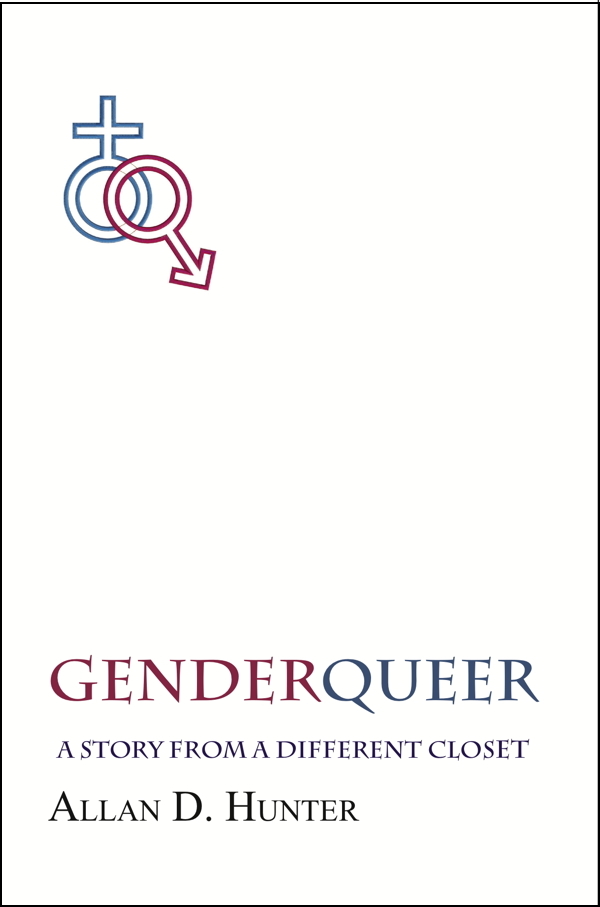
So here's what the delay is about: if you pick up a nonfiction book, you're likely to see a block of text on the copyright and dedication page that tells you how the Library of Congress has categorized the book. Libraries and other institutions make use of this.
It's called a "CIP Block".
Here, for example, is the CIP Block for the book Guns, Germs and Steel by Jared Diamond:
Library of Congress Cataloging-in-Publication Data
Diamond, Jared M.
Guns, germs, and steel : the fates of human societies / Jared Diamond.
p. cm.
Includes bibliographical references and index.
ISBN-13: 978-0-393-31755-8
1. Social evolution. 2. Civilization—History 3. Ethnology. 4. Human being—Effect of environment on. 5. Culture diffusion I. Title
HM206.D48 1997
303.4—dc21 96-37068
CIP
W W Norton & Company, Inc. 500 Fifth Avenue, New York N.Y.10110
www.wwnorton.com
W.W.Norton & Company Ltd., Castle House, 75/76 Wells Street, London, W1T3QT
Sunstone Press is a publisher that does release nonfiction books that are purchased by libraries and is therefore a participant in the Cataloging in Publication program. More info.
Since I hope for my book to be acquired by libraries and to become assigned reading for women's and gender studies programs at colleges, it seems very much in my best interests to have my book enrolled and given a CIP block.
Well, the Library of Congress apparently doesn't always move with great alacrity when a publisher sends in a manuscript. And that's what the wait has been about.
Between now and March 15, I should be getting a listing on Amazon for advance orders. I'll keep y'all informed.
———————
This LiveJournal blog is echoed on DreamWidth, WordPress, and Blogger. Please friend/link me from any of those environments on which you have an account.
————————
Index of all Blog Posts
Home Page
Thursday, January 16, 2020
Oppression
You may not like hearing this, but if you value equality and consensual relationships, and would personally prefer interacting with other people as mutual and free agents rather than exploiting or coercing them by having power over them if you had that choice, that means you *would not benefit* by having power over them.
That’s what benefit means – to have it better than would be the case otherwise. So if having power over others does not appeal to you as preferable to egalitarian relationships, you’re saying power over others would not improve your life, would not make it better. It would not benefit you.
And if that’s the case you can’t righteously assume that anyone in power necessarily benefits from that situation. You can’t assert that they would not also prefer equal and fair consensual social relationships if they could choose, not unless you can show that at the individual level they had the opportunity to make such choices and chose to oppress, chose to occupy positions of power.
I’d like to point out also that if you believe it to be true that power intrinsically is of benefit to those who do have power over others, that it is inherently desirable, then you’re saying that you would oppress if given the opportunity, since that, once again is what “to benefit” means – that it would be in your personal best interests, that it would bring you happiness, joy, satisfaction, pleasure, and so forth to have power over others. If there is a valid reason why you would not, that implies that it would actually be to your benefit to not do so. Whether it be conscience or a sense of justice and fairness, or a pleasure from interacting as equals and being trusted and being able to trust, or a wish to be in God’s good graces, or whatever, these reasons count as benefits when making such a choice.
Power is real. Inequality is real. Oppression is quite real, and struggles against it are noble and good and courageous and should be admired and lauded. What is not real is the notion that because you're rising up against oppression, you get to identify some culprits, evil people who can be blamed, perpetrators who can properly be thought of as unfairly getting away with oppressing. Power isn’t what we’ve been led to think it is. It defines the powerful as well as the disempowered. It isn’t a substance that one can possess and wield however one chooses. Most power is specifically the power to obtain this or attain that precise thing. Very seldom does a position of power give a person the power to dismantle the structures of authority that establish that power. Many people in social power were born to it, and far more were given a vastly unequal start within a system where people compete for it. Most of the social structures that specifically oppress categories of people – racism, patriarchy, colonialism, class stratification, etc – are solidly in place and individuals defined in a position without their participatory consent, the male white English-speaking wealthy western-nation able-bodied lucky privileged folks as much as the others.
Don't get me wrong -- many people in positions of structured power over others delight in it, revel in it, get a major part of their sense of worth from being able to feel like they're better than someone else. I'm very much exposed to that phenomenon, having endured bullying from fifth grade boys, assaults from fraternity boys in wealthy Long Island suburbs, and abuse of authority at the hands of police officers and psychiatric ward staff. Certainly they believed that having power over other people was a desirable commodity! But in all such cases it seemed like they were compensating for feelings of gross inadequacy. We're familiar with the trope of poor marginalized whites in the south making up for their sense of inferiority by abusing blacks so they can be better than someone, at least.
But that doesn’t make them right. And to go forth with the attitude that oppressors have it better in life than the rest of us do? It's the mindset of a child who thinks the misbehaving children are having a better time in life until and unless the teacher catches them at it and takes their pleasure away from them. It is not the mindset that creates a revolution. It's the mindset that creates a rotation. A rotation of the people in power. It's an old old story, people rising up against their oppressors so they can take the oppressor's comfy seats and make the former oppressors groven, put them up against the wall, show them what it feels like ...and guess what? After a very short time it's not just the former oppressors who seem to deserve the bottoms of our uprising's jackboots. And it's "meet the new boss, same as the old boss".
And dammit, you're better than that.
———————
And yes, my book is supposed to come out this month from Sunstone Press, but I *still* have no concrete news to report yet. Stay tuned!
———————
This LiveJournal blog is echoed on DreamWidth, WordPress, and Blogger. Please friend/link me from any of those environments on which you have an account.
————————
Index of all Blog Posts
Home Page
Tuesday, January 7, 2020
Polarized Echo Chambers
My facebook feed served me up a feminist group's post that mocked transitioners for allegedly having an attitude of "Hey, did you know that if you think being a girl would be a fun little upgrade, you can transition and be a girl? Lots of people start transitioning not because they think they 'need' to, but because they think it would improve their life and be more enjoyable".
The original post was followed by a long string of caustic comments about how these transitioners will never know what it was actually like to grow up as girls or are attempting to identify out of being oppressors, or think that a change of costume is all that gender identity is about. And several making fun of the use of "girl" instead of women.
I tried to engage with them with the following post, which wasn't moderated or piled onto, but was completely ignored. Not a single 'like'. No comment pro or con.
It's a shame, because I'd really like to have a dialog with them. (I hope you can see that from the tone and content of my post. It's not like I went in there yelling at them and calling them 'TERFs'!). But I guess they just prefer to preach to the choir.
--------- posted ---------
I'm certainly familiar with the notion that the male adults are often called "men" while the female adults are still being spoken of as "girls". But I'd call into question the logic by which the designation-terms used for males becomes the standard. I'm not a fundamentally different person than I was at eight, and the "adultist" notions within our culture teach us to turn our backs on who we originally were and embrace an adult identity that is often more constrained -- don't you think so? For me, the person I was at eight looked around the 2nd grade classroom and decided the people I admired and whose approval mattered to me were the girls. I valued what they valued. And *feminism* told me I wasn't "doing it wrong", that it was the double standard which was wrong, and if I valued "girl things" and "girl ways" that was entirely OK.
Feminism also has said that although there's nothing wrong with biological maleness, biological maleness is also NO EXCUSE for exhibiting the behaviors and embodying the values we characterize as 'masculine'. That the identity "MAN" is a political problem, that the personal is political, that the PERSONALITY is political, with its behavioral nuances and values and priorities and so on. Well, if there is to be a global feminist success, it kind of *has to involve male people pushing away from that "man" identity*, now doesn't it?
I'm sorry if the ways in which some of us approach that are insulting or cooptive of your identities, but we're thrashing about trying to find a language and a set of concepts that let us be self-affirming. We're not a unified lot of males (nor do all us identify ourselves AS males -- although I do, it's the bod I was born with and it's not the problem). I'm so sad to see the polarization and lack of dialog. You feminists are my role models, heroes, and inspiration.
———————
And yes, my book is supposed to come out this month from Sunstone Press, but I have no concrete news to report yet. Stay tuned!
———————
This LiveJournal blog is echoed on DreamWidth, WordPress, and Blogger. Please friend/link me from any of those environments on which you have an account.
————————
Index of all Blog Posts
Home Page
Saturday, December 28, 2019
Accommodations
1970, the start of a new decade. I was in fifth grade, attending Sallas-Mahone Elementary in Valdosta GA.
We weren't exactly forbidden to use the bathrooms during classroom hours, but you couldn't just rise from your seat and go when you felt like it. You had to raise your hand and ask. Even without the possibility of the teacher asking "Can't you just hold it?" or "Why didn't you go during break?", the necessity of making a request was probably enough to ensure that we mostly used the facilities in the mornings before classes, after classes, or during lunch break.
What that meant was that you were going to be in the bathroom at the same time as a handful of the kids from your classroom. To be more precise, other male kids from your classroom, if you were designated male. As I was.
I've never cared for the expression "assigned male at birth". It always seems to me to imply that my mom's obstetrician said "it's a boy" when I was born, and everyone else just went with that. That he did the assigning and no one else did, they just deferred to his judgment. That's not how it was. The same set of physiological characteristics that led the physician attending my birth to declare me male were intermittently referenced as sufficient reason to assign me male throughout my life, and when they weren't directly being observed, they were assumed from other cues and clues. When I lowered my underwear to pee, the evidence was right there in front of me, and I didn't question it: I was male.
But I did not like being in there, in the boys' bathroom. I wasn't like them, the boys, and I knew it, and they knew it. I didn't like having to go in there with THEM and being exposed.
Do you recall fifth grade? Well, do you perhaps recall Beavis and Butthead? The very epitome of being potty-mouthed rests with fifth grade boys. Everything pertaining to bathroom functions, the body parts involved in those functions, and half-understood sexual matters that also involve the same body parts, were the most interesting and prurient source material possible for the raunchiest and crudest storytelling and discussions, often called "jokes" although I rarely understood what the humorous portion was supposed to be.
Those boys were invasive. Peering, commenting, using filthy language about all this stuff.
They found me prim and hilariously prissy and so I became a focus for their attention when I was in there.
I myself identify as a gender invert, not as a transgender transitioning (and/or presenting) as female. I'm not directly affected by the laws and policies and social discussions about sex segregated bathrooms and the presence of transgender people in them. A law or policy saying I can utlize the women's bathroom instead doesn't really address any of my current issues or social situations. I manifest and present as a male-bodied person and any greater comfort I might otherwise feel to not be in the men's toilets would be offset by worrying that my presence would be disturbing to women in the women's room. And I'm used to it, to using the men's room, and aside from that, adult men aren't as awful as a batch of fifth graders, so not only am I used to it, I've been through far worse than what I currently experience in there.
But yeah, I can relate.
It's not just symbolic. It's not just wanting to be regarded and treated like the rest of the folks of the gender with which one identifies. It's also direct and real. Being in the wrong segregated space can be severely uncomfortable.
———————
This LiveJournal blog is echoed on DreamWidth, WordPress, and Blogger. Please friend/link me from any of those environments on which you have an account.
————————
Index of all Blog Posts
Home Page
Subscribe to:
Posts (Atom)