What do you think gender will look like in the future? Fifteen years from now? Twenty-five or fifty years?
A lot of people agree that the characteristics of a person's physical body shouldn't be used by society to attribute gender to them.
"A person's gender identity is valid", someone will say, "regardless of whether they have a penis or a vagina".
"Oh", says another person, "not just that, but whether they have a beard or not. Or breasts or no breasts. Or whether they have wide hips or wide shoulders. People shouldn't go around telling people their body isn't right for their gender identity!"
A smaller minority -- some nonbinary transgender, gender-critical feminists, genderqueer, gender-outlaw activists, etc -- explicitly want gender to utterly disappear:
"Gender doesn't exist except as harmful sexist propaganda about what it means if you have a certain kind of body", says one feminist.
An activist in a t-shirt that says FUCK GENDER says, "I don't see the point of being 'genderfluid', really. Having a gender is all about limitations, so what's the point of bouncing around from one set of limitations to another set when you can just be outside of all that?"
This question is for the rest of you, the ones who don't think gender itself is a bad thing, but don't want it to be connected to any specific physical body configuration: how do you think gender will survive being split off from an essentially physical anchor?
Let's review how gender has traditionally worked in human society. It was believed that people come in two (usually; occasionally more than two) essential types, which were different from each other in physical ways which was how you knew which type you were dealing with; and that each of these types were fundamentally different in other, less immediately visible ways. Personality differences. Differences in attitude towards what they want out of life. Different ways of behaving. Different ways of signalling what they want, both consciously and unconsciously, which meant differences in how you, the observer, should interpet behaviors. Different ways of experiencing sex and sexuality. Different values, different priorities, different obligations, different purposes in life.
So now, we're saying we're not going to attribute all that stuff to a person based on their bodies. Instead we're going to open up all those identities, and also add a bunch more that people have started identifying as, and establish throughout society that anyone can be any of these gender identities regardless of what body they were born with. So let's assume that really does happen. That people cease to see a person's physical body and mentally paste a batch of expectations of what that person is like.
Well, if it's not based on the body, what one (or three, or six) feature(s) of a person's dress or behavior determines which other expectations society ought to glue onto them?
If no expectations are being glued on from a handful of initial observations, how is that different from a world that doesn't have gender identities? If you don't have expectations from having mentally categorized a person, that person might do or be absolutely anything next. We aren't thinking of them as being "like" other people in that category and "different" from people who are in other categories.
So if you don't think gender will evaporate once we get rid of body-based stereotyped expectations, why wouldn't it? What's your theory on how gendered identities will persist? Will we preserve historically established identities, along with their roles and expected traits? Will we keep the traditional "man" and "woman"? How about the others, like "demigirl" and "demiboy" and "bigender" and "genderfluid" and so on, will we keep those too? Is there an upper limit to how many gender identities we'll believe people fit into, or will it expand to almost infinite numbers of identities?
Or maybe we won't impose expectations on others as part of understanding and accepting someone else's gender identity, but instead wait for them to explain to us how they want us to see them. But if we don't have any preformed notions in our heads, like "what it means to be a man" or "what women are like" or whatever, won't they be in the same situation they'd be in in a world without genders, where each person exists as a unique individual and as "one more person" not not as part of any divisional category?
What are your thoughts?
———————
You're secluded in quarantine, and all the performances and events have been cancelled, so it's a good time to read a book!
My book, GenderQueer: A Story From a Different Closet, has been published by Sunstone Press. It is available on Amazon and Barnes & Noble in paperback and ebook, and as ebook only from Apple, Kobo, and directly from Sunstone Press themselves.
Links to published reviews and comments are listed on my Home Page
———————
This DreamWidth blog is echoed on LiveJournal, WordPress, and Blogger. Please friend/link me from any of those environments on which you have an account.
————————
Index of all Blog Posts
Saturday, October 24, 2020

Saturday, October 17, 2020
BOOK REVIEW: Ciel, by Sophie Labelle
When I saw that Sophie Labelle, author-cartoonist of Assigned Male Comics, had published a book, I ordered a copy. It was described as featuring a gender nonconforming main character coping with high school, and I'm addicted to stories of how people formulate their unconventional gender identities and how they experience themselves during these formative years.
I wanted to see what Labelle would do with more space to expand into, the opportunity to dive deeper into things with more nuance and complexity than a four-panel strip provides.
(Ciel is NOT a graphic novel, by the way. It's concise at 188 pages but it's made up of text, just so you know).
The early part of the book left me feeling a little bit like everything about gender and identity was still being painted in primary colors, all platitudes and overly simplified viewpoints that imply more agreement among LGBTQIA people than actually exists. Labelle's Ciel refers to "another gender...than the one the doctors gave me at birth when they looked at my genitals (which are nobody's business, by the way!)" and goes on to complain that for children in many societies, "they're designated a girl or a boy, their room are painted a certain color, and they're given certain kinds of toys to play with".
But Sophie Labelle shifts to more politically complicated territory later on in the story. Tensions are explored around questions of sexual orientation and how they collide awkwardly with nonbinary gender identities, with characters such as Frank, who is involved with Ciel's best friend Stephie, a trans girl. Frank is starting to get facial hair and unclear on whether or not Stephie, who was assigned male, will also.
"You know, she wouldn't be any less a girl if she had a beard like a Viking, or an Adam's apple, or a low voice", Ciel tells him.
"But it would be a little weird."
"Why?"
"People might think I was going out with a guy, or something."
"And that would be a real tragedy, right?"
"That's not what I mean! Some of my friends say I'm gay becasue I'm going out with Stephie, and I don't care."
"Good."
This conversation gets Ciel wondering about facial hair. Ciel doesn't identify as a boy or a girl. And although Ciel is taking puberty hormone blockers, they're not firmly committed to continuing to do so.
Over and over again, the characters in Labelle's book, in pondering their own identities and their expressions of them, find themselves considering how they are viewed by others. It's an unavoidable part of identity. Sociologists sometimes call it "altercasting" — the act of assigning identities to other people. We all do it, not always with bad intentions, not always with narrowly limited categories, but even when we are aware of all this diversity, we still tend to listen and watch and then regard a person as a trans woman or a genderfluid nonbinary person or a lesbian trans girl or whatever. And we all also spend time and energy imagining how we are perceived, and we take it into account when choosing how to interact, how to present.
In Ciel's case, there is the matter of what name to use. The school's records have Ciel's proper name down as "Alessandro". Ciel is somewhat awkward about asking to be referred to as "Alessandra" instead, more comfortable about asking ahead of time than correcting a teacher who started using the other name. Ciel is even more open and out on their YouTube channel, where videos openly explore what it is like to be trans and gender-nonconforming.
That provokes the most polarized and antagonistically hostile reaction that Ciel experiences in the book — from another transgender person. A video blogger named Bettie Bobbie posts: "Hi everyboy! Today I watched a video that made me want to puke, about a gay boy who invented a gender for himself by saying he's neither a boy nor a girl...if you ask me, this video harms real trans people like me."
Sophie Labelle shows us that the world of LGBTQIA identities is intricate and that we struggle with identification and expression, and that there are hurt feelings and resentments and anger sometimes. This is honest and fair.
Through Ciel's tale, Labelle does a slow exploration of presentation by a gender nonconforming person (I would describe Ciel as genderfluid, myself, but the term isn't embraced in this story). Ciel's choice of clothing is presented as an internal dialog, facing the closet several mornings and deciding against the ostentatiously colorful apparel they're drawn to and instead putting on more drab and mundane garments. Only towards the end of the book does Labelle pull back and let us see that choice against the backdrop of Ciel's expectation of their classmates' attitudes and reactions.
Ciel, by Sophie Labelle, Second Story Press 2020 Toronto CA
https://secondstorypress.ca/kids/ciel
———————
You're secluded in quarantine, and all the performances and events have been cancelled, so it's a good time to read a book!
My book, GenderQueer: A Story From a Different Closet, has been published by Sunstone Press. It is available on Amazon and Barnes & Noble in paperback and ebook, and as ebook only from Apple, Kobo, and directly from Sunstone Press themselves.
Links to published reviews and comments are listed on my Home Page
———————
This DreamWidth blog is echoed on LiveJournal, WordPress, and Blogger. Please friend/link me from any of those environments on which you have an account.
————————
Index of all Blog Posts
I wanted to see what Labelle would do with more space to expand into, the opportunity to dive deeper into things with more nuance and complexity than a four-panel strip provides.
(Ciel is NOT a graphic novel, by the way. It's concise at 188 pages but it's made up of text, just so you know).
The early part of the book left me feeling a little bit like everything about gender and identity was still being painted in primary colors, all platitudes and overly simplified viewpoints that imply more agreement among LGBTQIA people than actually exists. Labelle's Ciel refers to "another gender...than the one the doctors gave me at birth when they looked at my genitals (which are nobody's business, by the way!)" and goes on to complain that for children in many societies, "they're designated a girl or a boy, their room are painted a certain color, and they're given certain kinds of toys to play with".
But Sophie Labelle shifts to more politically complicated territory later on in the story. Tensions are explored around questions of sexual orientation and how they collide awkwardly with nonbinary gender identities, with characters such as Frank, who is involved with Ciel's best friend Stephie, a trans girl. Frank is starting to get facial hair and unclear on whether or not Stephie, who was assigned male, will also.
"You know, she wouldn't be any less a girl if she had a beard like a Viking, or an Adam's apple, or a low voice", Ciel tells him.
"But it would be a little weird."
"Why?"
"People might think I was going out with a guy, or something."
"And that would be a real tragedy, right?"
"That's not what I mean! Some of my friends say I'm gay becasue I'm going out with Stephie, and I don't care."
"Good."
This conversation gets Ciel wondering about facial hair. Ciel doesn't identify as a boy or a girl. And although Ciel is taking puberty hormone blockers, they're not firmly committed to continuing to do so.
Over and over again, the characters in Labelle's book, in pondering their own identities and their expressions of them, find themselves considering how they are viewed by others. It's an unavoidable part of identity. Sociologists sometimes call it "altercasting" — the act of assigning identities to other people. We all do it, not always with bad intentions, not always with narrowly limited categories, but even when we are aware of all this diversity, we still tend to listen and watch and then regard a person as a trans woman or a genderfluid nonbinary person or a lesbian trans girl or whatever. And we all also spend time and energy imagining how we are perceived, and we take it into account when choosing how to interact, how to present.
In Ciel's case, there is the matter of what name to use. The school's records have Ciel's proper name down as "Alessandro". Ciel is somewhat awkward about asking to be referred to as "Alessandra" instead, more comfortable about asking ahead of time than correcting a teacher who started using the other name. Ciel is even more open and out on their YouTube channel, where videos openly explore what it is like to be trans and gender-nonconforming.
That provokes the most polarized and antagonistically hostile reaction that Ciel experiences in the book — from another transgender person. A video blogger named Bettie Bobbie posts: "Hi everyboy! Today I watched a video that made me want to puke, about a gay boy who invented a gender for himself by saying he's neither a boy nor a girl...if you ask me, this video harms real trans people like me."
Sophie Labelle shows us that the world of LGBTQIA identities is intricate and that we struggle with identification and expression, and that there are hurt feelings and resentments and anger sometimes. This is honest and fair.
Through Ciel's tale, Labelle does a slow exploration of presentation by a gender nonconforming person (I would describe Ciel as genderfluid, myself, but the term isn't embraced in this story). Ciel's choice of clothing is presented as an internal dialog, facing the closet several mornings and deciding against the ostentatiously colorful apparel they're drawn to and instead putting on more drab and mundane garments. Only towards the end of the book does Labelle pull back and let us see that choice against the backdrop of Ciel's expectation of their classmates' attitudes and reactions.
Ciel, by Sophie Labelle, Second Story Press 2020 Toronto CA
https://secondstorypress.ca/kids/ciel
———————
You're secluded in quarantine, and all the performances and events have been cancelled, so it's a good time to read a book!
My book, GenderQueer: A Story From a Different Closet, has been published by Sunstone Press. It is available on Amazon and Barnes & Noble in paperback and ebook, and as ebook only from Apple, Kobo, and directly from Sunstone Press themselves.
Links to published reviews and comments are listed on my Home Page
———————
This DreamWidth blog is echoed on LiveJournal, WordPress, and Blogger. Please friend/link me from any of those environments on which you have an account.
————————
Index of all Blog Posts
Sunday, October 11, 2020
I Get a Really Nice Interview! FiftyShadesOfGender!
Podcast host Esther Lemmens maintains Fifty Shades of Gender, a series in which she interviews a different individual in each episode to do a deep dive into gender, sex, and sexuality. "Come with us on a journey of inclusion, acceptance and respect", she invites.
Esther Lemmens has a gift for asking the right questions to let her subjects introduce or explain the things most important to them. She senses areas where the person might want to elaborate or make things clearer, and probes in such a way as to give that opportunity.
I've been interviewed several times as a book author with a book being published, but often came away from them feeling less than overjoyed about how my gender identity, or my book, were being presented. But Lemmens has elicited from me the best spoken overview I've ever given.
A Conversation with Allan D. Hunter, Podcast Episode 14, 2 October 2020.
You should check out her other episodes as well.
———————
You're secluded in quarantine, and all the performances and events have been cancelled, so it's a good time to read a book!
My book, GenderQueer: A Story From a Different Closet, has been published by Sunstone Press. It is available on Amazon and Barnes & Noble in paperback and ebook, and as ebook only from Apple, Kobo, and directly from Sunstone Press themselves.
Links to published reviews and comments are listed on my Home Page
———————
This DreamWidth blog is echoed on LiveJournal, WordPress, and Blogger. Please friend/link me from any of those environments on which you have an account.
————————
Index of all Blog Posts
Esther Lemmens has a gift for asking the right questions to let her subjects introduce or explain the things most important to them. She senses areas where the person might want to elaborate or make things clearer, and probes in such a way as to give that opportunity.
I've been interviewed several times as a book author with a book being published, but often came away from them feeling less than overjoyed about how my gender identity, or my book, were being presented. But Lemmens has elicited from me the best spoken overview I've ever given.
A Conversation with Allan D. Hunter, Podcast Episode 14, 2 October 2020.
You should check out her other episodes as well.
———————
You're secluded in quarantine, and all the performances and events have been cancelled, so it's a good time to read a book!
My book, GenderQueer: A Story From a Different Closet, has been published by Sunstone Press. It is available on Amazon and Barnes & Noble in paperback and ebook, and as ebook only from Apple, Kobo, and directly from Sunstone Press themselves.
Links to published reviews and comments are listed on my Home Page
———————
This DreamWidth blog is echoed on LiveJournal, WordPress, and Blogger. Please friend/link me from any of those environments on which you have an account.
————————
Index of all Blog Posts
Monday, October 5, 2020
Gender-Critical, Transgender, Gender Inversion, & Transsexuality Conference
Hi! Want to moderate a discussion panel? Your mission, should you choose to accept it, is to lead these four folks to some sort of accord, or, failing that, to moderate their debate fairly and give each one a chance to support their positions.
I'll let them introduce themselves as they deem appropriate --
Lillian: Hello, I'm Lillian. I'm a gender critical feminist. I'm 70. When I was young, I was part of the feminist second wave that attacked the notion that biology is destiny, that if you were born male you were designed to live *this* life but if you were female you were destined to live *that* life. As feminists, we indicted gender roles and gendered assumptions about people. Because they aren't necessary for the functioning of society -- except the unfair parts -- and they aren't good for us as individuals. They are restrictions! We opposed sexist double standards and sexist expectations and assumptions. Anyone might be a leader. Anyone might be a nurturant caregiver. Anyone might be a belligerent asshole. Anyone might be an empty-headed doll-person. None of that is due to whether you were born with a penis or a vagina! Sex polarization that divides us up into women and men is a tool of patriarchal oppression and it exists to the detriment of women. Women are oppressed. Now, me personally, when I was first in the women's movement, well, we were white and straight and didn't pay enough attention to other people's situation. But we've become more intersectional and we listen to black women's voices and the voices of women who come from poverty, disabled women, and other forms of additional marginalization. But first and foremost, society is a patriarchy; that's still the bottom line for me. If men don't like it, they're in charge so all they've got to do is stand down and change it and quit opposing us.
Sylvia: Well, I guess you could say I was also involved in attacking that 'biology is destiny' thing. Hey, everybody, I'm Sylvia. I am trans. Back when I was figuring that out, the word was 'transsexual', and that's still what I prefer to use, but I don't want to offend anybody. I had gender dysphoria, the body I was born with was not my destiny. It wasn't right for me, and I knew it from pretty much the time I was old enough to understand the difference between boys and girls. I know some of you younger folks say things differently, you'd say I was assigned male at birth. Well, I had to get myself unassigned, because my gender didn't match that assignment at all. I changed my body to match my gender. Now, I understand the notion that we ought to have equal attitudes to a person no matter if their body is male or female. Or whether it came with a penis on the front of it or a vagina instead, if you like that language better. I understand saying that what your body is like shouldn't matter and we shouldn't have sexist beliefs. But that's not the world I got to live in. Maybe someday society will be that way but not in my lifetime. Not in yours either, probably. Getting sex reassignment surgery was something I could get within a few years, and I did, and it has made it possible for me to live my life with people seeing me and treating me like who I am -- a woman -- and I don't see why anybody's got any cause for having a problem with that.
Jesse: My name's Jesse and my pronouns are he, him, his. I was assigned male at birth. When I was younger, there was an attitude that what you were supposed to do if your gender didn't match your designation was to go out and get hormones and surgery, and if you did that and you could *pass*, then you were authentically trans. Well, some of those surgeries are expensive and not everyone can afford them, and there's medical issues with procedures, and hormones too, and during my generation we pushed back against that elitist attitude. Because you don't need to have anything specific done to you to make your gender identity valid, okay? It's fine to get gender confirmation surgery if that's what you *want*, and you can afford it and it's safe for you and all that. What is *not* fine is to go around telling people they aren't trans enough if they don't, you hear what I'm saying? And I am a man. Trans men are men. Trans women are women. You body is not 'who you really are', so yeah count me in as well on kicking that 'biology is destiny' off the map. What's up with people deciding they get to decide who you are based on what's inside your underwear? That's creepy. Anyone with that attitude, go perv on someone else, all right? Meanwhile, I hear what you're saying about gender being confining, but it can also be liberating and you ought to think about that. There are strong notions about how to be a man that go beyond being an okay person, it's heroic and inspiring to connect with that. Women, too, womanhood is a powerful notion. I got nothing against people who want to be agender or whatever, but I like being a man.
Allan (me): I'm Allan. I never bought into all the junk that gets glued onto a male, beliefs and assumptions and all that, because I didn't get issued all that stuff along with the body in which I was born. I grew up with messages about what it means to be a man, and also messages about what it means if your body is male and you don't match that description. Feminism told me that was sexist and I could ignore it, so I did. Until I couldn't. The world was too much in my face about it to ignore. So I became an activist. And yeah, biology isn't destiny. I agree that gender has its positive uses. Androgyny means expecting everyone to be in the middle, like beige or something. I'm not androgynous, I'm femme. Meanwhile I understand about it being easier to change your body, or to just change your presentation, how you look to the world, to get folks to think of your body as the body that goes with your gender, so that they'll get your gender correct. But the world got in my face and I'm returning the favor, I don't want to pass, I want to take the fact that I am male but also feminine and shove that at people. My body is not the problem, it's people's notion that if your body is male that makes you a man, a masculine person. That's what's got to change. We don't change that by converting male people to female people so they can be correctly regarded as women. Damn right our gender identity is valid regardless of our body. That means I get to walk down the nude beach with my flat chest and facial hair and my penis bouncing against my testicles and that doesn't make me a man. I want to be accepted as femme without lipstick, corset, boobs, or tucking. And patriarchy is in my way. I don't care if you want to call me a feminist or what, but I'm in the struggle against patriarchal oppression for my own damn reasons. And, yeah, I get to call my body male. I don't need to believe that I'm female in order to validate my gender identity. That's the whole point. It's *not*, and yet I'm still as femme as anybody.
———————
You're secluded in quarantine, and all the performances and events have been cancelled, so it's a good time to read a book!
My book, GenderQueer: A Story From a Different Closet, has been published by Sunstone Press. It is available on Amazon and Barnes & Noble in paperback and ebook, and as ebook only from Apple, Kobo, and directly from Sunstone Press themselves.
Links to published reviews and comments are listed on my Home Page
———————
This DreamWidth blog is echoed on LiveJournal, WordPress, and Blogger. Please friend/link me from any of those environments on which you have an account.
————————
Index of all Blog Posts
I'll let them introduce themselves as they deem appropriate --
Lillian: Hello, I'm Lillian. I'm a gender critical feminist. I'm 70. When I was young, I was part of the feminist second wave that attacked the notion that biology is destiny, that if you were born male you were designed to live *this* life but if you were female you were destined to live *that* life. As feminists, we indicted gender roles and gendered assumptions about people. Because they aren't necessary for the functioning of society -- except the unfair parts -- and they aren't good for us as individuals. They are restrictions! We opposed sexist double standards and sexist expectations and assumptions. Anyone might be a leader. Anyone might be a nurturant caregiver. Anyone might be a belligerent asshole. Anyone might be an empty-headed doll-person. None of that is due to whether you were born with a penis or a vagina! Sex polarization that divides us up into women and men is a tool of patriarchal oppression and it exists to the detriment of women. Women are oppressed. Now, me personally, when I was first in the women's movement, well, we were white and straight and didn't pay enough attention to other people's situation. But we've become more intersectional and we listen to black women's voices and the voices of women who come from poverty, disabled women, and other forms of additional marginalization. But first and foremost, society is a patriarchy; that's still the bottom line for me. If men don't like it, they're in charge so all they've got to do is stand down and change it and quit opposing us.
Sylvia: Well, I guess you could say I was also involved in attacking that 'biology is destiny' thing. Hey, everybody, I'm Sylvia. I am trans. Back when I was figuring that out, the word was 'transsexual', and that's still what I prefer to use, but I don't want to offend anybody. I had gender dysphoria, the body I was born with was not my destiny. It wasn't right for me, and I knew it from pretty much the time I was old enough to understand the difference between boys and girls. I know some of you younger folks say things differently, you'd say I was assigned male at birth. Well, I had to get myself unassigned, because my gender didn't match that assignment at all. I changed my body to match my gender. Now, I understand the notion that we ought to have equal attitudes to a person no matter if their body is male or female. Or whether it came with a penis on the front of it or a vagina instead, if you like that language better. I understand saying that what your body is like shouldn't matter and we shouldn't have sexist beliefs. But that's not the world I got to live in. Maybe someday society will be that way but not in my lifetime. Not in yours either, probably. Getting sex reassignment surgery was something I could get within a few years, and I did, and it has made it possible for me to live my life with people seeing me and treating me like who I am -- a woman -- and I don't see why anybody's got any cause for having a problem with that.
Jesse: My name's Jesse and my pronouns are he, him, his. I was assigned male at birth. When I was younger, there was an attitude that what you were supposed to do if your gender didn't match your designation was to go out and get hormones and surgery, and if you did that and you could *pass*, then you were authentically trans. Well, some of those surgeries are expensive and not everyone can afford them, and there's medical issues with procedures, and hormones too, and during my generation we pushed back against that elitist attitude. Because you don't need to have anything specific done to you to make your gender identity valid, okay? It's fine to get gender confirmation surgery if that's what you *want*, and you can afford it and it's safe for you and all that. What is *not* fine is to go around telling people they aren't trans enough if they don't, you hear what I'm saying? And I am a man. Trans men are men. Trans women are women. You body is not 'who you really are', so yeah count me in as well on kicking that 'biology is destiny' off the map. What's up with people deciding they get to decide who you are based on what's inside your underwear? That's creepy. Anyone with that attitude, go perv on someone else, all right? Meanwhile, I hear what you're saying about gender being confining, but it can also be liberating and you ought to think about that. There are strong notions about how to be a man that go beyond being an okay person, it's heroic and inspiring to connect with that. Women, too, womanhood is a powerful notion. I got nothing against people who want to be agender or whatever, but I like being a man.
Allan (me): I'm Allan. I never bought into all the junk that gets glued onto a male, beliefs and assumptions and all that, because I didn't get issued all that stuff along with the body in which I was born. I grew up with messages about what it means to be a man, and also messages about what it means if your body is male and you don't match that description. Feminism told me that was sexist and I could ignore it, so I did. Until I couldn't. The world was too much in my face about it to ignore. So I became an activist. And yeah, biology isn't destiny. I agree that gender has its positive uses. Androgyny means expecting everyone to be in the middle, like beige or something. I'm not androgynous, I'm femme. Meanwhile I understand about it being easier to change your body, or to just change your presentation, how you look to the world, to get folks to think of your body as the body that goes with your gender, so that they'll get your gender correct. But the world got in my face and I'm returning the favor, I don't want to pass, I want to take the fact that I am male but also feminine and shove that at people. My body is not the problem, it's people's notion that if your body is male that makes you a man, a masculine person. That's what's got to change. We don't change that by converting male people to female people so they can be correctly regarded as women. Damn right our gender identity is valid regardless of our body. That means I get to walk down the nude beach with my flat chest and facial hair and my penis bouncing against my testicles and that doesn't make me a man. I want to be accepted as femme without lipstick, corset, boobs, or tucking. And patriarchy is in my way. I don't care if you want to call me a feminist or what, but I'm in the struggle against patriarchal oppression for my own damn reasons. And, yeah, I get to call my body male. I don't need to believe that I'm female in order to validate my gender identity. That's the whole point. It's *not*, and yet I'm still as femme as anybody.
———————
You're secluded in quarantine, and all the performances and events have been cancelled, so it's a good time to read a book!
My book, GenderQueer: A Story From a Different Closet, has been published by Sunstone Press. It is available on Amazon and Barnes & Noble in paperback and ebook, and as ebook only from Apple, Kobo, and directly from Sunstone Press themselves.
Links to published reviews and comments are listed on my Home Page
———————
This DreamWidth blog is echoed on LiveJournal, WordPress, and Blogger. Please friend/link me from any of those environments on which you have an account.
————————
Index of all Blog Posts
Monday, September 28, 2020
Thoughts From a Song: Running Up That Hill
In gender outlaw and other LGBTQIA Facebook groups and internet forums, someone will occasionally ask "What songs really reached out to you and made you feel recognized and understood?"
I need to remember to nominate Kate Bush's "Running Up That Hill" the next time someone asks.
It may not have a giant billboard sign on it proclaiming it to be relevant to gender inversion and being genderqueer, but that's where my head went when I first heard it, and how I interpret any time I've heard it since. "If only I could", Kate sings, "I'd make a deal with God and I'd get him to swap our places". Many of my trans friends, who have often plaintively wished that the transgender women who didn't want their penises could donate them to the transgender men who did, and receive a uterus and fallopian tubes and vagina in exchange, should be able to relate.
But that's not quite how Kate came to wish for the exchange of positions, to be sure. Her angle of approach has more to do with a concern specific to sexuality of the non-same-sex variety: "It doesn't hurt me; do you want to feel how it feels? Do you want to know that it doesn't hurt me?" Not every listener seems to immediately think that the "it" she speaks of is sex, but that's totally where my head went. She's conversing with a male lover who is concerned about how this is for her. Because he doesn't know, never having been female.
My feminist women friends are ready to hoot in derision. "Men don't spend much time worrying about whether any sex practice hurts women. They think that's what we're there for. And that whatever gets done to us must be hot for us if they find it hot, whether it's the joy of gagging on a dick or being raped and choked or just the everyday joy of being objectified and catcalled to by strangers, men never try to put themselves in our position and imagine what it must be like to be us. Or if they do, they have pathetically impaired imaginations!"
But not everyone who is male of body is a man, and not all sexuality involving a male person and a female person is heterosexuality. Because heterosexuality is an institution, one that is defined by and depends on seeing the sexual partner as Other, as utterly alien, one whose feelings and thoughts can't be approached by imagining what it would be like, because, well, because It's Different For Them. Because They're Different. And reciprocally, for people whose interactions and attractions are not defined around that alienating difference, there is likely to be that fervent wish to understand, to know what it's like.
"Let's exchange the experience", Kate says. That's intimacy. It's empathy.
Our current social politics often teaches us that empathy isn't real, that it's illusory. "Don't speak for them. You aren't them and you don't know what it's like". It is entirely valid to say "You should not speak for people when they can speak for themselves, especially if they've been kept voiceless by their marginalization". I agree with that. But some go on to say "Don't think that you know what it's like. You don't. You can't. It is arrogant of you to think that you do. You aren't them". It's not a nuanced position, as stated; and if it discourages people from thinking it possible to know what it's like, it can turn away their inclination to try. To imagine, to wonder, to watch from the outside and attempt to conjure up an awareness of what it must be like from the inside.
We can't even identify as part of a group without empathy. Transgender feminist author Julia Serano acknowledges the legitimacy of the statement that some have made to her: "How do you know you are 'a woman'? How do you know that who you are is the person that women are? You've never been one, you've only been yourself!" Serano agrees that she's never been anyone but herself, but, well, that's true for the person directing the question. How does a cisgender woman know she's a woman in the sense of having an identity in common with other women? She's never been any of those other women either, how does she know what it's like to be any of them, and to claim a commonality of identity? Only by observation from the outside. Which is how Serano knows the same thing. It's how I know I'm a femme; it's how I knew I was one of the girls (despite being male) when I was in grade school. It's empathy. The power to look across the divide and bridge the gaps and recognize and relate.
"We both matter, don't we?", Kate Bush asks.
Yeah, we do.
———————
You're secluded in quarantine, and all the performances and events have been cancelled, so it's a good time to read a book!
My book, GenderQueer: A Story From a Different Closet, has been published by Sunstone Press. It is available on Amazon and Barnes & Noble in paperback and ebook, and as ebook only from Apple, Kobo, and directly from Sunstone Press themselves.
Links to published reviews and comments are listed on my Home Page
———————
This DreamWidth blog is echoed on LiveJournal, WordPress, and Blogger. Please friend/link me from any of those environments on which you have an account.
————————
I need to remember to nominate Kate Bush's "Running Up That Hill" the next time someone asks.
It may not have a giant billboard sign on it proclaiming it to be relevant to gender inversion and being genderqueer, but that's where my head went when I first heard it, and how I interpret any time I've heard it since. "If only I could", Kate sings, "I'd make a deal with God and I'd get him to swap our places". Many of my trans friends, who have often plaintively wished that the transgender women who didn't want their penises could donate them to the transgender men who did, and receive a uterus and fallopian tubes and vagina in exchange, should be able to relate.
But that's not quite how Kate came to wish for the exchange of positions, to be sure. Her angle of approach has more to do with a concern specific to sexuality of the non-same-sex variety: "It doesn't hurt me; do you want to feel how it feels? Do you want to know that it doesn't hurt me?" Not every listener seems to immediately think that the "it" she speaks of is sex, but that's totally where my head went. She's conversing with a male lover who is concerned about how this is for her. Because he doesn't know, never having been female.
My feminist women friends are ready to hoot in derision. "Men don't spend much time worrying about whether any sex practice hurts women. They think that's what we're there for. And that whatever gets done to us must be hot for us if they find it hot, whether it's the joy of gagging on a dick or being raped and choked or just the everyday joy of being objectified and catcalled to by strangers, men never try to put themselves in our position and imagine what it must be like to be us. Or if they do, they have pathetically impaired imaginations!"
But not everyone who is male of body is a man, and not all sexuality involving a male person and a female person is heterosexuality. Because heterosexuality is an institution, one that is defined by and depends on seeing the sexual partner as Other, as utterly alien, one whose feelings and thoughts can't be approached by imagining what it would be like, because, well, because It's Different For Them. Because They're Different. And reciprocally, for people whose interactions and attractions are not defined around that alienating difference, there is likely to be that fervent wish to understand, to know what it's like.
"Let's exchange the experience", Kate says. That's intimacy. It's empathy.
Our current social politics often teaches us that empathy isn't real, that it's illusory. "Don't speak for them. You aren't them and you don't know what it's like". It is entirely valid to say "You should not speak for people when they can speak for themselves, especially if they've been kept voiceless by their marginalization". I agree with that. But some go on to say "Don't think that you know what it's like. You don't. You can't. It is arrogant of you to think that you do. You aren't them". It's not a nuanced position, as stated; and if it discourages people from thinking it possible to know what it's like, it can turn away their inclination to try. To imagine, to wonder, to watch from the outside and attempt to conjure up an awareness of what it must be like from the inside.
We can't even identify as part of a group without empathy. Transgender feminist author Julia Serano acknowledges the legitimacy of the statement that some have made to her: "How do you know you are 'a woman'? How do you know that who you are is the person that women are? You've never been one, you've only been yourself!" Serano agrees that she's never been anyone but herself, but, well, that's true for the person directing the question. How does a cisgender woman know she's a woman in the sense of having an identity in common with other women? She's never been any of those other women either, how does she know what it's like to be any of them, and to claim a commonality of identity? Only by observation from the outside. Which is how Serano knows the same thing. It's how I know I'm a femme; it's how I knew I was one of the girls (despite being male) when I was in grade school. It's empathy. The power to look across the divide and bridge the gaps and recognize and relate.
"We both matter, don't we?", Kate Bush asks.
Yeah, we do.
———————
You're secluded in quarantine, and all the performances and events have been cancelled, so it's a good time to read a book!
My book, GenderQueer: A Story From a Different Closet, has been published by Sunstone Press. It is available on Amazon and Barnes & Noble in paperback and ebook, and as ebook only from Apple, Kobo, and directly from Sunstone Press themselves.
Links to published reviews and comments are listed on my Home Page
———————
This DreamWidth blog is echoed on LiveJournal, WordPress, and Blogger. Please friend/link me from any of those environments on which you have an account.
————————
Saturday, September 12, 2020
Review / Interview in QueerPGH!
"...the book has some problematic aspects, and may be at odds with some of our queer values today. This seems to be by design, conveying a much different world for queer people."
— Rachel Lange, Senior Editor, QueerPGH
If you were ever part of a children's classroom drama group or were in a choir or rock band as a 4th grader, you may have encountered the "review that isn't really a review". The kind where the writer discusses how adorable your group was and how earnest you all were up there on that stage, and how cute your costumes were. The names of the lead singers or the performers in the primary roles are all dutifully mentioned, and the writer will generally find some nice things to say about the precision of the delivery or how nicely all in tune you were. But you don't get scathing criticism or a pointed comment on how your group chose to stage it, because the writer figures that no one goes to those things to hear the music or watch the dramatic tale unfold.
So-called "third party" politicians often get the same treatment when they run for office. If they get interviewed and covered at all, the questions are softball questions: "Tell me about your main issues", or "What made you decide to run for office?"; the interviewer rarely probes the marginal candidate's most politically vulnerable spot to see if the candidate has a good answer, like "You say you would close the town widget factory because of the toxicity levels. Seven hundred local citizens have jobs there; what's going to happen to them? And where will the airplane industry get their greasy widgets from, won't the cost of air travel jump through the roof if you do that?" They don't ask because the writer doesn't assume it matters to the voters, because this candidate isn't going to win the election anyway so who cares?
Rachel Lange of the queer publication QueerPGH apparently takes me seriously. Not only that I have something to say to the LGBTQIA community but that people might pay attention to it, that it might have some impact. In her interview with me, she asked some of the most provocative and probing questions I've faced.
She isn't wrong in her summary statement: I wrote GenderQueer not to add my voice to the chorus of voices that were already out there, but to add a different voice. To tell a story about an identity that was not already being explained and given a name. And she's quite right—I have often found myself at odds with activists who represent some of the other shades of the queer coalition rainbow, because some of the concepts they use are injurious to the identity I'm writing about. Some of the rhetoric they like to use erases people like me. I'm not unaware of the existing social dialog, so in rising to my feet to present my tale, my dissent with them is indeed by design. Not that I'm out to antagonize or deliberately cause dissent in the community, but because that erasure of which I spoke needs to end. I'm not out to negate anyone else's identity, and I hope readers of my book will see that. But I very much appreciate the candor and seriousness of the questions.
Book Review: Gender Queer: A Story from a Different Closet
———————
You're secluded in quarantine, and all the performances and events have been cancelled, so it's a good time to read a book!
My book, GenderQueer: A Story From a Different Closet, has been published by Sunstone Press. It is available on Amazon and Barnes & Noble in paperback and ebook, and as ebook only from Apple, Kobo, and directly from Sunstone Press themselves.
Links to published reviews and comments are listed on my Home Page
———————
This DreamWidth blog is echoed on LiveJournal, WordPress, and Blogger. Please friend/link me from any of those environments on which you have an account.
————————
Index of all Blog Posts
Saturday, September 5, 2020
Umbrella
Several times in several different groups somebody has asked about the difference between "transgender" and "genderqueer" and "nonbinary" and then somebody else has posted something like this:
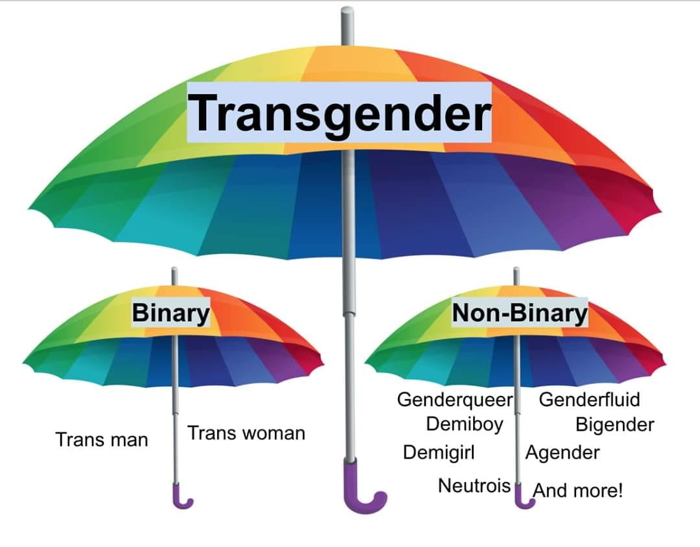
I don't like that illustration.
So what's my problem with it?
I identify as genderqueer and I do not identify as transgender, and that umbrella diagram sticks me into that category whether I like it or not. That diagram creates a hierarchy in which all genderqueer people are transgender (but not vice versa). That means that any statement that transgender people make on behalf of all trans people is going to be considered to apply to me and other people like me. Because we're defined as being under that umbrella.
Let's look at some of the broad all-inclusive statements that many transgender people have made, shall we?
a) A person's gender identity is valid regardless of their physical anatomy. You don't have to have a medical transition in order for your gender identity to be valid. You don't have to "pass" in order for your gender identity to be valid
Well, that one is wonderful, I'm totally on-board with that! It used to be that society's understanding of what it meant to be trans was that you went out and got yourself a medical transition to make your physical anatomy correspond with your gender identity. And that certainly didn't describe me! So this is a good change, a good shift. The problem is with additional assumptions and assertions that they very often attach to that, such as
b) A person's physical anatomy is not a polite topic of consideration. Anatomy is utterly irrelevant to identity and nobody's business. It's totally inappropriate to be identifying a person on the basis of what's inside their underpants
and...
c) You should not use any anatomy-based terms except to refer to the binary sex assignment that our society coercively attributes people to at birth. If someone identifies as a woman or girl, you would be misgendering them if you did not consider them female; if someone identifies as a man or boy, to not regard them as fully male is transphobic and misgendering also
and...
d) Any insistence that sex and gender are two different things is politically offensive and based on wrong out-of-date science that is now disproven. There's no such thing as "biological sex" because intersex people exist and there are multitudes of body variation from chromosomes to organ structures, so the binary is just a social construct and there is no physical sex.
Well, let's unpack some of that. (Because we don't all wear the same packers in here, okay?) In reverse order, my intersex-activist buddies do want to make a distinction between sex and gender. It's important to them and they're tired of "intersex" being used as an argument for why "biological sex doesn't exist" and otherwise ignored. Intersex people have bodies. They have bodies that other people found embarrassingly different. So embarrassing that they often coercively assigned their bodies to male or female with a surgeon's knife, without their consent. Intersex people can't discuss the fact that their body differed at birth from the body of either male people or female people if "male" refers to gender identity instead of physical sex. Intersex people can't identify themselves if people in society are confused and say things like "Oh me too, I've always had a female side, I wanted to dance ballet instead of play baseball". I'm not intersex myself, but I can't even explain that I'm not intersex if the language doesn't let me explain that although I was never a boy or man, my physical configuration wasn't unusual for male people. That it's my gender that's queer, that my sex falls into normative classifications.
I identify as a femme or girl. But unlike Teresa, my transgender sister, I would not be misgendered if you called me male. Teresa would be; she'd find it insulting and demeaning. She identifies as a woman and definitely female. But I'm not Teresa. I identify as male. I identify as femme or girl. My sex and my gender don't match. I'm genderqueer. And if you're going to raise a giant umbrella over my head and say we're all transgender, you can't go around making blanket statements that support Teresa's identity but erase mine.
If it is no longer necessary to "pass", to look like a typical cisgender person of your same gender, then it should not matter if people do make some guesses about what's inside my underwear. Because no matter what's in there, we already agreed that it doesn't invalidate my gender identity, right? So it doesn't have to be kept a shameful secret. I've got the anatomy that most directly caused my mom's obstetrician to designate me as "male". It's an unfortunate social fact that the same anatomy also caused my birth announcements to incorrectly tell everyone "It's a boy!", but the "male" part wasn't wrong and I have no reason to hide it. I was a male girl. Perfectly queer and not typical, and quite healthy and happy with that, thank you.
I propose this umbrella instead:
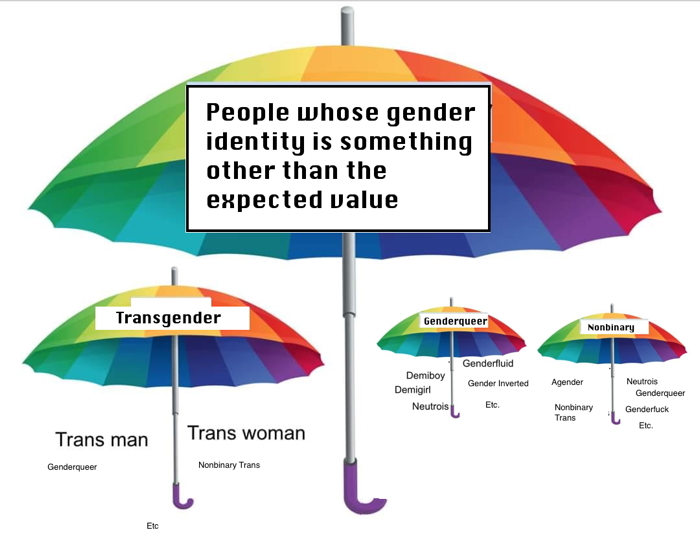
Notice that under this umbrella, several terms appear in multiple places. Because some genderqueer people do identify as transgender, whereas some do not; similarly some nonbinary people identify as transgender and others do not, and some nonbinary people consider themselves genderqueer while others do not, and vice versa and so on.
———————
You're secluded in quarantine, and all the performances and events have been cancelled, so it's a good time to read a book!
My book, GenderQueer: A Story From a Different Closet, has been published by Sunstone Press. It is available on Amazon and Barnes & Noble in paperback and ebook, and as ebook only from Apple, Kobo, and directly from Sunstone Press themselves.
Links to published reviews and comments are listed on my Home Page
———————
This DreamWidth blog is echoed on LiveJournal, WordPress, and Blogger. Please friend/link me from any of those environments on which you have an account.
————————
Index of all Blog Posts
I don't like that illustration.
So what's my problem with it?
I identify as genderqueer and I do not identify as transgender, and that umbrella diagram sticks me into that category whether I like it or not. That diagram creates a hierarchy in which all genderqueer people are transgender (but not vice versa). That means that any statement that transgender people make on behalf of all trans people is going to be considered to apply to me and other people like me. Because we're defined as being under that umbrella.
Let's look at some of the broad all-inclusive statements that many transgender people have made, shall we?
a) A person's gender identity is valid regardless of their physical anatomy. You don't have to have a medical transition in order for your gender identity to be valid. You don't have to "pass" in order for your gender identity to be valid
Well, that one is wonderful, I'm totally on-board with that! It used to be that society's understanding of what it meant to be trans was that you went out and got yourself a medical transition to make your physical anatomy correspond with your gender identity. And that certainly didn't describe me! So this is a good change, a good shift. The problem is with additional assumptions and assertions that they very often attach to that, such as
b) A person's physical anatomy is not a polite topic of consideration. Anatomy is utterly irrelevant to identity and nobody's business. It's totally inappropriate to be identifying a person on the basis of what's inside their underpants
and...
c) You should not use any anatomy-based terms except to refer to the binary sex assignment that our society coercively attributes people to at birth. If someone identifies as a woman or girl, you would be misgendering them if you did not consider them female; if someone identifies as a man or boy, to not regard them as fully male is transphobic and misgendering also
and...
d) Any insistence that sex and gender are two different things is politically offensive and based on wrong out-of-date science that is now disproven. There's no such thing as "biological sex" because intersex people exist and there are multitudes of body variation from chromosomes to organ structures, so the binary is just a social construct and there is no physical sex.
Well, let's unpack some of that. (Because we don't all wear the same packers in here, okay?) In reverse order, my intersex-activist buddies do want to make a distinction between sex and gender. It's important to them and they're tired of "intersex" being used as an argument for why "biological sex doesn't exist" and otherwise ignored. Intersex people have bodies. They have bodies that other people found embarrassingly different. So embarrassing that they often coercively assigned their bodies to male or female with a surgeon's knife, without their consent. Intersex people can't discuss the fact that their body differed at birth from the body of either male people or female people if "male" refers to gender identity instead of physical sex. Intersex people can't identify themselves if people in society are confused and say things like "Oh me too, I've always had a female side, I wanted to dance ballet instead of play baseball". I'm not intersex myself, but I can't even explain that I'm not intersex if the language doesn't let me explain that although I was never a boy or man, my physical configuration wasn't unusual for male people. That it's my gender that's queer, that my sex falls into normative classifications.
I identify as a femme or girl. But unlike Teresa, my transgender sister, I would not be misgendered if you called me male. Teresa would be; she'd find it insulting and demeaning. She identifies as a woman and definitely female. But I'm not Teresa. I identify as male. I identify as femme or girl. My sex and my gender don't match. I'm genderqueer. And if you're going to raise a giant umbrella over my head and say we're all transgender, you can't go around making blanket statements that support Teresa's identity but erase mine.
If it is no longer necessary to "pass", to look like a typical cisgender person of your same gender, then it should not matter if people do make some guesses about what's inside my underwear. Because no matter what's in there, we already agreed that it doesn't invalidate my gender identity, right? So it doesn't have to be kept a shameful secret. I've got the anatomy that most directly caused my mom's obstetrician to designate me as "male". It's an unfortunate social fact that the same anatomy also caused my birth announcements to incorrectly tell everyone "It's a boy!", but the "male" part wasn't wrong and I have no reason to hide it. I was a male girl. Perfectly queer and not typical, and quite healthy and happy with that, thank you.
I propose this umbrella instead:
Notice that under this umbrella, several terms appear in multiple places. Because some genderqueer people do identify as transgender, whereas some do not; similarly some nonbinary people identify as transgender and others do not, and some nonbinary people consider themselves genderqueer while others do not, and vice versa and so on.
———————
You're secluded in quarantine, and all the performances and events have been cancelled, so it's a good time to read a book!
My book, GenderQueer: A Story From a Different Closet, has been published by Sunstone Press. It is available on Amazon and Barnes & Noble in paperback and ebook, and as ebook only from Apple, Kobo, and directly from Sunstone Press themselves.
Links to published reviews and comments are listed on my Home Page
———————
This DreamWidth blog is echoed on LiveJournal, WordPress, and Blogger. Please friend/link me from any of those environments on which you have an account.
————————
Index of all Blog Posts
Sunday, August 30, 2020
I Get Reviewed by the Taos News!
After months and months of getting nice reviews in college newspapers and, at a lower volume, LGBTQIA press publications, I'm finally getting some reviews published in mainstream newspapers. Two weeks ago I made the Los Alamos Daily Post and now, extending my coverage in the New Mexican press, I'm in the Taos News.
Taos, like Los Alamos, is an eclectic little village, with a diverse and culturally savvy population and many farflung former residents who may still subscribe to the local paper.
— María Dolores Gonzales, Taos News https://www.taosnews.com/tempo/dont-forget-we-are-mexican/article_0b71eca2-1303-5733-b2b1-3d5a2c5151e1.html
———————
You're secluded in quarantine, and all the performances and events have been cancelled, so it's a good time to read a book!
My book, GenderQueer: A Story From a Different Closet, has been published by Sunstone Press. It is available on Amazon and Barnes & Noble in paperback and ebook, and as ebook only from Apple, Kobo, and directly from Sunstone Press themselves.
Links to published reviews and comments are listed on my Home Page
———————
This DreamWidth blog is echoed on LiveJournal, WordPress, and Blogger. Please friend/link me from any of those environments on which you have an account.
————————
Index of all Blog Posts
Taos, like Los Alamos, is an eclectic little village, with a diverse and culturally savvy population and many farflung former residents who may still subscribe to the local paper.
"When Derek Hunter moves to Los Alamos from Valdosta, Georgia, in eighth grade, he is bullied mercilessly. A tall, thin boy with glasses, who likes to wear stovepipe pants and slicked-back hair instead of bell-bottoms and long tresses (this is 1974), he embraces nonconformism mostly because he has nothing in common with boys his age.
What he knows about boys is "ribald and crude" and a "constant undercurrent of threat." He favors the company of girls, who are more accepting and physically attractive. Boys he begins to think of as "them," as the enemy. And they return the favor in terms of verbal and physical bullying.
In this tortured litany of harassment mostly set in Northern New Mexico, author Hunter, who lived in New Mexico until the mid-1980s, before moving to New York to become an activist in gender theory, presents a coming-of-age novel of ambivalent identity that the protagonist ultimately figures out on his own."
— María Dolores Gonzales, Taos News https://www.taosnews.com/tempo/dont-forget-we-are-mexican/article_0b71eca2-1303-5733-b2b1-3d5a2c5151e1.html
———————
You're secluded in quarantine, and all the performances and events have been cancelled, so it's a good time to read a book!
My book, GenderQueer: A Story From a Different Closet, has been published by Sunstone Press. It is available on Amazon and Barnes & Noble in paperback and ebook, and as ebook only from Apple, Kobo, and directly from Sunstone Press themselves.
Links to published reviews and comments are listed on my Home Page
———————
This DreamWidth blog is echoed on LiveJournal, WordPress, and Blogger. Please friend/link me from any of those environments on which you have an account.
————————
Index of all Blog Posts
Monday, August 24, 2020
Social Justice and Defunding the Police
One of the changes that some people have been advocating for since the police killing of George Floyd is to "defund the police". In some quarters, it's certainly a less than popular idea--nervously worried people glance at each other and try to visualize what our world would look like if the police all just packed up and went home. Most of these worried citizens haven't required a rescue from the predations of dangerous people in the last year, but still they think of the police as necessary protectors, a force without which there would be violent crime threatening us around every corner.
Me, I think there's something out of whack when our official organized response whenever there's a conflict between people is to go in with the attitude that somebody is the bad person, that somebody is the perpetrator, the evildoer. As if no two people could ever end up frustrated and feeling mutually thwarted and angry unless one of them was a bad person and the conflict was their fault. I think if you're a parent and your children are fighting, or you're a teacher and your students are furious and yelling and making threats, or you're a supervisor on the job and your employees are arguing and screaming and shoving each other, that you go in with the expectation that you need to listen to both sides, and the anticipation that there's going to be some way that everyone can get what they need out of the situation or at least enough of what they need that there's a solution everyone can live with. I'm not saying it's always going to work out that way, mind you, but you go in with that attitude. Not with the attitude that someone's in the wrong and needs to be stopped and then punished. And frankly if that's not your approach, if you don't go in looking to see how to make peace between these squabbling people, you're not a very good parent, a very good teacher, a very good supervisor. That over time you're going to contribute to the problems and make the fighting worse.
So why do we have police, when what we generally mean by "police" is a professional force that goes in to intervene specifically looking for lawbreakers to arrest? There are, in fact, some police forces in some locales where the officers are more inclined to go in and get people settled down and listen to all sides and remind the people in the community that we need to stick together and work together. That does exist. But you know, and I know, that that's the exception, not the general rule. People who aspire to become police officers don't imagine themselves doing inpromptu counseling sessions on the sidewalk. The people who wince at "defund the police" aren't worried about not having mediators in blue uniforms to get both sides listening to each other and working towards a mutually acceptable solution either. Instead, we've all been brought up to think of the police as the ones who get the bad guys. They have fast cars and radios; they have sticks, guns, and handcuffs on their belt. They will stop the criminals and put them in jail. Yeah, that model.
I'd like to see the police as we know them replaced with people who have been trained in defusing and mediating. And if the existing people wearing police badges feel like they didn't sign up for that, replace them with people who took social sciences and humanities courses in college.
I'm reading a book, mainstream entertainment fiction. Michael Connelly, The Closers. Like the overwhelming majority of police procedurals and mysteries, it's about murder. Because our steady diet of laudatory praise and respect for the police is centered around murder. It's not so easy to see why the enforcement of the rule that you shouldn't go around killing other people is somehow reinforcing our existing social inequalities--I mean, yeah, sure, you can no doubt come up with a scenario or two where somebody is in a situation where they have a moral right to kill someone (their rapist, the slaveowner who stands in the way of their freedom, etc), but it's a reach. We think it's a rare situation where killing someone isn't just plain inexcusable.
But most of the situations that police officers intervene in aren't murders. They investigate property crimes and occurrences of people shouting and shoving, and respond to situations where one person feels threatened by another; they look for violations of drug laws and they watch for people misbehaving in their vehicles; and they show up to investigate when there is vandalism or theft.
We didn't always have them around, you know. Yeah. We haven't always had a professional police force in the modern sense. Furthermore, the history of their existence is pretty tangled up with maintaining and enforcing an "us versus them" division or two in our society. The kind where one group is defined as "them". The bad people, the criminal elements that the other group needs to be protected from. And in the United States, the number one "them" group has been black folks. The entire notion of "criminals", the widely shared belief in a "them" who would otherwise threaten our safety and security here in our own homes and on our downtown sidewalks, is heavily interwoven with our notions about race. It's not always painted as overtly so, but we're made to fear the anger and hate of black people. (Why, because maybe we think they've been mistreated and deprived and just might have an understandable reason to be angry and hate us, ya think? Little bit of white guilt turned inside out to become a fear of a righteous wrath, perhaps?) Several white people have pointed out that it's an act of white privilege to call the cops any time there's a possible conflict, especially when the people with whom we're having a conflict are nonwhite people. They point out that for a nonwhite person to make a similar call, there's a legitimate worry that the police, upon arrival, will not help but will instead treat them as the cause of the problem. I watched a video earlier this week where a group of black teenagers called the police when they'd been physically attacked by someone else, only to have the police pull out guns on them when they showed up.
Meanwhile, we have the calls for social justice. I've never liked that phrase. "Justice", as in Department of Justice, as in dispensing justice from the judge's bench in the courtroom, is part and parcel of the police model. The notion that somebody is a culprit, an evildoer who is at fault and deserves for bad things to happen to them for the evil that they've done.
You can't really have it both ways. If it's a better approach to get everyone talking and listening instead of barging in designating somebody as the bad person, I don't think that changes when the alteraction is not about a cluster of teenagers arguing in a parking lot but instead is about different broad social factions arguing about oppression.
———————
You're secluded in quarantine, and all the performances and events have been cancelled, so it's a good time to read a book!
My book, GenderQueer: A Story From a Different Closet, has been published by Sunstone Press. It is available on Amazon and Barnes & Noble in paperback and ebook, and as ebook only from Apple, Kobo, and directly from Sunstone Press themselves.
Links to published reviews and comments are listed on my Home Page
———————
This DreamWidth blog is echoed on LiveJournal, WordPress, and Blogger. Please friend/link me from any of those environments on which you have an account.
————————
Index of all Blog Posts
Me, I think there's something out of whack when our official organized response whenever there's a conflict between people is to go in with the attitude that somebody is the bad person, that somebody is the perpetrator, the evildoer. As if no two people could ever end up frustrated and feeling mutually thwarted and angry unless one of them was a bad person and the conflict was their fault. I think if you're a parent and your children are fighting, or you're a teacher and your students are furious and yelling and making threats, or you're a supervisor on the job and your employees are arguing and screaming and shoving each other, that you go in with the expectation that you need to listen to both sides, and the anticipation that there's going to be some way that everyone can get what they need out of the situation or at least enough of what they need that there's a solution everyone can live with. I'm not saying it's always going to work out that way, mind you, but you go in with that attitude. Not with the attitude that someone's in the wrong and needs to be stopped and then punished. And frankly if that's not your approach, if you don't go in looking to see how to make peace between these squabbling people, you're not a very good parent, a very good teacher, a very good supervisor. That over time you're going to contribute to the problems and make the fighting worse.
So why do we have police, when what we generally mean by "police" is a professional force that goes in to intervene specifically looking for lawbreakers to arrest? There are, in fact, some police forces in some locales where the officers are more inclined to go in and get people settled down and listen to all sides and remind the people in the community that we need to stick together and work together. That does exist. But you know, and I know, that that's the exception, not the general rule. People who aspire to become police officers don't imagine themselves doing inpromptu counseling sessions on the sidewalk. The people who wince at "defund the police" aren't worried about not having mediators in blue uniforms to get both sides listening to each other and working towards a mutually acceptable solution either. Instead, we've all been brought up to think of the police as the ones who get the bad guys. They have fast cars and radios; they have sticks, guns, and handcuffs on their belt. They will stop the criminals and put them in jail. Yeah, that model.
I'd like to see the police as we know them replaced with people who have been trained in defusing and mediating. And if the existing people wearing police badges feel like they didn't sign up for that, replace them with people who took social sciences and humanities courses in college.
I'm reading a book, mainstream entertainment fiction. Michael Connelly, The Closers. Like the overwhelming majority of police procedurals and mysteries, it's about murder. Because our steady diet of laudatory praise and respect for the police is centered around murder. It's not so easy to see why the enforcement of the rule that you shouldn't go around killing other people is somehow reinforcing our existing social inequalities--I mean, yeah, sure, you can no doubt come up with a scenario or two where somebody is in a situation where they have a moral right to kill someone (their rapist, the slaveowner who stands in the way of their freedom, etc), but it's a reach. We think it's a rare situation where killing someone isn't just plain inexcusable.
But most of the situations that police officers intervene in aren't murders. They investigate property crimes and occurrences of people shouting and shoving, and respond to situations where one person feels threatened by another; they look for violations of drug laws and they watch for people misbehaving in their vehicles; and they show up to investigate when there is vandalism or theft.
We didn't always have them around, you know. Yeah. We haven't always had a professional police force in the modern sense. Furthermore, the history of their existence is pretty tangled up with maintaining and enforcing an "us versus them" division or two in our society. The kind where one group is defined as "them". The bad people, the criminal elements that the other group needs to be protected from. And in the United States, the number one "them" group has been black folks. The entire notion of "criminals", the widely shared belief in a "them" who would otherwise threaten our safety and security here in our own homes and on our downtown sidewalks, is heavily interwoven with our notions about race. It's not always painted as overtly so, but we're made to fear the anger and hate of black people. (Why, because maybe we think they've been mistreated and deprived and just might have an understandable reason to be angry and hate us, ya think? Little bit of white guilt turned inside out to become a fear of a righteous wrath, perhaps?) Several white people have pointed out that it's an act of white privilege to call the cops any time there's a possible conflict, especially when the people with whom we're having a conflict are nonwhite people. They point out that for a nonwhite person to make a similar call, there's a legitimate worry that the police, upon arrival, will not help but will instead treat them as the cause of the problem. I watched a video earlier this week where a group of black teenagers called the police when they'd been physically attacked by someone else, only to have the police pull out guns on them when they showed up.
Meanwhile, we have the calls for social justice. I've never liked that phrase. "Justice", as in Department of Justice, as in dispensing justice from the judge's bench in the courtroom, is part and parcel of the police model. The notion that somebody is a culprit, an evildoer who is at fault and deserves for bad things to happen to them for the evil that they've done.
You can't really have it both ways. If it's a better approach to get everyone talking and listening instead of barging in designating somebody as the bad person, I don't think that changes when the alteraction is not about a cluster of teenagers arguing in a parking lot but instead is about different broad social factions arguing about oppression.
———————
You're secluded in quarantine, and all the performances and events have been cancelled, so it's a good time to read a book!
My book, GenderQueer: A Story From a Different Closet, has been published by Sunstone Press. It is available on Amazon and Barnes & Noble in paperback and ebook, and as ebook only from Apple, Kobo, and directly from Sunstone Press themselves.
Links to published reviews and comments are listed on my Home Page
———————
This DreamWidth blog is echoed on LiveJournal, WordPress, and Blogger. Please friend/link me from any of those environments on which you have an account.
————————
Index of all Blog Posts
Friday, August 14, 2020
Los Alamos Home Town Newspaper Reviews My Book
I have had many nice reviews printed in college newspapers and I've been reviewed in the LGBTQIA press. And I've had notices and interviews in mainstream papers that speak to the existence of the book, but which weren't actually reviews of it. But until this week I did not have an actual review of GenderQueer printed in a mainstream municipal newspaper.
So it seems utterly appropriate that the first to do so would be the Los Alamos Daily Post, the newspaper from the town where I attended junior high and high school. The newspaper from the town where most of the action in the book takes place.
Lifestyles Editor Bonne Gordon was a great interviewer; when she called me to ask questions about my book and my experiences, it was obvious that she had not only been giving the book a close read but was also familiar on a deep level with the relevant backdrop issues. We discussed gender from the standpoint of LGBTQIA experiences and feminism, and how things have changed (and how they haven't) over the forty years since the events described in the book.
Los Alamos is both a small community and a special, well-known one. It's received far more literary attention than a typical village of 12,000 inhabitants would, but not so much that the people who live there don't become interested when a book about living there goes to press. So with any luck, the article will spark some local interest in reading my book.
Putting the Q in LGBTQ: Growing Up 'Different' In Los Alamos — Bonnie Gordon, The Los Alamos Daily Post
———————
You're secluded in quarantine, and all the performances and events have been cancelled, so it's a good time to read a book!
My book, GenderQueer: A Story From a Different Closet, has been published by Sunstone Press. It is available on Amazon and Barnes & Noble in paperback and ebook, and as ebook only from Apple, Kobo, and directly from Sunstone Press themselves.
Links to published reviews and comments are listed on my Home Page
———————
This DreamWidth blog is echoed on LiveJournal, WordPress, and Blogger. Please friend/link me from any of those environments on which you have an account.
————————
Index of all Blog Posts
So it seems utterly appropriate that the first to do so would be the Los Alamos Daily Post, the newspaper from the town where I attended junior high and high school. The newspaper from the town where most of the action in the book takes place.
Lifestyles Editor Bonne Gordon was a great interviewer; when she called me to ask questions about my book and my experiences, it was obvious that she had not only been giving the book a close read but was also familiar on a deep level with the relevant backdrop issues. We discussed gender from the standpoint of LGBTQIA experiences and feminism, and how things have changed (and how they haven't) over the forty years since the events described in the book.
Los Alamos is both a small community and a special, well-known one. It's received far more literary attention than a typical village of 12,000 inhabitants would, but not so much that the people who live there don't become interested when a book about living there goes to press. So with any luck, the article will spark some local interest in reading my book.
Putting the Q in LGBTQ: Growing Up 'Different' In Los Alamos — Bonnie Gordon, The Los Alamos Daily Post
———————
You're secluded in quarantine, and all the performances and events have been cancelled, so it's a good time to read a book!
My book, GenderQueer: A Story From a Different Closet, has been published by Sunstone Press. It is available on Amazon and Barnes & Noble in paperback and ebook, and as ebook only from Apple, Kobo, and directly from Sunstone Press themselves.
Links to published reviews and comments are listed on my Home Page
———————
This DreamWidth blog is echoed on LiveJournal, WordPress, and Blogger. Please friend/link me from any of those environments on which you have an account.
————————
Index of all Blog Posts
Friday, August 7, 2020
My Query-letter and Elaboration for the Proposal
I've started sending out my pitch to get my second book published.
Here is my standard query letter, and below that, the parts of the formal proposal that spell out in more detail what the book is about.
Query Letter:
"When you're a fish out of water you look for the nearest ocean" — Anthony T. Hincks
THAT GUY IN OUR WOMEN'S STUDIES CLASS is a nonfiction memoir about a genderqueer sissy male, Derek, who decided that women's studies in college would be a good place to engage people in discussions about gender.
This narrative tale follows Derek down Oklahoma highways and into heroin dens in Harlem and then into the homeless shelters of 1980s New York City, as the determined but not always practical Derek pursues his dream.
Along the way, the story delves into the complexities of privilege and social identity in ways that challenge assumptions about power and marginalization—not in primary-color simplicity but by exploring privilege and deprivation along a number of different dimensions and showing it in all of its native complexity, all while still respecting a concern for empowering the voice of those left out.
"Hunter's prose explores the delicate tapestry of privilege and power... this is a deployment of 'show, not tell' I've rarely seen done... narrative social theory" — An early reader
Length: 95,962 words
From the Formal Proposal:
Elevator Statement —
In 1980, I came out as a sissy. I was reclaiming the term the same way that proud lesbians referred to themselves as "dykes" or the way that gay folks were reclaiming "queer". "Sissy" comes from the word "sister" and so it seemed like the right word: a sisterlike, i.e., feminine or girlish, male person.
We had gay rights activists back then. We even had trans activists. A lot of people didn't understand why I was using a new and different term. But I wasn't gay or trans. It was something else.
Trans women, both back then and today, tend to say "Don't see me as a trans woman. See me as a woman". That wasn't me. I didn't consider myself female. I considered myself femme. I didn't identify with the gay rights movement: my sexuality wasn't same-sex attraction and I saw a need to untangle gender from either physical sex OR sexual orientation.
The activists I identified with the most were feminists. They were the ones who said having a different behavioral standard and polarized social roles for the sexes was sexist.
So I headed off to the university to major in women's studies.
That Guy in our Women's Studies Class is a rare thing in the world of memoirs: a sequel. In March 2020, my book GenderQueer: A Story From a Different Closet, was published by Sunstone Press (Santa Fe NM).
GenderQueer told the coming-of-age and coming-out story of realizing I had a different gender identity and of giving it a name. At the end of it, I vow to confront the world about how sissy males are treated. In That Guy in our Women's Studies Class, I set out to do exactly that, choosing the world of academic women's studies as my platform.
Elaborating on the Concept —
"When you're a fish out of water you look for the nearest ocean" — Anthony T. Hincks
As a male person very focused on the unfairness of gender expectations, I headed for the largest metropolitan center I could easily get to—New York City—figuring that even if my identity made me an exception to the exception to the rule, I'd be able to find people who were like me. And I pinned my hopes and dreams to women's studies, because the material I wanted to discuss with people would overlap with the material we'd be focusing on in the classroom.
That Guy in our Women's Studies Class illustrates the complexities of intersectionality, the interconnected nature of social categorizations such as race, class, and gender and so forth. The main character is male, the privileged sex in the patriarchal context. Within the first few pages of the book, he has reason to worry that he's invading women's space by attending women's studies classes. At the same time, he's a minority within that space, and, as a gender-nonconforming sissy in the 1980s, a person with a gender identity that wasn't acknowledged and recognized yet, he's been somewhat marginalized by gender himself.
That's the presenting surface of a larger and even more intricate situation. To get to New York and attempt to get into college, he hitchhikes across the country and becomes a homeless person on the New York streets, eventually trading in on a history of psychiatric incarceration (he'd been placed on a locked ward shortly after coming out) to get into the better-funded assistance programs, which were earmarked for the "homeless mentally ill". A person with a psychiatric diagnosis was thus both privileged among the homeless and at the same time often stripped of basic rights because of that same status. And we follow along as the main character commutes every day from the grounds of Creedmoor Psychiatric Hospital to SUNY college campus, where most of the other students are middle class suburban commuters with the advantages and privileges of that existence.
There is also the dynamic of race: although the SUNY campus is not as disproportionately black as an historically black college such as Grambling, there is a high proportion of inner city black students living in the dorms as residential students, and there's a tension between the mostly-white commuters and the majority-black resident students. The book's main character is commuting from a different majority-minority environment, the world of formerly homeless halfway-house residents. In his second year he moves into the dormitories to live among the resident students and get away from the oppressive environment of the psychiatric facility. Over and over again, he finds his attention diverted from matters of gender identity to questions of race and racial oppression.
Meanwhile, in his academic studies, he gets increasingly immersed in studying the complex tapestry of power itself, and the larger question of its desirability, which feminist theory examines as part of the patriarchal value structure.
That Guy in our Women's Studies Class is a narrative story, with characters and conversations and a compelling storyline. While real life doesn't often resemble the trajectory of a fictional novel's plot, this particular slice of life tells that kind of tale. It's an entertaining book, one that does not read like an educational treatise. It's the story of a young out-of-town person from a small village making a go of it in the big city, of a survivor coping with life on the streets while seeking employment and a place to stay, and of a fervent activist looking for his 'people', finding a place in the world, and finding a political voice.
The people and events described in this memoir were all quite real, but to streamline and optimize the narrative flow, I sometimes combined several characters into one composite character, so as to not have to develop so many characters; and on occasions I also condensed multiple similar events and described them as single events.
The names have all been changed—including my own, for consistency. As I did in GenderQueer, I refer to myself as Derek Turner throughout.
———————
You're secluded in quarantine, and all the performances and events have been cancelled, so it's a good time to read a book!
My book, GenderQueer: A Story From a Different Closet, has been published by Sunstone Press. It is available on Amazon and Barnes & Noble in paperback and ebook, and as ebook only from Apple, Kobo, and directly from Sunstone Press themselves.
Links to published reviews and comments are listed on my Home Page
———————
This DreamWidth blog is echoed on LiveJournal, WordPress, and Blogger. Please friend/link me from any of those environments on which you have an account.
————————
Index of all Blog Posts
Here is my standard query letter, and below that, the parts of the formal proposal that spell out in more detail what the book is about.
Query Letter:
"When you're a fish out of water you look for the nearest ocean" — Anthony T. Hincks
THAT GUY IN OUR WOMEN'S STUDIES CLASS is a nonfiction memoir about a genderqueer sissy male, Derek, who decided that women's studies in college would be a good place to engage people in discussions about gender.
This narrative tale follows Derek down Oklahoma highways and into heroin dens in Harlem and then into the homeless shelters of 1980s New York City, as the determined but not always practical Derek pursues his dream.
Along the way, the story delves into the complexities of privilege and social identity in ways that challenge assumptions about power and marginalization—not in primary-color simplicity but by exploring privilege and deprivation along a number of different dimensions and showing it in all of its native complexity, all while still respecting a concern for empowering the voice of those left out.
"Hunter's prose explores the delicate tapestry of privilege and power... this is a deployment of 'show, not tell' I've rarely seen done... narrative social theory" — An early reader
Length: 95,962 words
From the Formal Proposal:
Elevator Statement —
In 1980, I came out as a sissy. I was reclaiming the term the same way that proud lesbians referred to themselves as "dykes" or the way that gay folks were reclaiming "queer". "Sissy" comes from the word "sister" and so it seemed like the right word: a sisterlike, i.e., feminine or girlish, male person.
We had gay rights activists back then. We even had trans activists. A lot of people didn't understand why I was using a new and different term. But I wasn't gay or trans. It was something else.
Trans women, both back then and today, tend to say "Don't see me as a trans woman. See me as a woman". That wasn't me. I didn't consider myself female. I considered myself femme. I didn't identify with the gay rights movement: my sexuality wasn't same-sex attraction and I saw a need to untangle gender from either physical sex OR sexual orientation.
The activists I identified with the most were feminists. They were the ones who said having a different behavioral standard and polarized social roles for the sexes was sexist.
So I headed off to the university to major in women's studies.
That Guy in our Women's Studies Class is a rare thing in the world of memoirs: a sequel. In March 2020, my book GenderQueer: A Story From a Different Closet, was published by Sunstone Press (Santa Fe NM).
GenderQueer told the coming-of-age and coming-out story of realizing I had a different gender identity and of giving it a name. At the end of it, I vow to confront the world about how sissy males are treated. In That Guy in our Women's Studies Class, I set out to do exactly that, choosing the world of academic women's studies as my platform.
Elaborating on the Concept —
"When you're a fish out of water you look for the nearest ocean" — Anthony T. Hincks
As a male person very focused on the unfairness of gender expectations, I headed for the largest metropolitan center I could easily get to—New York City—figuring that even if my identity made me an exception to the exception to the rule, I'd be able to find people who were like me. And I pinned my hopes and dreams to women's studies, because the material I wanted to discuss with people would overlap with the material we'd be focusing on in the classroom.
That Guy in our Women's Studies Class illustrates the complexities of intersectionality, the interconnected nature of social categorizations such as race, class, and gender and so forth. The main character is male, the privileged sex in the patriarchal context. Within the first few pages of the book, he has reason to worry that he's invading women's space by attending women's studies classes. At the same time, he's a minority within that space, and, as a gender-nonconforming sissy in the 1980s, a person with a gender identity that wasn't acknowledged and recognized yet, he's been somewhat marginalized by gender himself.
That's the presenting surface of a larger and even more intricate situation. To get to New York and attempt to get into college, he hitchhikes across the country and becomes a homeless person on the New York streets, eventually trading in on a history of psychiatric incarceration (he'd been placed on a locked ward shortly after coming out) to get into the better-funded assistance programs, which were earmarked for the "homeless mentally ill". A person with a psychiatric diagnosis was thus both privileged among the homeless and at the same time often stripped of basic rights because of that same status. And we follow along as the main character commutes every day from the grounds of Creedmoor Psychiatric Hospital to SUNY college campus, where most of the other students are middle class suburban commuters with the advantages and privileges of that existence.
There is also the dynamic of race: although the SUNY campus is not as disproportionately black as an historically black college such as Grambling, there is a high proportion of inner city black students living in the dorms as residential students, and there's a tension between the mostly-white commuters and the majority-black resident students. The book's main character is commuting from a different majority-minority environment, the world of formerly homeless halfway-house residents. In his second year he moves into the dormitories to live among the resident students and get away from the oppressive environment of the psychiatric facility. Over and over again, he finds his attention diverted from matters of gender identity to questions of race and racial oppression.
Meanwhile, in his academic studies, he gets increasingly immersed in studying the complex tapestry of power itself, and the larger question of its desirability, which feminist theory examines as part of the patriarchal value structure.
That Guy in our Women's Studies Class is a narrative story, with characters and conversations and a compelling storyline. While real life doesn't often resemble the trajectory of a fictional novel's plot, this particular slice of life tells that kind of tale. It's an entertaining book, one that does not read like an educational treatise. It's the story of a young out-of-town person from a small village making a go of it in the big city, of a survivor coping with life on the streets while seeking employment and a place to stay, and of a fervent activist looking for his 'people', finding a place in the world, and finding a political voice.
The people and events described in this memoir were all quite real, but to streamline and optimize the narrative flow, I sometimes combined several characters into one composite character, so as to not have to develop so many characters; and on occasions I also condensed multiple similar events and described them as single events.
The names have all been changed—including my own, for consistency. As I did in GenderQueer, I refer to myself as Derek Turner throughout.
———————
You're secluded in quarantine, and all the performances and events have been cancelled, so it's a good time to read a book!
My book, GenderQueer: A Story From a Different Closet, has been published by Sunstone Press. It is available on Amazon and Barnes & Noble in paperback and ebook, and as ebook only from Apple, Kobo, and directly from Sunstone Press themselves.
Links to published reviews and comments are listed on my Home Page
———————
This DreamWidth blog is echoed on LiveJournal, WordPress, and Blogger. Please friend/link me from any of those environments on which you have an account.
————————
Index of all Blog Posts
Saturday, August 1, 2020
Two New Reviews from Book Bloggers
A couple of really nice reviews of GenderQueer were posted this week by book bloggers, with any luck drawing some more attention to my book and luring more people to read it!
"In a world which is still conservative at large and prejudiced for the most part, Derek's story is agonizing despite being inspirational. I say this because it shows us just how hurtful and indifferent people can be, especially if you are trying to tell the truth about something that they'd much rather pretend doesn't exist...
No amount of research into theoretical assumptions and claims can replace the experience of reading someone's life story and knowing what they've been through. The narrative style is simple yet powerful. By the time you reach the final page, you'll feel like you've had quite the journey...
Characters: This is obviously about the main character or the author himself. I don't think its necessary to mention again how moved I was by his story. I, however, would like to talk about the brilliant way in which the others are depicted. Some characters represent a particular way of thinking. No matter what we think about stereotyping, it's true that some people share the same sort of antagonism and hatred when it comes to the LGBTQ+ community and this group appears pretty frequently in the book, needless to say. The author has merged several like minded people into a few characters because they are significant only because of their point of view. This has resulted in a story not overcrowded with characters and has left enough space for Derek to reveal himself to the reader...
Genderqueer succeeds greatly as a memoir because it excels in every sub-category."
Saradia Chatterjee (Blogger: Crazy Curious Sara) Crazy Curious Reader
"I guess I'd shot my mouth off. - First Sentence, Part One: School. At A Party: 1979
This is who I am, how I am. Get used to it! I will never again tolerate people being mean and nasty to me and acting like I deserve it because I don't act like a guy. From now on being all worried about that is gonna be their problem. - Memorable Moment, Page 166
I ...had thought to use the metaphor 'like a round peg in a square hole' but somehow that didn't feel strong enough so, abnormal, there I've said it - the author was made to feel abnormal, for the most part this wasn't comfortable reading and arguably the former portions spent on the author's early life experiences were a tad too drawn out, and yet that said ...
Not always a journey easily travelled (and especially not then) I think that not to have chronicled these events and, perhaps more importantly, the feelings they gave rise to, in such detail would have been to do a disservice to the experiences of not only Derek but also to generations of people who have rarely been represented; whose stories have never been told.
A very human story but one that provides an important insight into gender and identity."
Felicity Grace Terry (Blogger) Pen and Paper
More reviews and book purchase information available here on my author web site
In other news, I've begun querying lit agents and small publishers about my second book, That Guy in our Women's Studies Class, and next week I'm thinking I'll post the query letter than I'm using for it. On the one hand, I think it will be a more difficult sell: the topic of being genderqueer is about as hot at the moment as its ever been, whereas the second book, while still tangentially about that (the main character, i.e., me, is genderqueer, and that both informs a lot of the character's interactions with the other characters and also is the reason for majoring in women's studies in the first place), is a lot more focused on the presence of a male person (or man, or person perceived to be male or a man at any rate) within feminism and the larger questions of privilege and marginalization... and that's probably going to be perceived by lit agents and publishers as a lot more intellectual and less mainstream. On the other hand, I'll have the advantage of being a published author already this time around. The author of a book that's being nominated by the publisher as their entry for the Aspen Prize, in fact!
*preen*
So I may be able to pull it off, to get my second book published.
I'm still soliciting beta readers, by the way. It's only recently out of the oven and I want to get some folks to do taste tests, so if you're up for a novel-length nonfiction book about a sissy who hitches to New York to major in women's studies, give me a holler.
———————
You're secluded in quarantine, and all the performances and events have been cancelled, so it's a good time to read a book!
My book, GenderQueer: A Story From a Different Closet, has been published by Sunstone Press. It is available on Amazon and Barnes & Noble in paperback and ebook, and as ebook only from Apple, Kobo, and directly from Sunstone Press themselves.
Links to published reviews and comments are listed on my Home Page
———————
This DreamWidth blog is echoed on LiveJournal, WordPress, and Blogger. Please friend/link me from any of those environments on which you have an account.
————————
Index of all Blog Posts
"In a world which is still conservative at large and prejudiced for the most part, Derek's story is agonizing despite being inspirational. I say this because it shows us just how hurtful and indifferent people can be, especially if you are trying to tell the truth about something that they'd much rather pretend doesn't exist...
No amount of research into theoretical assumptions and claims can replace the experience of reading someone's life story and knowing what they've been through. The narrative style is simple yet powerful. By the time you reach the final page, you'll feel like you've had quite the journey...
Characters: This is obviously about the main character or the author himself. I don't think its necessary to mention again how moved I was by his story. I, however, would like to talk about the brilliant way in which the others are depicted. Some characters represent a particular way of thinking. No matter what we think about stereotyping, it's true that some people share the same sort of antagonism and hatred when it comes to the LGBTQ+ community and this group appears pretty frequently in the book, needless to say. The author has merged several like minded people into a few characters because they are significant only because of their point of view. This has resulted in a story not overcrowded with characters and has left enough space for Derek to reveal himself to the reader...
Genderqueer succeeds greatly as a memoir because it excels in every sub-category."
Saradia Chatterjee (Blogger: Crazy Curious Sara) Crazy Curious Reader
"I guess I'd shot my mouth off. - First Sentence, Part One: School. At A Party: 1979
This is who I am, how I am. Get used to it! I will never again tolerate people being mean and nasty to me and acting like I deserve it because I don't act like a guy. From now on being all worried about that is gonna be their problem. - Memorable Moment, Page 166
I ...had thought to use the metaphor 'like a round peg in a square hole' but somehow that didn't feel strong enough so, abnormal, there I've said it - the author was made to feel abnormal, for the most part this wasn't comfortable reading and arguably the former portions spent on the author's early life experiences were a tad too drawn out, and yet that said ...
Not always a journey easily travelled (and especially not then) I think that not to have chronicled these events and, perhaps more importantly, the feelings they gave rise to, in such detail would have been to do a disservice to the experiences of not only Derek but also to generations of people who have rarely been represented; whose stories have never been told.
A very human story but one that provides an important insight into gender and identity."
Felicity Grace Terry (Blogger) Pen and Paper
More reviews and book purchase information available here on my author web site
In other news, I've begun querying lit agents and small publishers about my second book, That Guy in our Women's Studies Class, and next week I'm thinking I'll post the query letter than I'm using for it. On the one hand, I think it will be a more difficult sell: the topic of being genderqueer is about as hot at the moment as its ever been, whereas the second book, while still tangentially about that (the main character, i.e., me, is genderqueer, and that both informs a lot of the character's interactions with the other characters and also is the reason for majoring in women's studies in the first place), is a lot more focused on the presence of a male person (or man, or person perceived to be male or a man at any rate) within feminism and the larger questions of privilege and marginalization... and that's probably going to be perceived by lit agents and publishers as a lot more intellectual and less mainstream. On the other hand, I'll have the advantage of being a published author already this time around. The author of a book that's being nominated by the publisher as their entry for the Aspen Prize, in fact!
*preen*
So I may be able to pull it off, to get my second book published.
I'm still soliciting beta readers, by the way. It's only recently out of the oven and I want to get some folks to do taste tests, so if you're up for a novel-length nonfiction book about a sissy who hitches to New York to major in women's studies, give me a holler.
———————
You're secluded in quarantine, and all the performances and events have been cancelled, so it's a good time to read a book!
My book, GenderQueer: A Story From a Different Closet, has been published by Sunstone Press. It is available on Amazon and Barnes & Noble in paperback and ebook, and as ebook only from Apple, Kobo, and directly from Sunstone Press themselves.
Links to published reviews and comments are listed on my Home Page
———————
This DreamWidth blog is echoed on LiveJournal, WordPress, and Blogger. Please friend/link me from any of those environments on which you have an account.
————————
Index of all Blog Posts
Friday, July 24, 2020
Kitten Robe
I was unsure about whether I'd end up blog-posting about my robe project. Wondering if it wasn't more than a bit off-topic, you know? But then I got into a conversation with someone who'd attended the same schools as me, initially discussing shop class but that got me to thinking about how home ec was required for girls only when I was in junior high.
So yeah, learning how to sew from a pattern on a sewing machine is gendered. Sure, there are tailors and other male-bodied folks who sew, but you could make that case for any activity, including vamping in sexy lingerie. And people in my gender-atypical FB groups often post selfies showing themselves modeling or posing. So why not?
Also, there's a scene in my book where my mom teaches me how to make a shirt from a pattern when I'm 18, and I make this brilliant red-and-gold paisley shirt, and then about a year later I'm wearing that shirt at a party and get beaten up, with a lot of references to me being sissy and probably queer and therefore that I'd had it coming. And I hadn't really ever gone back to sew from a pattern since then, not until now.
I wore out my old summer bathrobe (it was hanging in tatters) and what with me being at home due to Covid / unemployment, it made sense to do a creative project, so my partner (who is quite adept on the sewing machine) proposed that I make my own. So I picked out a fabric and she helped me select a sewing pattern and I was soon ensconced in chair, pinning and cutting and turning that pile of cloth into a garment.
The fabric arrives:
https://www.genderkitten.com/WS4/ah3files2/Robe/IMG_2617_sm.jpg
Separating the pattern pieces:
https://www.genderkitten.com/WS4/ah3files2/Robe/IMG_2620_sm.jpg
https://www.genderkitten.com/WS4/ah3files2/Robe/IMG_2618_sm.jpg
Our dining room table repurposed as a working surface:
https://www.genderkitten.com/WS4/ah3files2/Robe/IMG_2625_sm.jpg
Cutting the fabric as per the pattern pieces:
https://www.genderkitten.com/WS4/ah3files2/Robe/IMG_2629_sm.jpg
Stacking the cut pieces on the back of the couch until needed:
https://www.genderkitten.com/WS4/ah3files2/Robe/IMG_2630_sm.jpg
Pockets: the goal here is to have the print pattern on the pockets merge exactly with the underlying print on the robe front:
https://www.genderkitten.com/WS4/ah3files2/Robe/IMG_2633_sm.jpg
https://www.genderkitten.com/WS4/ah3files2/Robe/IMG_2634_sm.jpg
Pinning in preparation for sewing the pocket down:
https://www.genderkitten.com/WS4/ah3files2/Robe/IMG_2648_sm.jpg
Belt Loops:
https://www.genderkitten.com/WS4/ah3files2/Robe/IMG_2652_sm.jpg
The sewing machine: not fancy but portable and functional:
https://www.genderkitten.com/WS4/ah3files2/Robe/IMG_2653_sm.jpg
Now just lay down a stitch in a straight line...
https://www.genderkitten.com/WS4/ah3files2/Robe/IMG_2657_sm.jpg
Not too bad!
https://www.genderkitten.com/WS4/ah3files2/Robe/IMG_2664_sm.jpg
Finished seams:
https://www.genderkitten.com/WS4/ah3files2/Robe/IMG_2661_sm.jpg
It's starting to be a robe!
https://www.genderkitten.com/WS4/ah3files2/Robe/IMG_2662_sm.jpg
Close to the edge...
https://www.genderkitten.com/WS4/ah3files2/Robe/IMG_2669_sm.jpg
Sleeve!
https://www.genderkitten.com/WS4/ah3files2/Robe/IMG_2677_sm.jpg
Finished product!
https://www.genderkitten.com/WS4/ah3files2/Robe/IMG_2678_sm.jpg
https://www.genderkitten.com/WS4/ah3files2/Robe/IMG_2680_sm.jpg
———————
You're secluded in quarantine, and all the performances and events have been cancelled, so it's a good time to read a book!
My book, GenderQueer: A Story From a Different Closet, has been published by Sunstone Press. It is available on Amazon and Barnes & Noble in paperback and ebook, and as ebook only from Apple, Kobo, and directly from Sunstone Press themselves.
Links to published reviews and comments are listed on my Home Page
———————
This DreamWidth blog is echoed on LiveJournal, WordPress, and Blogger. Please friend/link me from any of those environments on which you have an account.
————————
Index of all Blog Posts
So yeah, learning how to sew from a pattern on a sewing machine is gendered. Sure, there are tailors and other male-bodied folks who sew, but you could make that case for any activity, including vamping in sexy lingerie. And people in my gender-atypical FB groups often post selfies showing themselves modeling or posing. So why not?
Also, there's a scene in my book where my mom teaches me how to make a shirt from a pattern when I'm 18, and I make this brilliant red-and-gold paisley shirt, and then about a year later I'm wearing that shirt at a party and get beaten up, with a lot of references to me being sissy and probably queer and therefore that I'd had it coming. And I hadn't really ever gone back to sew from a pattern since then, not until now.
I wore out my old summer bathrobe (it was hanging in tatters) and what with me being at home due to Covid / unemployment, it made sense to do a creative project, so my partner (who is quite adept on the sewing machine) proposed that I make my own. So I picked out a fabric and she helped me select a sewing pattern and I was soon ensconced in chair, pinning and cutting and turning that pile of cloth into a garment.
The fabric arrives:
https://www.genderkitten.com/WS4/ah3files2/Robe/IMG_2617_sm.jpg
Separating the pattern pieces:
https://www.genderkitten.com/WS4/ah3files2/Robe/IMG_2620_sm.jpg
https://www.genderkitten.com/WS4/ah3files2/Robe/IMG_2618_sm.jpg
Our dining room table repurposed as a working surface:
https://www.genderkitten.com/WS4/ah3files2/Robe/IMG_2625_sm.jpg
Cutting the fabric as per the pattern pieces:
https://www.genderkitten.com/WS4/ah3files2/Robe/IMG_2629_sm.jpg
Stacking the cut pieces on the back of the couch until needed:
https://www.genderkitten.com/WS4/ah3files2/Robe/IMG_2630_sm.jpg
Pockets: the goal here is to have the print pattern on the pockets merge exactly with the underlying print on the robe front:
https://www.genderkitten.com/WS4/ah3files2/Robe/IMG_2633_sm.jpg
https://www.genderkitten.com/WS4/ah3files2/Robe/IMG_2634_sm.jpg
Pinning in preparation for sewing the pocket down:
https://www.genderkitten.com/WS4/ah3files2/Robe/IMG_2648_sm.jpg
Belt Loops:
https://www.genderkitten.com/WS4/ah3files2/Robe/IMG_2652_sm.jpg
The sewing machine: not fancy but portable and functional:
https://www.genderkitten.com/WS4/ah3files2/Robe/IMG_2653_sm.jpg
Now just lay down a stitch in a straight line...
https://www.genderkitten.com/WS4/ah3files2/Robe/IMG_2657_sm.jpg
Not too bad!
https://www.genderkitten.com/WS4/ah3files2/Robe/IMG_2664_sm.jpg
Finished seams:
https://www.genderkitten.com/WS4/ah3files2/Robe/IMG_2661_sm.jpg
It's starting to be a robe!
https://www.genderkitten.com/WS4/ah3files2/Robe/IMG_2662_sm.jpg
Close to the edge...
https://www.genderkitten.com/WS4/ah3files2/Robe/IMG_2669_sm.jpg
Sleeve!
https://www.genderkitten.com/WS4/ah3files2/Robe/IMG_2677_sm.jpg
Finished product!
https://www.genderkitten.com/WS4/ah3files2/Robe/IMG_2678_sm.jpg
https://www.genderkitten.com/WS4/ah3files2/Robe/IMG_2680_sm.jpg
———————
You're secluded in quarantine, and all the performances and events have been cancelled, so it's a good time to read a book!
My book, GenderQueer: A Story From a Different Closet, has been published by Sunstone Press. It is available on Amazon and Barnes & Noble in paperback and ebook, and as ebook only from Apple, Kobo, and directly from Sunstone Press themselves.
Links to published reviews and comments are listed on my Home Page
———————
This DreamWidth blog is echoed on LiveJournal, WordPress, and Blogger. Please friend/link me from any of those environments on which you have an account.
————————
Index of all Blog Posts
Friday, July 17, 2020
Hey, Sister...
Hey, sister, got a moment? Any chance we can reconcile?
You find it bewildering that as a femme-identifying person, I refer to myself as male. You find it appalling and maybe even transphobic when I explain that what I mean when I say I'm "male" is that I was born with a set of physical equipment that, in our culture, has historically been designated "male", although many other people (perhaps including you) may have this same set of bodily components and call those physical structures something other than "male".
You say "Why can't you just call it a penis? A penis isn't male. It's just a penis! Girls can have a penis. Boys can have a vulva".
Well, yeah, I know girls can have a penis. I'm a girl and I've got one. Are we both cool and totally down with the notion that having a penis doesn't define our gender? Can we please have a little moment of peace and solidarity and not be quick to hate on each other for using language a bit differently, and for coming at this situation from different angles?
You identify as transgender. I don't. That means you're a part of a subculture, a community; and you folks, collectively, you got your own way of expressing things, and you also got your own history. Let's talk about the history thing for a sec.
I'm 61; forty years ago, when I was 21 and first coming out, trans people explained the situation to the larger surrounding culture like this: trans people realized at some point in their life that their gender was the gender typically found in the other type of body, and so they'd ideally get hormones and surgery and transition, so that their body would match their gender. And what they said they wanted from the surrounding world was to be accepted as a normal and ordinary person of that gender and that sex. And most trans people wanted to "pass" — they didn't want to receive social acceptance only from a handful of people who heard their life story and learned about transsexuals and all that, but instead they wanted to look and otherwise present in such a way that strangers who didn't know them would just automatically treat them as the gender that they were.
Fast forward to the more-or-less present era. Trans activists interact with lots of transgender people who can't afford hormones and surgery even if they want them, and lots of people who are blocked from having access to the medical interventions they want because doctors and insurance companies are playing gatekeeper. They also interact with a lot of transgender people who don't want the whole package of medical options for a variety of reasons. There's a risk of significant loss of sensation and function when doctors rearrange biological tissue, and there are systemic repercussions to hormones with risk factors and so on and so forth.
Well, it's really fundamentally a human rights issue that the body you inhabit should not detract from the legitimacy of your gender identity. So the social message changed, to become a lot more inclusive. You were valid as a trans person (woman or man) whether you passed or did not pass, and, in fact, fuck "pass". Identities are what are valid; your body doesn't matter! And they didn't use "male" and "female" to refer to bodily architecture because that can imply to some trans people that they've got the wrong body for their gender identity.
I apologize if I've misrepresented the transgender movement and its history in that short summary. I'm writing from the outside. I try to learn and listen but if I've distorted things, I'm sorry, but I hope I mostly got it right.
I'm not trans. I heard the 40-years-ago version of what trans was, gave it some thought, decided nope, that's not me. It's something else. I haven't been a part of your community these 40 years.
So I've got a different history, with different understandings and stuff. I'm hoping you'll be compassionate and interested in a story that's different from yours, so you can see how I got to my viewpoint, ok?
I came out in 1980 as a sissy. A person in a male body whose personality and behavior were a mismatch for what's expected of male people, but a good match for the expectations for female people. I did not want to be perceived as an ordinary typical female person any more than I wanted to be perceived as an ordinary male person. I wanted to be perceived as what I'd been harassed about and accused of all my life: an effeminate sissy girlish male person. The world apparently thought I should be ashamed of that, but I was proud of it. And I was finally angry about it and ready to take a stand. To be in your face about it. Yeah, I'm male, and I'm one of the girls. Get used to it. Deal.
My attitude is that until the world nods in agreement that yeah, male girls exist and no, it's not a damn affliction or an embarrassment, a failure to be sufficiently manly... until then, there's always going to be this notion that if you're perceived and recognized as a male-bodied person, you'll be regarded as less of a man than a masculine man and less of a woman than a physically female-structured person who has boobs and vag and all that.
Not only don't I want to pass, I want to "anti-pass". I want, as I said, to be up in people's face about the lack of correspondence between my body and my gender identity. You've got a male girl here. Flying pride flags about it, no less, got that?
So... you don't use "male" to refer to physical stuff like testicles and penis. You basically use "male" to mean the same thing as "man" and "boy" and so on. I, on the other hand, do use it to mean the physical stuff. My attitude is we've already got plenty of gender words ("man", "boy", "masculine", "feminine", "guy", "dude", "gal", etc), and the word "male" is historically about the raw physical architecture (including other species and also things like hose couplings and electrical plugs), so why can't we keep that word for sex and use existing gender words for gender? This isn't about invalidating anybody's gender identity, it's really not. Yeesh, do I sound like J. K. fucking Rowling here? Seriously?
You ask "Well, why can't you just call it a penis, why do you have to say male?". I say "I want a goddam adjective. An already-recognized adjective to describe me as a person-with-penis-and-associated-bits. I don't want to use a long klunky phrase like 'person with a penis and testicles and adam's apple and absence of a vulva and clitoris and breasts, person who happens to be dyadic or endosex as opposed to intersex and most likely has XY chromosomes and doesn't have a period and has spermatotrophic hormone and a vas deferens'".
If I don't specify that when I say "male" I'm talking about my plumbing and not my personality and inclinations, people often assume I'm saying I have a "male side and a female side", like genderfluid or bigender people. Which isn't it at all. I'm not less feminine than you are. I'm not less male than a rooster. I'm not in-between, either sexually (as intersex people may consider themselves to be) or genderwise. I'm solidly male and utterly feminine.
I'm talking about mine. MY parts. I'm not calling your parts male. I'm calling my parts male.
Not everybody is either male or female, just as not everybody who is male is a man and not everybody who is female is a woman. But the fact that sex isn't binary doesn't mean sex doesn't exist. By the way, intersex people can't talk about being intersex — and distinguish intersex from being nonbinary or intergender or genderfluid or whatever — if they can't talk about bodies and why their atypical body has marked them as different and marginalized them. Most of the intersex activists I know really want to distinguish sex from gender. Because otherwise they get erased.
In a similar way, I can't do the political activity of getting in people's face about being a male girl if I can't say "male girl" and can't talk about the body that caused my girlness to be perceived as something wrong and in need of fixing, or as reason to provoke dismissive contempt.
I personally identify as genderqueer and, more specifically, as a gender invert. I'm a speaker, a blogger, and an author. I just got a book published (and BTW you should read it if you have any appetite for coming-of-age / coming-out stories). I'm not going to go away or shut up.
Does this help?
———————
You're secluded in quarantine, and all the performances and events have been cancelled, so it's a good time to read a book!
My book, GenderQueer: A Story From a Different Closet, has been published by Sunstone Press. It is available on Amazon and Barnes & Noble in paperback and ebook, and as ebook only from Apple, Kobo, and directly from Sunstone Press themselves.
Links to published reviews and comments are listed on my Home Page
———————
This DreamWidth blog is echoed on LiveJournal, WordPress, and Blogger. Please friend/link me from any of those environments on which you have an account.
————————
Index of all Blog Posts
You find it bewildering that as a femme-identifying person, I refer to myself as male. You find it appalling and maybe even transphobic when I explain that what I mean when I say I'm "male" is that I was born with a set of physical equipment that, in our culture, has historically been designated "male", although many other people (perhaps including you) may have this same set of bodily components and call those physical structures something other than "male".
You say "Why can't you just call it a penis? A penis isn't male. It's just a penis! Girls can have a penis. Boys can have a vulva".
Well, yeah, I know girls can have a penis. I'm a girl and I've got one. Are we both cool and totally down with the notion that having a penis doesn't define our gender? Can we please have a little moment of peace and solidarity and not be quick to hate on each other for using language a bit differently, and for coming at this situation from different angles?
You identify as transgender. I don't. That means you're a part of a subculture, a community; and you folks, collectively, you got your own way of expressing things, and you also got your own history. Let's talk about the history thing for a sec.
I'm 61; forty years ago, when I was 21 and first coming out, trans people explained the situation to the larger surrounding culture like this: trans people realized at some point in their life that their gender was the gender typically found in the other type of body, and so they'd ideally get hormones and surgery and transition, so that their body would match their gender. And what they said they wanted from the surrounding world was to be accepted as a normal and ordinary person of that gender and that sex. And most trans people wanted to "pass" — they didn't want to receive social acceptance only from a handful of people who heard their life story and learned about transsexuals and all that, but instead they wanted to look and otherwise present in such a way that strangers who didn't know them would just automatically treat them as the gender that they were.
Fast forward to the more-or-less present era. Trans activists interact with lots of transgender people who can't afford hormones and surgery even if they want them, and lots of people who are blocked from having access to the medical interventions they want because doctors and insurance companies are playing gatekeeper. They also interact with a lot of transgender people who don't want the whole package of medical options for a variety of reasons. There's a risk of significant loss of sensation and function when doctors rearrange biological tissue, and there are systemic repercussions to hormones with risk factors and so on and so forth.
Well, it's really fundamentally a human rights issue that the body you inhabit should not detract from the legitimacy of your gender identity. So the social message changed, to become a lot more inclusive. You were valid as a trans person (woman or man) whether you passed or did not pass, and, in fact, fuck "pass". Identities are what are valid; your body doesn't matter! And they didn't use "male" and "female" to refer to bodily architecture because that can imply to some trans people that they've got the wrong body for their gender identity.
I apologize if I've misrepresented the transgender movement and its history in that short summary. I'm writing from the outside. I try to learn and listen but if I've distorted things, I'm sorry, but I hope I mostly got it right.
I'm not trans. I heard the 40-years-ago version of what trans was, gave it some thought, decided nope, that's not me. It's something else. I haven't been a part of your community these 40 years.
So I've got a different history, with different understandings and stuff. I'm hoping you'll be compassionate and interested in a story that's different from yours, so you can see how I got to my viewpoint, ok?
I came out in 1980 as a sissy. A person in a male body whose personality and behavior were a mismatch for what's expected of male people, but a good match for the expectations for female people. I did not want to be perceived as an ordinary typical female person any more than I wanted to be perceived as an ordinary male person. I wanted to be perceived as what I'd been harassed about and accused of all my life: an effeminate sissy girlish male person. The world apparently thought I should be ashamed of that, but I was proud of it. And I was finally angry about it and ready to take a stand. To be in your face about it. Yeah, I'm male, and I'm one of the girls. Get used to it. Deal.
My attitude is that until the world nods in agreement that yeah, male girls exist and no, it's not a damn affliction or an embarrassment, a failure to be sufficiently manly... until then, there's always going to be this notion that if you're perceived and recognized as a male-bodied person, you'll be regarded as less of a man than a masculine man and less of a woman than a physically female-structured person who has boobs and vag and all that.
Not only don't I want to pass, I want to "anti-pass". I want, as I said, to be up in people's face about the lack of correspondence between my body and my gender identity. You've got a male girl here. Flying pride flags about it, no less, got that?
So... you don't use "male" to refer to physical stuff like testicles and penis. You basically use "male" to mean the same thing as "man" and "boy" and so on. I, on the other hand, do use it to mean the physical stuff. My attitude is we've already got plenty of gender words ("man", "boy", "masculine", "feminine", "guy", "dude", "gal", etc), and the word "male" is historically about the raw physical architecture (including other species and also things like hose couplings and electrical plugs), so why can't we keep that word for sex and use existing gender words for gender? This isn't about invalidating anybody's gender identity, it's really not. Yeesh, do I sound like J. K. fucking Rowling here? Seriously?
You ask "Well, why can't you just call it a penis, why do you have to say male?". I say "I want a goddam adjective. An already-recognized adjective to describe me as a person-with-penis-and-associated-bits. I don't want to use a long klunky phrase like 'person with a penis and testicles and adam's apple and absence of a vulva and clitoris and breasts, person who happens to be dyadic or endosex as opposed to intersex and most likely has XY chromosomes and doesn't have a period and has spermatotrophic hormone and a vas deferens'".
If I don't specify that when I say "male" I'm talking about my plumbing and not my personality and inclinations, people often assume I'm saying I have a "male side and a female side", like genderfluid or bigender people. Which isn't it at all. I'm not less feminine than you are. I'm not less male than a rooster. I'm not in-between, either sexually (as intersex people may consider themselves to be) or genderwise. I'm solidly male and utterly feminine.
I'm talking about mine. MY parts. I'm not calling your parts male. I'm calling my parts male.
Not everybody is either male or female, just as not everybody who is male is a man and not everybody who is female is a woman. But the fact that sex isn't binary doesn't mean sex doesn't exist. By the way, intersex people can't talk about being intersex — and distinguish intersex from being nonbinary or intergender or genderfluid or whatever — if they can't talk about bodies and why their atypical body has marked them as different and marginalized them. Most of the intersex activists I know really want to distinguish sex from gender. Because otherwise they get erased.
In a similar way, I can't do the political activity of getting in people's face about being a male girl if I can't say "male girl" and can't talk about the body that caused my girlness to be perceived as something wrong and in need of fixing, or as reason to provoke dismissive contempt.
I personally identify as genderqueer and, more specifically, as a gender invert. I'm a speaker, a blogger, and an author. I just got a book published (and BTW you should read it if you have any appetite for coming-of-age / coming-out stories). I'm not going to go away or shut up.
Does this help?
———————
You're secluded in quarantine, and all the performances and events have been cancelled, so it's a good time to read a book!
My book, GenderQueer: A Story From a Different Closet, has been published by Sunstone Press. It is available on Amazon and Barnes & Noble in paperback and ebook, and as ebook only from Apple, Kobo, and directly from Sunstone Press themselves.
Links to published reviews and comments are listed on my Home Page
———————
This DreamWidth blog is echoed on LiveJournal, WordPress, and Blogger. Please friend/link me from any of those environments on which you have an account.
————————
Index of all Blog Posts
Saturday, July 11, 2020
Diversity Versus Community
Content warning: discussion of body parts (mostly in the abstract)
I called them "boy parts" when I was little. We were in kindergarten, first grade. To be honest we kids were kind of obsessed with sexual difference. We talked about it a lot. But I was one of the girls. I was a girl with boy parts. I wasn't entirely unique. One of the people I played with during recess, Clea, was a boy with girl parts.
If we showed up in your Facebook group and introduced ourselves the way we understood ourselves back then, would you embrace us, or would you attack us for being insensitive to people who don't consider those parts to be "boy parts" or "girl parts" and invalidating other people's identities, and not using the phrases that have been embraced as the most appropriate and least offensive ones and so forth?
Last week I put up a blog post: femininity versus femaleness. It generated mixed feedback, with lots of Facebook "likes" and a handful of people posting praise for what I'd said, saying that they'd been trying to put those sentiments into words for a long long time, or explaining how their personal experiences meshed with what I was saying. But with a lot of other people saying they found it transphobic, insulting, binary in a reductionistic sense, oppressive.
I was *kicked out* of one Facebook group, as if I'd planted a post that was so offensive that it demanded banning me. Nonbinary Femmes. A group I've been a part of for six years, posting at least one a week. In another group, my post was locked to further comments and I was afraid I was about to be banned there as well, although in the long run they only demanded that I place a content warning.
Honestly, what was more disturbing to me was how many people in groups I've been an ongoing participant in were so quick to respond with short and judgmental dismissals:
"No".
"TERF puke"
"What a load of internalized transphobia"
and of course: "Why hasn't a moderator done something about this shit?"
Considering how long I've been posting and participating, I'm stung that so many people wouldn't give me the benefit of the doubt, not necessarily agreeing with me but at least not being quick to believe that I'm a biased hate-monger!
I don't think we've created safe spaces. That may have been our intention, but we've become so quick to trigger when someone uses a phrase or term that the general consensus has shifted against using that one person's need to be kept safe from being upset becomes another person's feeling that they have to walk on eggshells.
The problem with general consensus is that we aren't all alike. We come here from different experiences. Some of us call ourselves "transgender"; some say "nonbinary"; some "genderqueer"; we also have intersex and gay and lesbian and bisexual and pansexual and other kinds of queer folks here. We value diversity, yeah? Well, then, we can't be going around with an attitude like "This is the party line, everyone in here has to have this opinion on this issue, that opinion on that issue, has to believe this, has to agree with this other thing, or you don't belong in here!". Because sometimes some of those established consensus beliefs conflict with the needs of some of our identities.
The centerpoint in this case was whether or not body parts (however you refer to them) and gender are, or are not, two different things, and how to talk about them separately. Yeah, I know a lot of transgender people in particular have had their gender identity invalidated by people emphasizing genitals. Yeah, I know that not everyone wishes to transition, and that not everyone who'd like to can afford it anyway, and that it's important not to make people feel like they are less authentic if they don't.
But there are other people in here, in our community, who find it necessary to distinguish between sex and gender and sometimes we are going to refer to our own body parts in the course of explaining our marginalized queer identities.
Some of us are intersex people. Me, I'm a gender invert. If you don't understand our reasons for drawing attention to our genital configurations, that shows how much teaching we still need to do.
If you think there is an LGBTQIA consensus that nobody gets to say that sex isn't the same thing as gender—or that there should be—consider yourself notified that consensus on that issue has not been reached and some of us are not on board with that.
Diversity has to include diversity of viewpoint.
———————
You're secluded in quarantine, and all the performances and events have been cancelled, so it's a good time to read a book!
My book, GenderQueer: A Story From a Different Closet, has been published by Sunstone Press. It is available on Amazon and Barnes & Noble in paperback and ebook, and as ebook only from Apple, Kobo, and directly from Sunstone Press themselves.
Links to published reviews and comments are listed on my Home Page
———————
This DreamWidth blog is echoed on LiveJournal, WordPress, and Blogger. Please friend/link me from any of those environments on which you have an account.
————————
Index of all Blog Posts
I called them "boy parts" when I was little. We were in kindergarten, first grade. To be honest we kids were kind of obsessed with sexual difference. We talked about it a lot. But I was one of the girls. I was a girl with boy parts. I wasn't entirely unique. One of the people I played with during recess, Clea, was a boy with girl parts.
If we showed up in your Facebook group and introduced ourselves the way we understood ourselves back then, would you embrace us, or would you attack us for being insensitive to people who don't consider those parts to be "boy parts" or "girl parts" and invalidating other people's identities, and not using the phrases that have been embraced as the most appropriate and least offensive ones and so forth?
Last week I put up a blog post: femininity versus femaleness. It generated mixed feedback, with lots of Facebook "likes" and a handful of people posting praise for what I'd said, saying that they'd been trying to put those sentiments into words for a long long time, or explaining how their personal experiences meshed with what I was saying. But with a lot of other people saying they found it transphobic, insulting, binary in a reductionistic sense, oppressive.
I was *kicked out* of one Facebook group, as if I'd planted a post that was so offensive that it demanded banning me. Nonbinary Femmes. A group I've been a part of for six years, posting at least one a week. In another group, my post was locked to further comments and I was afraid I was about to be banned there as well, although in the long run they only demanded that I place a content warning.
Honestly, what was more disturbing to me was how many people in groups I've been an ongoing participant in were so quick to respond with short and judgmental dismissals:
"No".
"TERF puke"
"What a load of internalized transphobia"
and of course: "Why hasn't a moderator done something about this shit?"
Considering how long I've been posting and participating, I'm stung that so many people wouldn't give me the benefit of the doubt, not necessarily agreeing with me but at least not being quick to believe that I'm a biased hate-monger!
I don't think we've created safe spaces. That may have been our intention, but we've become so quick to trigger when someone uses a phrase or term that the general consensus has shifted against using that one person's need to be kept safe from being upset becomes another person's feeling that they have to walk on eggshells.
The problem with general consensus is that we aren't all alike. We come here from different experiences. Some of us call ourselves "transgender"; some say "nonbinary"; some "genderqueer"; we also have intersex and gay and lesbian and bisexual and pansexual and other kinds of queer folks here. We value diversity, yeah? Well, then, we can't be going around with an attitude like "This is the party line, everyone in here has to have this opinion on this issue, that opinion on that issue, has to believe this, has to agree with this other thing, or you don't belong in here!". Because sometimes some of those established consensus beliefs conflict with the needs of some of our identities.
The centerpoint in this case was whether or not body parts (however you refer to them) and gender are, or are not, two different things, and how to talk about them separately. Yeah, I know a lot of transgender people in particular have had their gender identity invalidated by people emphasizing genitals. Yeah, I know that not everyone wishes to transition, and that not everyone who'd like to can afford it anyway, and that it's important not to make people feel like they are less authentic if they don't.
But there are other people in here, in our community, who find it necessary to distinguish between sex and gender and sometimes we are going to refer to our own body parts in the course of explaining our marginalized queer identities.
Some of us are intersex people. Me, I'm a gender invert. If you don't understand our reasons for drawing attention to our genital configurations, that shows how much teaching we still need to do.
If you think there is an LGBTQIA consensus that nobody gets to say that sex isn't the same thing as gender—or that there should be—consider yourself notified that consensus on that issue has not been reached and some of us are not on board with that.
Diversity has to include diversity of viewpoint.
———————
You're secluded in quarantine, and all the performances and events have been cancelled, so it's a good time to read a book!
My book, GenderQueer: A Story From a Different Closet, has been published by Sunstone Press. It is available on Amazon and Barnes & Noble in paperback and ebook, and as ebook only from Apple, Kobo, and directly from Sunstone Press themselves.
Links to published reviews and comments are listed on my Home Page
———————
This DreamWidth blog is echoed on LiveJournal, WordPress, and Blogger. Please friend/link me from any of those environments on which you have an account.
————————
Index of all Blog Posts
Saturday, July 4, 2020
Femininity in Contrast to Femaleness
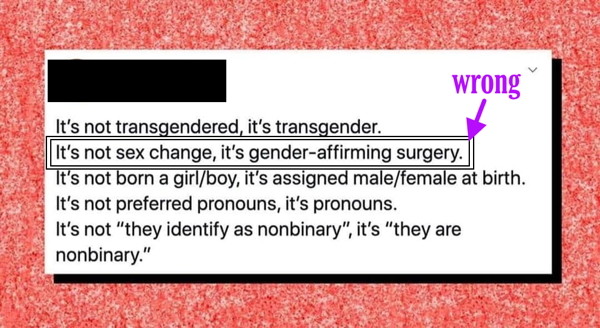
Femininity and womanhood are gender identity terms, but more fundamentally than that, they are socially shared notions, and what they are notions about, historically speaking, are female people.
I have male parts (or at least the parts that led my mom's obstetrician to put "male" on my birth certificate—and for the record I call them male parts myself). But I'm definitely a femme, and I'm happy to be living in 2020 where gender identity has been somewhat split off from physical bodily architecture.
But it doesn't avail us anything to pretend that the feminine gender identities don't have diddly squat to do with physical femaleness. The socially shared concepts and roles, and the accompanying notions about a feminine person's beliefs and attitudes and priorities, personality and behavioral nuances and tastes and so on, didn't originate independently and then somehow get ideologically and artificially attached to the female physical morphology. The notions were originally notions about female people. They may not have correctly or adequately described female people in general, and they certainly did not correctly or adequatly describe all female people; and because this has long been a patriarchy, this human society of ours, there may indeed have been ideological content stirred into the pot along with the generalizations. But the gender identity is social; it exists as a bundle of shared concepts, and the subject matter that the concepts were originally and historically concepts about were people who had vaginas and ovaries and fallopian tubes, the biological females of our species.
Now, even as increasing numbers of us find personal validation in gender identities that don't correspond to the physical morphology to which those identities were originally and historically attached, some of that past still haunts us.
You'll recall that I said this society has historically been a patriarchy. One thing that means is that the most established socially shared notions about pretty much anything are men's ideas. To be more specific, cisgender heterosexual men's ideas. Because the viewpoints of other people weren't being spoken in public, weren't being published. So views and attitudes that were really only the views and attitudes of these men got put out there as default views and attitudes. That applies to a lot of subjects, but at the moment let's focus on the definition of women.
Top of the list: sexual attractiveness, the desirability quotient, one's value as a sexual commodity. These days we refer to it as the "male gaze" but it used to be discussed as if women's sexual appeal was intrinsic to the women and men were just noticing it. Because "attractive to cis het men" was defaulted, universalized into "attractive". Because women's usefulness in patriarchy was largely constrained to their usefulness as mates to men.
Women may have meant more to each other, and to themselves, but their opinions weren't being enshrined. I wrote earlier of a feminine person's beliefs and attitudes and priorities, personality and behavioral nuances and tastes and so on — all components of her gender identity as a woman. Those are all aspects of the self that a woman may find validation in, may take pride in, but all that has tended to be overshadowed by the focus on sexual desirability, aka sexual desirability as determined by an audience of cis het male people and their appetites.
Why is this relevant to today's gender identity discussion? Because sexual attraction often tends to be "to a body structure". (And that, too, has been culturally emphasized.) In short, sexual orientation has been geared not so much towards what we speak of as gender identity, but to the physical morphology, to shape and contour. So the most emphasized, the most underlined, aspect of what it means to be a woman is to have female curves and contours and the relevant female organs. That shoves beliefs and attitudes and priorities, personality and behavioral nuances and tastes, etc, into the background.
Someone in a Facebook group posted a meme stating "It's not sex change, it's gender-affirming surgery". Well, that's wrong. It's not gender-affirming surgery, its SEX-affirming surgery. If a person's gender identity as a woman is 100% valid whether they have a penis or a vagina, then obtaining surgical services to modify their physical structure so that any visual observers will assign it "vagina" doesn't affirm their gender. It affirms their SEX, as female.
Of course, being attractive to the heterosexual male gaze really is central to some people's sense of their feminine identity. It's what's most emotionally important to them about being a woman, as opposed to singing alto arias or becoming a really good seamstress or something. Nothing wrong with that.
But not everyone who identifies as woman or femme or girl is primarily concerned with appealing to the male gaze. Of having a sexually desirable appearance as filtered through the fakely universalized male gaze.
The centrality of the whole "do you look sexy, can you compete with the sexy women of the world in sexy appearance?" question is often used to invalidate feminine people. It is used to invalidate many cis women for whom it simply isn't the end-all and be-all of their self-worth. It is used to invalidate many trans women for whom being evaluated in terms of how well they "pass" as a sexually desirable specimen gets to be old and tiresome.
Well, it is also used to invalidate the identity of people like me, who definitively do not identify as female, who do not transition, who do not attempt to present as female-bodied people, who distinguish between physical sex and gender and identify as male women, male femmes, male girls.
I get a lot of pushback about it. People who say "It's nobody's business what you got in your underpants" when what they really mean is "You've got no business having that attitude of 'yeah I'm male, so what', that's the wrong attitude about your male parts, we're all supposed to be going around saying 'it doesn't matter'". But what actually doesn't matter to me is being found sexy in that sense. Sexy to the falsely universal male gaze. I am male. Sure I want to be found sexy... to people who specifically like the male physical morphology. Since that's the morphology I've got. And I'm a male girl. My gender-atypical identity doesn't have a damn thing to do with claiming femaleness, regardless of whether yours does or not.
———————
You're secluded in quarantine, and all the performances and events have been cancelled, so it's a good time to read a book!
My book, GenderQueer: A Story From a Different Closet, has been published by Sunstone Press. It is available on Amazon and Barnes & Noble in paperback and ebook, and as ebook only from Apple, Kobo, and directly from Sunstone Press themselves.
Links to published reviews and comments are listed on my Home Page
———————
This LiveJournal blog is echoed on DreamWidth, WordPress, and Blogger. Please friend/link me from any of those environments on which you have an account.
————————
Index of all Blog Posts
Subscribe to:
Posts (Atom)